
Sony WH-1000XM6 review: 31 years of coach engines, then ten weeks of quiet
I drove coaches for 31 years with a diesel humming under my seat. This summer I sat in the back for once, with Sony's best headphones on. Here's what they took away, and what they didn't.
 By Nigel Stubbs, travel tester
Tested in Norwich · 9 September 2026 · 12 min read

- Took the diesel drone out of a coach almost completely
- 32 h 50 min of music on one charge in our test
- They fold again, and the case shuts with a magnet
- Sandra heard me clearly from a windy ferry deck
- Hot ears after two hours at 29°C on the Rhine
- Voices and crying babies get through more than engines
- The case is bigger than a paperback
- Wearing them lying on your side is hopeless
Short version: if you travel by coach, train, ferry or plane and want the low rumble gone, these are the best headphones I've tried. Pay £349 if you must, but £300 has come round twice in a year, so for a Christmas present, wait for Black Friday.
Seat 4, window side, just behind the front wheels. For 31 years I sat three metres in front of that seat with a diesel engine humming away under my backside, and I never once wondered what it sounded like from the back.
In August I found out. My old firm in Norwich runs a six-day tour to the Rhine every summer, and this year Sandra and I went along as passengers, the first time in my life I've done that trip without a steering wheel in front of me. The answer is that it sounds like a fridge the size of a bungalow. For about ten minutes, anyway. Then I put the Sony WH-1000XM6 on, pressed play on a podcast, and the fridge went away.
I bought them in late June, in black, when Amazon.co.uk had them at £300. Since then they've been on that coach tour, two night sailings out of Harwich, a return train to London for a reunion of retired drivers, and a lot of evenings on our sofa. Sandra has worn them too, with her reading glasses on, which turned out to be a test all of its own.
Ten weeks is a fair trial for a pair of headphones. Before the verdict, here's what Sony changed.
What's new since the XM5
Sony's XM range has been top of most "best headphones" lists for years, and the XM5 is still on sale. The XM6 arrived in May 2025 and brought back a few things people missed, plus some new ones:
- They fold again. The XM5 only laid flat, which made its case the size of a small dinner plate. The XM6 folds up, and the case is smaller, with a magnetic clasp instead of a zip.
- A new noise cancelling chip, which Sony calls the QN3, working with 12 microphones that listen to the world outside and cancel it out.
- Sound tuned with mastering engineers, the people who put the final polish on albums in a studio.
- 30 hours of battery with noise cancelling on, and a three-minute charge that Sony says gives up to three hours of playback, using a USB PD charger.
They come in black, Platinum Silver and Midnight Blue, and this year Sony added Sand Pink and Olive Gray to the range. Mine are black, because at my age you buy the colour that goes with an anorak.
Then there's the price, which has moved about more than most, so here it is in one place.
| When | Price | Where |
|---|---|---|
| Launch, May 2025 | £399 | Sony's list price |
| Black Friday 2025 | £300 | Amazon.co.uk, the lowest at the time |
| June 2026 sale | £300 | Amazon.co.uk, where I bought mine |
| At the time of writing | £349 | John Lewis, and about the same at Amazon.co.uk |
You'll see them cheaper still on price comparison sites, from marketplace sellers. I'd be careful there, and I'll explain why further down. First, how I put them through it.
How I tested them
I'm not a hi-fi man, so I tested them the way I'd test a coach seat: by sitting in it for a long time and noticing what gets on my nerves. I bought a basic sound level meter, about £20 online, and measured the noise wherever I wore them. For battery life I ran them from full to flat with noise cancelling on, at the same volume, twice. I hung them from my trusty luggage scale for the weight, and I kept a notebook in my anorak pocket, because I don't trust myself to remember anything after a ferry crossing.
The one thing a meter can't tell you is what reaches your ears with them on. For that I used a simple trick: the volume. Without cancelling, I'd turn a podcast up until I could follow it comfortably. With cancelling on, I did the same again. The fewer steps up, the more noise the headphones had removed. It's crude, but it's the same crude test every time, and repeatable beats clever, which is the whole idea behind the way we test.
The coach came first, and it was the one I was most curious about.
Six days on a coach to the Rhine
At 60 mph on the A11 out of Norwich, my meter read 71 dB at head height in seat 4. That's mostly a low, steady drone from the engine and tyres, with road noise on top on rougher surfaces. It's not loud like a pub, but after five hours it grinds you down. I know, because I spent three decades listening to it and being tired by teatime.
With the XM6 on and cancelling switched on, the drone went down to something you'd have to go looking for. I could follow a Radio 4 podcast with the phone volume on 5 of 16 steps. Without the headphones' cancelling I needed 11. On the long stretch through Belgium, I listened to a whole cricket commentary, then took them off to talk to Sandra and got a small shock at how loud the coach actually was.
The honest limit showed up in the middle of the coach. A family two rows back had a toddler who objected to Belgium, loudly and often, and the cancelling took the edge off her but didn't remove her. That's normal. Noise cancelling is brilliant on steady low sounds like engines, and much weaker on sudden high ones like voices and wailing. Anyone who tells you otherwise is selling something.
The tour guide's announcements were the other question. I set the headphones to let voices through automatically, and it worked most of the time. Twice it missed her because the coach was noisy and she was quietly spoken, so on the last two days I just used the button on the left cup to hear the world when she picked up the microphone.
A coach is one kind of noise. A ship at night is another.
Overnight on the North Sea
In July we took the night boat over to Holland to see family near Utrecht, and the night boat back. In our inside cabin my meter read 58 dB, a deep hum from the engines that you feel as much as hear. I usually sleep badly on that crossing and blame the kippers.
On my back with the XM6 on and nothing playing, the hum dropped to a faint purr and I slept better than I ever have on that boat. On my side, they were no use at all. The ear cup presses into the pillow, the band slides, and you wake at three with one ear out. For sleeping, earbuds are the better tool. For lying on your back with a book and wanting the world to go away, these are wonderful.
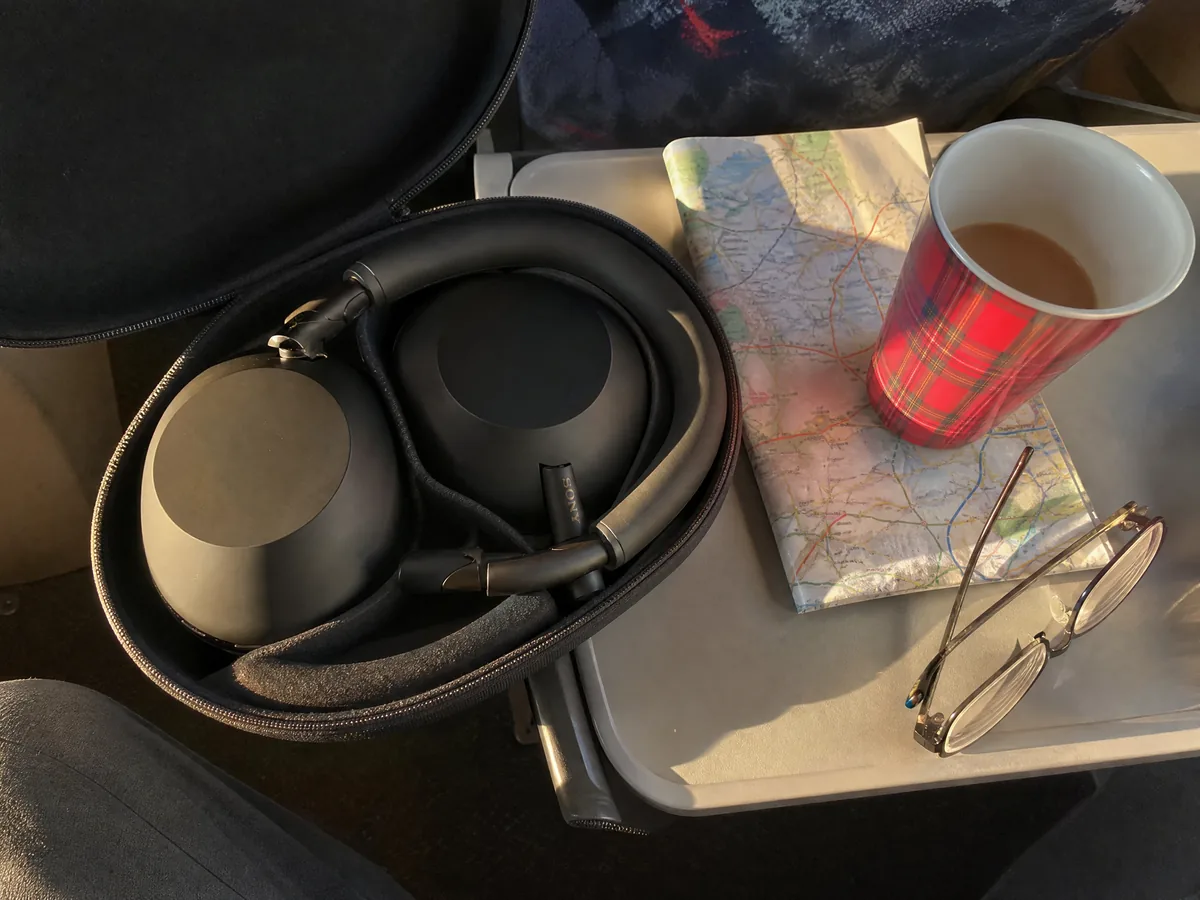
The crossing was also a fair test of the new case. It folds into a shape about the size of a large hardback, and with the magnetic clasp it's quick to open in a dark cabin, no hunting for a zip. It's still bigger than I'd like in a 10 kg cabin bag, and I ended up carrying it in the big pocket of my anorak, where it fits with room for a Kindle. Speaking of which, my Kindle Paperwhite review covers what else earns its space in my bag.
Quiet is only half of it, though. The other half is what they sound like.
How they sound, to an ordinary pair of ears
I listen to brass bands, sixties pop, podcasts and the cricket. None of that needs audiophile gear, and I won't pretend to hear what a studio engineer hears. To my ears everything sounded clear and full, with bass that's there without thumping, and voices that sound like people rather than like a phone call.
The Black Dyke Band doing a march came across with the cornets bright and the basses deep without one drowning the other. The Kinks sounded like The Kinks. Sandra's audiobook narrator sounded like he was sitting next to her, which she found slightly unnerving.
There's a ten-band equaliser in Sony's app if you like fiddling. I turned the bass down one notch for podcasts and left it. Our Karen, who tests all the tech and has better ears than me, borrowed them for an evening and said the sound was "warm and polished, more exciting than the Bose, less fussy than the AirPods Max". I nodded as though I knew what she meant.
Good sound's no use if you can't wear them for hours, so here's where I fussed most.
Comfort, glasses and the hot day in Rüdesheim
On my luggage scale they weighed 250 g, about the same as a tin of beans. The headband is well padded and the clamp is gentle. I wore them for four hours straight from Calais to near Cologne and only took them off for a stretch at the services.
The heat was the problem. On the fourth day it was 29°C in Rüdesheim and the coach's air conditioning was having an off day. After about two hours, my ears were warm and damp under the cushions, and I took them off for a while. That's true of every over-ear pair I've worn, but these didn't breathe any better than the others.
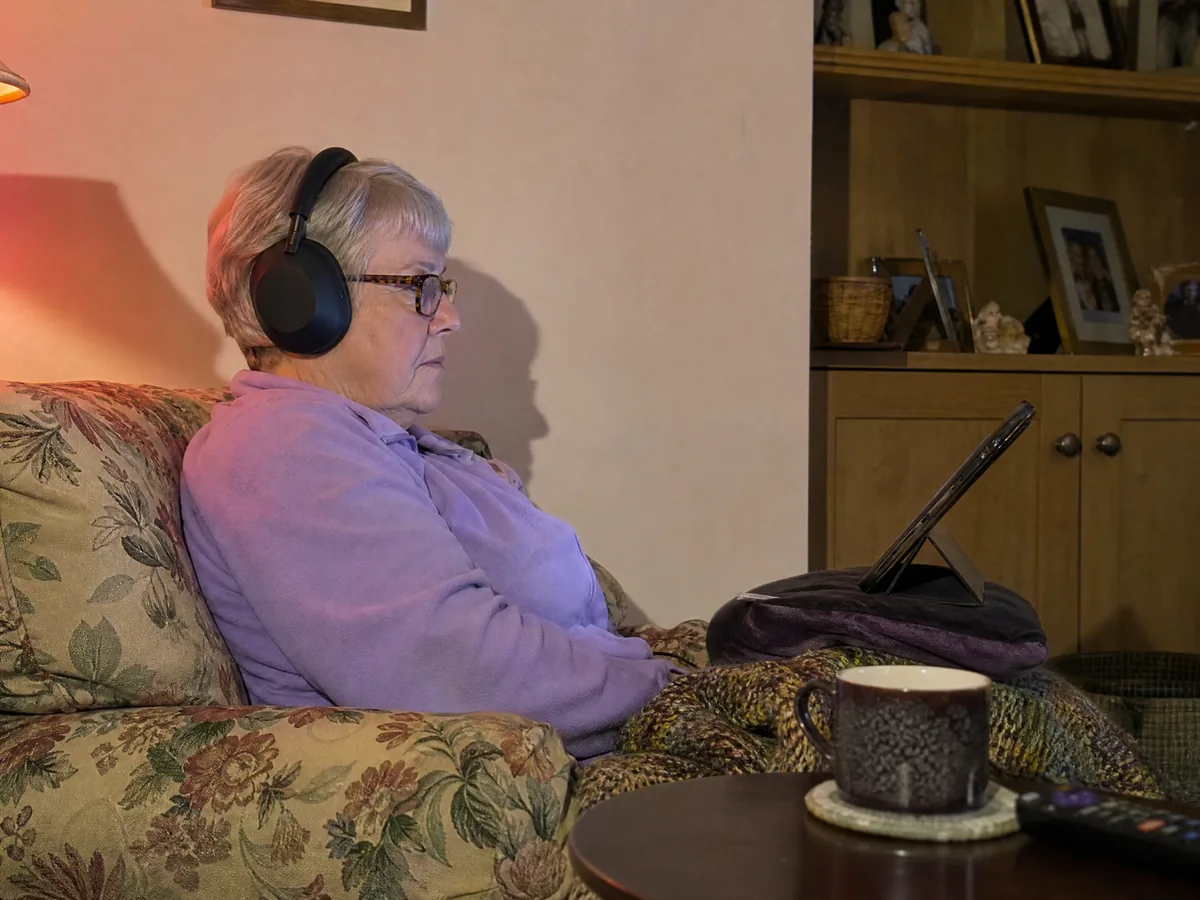
Sandra wears glasses and wore the XM6 for two hours on the sofa watching a drama on her tablet. She's the real test, because glasses arms under ear cushions usually give her a headache behind the ears within the hour. With these she lasted the full episode and a half before she took them off, and said the pressure was "about as good as it gets, which isn't saying much".
"They're lovely. But I can't hear you, which is either a feature or a fault depending on what you're saying." Sandra, on the sofa, with the cancelling on
After comfort, the battery, because nothing spoils a trip like a flat pair of headphones halfway to Germany.
Battery and calls: what I measured
| What I measured | Result |
|---|---|
| Music with cancelling on, volume at 40%, full to flat | 32 h 50 min (average of two runs) |
| Sony's claim, cancelling on | 30 h |
| Three-minute charge on a 20 W phone plug | 2 h 55 min of playback |
| Empty to full on the same plug | About 3 h 20 min |
| Coach at 60 mph, seat 4 | 71 dB outside the headphones |
| Ferry cabin at night | 58 dB outside the headphones |
| Podcast volume needed on the coach | 5 of 16 with cancelling, 11 without |
| Weight on my luggage scale | 250 g |
On the six-day tour, I used them about five hours a day and charged them once, on the Wednesday night. The three-minute trick is real, and it's the best habit to learn: plug them in while you brush your teeth and you've got the morning covered.
Calls were better than I expected. I rang Sandra from the top deck of a Rhine ferry at Bingen, in a stiff breeze, while she was down below with a coffee. She said I sounded "a bit far away, but not like I was in a wind tunnel", which is more than she says about most of my phone calls. They'll connect to two devices at once, too, so my phone and Sandra's tablet could both use them without me pairing them again.
So, the money, and Christmas.
Black Friday, Christmas presents and the cheap listings
The XM6 went to £300 on Amazon.co.uk last Black Friday, £100 off, and came back to £300 in the June sale. That's twice in about seven months, so I'd call £300 the price to wait for. This year the big sale weekend starts on 27 November.
| Price for the WH-1000XM6 | Our view |
|---|---|
| £399 | List price. No reason to pay it any more |
| £349 | Where John Lewis and Amazon.co.uk sit today. Fair if you're travelling next week |
| £300 to £320 | A good deal from a proper retailer |
| Under £300 | Excellent, if the seller is Sony, a big UK shop or Amazon itself |
About those cheaper listings. Price comparison sites show the XM6 from under £250 from marketplace sellers. Some will be fine. Some may be imports without a UK warranty, and some won't be what they say they are. Look at who's actually selling and dispatching before you click, not just the logo on the website.
As a gift, they're a very good one for anyone who travels, commutes by train or bus, or lives with a noisy household. A bit of a waste for someone who mostly listens at home on a quiet evening, and not for a teenager who'll leave them on the bus. You don't need to buy much with them: the cable and case are in the box. A small USB-C charger with USB PD makes the three-minute charge work properly, and an airline adapter is a few pounds if you like the in-flight films.
And if £300 is still too much, there are cheaper routes to a quieter journey.
Is it for you?
Here's what else I'd consider, with prices at the time of writing.
- Sony WH-1000XM5, £219 to £229.99 at John Lewis. Still excellent at cancelling, and £120 cheaper than the XM6 today. No folding, and the case is much bigger.
- Bose QuietComfort Ultra (2nd Gen), £399 at John Lewis. The XM6's closest rival. Karen found them a little comfier on the head and a little less rich in sound.
- AirPods Pro 3, £219 list. Earbuds, not over-ears, but brilliant on planes and far better for dozing off. Karen flew 61 times with hers in our AirPods Pro 3 review.
More travel kit, tested the hard way, lives on our blog.
Ten weeks later
On the last day of the tour, the new driver, a lad of about thirty called Dean, asked me what I made of the view from the back. I told him the seats were fine, the air con needed a look, and the engine was a lot quieter than I remembered. He looked pleased until I lifted the headphones off my neck.

The Sony WH-1000XM6 did the one job I bought them for better than anything I've tried: they took away the drone that's followed me round Europe for forty years. They sound good, they last well past what Sony promises, and they fold into my anorak. Hot ears in a heatwave and a bulky case are the only real grumbles.
At £349 they're good value if you travel a lot. At £300 they're an easy yes. And if you're buying them for a retired coach driver, I can tell you he'll be grateful, and slightly smug in seat 4.
WH-1000XM6 questions people ask
Are the Sony WH-1000XM6 worth it over the XM5?
If you're buying new, yes: better cancelling, a folding design and a smaller case. If you already own a working XM5, the difference isn't big enough to replace them. The XM5 is £219 to £229.99 at John Lewis at the time of writing, which makes it a good buy on a budget.
Do the Sony WH-1000XM6 fold?
Yes. Unlike the XM5, the XM6 folds up, and the case is smaller, with a magnetic clasp. It's still roughly the size of a large hardback.
How long does the WH-1000XM6 battery last?
Sony says 30 hours with noise cancelling on. In our test at 40% volume we got 32 hours 50 minutes. A three-minute charge on a USB PD plug gave us 2 hours 55 minutes of playback.
Can you use them with in-flight entertainment?
Yes, with the 3.5 mm cable that comes in the box. Some older planes use a two-pin socket, so a cheap airline adapter is worth keeping in the case.
How cheap do the WH-1000XM6 get on Black Friday?
They were £300 on Amazon.co.uk last Black Friday and again in the June 2026 sale. We'd treat £300 to £320 from a proper retailer as a good deal, and anything below that as excellent.