
How we test
A verdict is only as good as the work that goes into it. This is everything that happens between "that looks interesting" and a score out of 10 at the top of one of our reviews.
Imagine two air fryers side by side on a worktop. Same size, same price, both rated 4.7 stars. One will crisp chicken thighs for a family of four in 22 minutes. The other will steam them for half an hour and leave you scrubbing the drawer. From the outside there's no way to tell them apart. That's why this page exists.
Below is the method every one of our testers follows, in the same order, every single time. Nothing about it is secret or clever. It simply takes a lot of weeks.
1. Everything starts with the primary goal
Before we order anything, we write one sentence answering a plain question: what does "best" really mean for this product? We call it the primary goal, and it's the first line on every card on our tests in progress page.
Some real examples from the current bench:
- Cordless vacuum cleaners: which one cleans a whole three-bedroom home, carpets and pet hair included, on a single charge.
- Noise-cancelling earbuds: which one blocks the most engine noise on a long-haul flight and stays comfortable for six hours.
- Pellet and gas barbecues: which one holds a steady temperature through a 10-hour low-and-slow cook in cold weather.
- Automatic pet feeders: which one never skips a meal or jams across 30 days of twice-daily feeding.
The primary goal picks the winner. Everything else is a tiebreaker. It keeps us honest, too: it's written before a single parcel turns up, so we can't move the goalposts after falling for a clever feature.
2. The shortlist
We start broad. Best sellers at Argos, Currys, John Lewis and Amazon.co.uk, brands that are growing quickly, models that keep cropping up on forums and Reddit threads, and every product you ask us about by email. That normally gives us 12 to 20 candidates.
Then we whittle it down. Anything with a pattern of safety complaints, a product recall, dodgy-looking reviews or no reachable customer service is out before we spend a penny. We also drop models about to be discontinued, because a glowing review of something you can't buy helps nobody. What's left is usually 4 to 7 models, the ones a normal person is genuinely choosing between.
3. We pay the shop price, like you
Every test unit is bought with our own money from ordinary retailers, at normal prices, delivered like any other order. We don't request review units and we don't test free samples sent in return for coverage.
Buying this way also shows us what you'll experience: how the box arrives, how long delivery takes, whether the manual makes sense and whether the "quick setup" really takes nine minutes or forty. Those details go into the review.
All our testers live in the UK, so we buy the model sold here, from the same shops you use, from Currys and Argos to Boots and Lakeland. That means the UK plug, the 230-volt motor and the model number you'll find on the shelf. Bedding comes in UK sizes and every price is given in pounds.
4. Weeks of everyday life
Our testers use the products at home, on their own timetables. The hoover does the Sunday tidy-up after a birthday party in Clive's 1930s semi in Sheffield, springer spaniel included. The air fryer makes tea on a Tuesday in Tracey's kitchen in Leeds with two hungry boys round her ankles. The cabin bag goes through gate sizers at Manchester Airport with Karen, who took 71 flights in the past twelve months.
Most tests last between 21 and 60 days. Simple products such as power banks get three weeks. Anything with a battery, a filter, a foam core or a fabric that wears gets longer, because that's where cheap products give up. Smart rings and sleep trackers get up to 60 days, as a month of sleep data is barely enough to spot a trend.
5. The kit we measure with
First impressions count, but numbers settle arguments. Every tester has the same basic kit, and some categories get specialist tools.
| Tool | What we use it for |
|---|---|
| Sound level meter | Noise in dB, always from 1 metre, on the lowest and highest setting |
| Plug-in energy monitor | Real power draw in watts and cost per use in pence, for anything that plugs in |
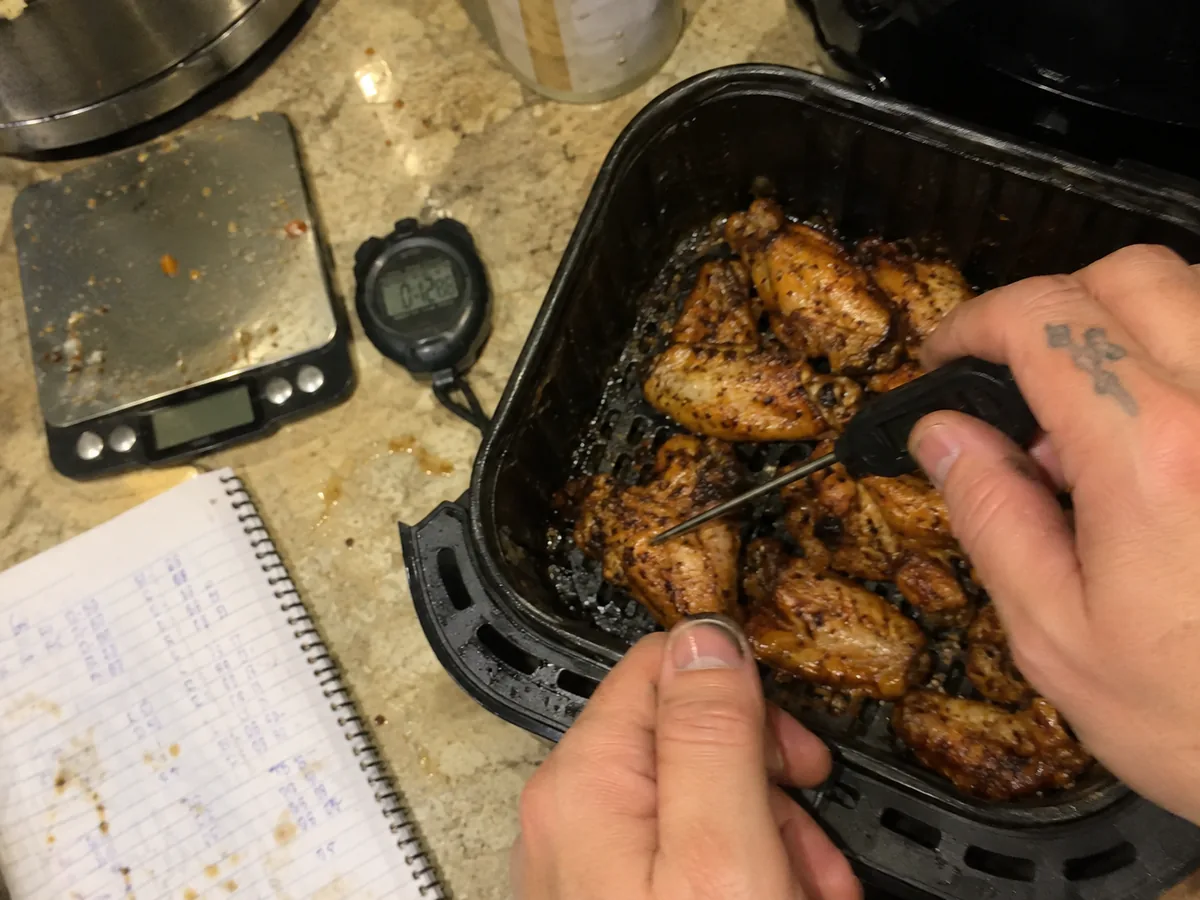
| Infrared thermometer and probe thermometers | Surface temperature of pillows and toppers in °C, oven and barbecue accuracy, cooking results |
| Kitchen scale (0.1 g) | Pickup in the 50 g sand test, feeder portions, how much food a drawer really holds |
| Digital callipers and steel tape | Threshold heights, bag dimensions, blade gaps, the details a spec sheet rounds off |
| Luggage scale | Empty and packed weight of bags, weight of travel kit in kilos |
| Chest strap heart rate monitor | Reference for watches, rings and earbuds with heart rate sensors |
| Stopwatch and battery logs | Real run time, charging time, time to a finished result |
| Irradiance meter | Actual output of red light panels at a realistic treatment distance |
We repeat every key measurement at least three times and take the middle result, so one lucky run never decides anything.
6. Scoring sheets and weightings
Each category has its own scoring sheet, written before testing begins. The criterion tied to the primary goal always carries the heaviest weighting. The weightings add up to 100, and value for money is always included. A product that's 5% better and costs twice as much rarely wins.
Here are six real examples of how the weightings are set.
Cordless and robot vacuums
| Criterion | How we measure it | Weight |
|---|---|---|
| Cleaning on one charge (primary goal) | 50 g sand test on carpet, pet hair on rugs, whole-house run on a single battery | 35 |
| Hard floors and edges | Rice, flour and cereal on oak and tiles, pickup along skirting boards | 15 |
| Emptying and maintenance | Seconds to empty, hair tangled on the brush bar after 2 weeks | 15 |
| Noise | dB at 1 metre on normal and maximum | 10 |
| Navigation or handling | Thresholds cleared, obstacles avoided, weight in the hand on stairs | 10 |
| Value for money | Price plus a year of filters, bags and brushes in £ | 15 |
Kitchen appliances
| Criterion | How we measure it | Weight |
|---|---|---|
| Results on real meals (primary goal) | The same recipes on every model, timed, tasted blind by the family | 35 |
| Speed | Minutes from a cold start to food on the table | 15 |
| Washing up | Minutes to clean, dishwasher fit, baked-on residue after 4 weeks | 15 |
| Everyday usability | Controls, presets, how often we reached for the manual | 10 |
| Energy and noise | kWh per cook, cost in pence, dB at 1 metre | 10 |
| Value for money | Price against results and capacity | 15 |
Sleep
| Criterion | How we measure it | Weight |
|---|---|---|
| The goal of the test (cooling, alignment, comfort) | Surface temperature in °C after 1 hour, neck angle photos, nightly sleep diaries | 35 |
| Shape after 30 nights | Height measured on day 1 and day 30 | 20 |
| Comfort in every position | Side, back and front sleepers on the team | 15 |
| Washing | Three washes, then shrinkage and bobbling checked | 10 |
| Smell and off-gassing | Day 1 and day 7, noted by two testers | 5 |
| Value for money | Price against lifespan and guarantee | 15 |
Health and recovery devices
| Criterion | How we measure it | Weight |
|---|---|---|
| Does it do what it claims (primary goal) | Protocol written by Darren Ackroyd, reviewed every fortnight | 35 |
| Safety and comfort | Skin marks, soreness, pressure over 20 minutes | 20 |
| Ease of daily use | Could the tester keep it up for the whole test? | 15 |
| Battery and noise | Minutes per charge, dB at 1 metre | 10 |
| Evidence behind the claims | What published research supports, and what it doesn't | 5 |
| Value for money | Price against what it actually delivers | 15 |
Tech and travel
| Criterion | How we measure it | Weight |
|---|---|---|
| Real-world performance (primary goal) | Noise blocking in flight, GPS against a known route, overhead locker fit on real planes | 35 |
| Battery claims against real life | Timed from 100% to shutdown on a normal day | 20 |
| Comfort and portability | Hours worn, grams carried | 15 |
| Durability | Scratches, hinges, wheels and seams after weeks of travel | 10 |
| Software and connection | Dropouts, app bugs, update support | 5 |
| Value for money | Price against the closest rival | 15 |
Outdoor and barbecues
| Criterion | How we measure it | Weight |
|---|---|---|
| Temperature control (primary goal) | Swing in °C over a 10-hour cook, logged with probes | 35 |
| Food results | Burgers, steaks, a pork shoulder, a whole chicken | 20 |
| Build and weatherproofing | Rust spots, loose bolts, lid seal after weeks outdoors | 15 |
| Assembly and cleaning | Minutes to assemble, ash and grease handling | 10 |
| Fuel cost | Pellets or gas used per cook | 5 |
| Value for money | Price against guarantee and lifespan | 15 |
Each criterion is scored from 1 to 10 and multiplied by its weighting, and the total becomes the score out of 10 at the top of every review. We round to one decimal place, and we never round up to make a number look tidier.
7. How we read customer reviews
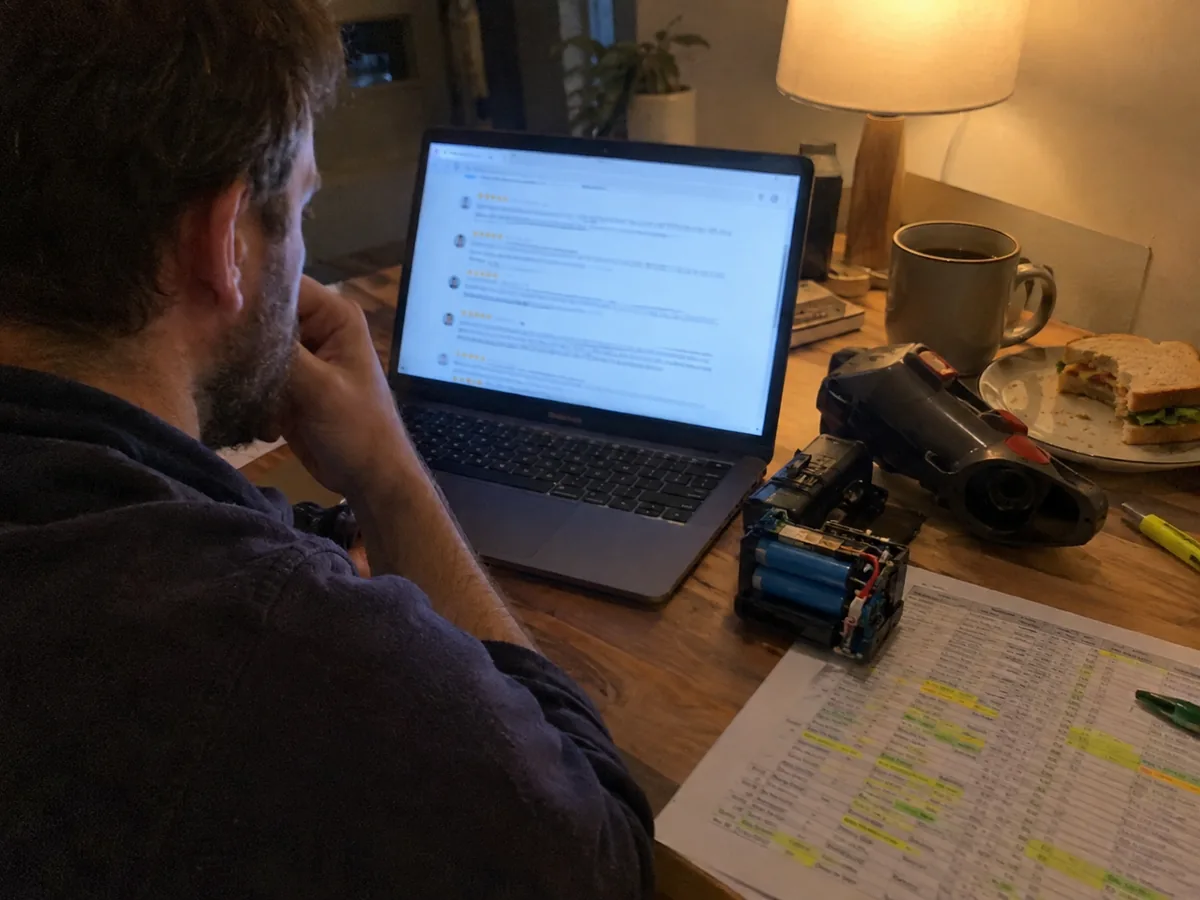
A few weeks with one unit can't reveal everything. Perhaps we got a good one. So for every product we also read verified customer reviews in bulk, typically 300 to 500 per model across two or three retailers.
We pay little attention to 5-star reviews written the day the parcel arrived. The useful ones are the 1 and 2-star reviews written after months of use, plus the 3-star ones where people explain what they'd change. We group the complaints and count them. One cross review about a dead battery is bad luck. Forty describing the same fault after four months is a pattern.
If a pattern appears, it counts against the score even if our own unit held up. It can cost a product up to a full point, and if it's a safety issue the product is out of the running altogether. We ignore complaints about delivery, late presents and anything that's clearly about the retailer rather than the product.
8. The verdict and the write-up
When a test finishes we set the results against the primary goal and ask one question: which product did the job best for a normal person at a fair price? That's the winner. The tester who lived with it then writes the review in their own words, with the figures, the niggles and the funny moments along the way.
Every review states how long we tested, what we measured and who it suits, and just as plainly who it doesn't. You'll find them all in our reviews.
9. When we retest
Every review shows an "updated" date. We go back to a product when:
- a new model or version launches that changes the comparison
- the price moves by roughly 20% or more, in either direction
- a firmware or app update fixes, or breaks, something we wrote about
- readers report a problem we didn't see in our test
- six months have passed on a popular pick, so we can check long-term wear
Whenever possible we keep the winning unit for exactly these follow-ups. The six-month check is often where the real story lies: a hinge that creaks, a battery now managing 70% of what it did, a pillow that's gone flat on one side. When that happens the verdict changes and we say so on the page.
10. Where the products go afterwards
A test leaves us with a lot of kit. This is what happens to it:
- The winners stay with the tester for long-term follow-up, which is how we can tell you how something is holding up after six months.
- Working products that didn't win are cleaned, reset to factory settings and donated to local schools, family shelters and community centres. Pet products go to animal rescues, which have been delighted with a steady supply of feeders and litter trays.
- Broken products and anything unsafe go to certified electrical recycling, with batteries removed and recycled separately.
We never send opened test units back to the shop for a refund, and we never resell them as new. Nobody should end up with a product we've spent six weeks putting through its paces.
Spotted something we missed?
Our readers are the biggest test panel we've got. If something you bought on our advice let you down, or you think we've got a figure wrong, let us know. Reader reports have sent more than one product back to the bench, and you can see what's on it right now in our tests in progress.
Do brands pay to be tested or reviewed?
No. We buy every product at the shop price, and no brand can pay for a test, a review or a better score.
Are the products tested in the UK?
Yes. Every tester on the team lives in the UK, from Swansea to Norwich, and uses the British version of each product at home. We buy from UK retailers and quote prices in pounds.
Can I suggest a product for a test?
Please do. Email us the exact model name and where you saw it. Plenty of our current tests started with a reader's email.