
iPhone 18 Pro or Pro Max? A week of flights from Manchester settled it
Two new iPhones in one flat, four flights and a train to Leeds. The battery gap between the Pro and the Pro Max turned out much bigger than the £100 between them.
 By Karen Oldroyd, tech and travel tester
Tested in Manchester · 25 September 2026 · 11 min read
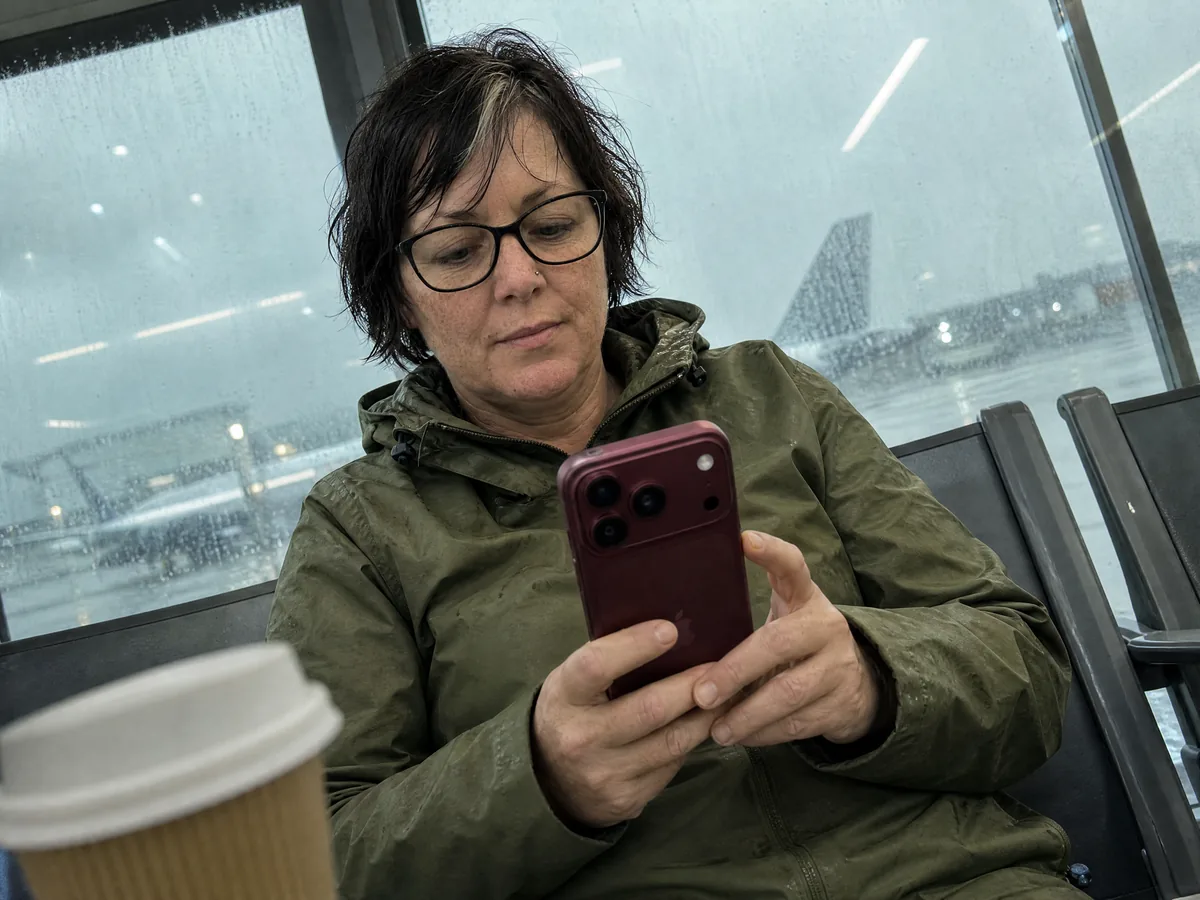
- The Max came home from a 19-hour Amsterdam day on 27%
- Half full in 17 minutes on a 60W plug
- You choose between creamy blur and everything sharp
- A real SIM tray is still there on UK models
- Both cost £100 more than last year's launch prices
- At 249 g the Max is heavy before any case
- Little reason to move from a 17 Pro
- Quick charging needs a plug Apple doesn't include
Short version: for travellers, people who film a lot and anyone with Low Power Mode anxiety, the Pro Max is the one. For one-handed use and small pockets, the Pro. Owners of a 15 Pro or anything older will feel a big jump with either. Owners of a 17 Pro can sit this year out.
I have one rule about new iPhones, and I've kept it for eleven years: never in the first week. Let somebody else find the bugs, the scratches and the battery that drains overnight for no reason.
At 1:02 p.m. on Saturday 12 September, I broke it. My partner Jo had pre-ordered the iPhone 18 Pro in Silver the minute Apple's online store came back, and I watched her do it over a mug of tea. Two minutes later my own thumb had ordered the iPhone 18 Pro Max in Burgundy, and I was telling myself it was for work.
Both arrived on launch day, Friday 18 September, and for the next seven days our flat in Chorlton became a very small test lab. The Max came with me on four flights, Dublin and back on the Tuesday and Amsterdam and back on the Thursday, plus a TransPennine train to Leeds for a team meet-up. Jo used the Pro as her only phone and put up with me borrowing it at odd hours. We were both coming from a 15 Pro, which may well be the phone in your hand right now.
Seven days won't tell you everything. They do settle the three things my friends keep texting me about: the battery, the new camera, and which size. Start with what's different.
What Apple changed, in plain English
Hold one next to a 17 Pro and only the colours give it away. The real changes are under the glass:
- A20 Pro chip, the first on a 2 nm process. Apple talks about roughly 40% more graphics power than the A19 Pro.
- Variable aperture on the main camera. The lens can open to f/1.48 or close down to f/4, so it controls how much light gets in instead of leaving it all to software.
- More battery, faster refills. Apple quotes around half a charge in a quarter of an hour on a 60W cable, and MagSafe now runs at 25W.
- A slimmer Dynamic Island. Some of the Face ID parts have moved beneath the display.
Smaller changes: Apple's C2 modem, which it says draws around 15% less power than the C1X, plus Wi-Fi 7 and the rebuilt Siri in iOS 27. Colours are Black, Silver, Glacier and Burgundy. Jo said mine was "the colour of a decent claret", which I've decided to take as a compliment.
One thing stayed, and it's a relief: UK models still have a physical SIM tray as well as eSIM. American buyers get eSIM only. If you ever pop a local SIM in abroad, that tiny slot still earns its place.
Apple spent most of its keynote on stamina, so that's where most of my week went.
Battery: the Amsterdam day
Thursday was the proper test. Alarm at 4:35, a taxi to Terminal 2 in the dark, the 06:50 to Schiphol, meetings in an office where the Wi-Fi dropped every twenty minutes, dinner by a canal and the last flight home. Both phones came along and did identical jobs all day: the same apps, auto brightness, one playlist on the plane, boarding passes, photos and maps.
When I dropped my bag on the kitchen floor at 23:30, the Max still showed 27%. Jo's Pro, which I'd been carrying too, sat at 6%, yellow since quarter past eight somewhere over the North Sea. My old 15 Pro used to beg for a socket at Schiphol before I'd even reached the office.
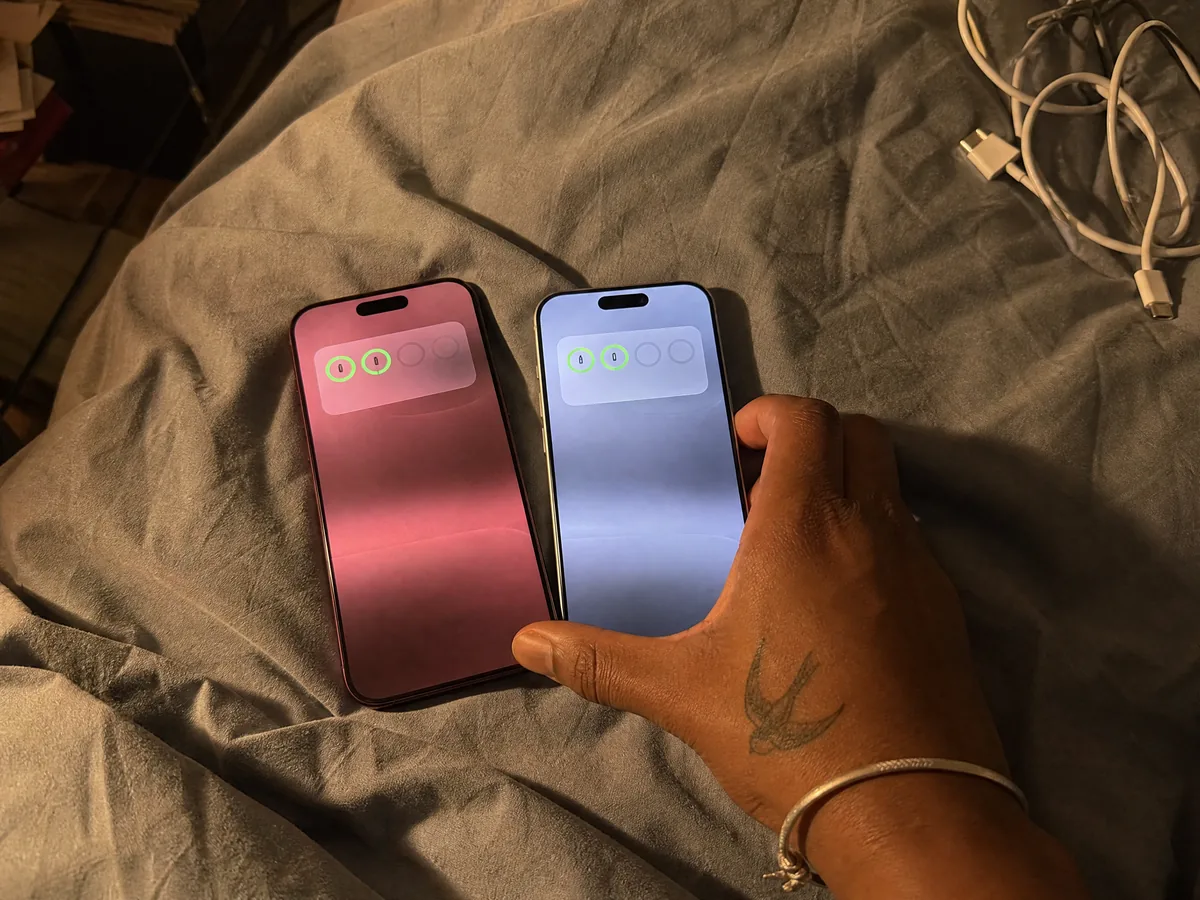
Back home both went through our usual rundown: a video playing on repeat over Wi-Fi, brightness locked at 200 nits, until the screen went black. The figures below are ours.
| What we timed | 18 Pro | 18 Pro Max |
|---|---|---|
| Video rundown at 200 nits | 22 h 06 min | 27 h 41 min |
| Amsterdam day, 04:35 to 23:30 | 6%, Low Power on since 20:15 | 27% remaining |
| Empty to half, 60W plug | 16 min | 17 min |
| Empty to full, 60W plug | 57 min | 61 min |
| Empty to half, old 20W cube | 30 min | 34 min |
| Apple's video playback figure | 36 h | 45 h |
Look closely at the 20W row. With the little white cube that has lived in my bag since 2021, the Max needed twice as long to reach halfway. The speed is genuine, but only when the plug can deliver it.
Apple's stamina promises survived my week, and the bigger phone beat them comfortably. Then there's the camera.
The aperture camera, without the jargon
Until this year the main lens on an iPhone couldn't change its opening. Picture a window jammed wide open: lovely for light, hopeless when you want the whole scene in focus. Portrait mode papered over that with software. Now the opening can shrink from f/1.48 to f/4, just as it does on a big camera with a proper lens.
Leave it on Auto and you'll hardly know. In a dim pub it simply stays open. My night shots around Deansgate came out a little cleaner than on the 15 Pro.
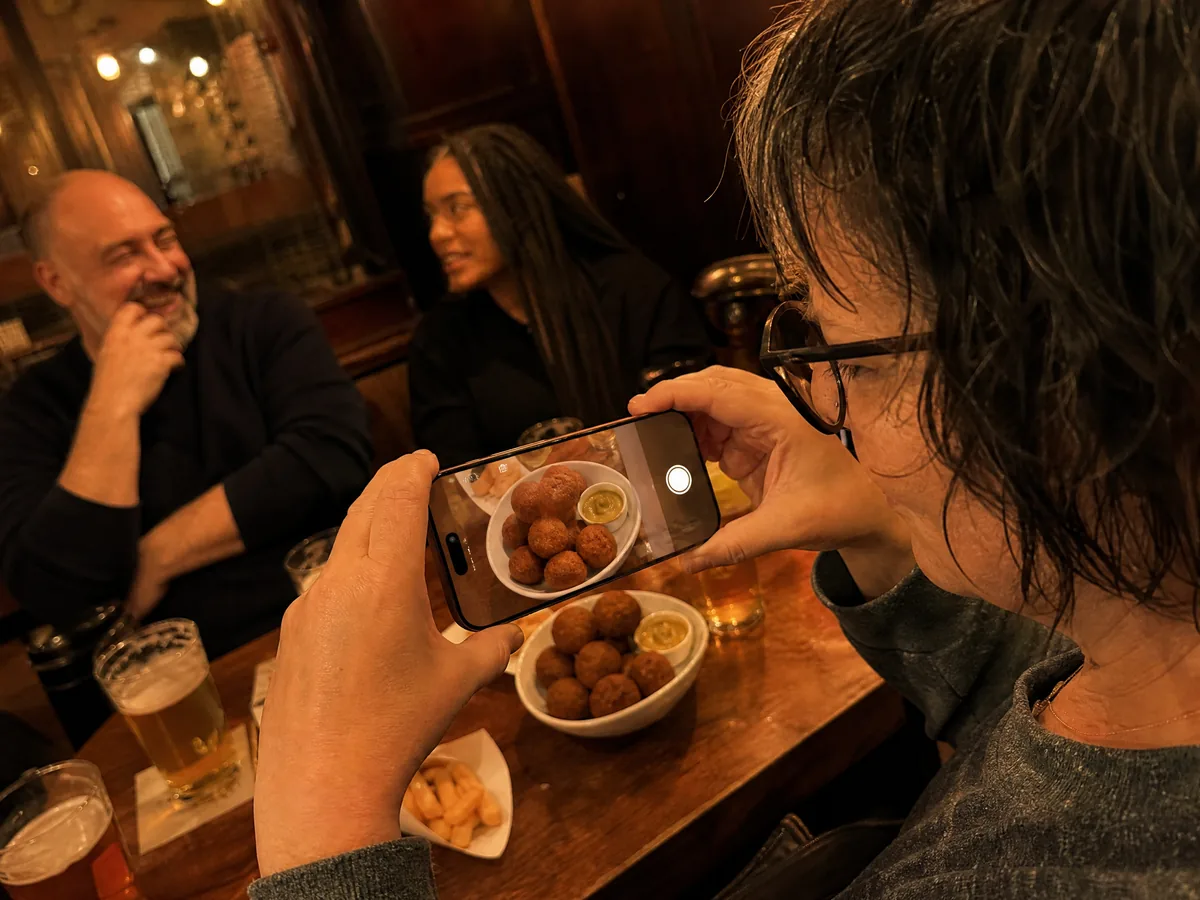
The moment it earned its keep was in a brown café in Amsterdam. Three of us, a table crowded with bitterballen, a pot of mustard, chips in a paper cone and three glasses of beer. Wide open, only the nearest glass was sharp and the food turned to soup behind it. At f/4, picked by hand, every last bitterbal came out crisp. My colleague asked me to send it to her mum.
Open it right up and the opposite happens: one person, and a background that melts away because of the glass, not an algorithm. On the Sunday I photographed my dad in his back garden in Stockport, and his wispy hair kept its real edges instead of looking trimmed with nail scissors, which is what portrait mode always did to him. The 4x zoom, 48 MP with an 8x crop Apple says holds optical quality, picked out a grey heron on a log at Chorlton Water Park from the footpath, feathers and all, in drizzle.
"Same camera on both? So you've paid an extra hundred quid to carry a brick." Jo, weighing the two phones in her hands at the kitchen counter
She wasn't wrong about the camera. The brick part is where it gets personal.
Weight, size and the one-hand test
Inside, the two are twins. Outside, they differ in three ways: the screen, the battery that fits behind it and the weight you carry. Jo's Pro is 211 g. My Max is 249 g, more than any iPhone before it, and 286 g in a clear case on our kitchen scales.
I felt it on day two, reading in bed with the phone held over my face, and again standing on a packed train to Leeds with one hand on a seat back. By day five I'd mostly stopped noticing. Jo never had that phase. Her Pro slides into a jeans pocket and she uses it one-handed on the tram with a coffee in the other hand, which I tried once with the Max and won't be trying again.
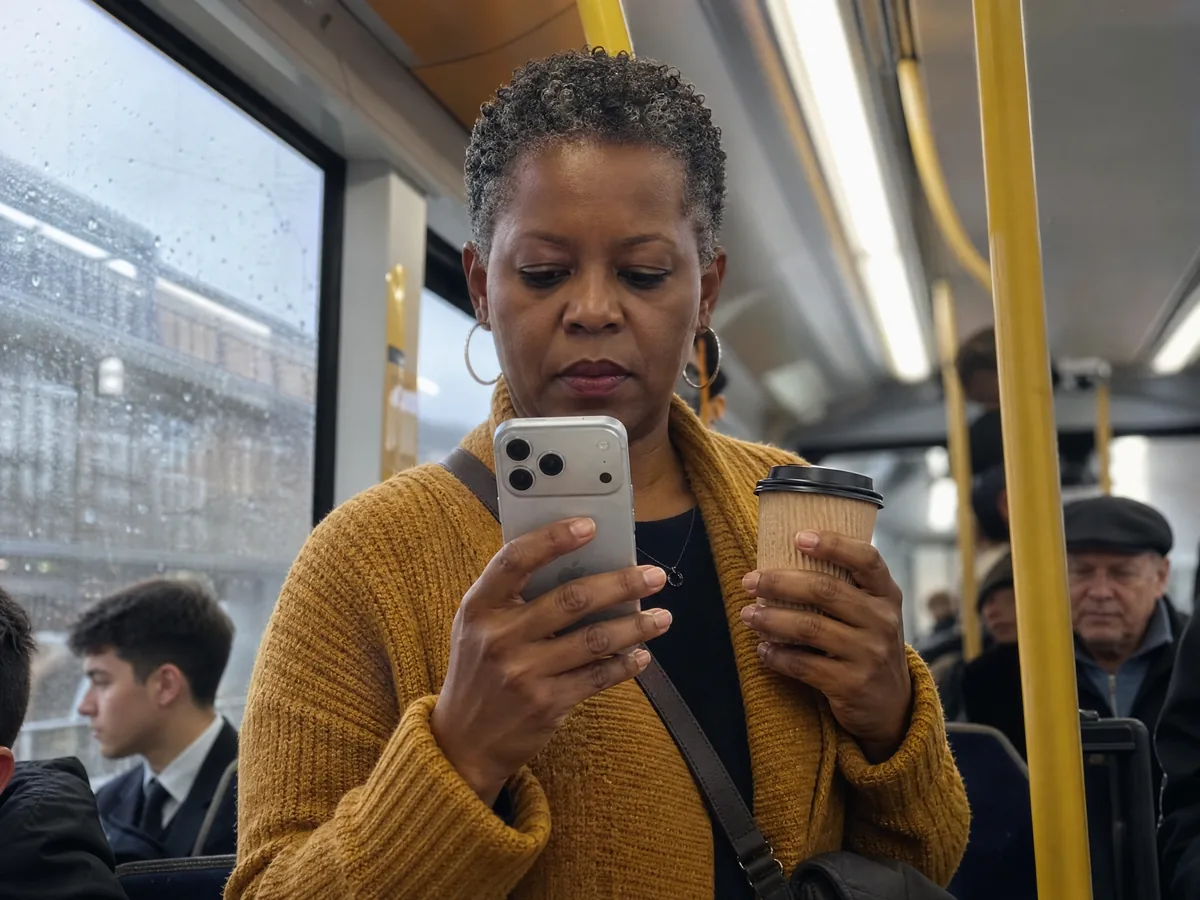
The Pro's display measures 6.3 inches and the Max's 6.9. Both refresh at 120Hz and Apple rates both at up to 3,000 nits in sunshine, though Manchester in September mostly asked them to cope with grey skies and raindrops. The trimmed Dynamic Island gives you a slightly bigger picture and space for three live updates side by side, a flight, a taxi and a timer in my case. Pleasant, but nobody should buy a phone for it.
So which one? Here's the cheat sheet I wanted on pre-order day.
Pro or Pro Max: the cheat sheet
| 18 Pro | 18 Pro Max | |
|---|---|---|
| Display | 6.3 in | 6.9 in |
| Weight without a case | 211 g | 249 g |
| Our video rundown | 22 h 06 min | 27 h 41 min |
| Chip and cameras | Identical | |
| 256 GB | £1,199 | £1,299 |
| 512 GB | £1,399 | £1,499 |
| Suits | One hand, jeans pockets, days that end near a socket | Flights, filming, reading, long days with no socket in sight |
My rule after a week: if you've ever watched your battery icon turn yellow on the train home and felt your stomach drop a little, buy the Max. Five and a half extra hours in our rundown is the best thing that £100 gets you. If the phone spends most of its life in your pocket and the day finishes on your own sofa, the Pro weighs less, costs less and runs every bit as fast.
Storage runs from 256 GB up to 2 TB on both. Lab testers have found that the top tiers use slower flash chips. Day to day that's invisible, but for long ProRes shoots I'd stop at 512 GB.
Size is easy once you think about your days. Software is a more personal matter.
iOS 27 and the new Siri, one week in
Both came with iOS 27 and the rebuilt Siri, and a week is nowhere near enough to judge an assistant. One story, then. In the taxi queue at Schiphol I asked it to "text Jo that I'm in the queue and I'll be home by half eleven", and it wrote a sensible, friendly message. Then it sent it to Joe, our plumber. He replied "no bother love, see you then", and I still haven't found the courage to explain.
With Jo's surname added, it found the right person. Clever with words, careless with contacts. Performance never came into question: the A20 Pro cut a 4K canal clip in Photos without a hiccup and got warm, never hot, through a 35-minute game on the Dublin flight.
Which leaves the honest part: who shouldn't spend £1,199 or more this autumn.
Upgrade now, or hold on?
Then there's the money. Both models cost £100 more than the 17 Pro and Pro Max did at launch. EE, O2, Vodafone and Three will all spread the cost, and Apple's trade-in knocks a little off. Read the small print on the cheapest monthly deals, because some run for 36 months.
And if you're not wedded to iOS, one other phone spent a lot of this year in my bag.
Other phones worth a look
- Samsung Galaxy S26 Ultra, from £1,249. It weighs 214 g, hides a stylus in its base and can blank its screen to the person beside you. In the lab tests we read it ran out sooner than the Max, but it refills at a similar pace. It was my only phone for 38 days this spring, all written up in my Galaxy S26 Ultra review.
- iPhone 17 Pro Max, if a retailer still has one reduced. Same shape, slightly less battery, a fixed aperture. At £150 or more under the 18 Pro Max, it's the bargain.
- Google Pixel 11 Pro XL. Call screening and Google's photo processing remain its best arguments. It hasn't been through our tests yet.
On all four flights I wore the earbuds from my AirPods Pro 3 review, which pair with these phones the moment you open the case. Everything we've tested lives on our blog, and our scoring is laid out on the how we test page.
What seven days can't tell you
A week is enough for battery patterns, camera habits and weight. It can't tell you how the battery ages, how the aluminium frame copes with a pocket full of keys, or whether Siri learns the difference between Jo and Joe. The Max is staying as my everyday phone, and I'll add a 30-day update here with a second travel log, Singapore included.
For now the verdict fits in one line. The Max is the iPhone for anyone tired of hunting for plug sockets, and the Pro is the one for anyone tired of heavy phones. In our flat we've settled it the fair way: Jo keeps the light one, I keep the one that lasts, and we share the 60W plug.
Questions readers asked us
Should I upgrade from an iPhone 17 Pro to the iPhone 18 Pro?
Probably not. The battery, the adjustable aperture and the slimmer Dynamic Island are real improvements, but you'd notice them less than you'd notice the bill. Anyone on a 15 Pro or earlier gets a much bigger jump, especially in battery life.
Is there a SIM tray on the UK iPhone 18 Pro?
Yes. UK models keep a physical nano-SIM tray and also support eSIM, so you can keep your normal SIM and add a travel eSIM. The eSIM-only versions are sold in the US.
How much is the iPhone 18 Pro in the UK?
At the time of writing, the iPhone 18 Pro starts at £1,199 for 256 GB and the Pro Max at £1,299. The 512 GB models cost £1,399 and £1,499, and the 2 TB versions top out at £2,399 and £2,499.
Which charger gives the iPhone 18 Pro its fastest charging?
Any USB-C charger rated 60W or above. Ours took the Pro Max from flat to half in 17 minutes. An old 20W cube needed 34 minutes to do the same.