
Five gas barbecues, one windy bank holiday: the steadiest heat we found in Burnley
Seventy-six days, a 29 mph gust on bank holiday Monday and 60 slices of toast. One gas barbecue barely flinched in the wind, and it browned the grate almost evenly from corner to corner.
 By Keith Ormerod, garden and barbecue tester, allotment holder
Tested in Burnley · 4 November 2026 · 13 min read
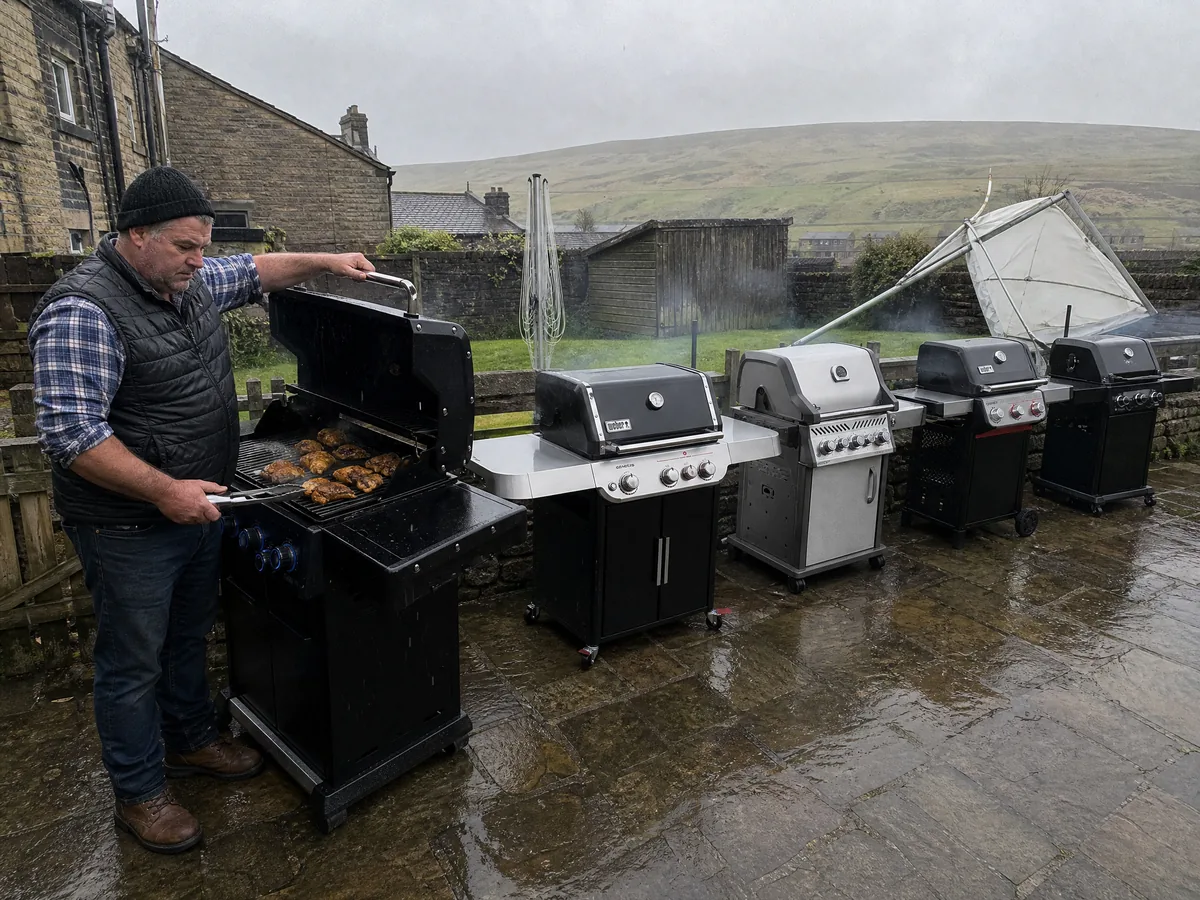
At ten past two on bank holiday Monday, the little wind meter I'd taped to the washing line post read 29 mph. At eleven minutes past, next door's pop-up gazebo went over the fence and landed on its side by our water butt. Nobody was under it, thank goodness. Graham came round for it with a bacon barm still in his hand.
On our patio, five gas barbecues stood in a row with their lids shut and probes clipped to their grates. Four of the logger lines on my phone dived the moment that gust came through. One of them dipped like it had hiccupped, then carried on.
That was the question I'd set myself back in August. Which gas barbecue holds a steady temperature when the wind and drizzle come in, and which cooks evenly from one edge of the grate to the other? From Friday 14 August to Wednesday 28 October, 76 days in all, five well-known models lived on the sandstone flags behind our house in Burnley. The winner surprised Bev more than it surprised me.
- Dropped only 18°C at grate level in a 29 mph gust, lid shut, against 46°C for the worst
- Just 14°C between the hottest and coolest of nine points on the grate
- 11 of 12 slices of toast came out the same shade
- Side burner and rear rotisserie burner for the Sunday dinner crowd
- 74 kg, so it's a two-person job off the pallet
- Uses the most gas of the five, about 0.47 kg an hour on medium
- Cast iron grates need a wipe of oil after wet weeks
- The blue-lit knobs are a bit Blackpool Illuminations for my taste
Verdict: if you barbecue on a hillside, by the coast or anywhere the wind gets in, this is the one I'd buy. It held its heat best and cooked most evenly, two things that matter far more on a British patio than a big number on the box. If you mostly cook steaks and want the strongest sear, the Weber Genesis E-325s ran it close. On a tighter budget, the Char-Broil Performance Core B 3 was the surprise for even heat, as long as you keep it out of the wind.
- Five barbecues on a Burnley patio
- Bank holiday Monday, gust by gust
- The whole test in one table
- Sixty slices of toast
- Broil King Baron 490 Shadow: the one that didn't flinch
- Weber Genesis E-325s: the strongest, nearly the steadiest
- Napoleon Rogue SE 425: lovely kit, chilly front
- Weber Spirit E-325: still my everyday barbecue
- Char-Broil Performance Core B 3: even, but not in a gale
- Gas, weighed on the onion scale again
- Which one for which garden
- UK prices and where to buy
- Questions from over the garden wall
Five barbecues on a Burnley patio
Our back garden faces west, towards the moors, and the wind comes straight down the hill and over the dry-stone wall. If a barbecue can cope here, it can cope most places. Bev's view is that it's the worst garden in Lancashire for cooking outdoors, which is exactly why I chose it.
The five lined up side by side on the flags, about a metre apart, backs to the garden wall with a good metre of clear space behind them. Two Webers, the Genesis E-325s and the Spirit E-325 that's been in our yard since June. The stainless Napoleon Rogue SE 425, the black Broil King Baron 490 Shadow, and the cheapest of the group, the Char-Broil Performance Core B 3. Each ran on its own propane bottle, so none of them was starved of gas while the others were lit.
The kit was simple and the same for all five:
- A four-channel probe logger on each barbecue, with probes clipped at grate level front left, front right, back left and back right, logging every 10 seconds.
- A cheap handheld anemometer for wind speed, taped to the washing line post at barbecue height.
- The same yellow infrared gun from my Spirit review, for nine-point grate checks.
- Plain white sliced bread, a lot of it.
Over the 76 days I lit all five together on 23 days, for heat runs and family cooks. In between, they took turns with our weeknight teas. That came to 117 cooks, 24 each on the Broil King and the Genesis and 23 on the other three. It drizzled on 14 of those 23 days, which in Burnley counts as a dry autumn. The day that mattered most was the bank holiday.
Bank holiday Monday, gust by gust
Monday 31 August was 14°C, grey, with drizzle on and off and a westerly that gusted all afternoon. Eighteen of us, family and neighbours, and five barbecues to feed them. Kayleigh and Ryan came with the seating plan for their wedding in spring and a lot of opinions about chicken.
The night before, in still air, I'd set every barbecue to sit at 200°C at the grate with the lid shut. Then I didn't touch the knobs from one o'clock until ten past five. The loggers did the watching. Between cooks I measured two things: how far each one dropped in the biggest gusts, and how long it took to get back to 200°C after the lid had been open for 30 seconds.
The Broil King barely moved. Its biggest dip was 18°C, in that 29 mph gust at ten past two, and it was back inside two minutes. The Genesis dropped 24°C but recovered quickest of all, in 1 minute 50 seconds, because it has more power in hand. The Napoleon fell 31°C, the Spirit 38°C, and the little Char-Broil 46°C, with nearly five minutes to recover.
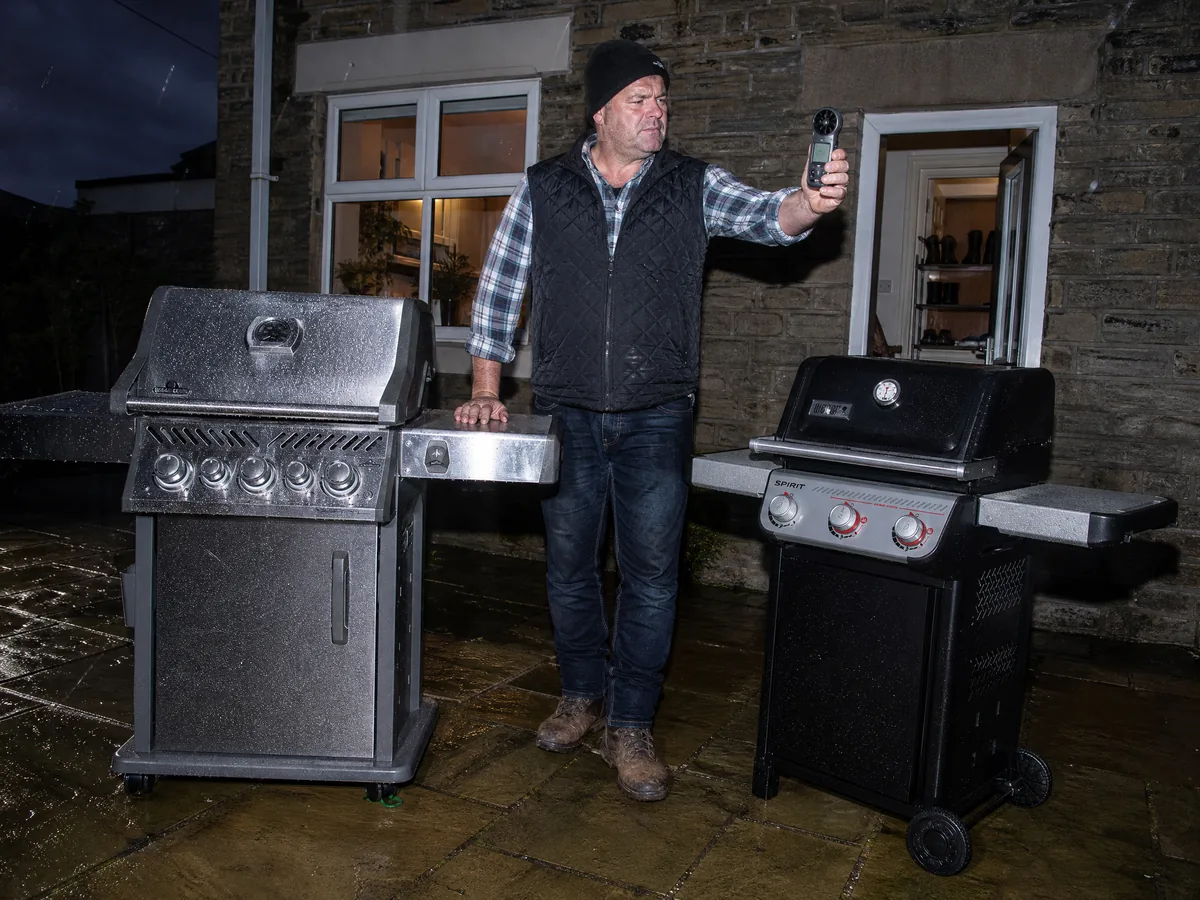
Across the whole afternoon, I looked at the gap between each barbecue's highest and lowest grate reading with the knobs left alone. The Broil King stayed inside a 21°C band for over four hours. The Char-Broil wandered across 57°C. That's the difference between chicken thighs that are all done at the same time and a tray of "try this one, love, it's probably cooked".
"Keith, they're all the same temperature now. Can we eat?" Ryan, ten to three, holding two plates
He was right, more or less, once the wind dropped. When it came back, the numbers split again. Here's how all of it added up over the eleven weeks.
The whole test in one table
"Biggest drop" is the worst dip at grate level in a gust, lid shut. "Grate spread" is the gap between the hottest and coolest of nine points with every burner on medium, averaged over four runs. Gas use is weighed, more on that below.
| Model | UK price at the time of writing | Biggest drop in a gust | Back to 200°C after 30 s lid open | Grate spread | Even slices of toast | Gas per hour on medium | Score |
|---|---|---|---|---|---|---|---|
| Broil King Baron 490 Shadow | About £949 to £1,399 | 18°C | 2 min 10 s | 14°C | 11 of 12 | 0.47 kg | 9.1 |
| Weber Genesis E-325s | About £1,149 to £1,260 | 24°C | 1 min 50 s | 22°C | 10 of 12 | 0.44 kg | 8.8 |
| Napoleon Rogue SE 425 RSIB | About £1,279 to £1,350 | 31°C | 2 min 30 s | 27°C | 8 of 12 | 0.42 kg | 8.3 |
| Weber Spirit E-325 | About £499 to £559 | 38°C | 3 min 20 s | 31°C | 8 of 12 | 0.33 kg | 7.9 |
| Char-Broil Performance Core B 3 | RRP £479.99 | 46°C | 4 min 40 s | 19°C | 10 of 12 | 0.29 kg | 7.2 |
Two things stood out. The steadiest barbecue in wind was also the most even, which makes sense once you see how it's built. And the cheapest one came second for even heat, which I did not see coming. Both of those showed up best in bread.
Sixty slices of toast
For the Spirit review I used crumpets. This time I wanted something flatter and fussier, so it was plain white sliced bread: twelve slices per barbecue in a grid of three rows of four, every burner on medium, lid shut, 90 seconds a side. I did it on four mornings and counted a slice as even if it matched the middle slice's colour. Bev was the judge, because I'm biased towards whatever's in front of me.
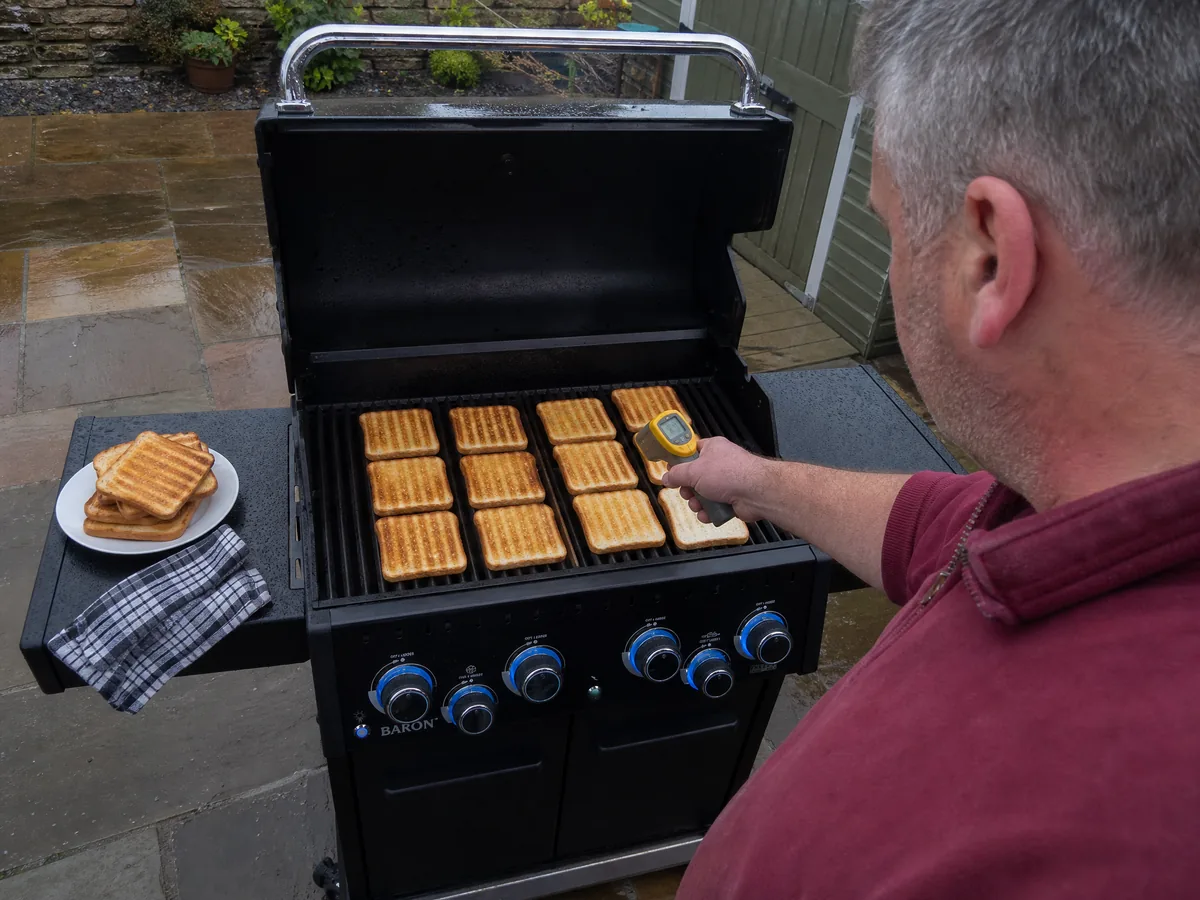
The Broil King turned out eleven matching slices nearly every time, with the front right one a shade paler. The Genesis and, to my surprise, the Char-Broil managed ten. The Napoleon and the Spirit both managed eight: the Napoleon's back row came out darker than the front, and the Spirit's front left corner stayed pale, just as it did in June.
We ate toast for three days. The rest went to the hens on the allotment, who have never been happier. The reasons behind those patterns are in how each barbecue spreads its heat, so here they are one at a time.
Broil King Baron 490 Shadow: the one that didn't flinch
Broil King is Canadian, which explains the "OFF / ARRÊT" printed round every knob. The Baron 490 Shadow has four main burners, a side burner, a rear rotisserie burner and heavy cast iron cooking grates. Under the lid, the cookbox is cast aluminium, thick enough that you can feel the warmth in it ten minutes after you've switched off.
That weight is the whole story in wind. A gust has to cool a lot of metal before it cools your food, and the Broil King's burners are tubes with two rows of flame ports, so the heat is spread wide rather than in three narrow strips. Over the flame sits a stainless steel tray with waves pressed into it, which catches fat and evens things out further. The result was the tightest grate spread of the test, 14°C, and the smallest dip in every gust I recorded.
It's not perfect. It weighs 74 kg, and Ryan and I needed two hours forty to build it, including a cup of tea and a lost bolt that turned out to be in my pocket. It burns the most gas of the five. And the cast iron grates went a rusty tinge along the edges after a wet week in September. Ten minutes on high and a wipe of oil fixed it. For a family who barbecue through to October, I can live with all of that. The next one is stronger, but not as calm.
Weber Genesis E-325s: the strongest, nearly the steadiest
The Genesis E-325s is the big brother of the Spirit, with three main burners plus a separate sear burner on its own red knob. It's also 68 kg, with huge stainless side tables and four castors that roll properly over flags, which the Spirit's two wheels and two feet never have.
It had the most power in reserve and recovered fastest after the lid had been open, 1 minute 50 seconds. On steaks it was the best of the five, with a deep crust in under three minutes a side over the sear zone. It just isn't designed to be dead even. The front of the grate ran about 15°C cooler than the back on medium, which is handy for resting food and less handy if you fill the whole thing with burgers.
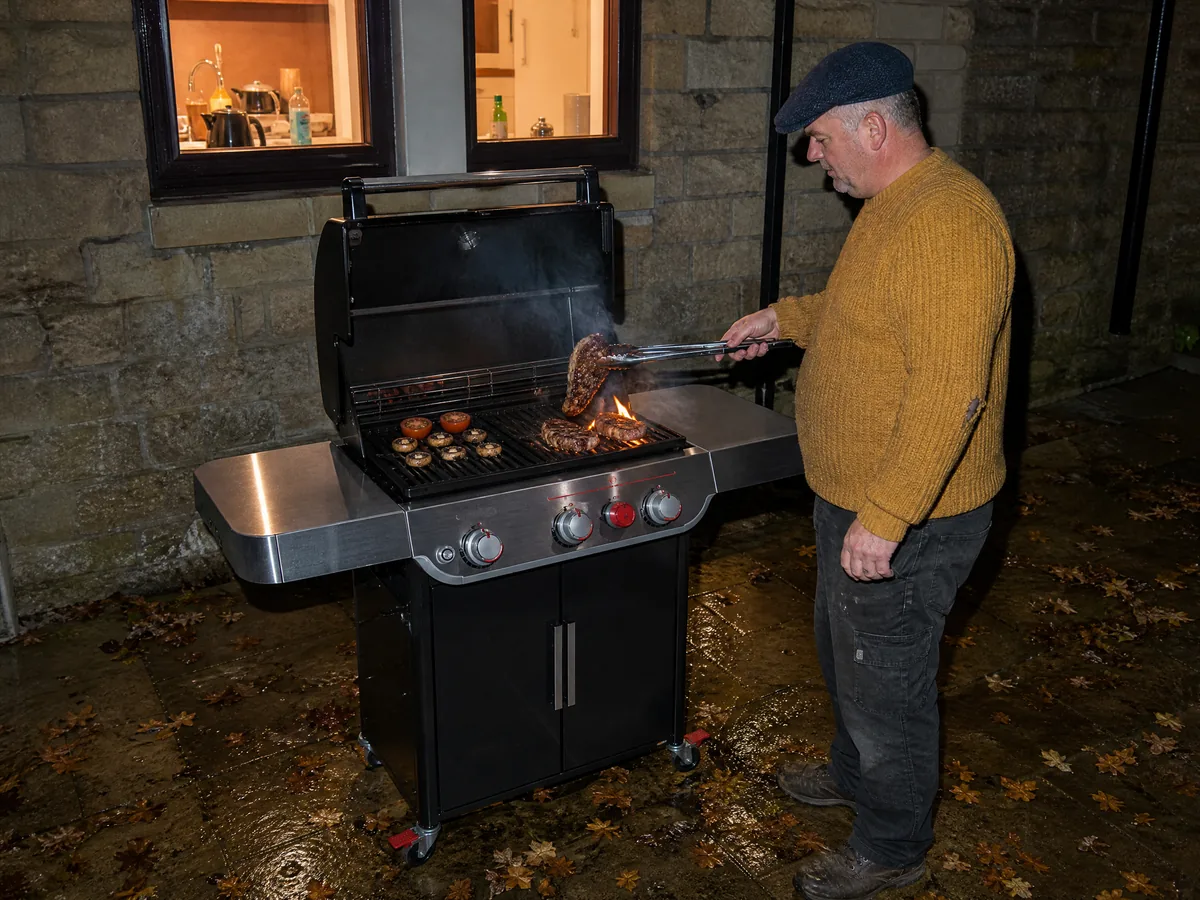
If your barbecue sits somewhere sheltered and steak night is the main event, I'd happily swap the Broil King for this one. The Napoleon, on paper, should have beaten both.
Napoleon Rogue SE 425: lovely kit, chilly front
The Napoleon Rogue SE 425 RSIB is the one the neighbours came to look at. Stainless steel lid, three main burners, an infrared side burner under a lid on the left shelf and an infrared rotisserie burner at the back. The side burner is a joy: I seared steaks on it at what my infrared gun called 400°C plus, while the main grill did the veg.
On the main grate, the heat leaned to the back. The back row of toast came out darker every time, and in gusts the shiny lid lost heat faster than the Broil King's or the Genesis's. A 31°C dip isn't a disaster, but you notice it on a three-hour cook. The stainless also shows every drizzle mark, which bothered me more than it should.
It's the barbecue for someone who likes gadgets and cooks with the lid up a lot, with rotisserie chicken as a weekend hobby. For a windy patio, it came third. Fourth went to one I already knew well.
Weber Spirit E-325: still my everyday barbecue
I reviewed the Spirit E-325 in July after six weeks of summer, and nothing in this test changed my view of it as a family barbecue. It lit first time on 22 of its 23 cooks here, the grease tray is still a two-minute job, and the sear zone still makes a better steak than it has any right to at the price.
The wind found its weak spots, though. It's lighter and smaller than the three above, and it dropped 38°C in the big gust. The cool front left corner is still there too, and it's why the Spirit only managed eight even slices of toast. If you already have one, cook sausages on the left, as I wrote in my Weber Spirit E-325 review, and put it where the house blocks the worst of the weather. The last of the five needs that advice even more.
Char-Broil Performance Core B 3: even, but not in a gale
The Char-Broil Performance Core B 3 costs less than half of the Genesis, with an RRP of £479.99. It uses Char-Broil's TRU-Infrared system: a perforated stainless plate sits between the three burners and the grates, heats up and passes the heat on as infrared. In still air, that gave it the second most even grate in the test, 19°C between the hottest and coolest points, and the fewest flare-ups of the five.
In wind, it struggled. It's the smallest and lightest of the group, the lid is thin, and every gust cut straight in round the back. It dropped 46°C in the big one, and with the knobs left alone it wandered across 57°C over the afternoon. On calm evenings it was a lovely little barbecue. The igniter also needed three clicks in drizzle more often than not.
The grate is 54.3 by 43.5 cm, about 2,362 cm², plenty for four to six people, and a 5 kg bottle fits in the cart. For a sheltered terrace and a family on a budget, it's a smart buy. That leaves the question of what all this costs to run.
Gas, weighed on the onion scale again
None of the five has a proper gas gauge, so the hanging onion scale came back out of the shed, much to Graham's amusement. I weighed each bottle before and after a two-hour run with every main burner on medium, lid shut, three times over.
At the roughly £54 I paid for a 13 kg propane refill this autumn, that's about £4.15 a kilo. So, per hour on medium: Broil King about £1.95, Genesis about £1.83, Napoleon about £1.74, Spirit about £1.37 and Char-Broil about £1.20. Over a summer of weekly two-hour cooks, the gap between the thirstiest and the most frugal is around £40. Not nothing, but not a reason to pick the wrong barbecue either.
If the probe thermometer is the missing piece, our wireless meat thermometer test found the one that kept its signal through brick walls. Every barbecue here went through the same routine we use for all our outdoor tests, written up on our how we test page. Now for the bit you actually came for.
Which one for which garden
The Weber Spirit E-325 is still the one I'd point most families to if they cook on weeknights and want Weber's build and warranty for around £500. Put it where the wind can't get at it. If slow, smoky cooks are more your thing than gas, my Traeger Woodridge Pro review covers a pellet grill through a wet spring.
UK prices and where to buy
We bought all five ourselves. These are the prices as I write this in early November, end-of-season deals included, and the price I'd wait for:
- Broil King Baron 490 Shadow: RRP £1,399.95, about £949 to £999 at garden centres and barbecue dealers clearing stock. Good under £1,000.
- Weber Genesis E-325s: about £1,149 to £1,260 at Weber dealers and department stores, RRP around £1,399. Good under £1,150.
- Napoleon Rogue SE 425 RSIB: about £1,279 to £1,350 in stainless at specialist barbecue shops. The black Phantom version is dearer, about £1,365.
- Weber Spirit E-325: about £499 to £559, RRP £599. Good under £520.
- Char-Broil Performance Core B 3: RRP £479.99 at Char-Broil's UK shop. Good under £420.
Barbecue prices are at their lowest between Black Friday on 27 November and early spring, when shops want the floor space back. The Broil King is staying on our patio for the winter under a proper cover, and the Spirit is going to Kayleigh and Ryan's new place. My pressure washer test on our sandstone flags is still running, and you can follow it on our tests in progress page. Everything else we've tested for the garden is in the outdoor section.
Questions from over the garden wall
Which gas barbecue is best in windy weather?
In our 76-day test in Burnley, the Broil King Baron 490 Shadow lost the least heat in gusts, 18°C at grate level in a 29 mph gust with the lid shut. Its heavy cast aluminium cookbox and wide burners kept the grate steady. The Weber Genesis E-325s came second and recovered fastest after the lid was opened.
Can you use a gas barbecue in the rain?
Yes. All five we tested kept burning in steady drizzle with the lid down. Keep the barbecue in the open with the clearance the manual asks for, never under a gazebo, awning or anything else that can burn, and give it a longer warm-up on cold, wet days.
How do you stop wind blowing out a gas barbecue?
Turn the back of the barbecue towards the wind, keep the lid closed as much as you can, and use a spot sheltered by a wall or the house if possible, still with proper clearance. None of our five blew out in gusts up to 29 mph, but the lighter models lost a lot more heat.
Is Broil King better than Weber?
For steady, even heat in wind, the Broil King Baron 490 Shadow beat both Webers in our test. For searing and quick recovery after opening the lid, the Weber Genesis E-325s was better. Weber's dealer network and warranty are excellent, so it comes down to whether your garden is exposed and whether steak is the main event.