
Traeger Woodridge Pro review: a pellet smoker through a wet Lancashire spring
Nineteen cooks, 52 kg of pellets and more rain than any barbecue deserves. What the Traeger Woodridge Pro does well in a British back garden, and the one thing it hates.
 By Keith Ormerod, garden and barbecue tester, allotment holder
Tested in Burnley · 17 June 2026 · 12 min read
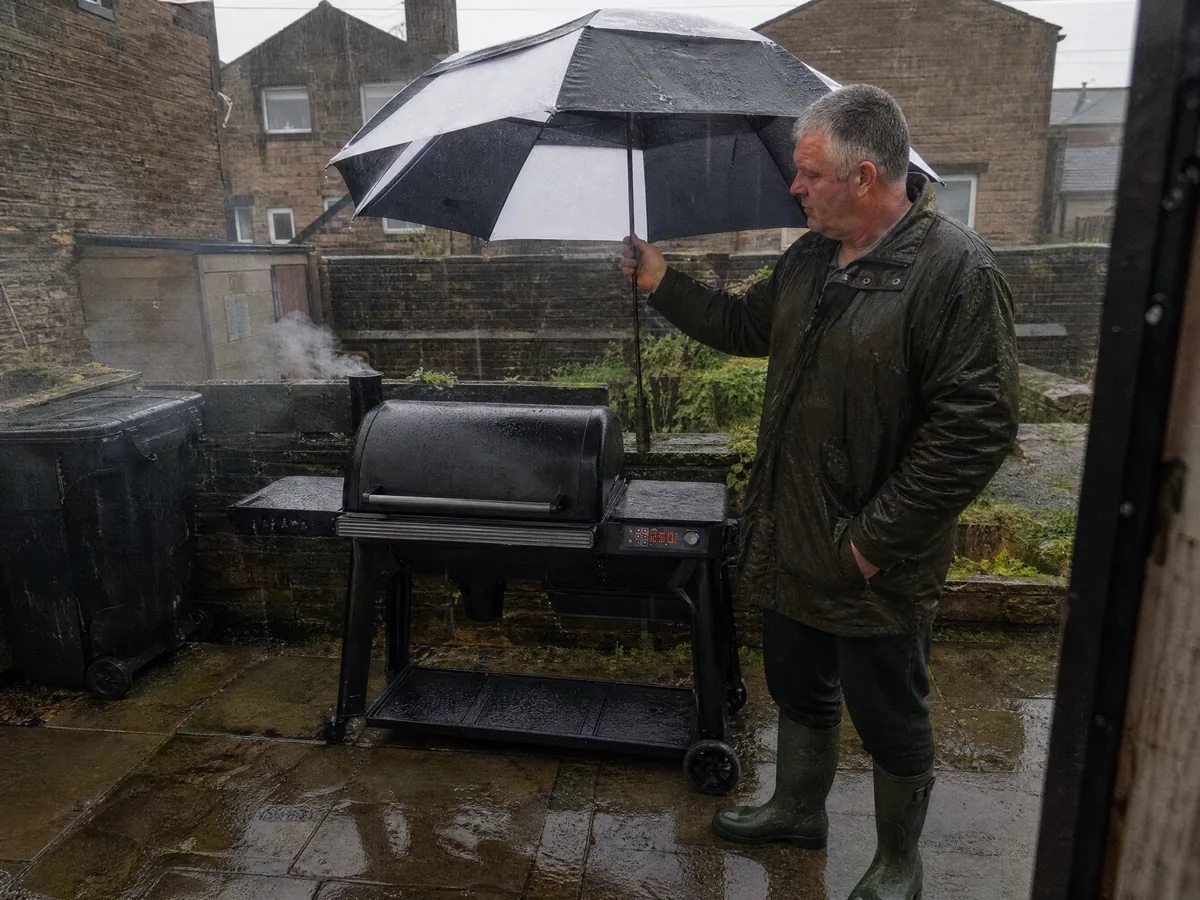
There's a photo on Bev's phone from seven o'clock on Easter Sunday. It shows me in the back yard in my wellies, holding a golf umbrella over a barbecue while the rain runs down the back of my neck. The barbecue is perfectly dry. I am not.
Under that umbrella was the Traeger Woodridge Pro, with a lamb shoulder inside it for Easter dinner. I tested it from Good Friday, 3 April, to 7 June. That's 19 cooks in about nine and a half weeks, 52 kg of pellets, and a Lancashire spring that did its level best to put the fire out.
I'm a maintenance fitter by trade and I've cooked on charcoal and gas for longer than I've had the allotment. A barbecue that runs itself from an app sounded to me like something designed for California. So the question I wanted answered was plain: does a pellet smoker make sense when you live in Burnley?
Traeger Woodridge Pro
About £1,299 to £1,400 at the time of writing (RRP £1,399.99)
- Held 110°C within about 6°C on still days
- An 11 kg hopper runs a whole overnight cook
- Easter lamb and brisket that people still mention
- The grease and ash keg makes clean-up quick
- Hates damp: pellets left in the hopper swelled and jammed
- Single-wall body loses heat in wind and rain
- Reads about 8°C high against our probe
- Never got past 243°C, so no proper steak sear
Our verdict: the easiest way I know to cook real barbecue at home, and it copes with British weather better than I expected. Keep your pellets bone dry, put it out of the wind, set it a few degrees higher than you want, and use something else for steak.
Why a pellet smoker in Lancashire at all
A pellet grill is an outdoor oven that burns small pellets of compressed hardwood. You fill a hopper on the side, set a temperature, and an auger feeds pellets into a firepot while a fan keeps them burning. A controller adds more pellets when it's too cool and fewer when it's too hot. You get real wood smoke without tending a fire.
The catch for us is in that description: fan, controller, auger. It all runs on mains electricity. That rules out the allotment straight away, because like most allotments ours has no power, which disappointed Arthur on plot 9 more than it did me. At home, it means a socket in the garden.
Assembly took me 52 minutes on my own. The grill weighs about 78 kg, so tip the box over and build it lying down, the way the instructions show, rather than trying to lift the barrel onto the legs yourself. Then there's a first burn-in to do, and after that, the first real test arrived with the Easter weather.
Easter Sunday: lamb shoulder in the rain
A 2.4 kg lamb shoulder, rubbed with garlic, rosemary and salt the night before. On at 7 a.m., 135°C, Super Smoke on for the first two hours. It rained steadily all morning, 9°C, with the wind coming off the moors in gusts.
Rain itself did less harm than I feared. The hopper lid shut properly and the controller didn't mind being wet. What the rain did do was cool the barrel. The app showed the grill working harder, feeding pellets more often to hold its temperature, and my probe at the grate showed slow wobbles of 10 to 12 degrees around the setpoint instead of the usual 5 or 6. The umbrella was mostly for my benefit, and for Bev's photo.
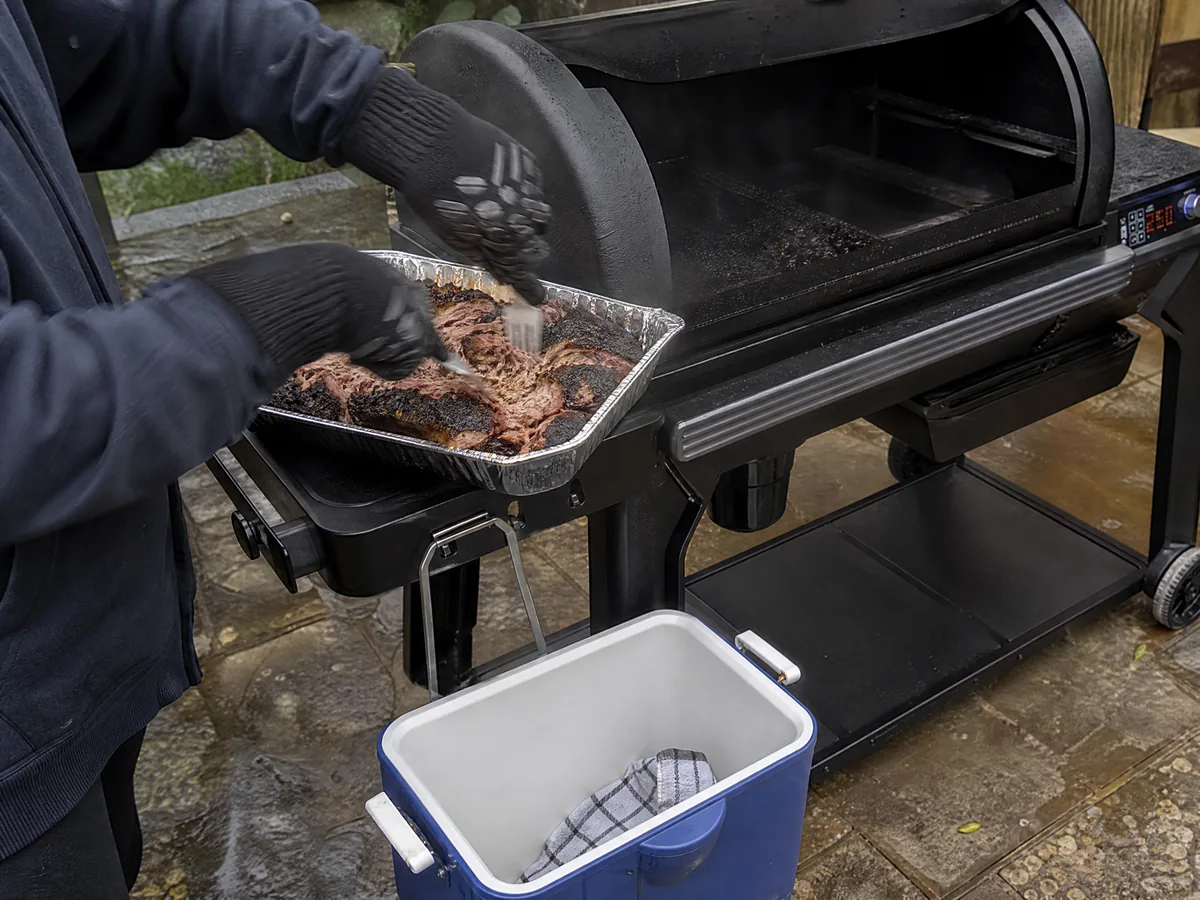
By 1:15 p.m. the lamb was at 92°C inside and pulled apart with a fork. It had a dark, sticky crust and a pink smoke ring under it, and my brother-in-law, who normally tells me what I've done wrong, asked for the rub recipe. That was 6 hours and 15 minutes and about 4.8 kg of pellets. Good start. But one lamb shoulder proves nothing, so over the next eight weeks I measured the grill properly.
The numbers, with a probe that doesn't lie
A probe of my own sat dead centre on the main rack at grate height, and on every cook I wrote its reading next to whatever the Traeger's screen claimed. These are averages from days between 8°C and 19°C, which is spring in Burnley.
| Test | Result |
|---|---|
| Ignition to 110°C | about 13 minutes |
| Ignition to 230°C | about 21 minutes |
| Swing around 110°C, still day | plus or minus 6°C |
| Swing around 120°C, gusty and wet | 101°C to 138°C |
| Display vs our grate probe at 110°C | display about 8°C higher |
| Highest grate temperature we saw | 243°C, on a 17°C day |
| Pellet use at 110°C, still day | about 0.5 kg per hour |
| Pellet use at 120°C, wind and rain | about 1.0 kg per hour |
| Pellet use at 230°C | about 1.5 kg per hour |
Six degrees either way is the grill breathing: pellets drop in, flare, burn down, drop in again. Over a ten-hour cook a shoulder of pork can't tell. What caught me out was the gap between the screen and the grate. With 110°C on the display, my probe sat between 100 and 104°C, and Traeger gives you no way to correct it, so I just ask for 118°C when I want 110°C. Gareth, who tests grills with me from Cardiff, found the same on the Traeger he cooked on last year, which suggests it's where the probe sits rather than a faulty unit.
At UK prices, pellet use is worth knowing. A 9 kg bag of Traeger pellets was around £23 where I bought them, so the Easter lamb cost about £12 in pellets and a calm-day overnight brisket about £6. In wind and rain, double it. Which brings me to the brisket.
The overnight brisket, and the Wi-Fi at the bottom of the garden
You can't just pick up a whole brisket at the supermarket here. I ordered a 5.8 kg untrimmed one from the butcher in Padiham a week ahead, and he looked at me as if I'd asked for a whole cow. Salt, pepper, on the grill at 10 p.m. at 118°C on the display, so about 110°C at the grate. The hopper holds 11 kg, which is more than a full overnight cook uses in calm weather, so no midnight refills.
The problem was my Wi-Fi. Our router is at the front of the house, and the grill was at the far end of the yard, out of the wind by the back wall. At 1:40 a.m. the app lost the grill. The grill was fine. I wasn't, because I got up, put my coat on over my pyjamas and went out with a torch to check. After that night I fitted a cheap Wi-Fi extender in the back bedroom and never lost the connection again.
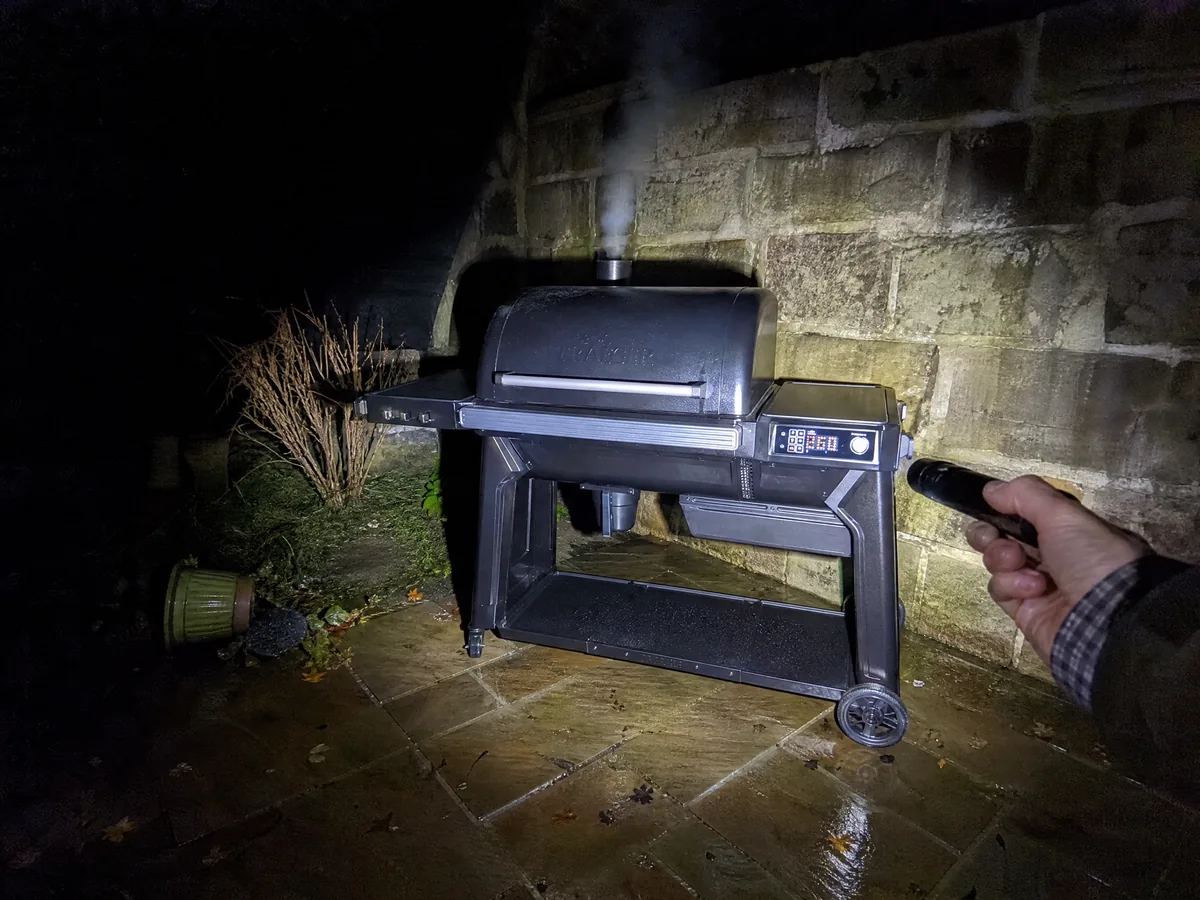
I wrapped the brisket at 7 a.m. at 68°C inside and pulled it at 12:30 p.m. at 95°C. Fourteen and a half hours, about 8.3 kg of pellets, and a bark you could hear when you cut it. We took half of it, pulled and still warm in a cool box, to the allotment society's plant sale that Saturday. It went faster than the tomato plants.
"I've had forty years of barbecues and nobody ever made me one that tasted of the wood." Arthur, plot 9, on his second bap
Damp pellets: the problem nobody in California has
Here's the part I most want British buyers to read. Wood pellets are compressed sawdust, and sawdust loves water. After the brisket I left about 4 kg of pellets in the hopper for eight days. The grill was under its cover, but it rained on six of those eight days, and the air here is damp even when it isn't raining.
When I fired it up again, it took 26 minutes to reach temperature instead of 13 and then struggled to hold it. I opened the hopper and found the bottom layer of pellets swollen and soft, and some had turned back into sawdust mush around the auger. I scooped the lot out, ran the auger empty, vacuumed out the firepot with my workshop vac and started again with a fresh bag. Forty minutes of my Saturday, and it could have been worse. A properly jammed auger means taking panels off.
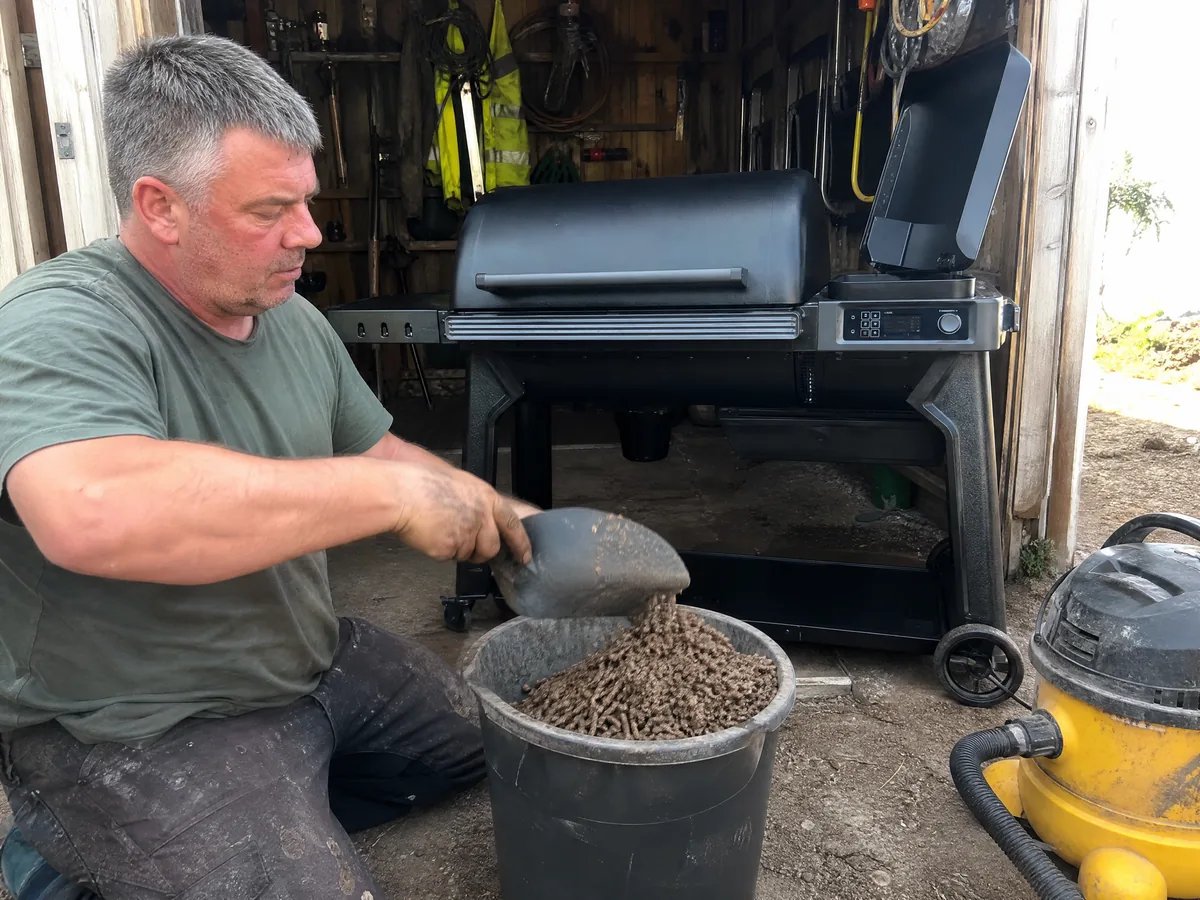
Once I followed those rules, I had no more trouble for the rest of the test. Which left me free to judge the thing I judge everything by: how it's built.
A fitter's look at the build
The legs and cart are solid. It rolls well on two big wheels and two casters, even over the uneven stone flags in our yard, and the side shelf takes a tray of meat without any bounce. Underneath, the EZ-Clean keg is a bucket that grease and a bit of ash drain into. Mine got tipped into the bin about once a month.
The barrel is single-wall steel, and in our weather you feel that. Wisps of smoke curl out all round the lid, because there's no seal, and on a cold evening the whole barrel shimmers with lost heat. The keg doesn't catch the fine grey ash, which builds up in the barrel floor, and my workshop vac came out roughly every sixth cook. By week eight, a couple of bolt heads under the side shelf had gone orange. Nothing structural, but a good cover is not optional in Lancashire.
Where the Woodridge Pro really scores is the everyday stuff. On a normal Saturday I'd fill the hopper, press ignite, put chicken thighs on at 180°C and go to the allotment for two hours with the app in my pocket. That's the part no spec sheet tells you. It gives you your day back.
What it won't do
Traeger says it reaches 260°C. The best I saw at the grate was 243°C after 25 minutes on a mild day. Plenty for a roast chicken, a pizza stone or a tray of veg. Nowhere near enough for steak. My sirloins came out grey with faint stripes. What works is doing it backwards: smoke the steak gently at about 110°C to 45°C in the middle, then give it a minute a side in a smoking cast iron pan on the hob, or over a gas barbecue.
The hotter you run it, the less it tastes of wood. Past about 160°C the fire burns clean and the smoke all but disappears, which is true of every pellet grill I've used, so smoky burgers aren't on the menu. The top shelf is also a few degrees behind the main rack, and I used it for sides and sausages.
Specs at a glance
| Spec | Traeger Woodridge Pro |
|---|---|
| Cooking area | About 6,260 cm² (970 sq in), main rack plus upper rack |
| Temperature range | About 74°C to 260°C (we reached 243°C) |
| Hopper | 11 kg, with pellet level sensor |
| Connectivity | WiFIRE, app control and alerts |
| Smoke mode | Super Smoke at low temperatures |
| Probe | 1 wired meat probe |
| Cleaning | EZ-Clean grease and ash keg |
| Weight | About 78 kg |
| Power | Mains electricity required |
| Warranty | 10-year limited |
Should you buy one?
Stuck between this and gas? Think about Tuesday, not Sunday. Straight after this test I spent six weeks cooking on gas for our Weber Spirit E-325 review. The gas one got used on school nights for twenty-minute teas. The Traeger got the lamb, the brisket and the long Saturdays.
Other Traegers worth a look
- Traeger Woodridge (RRP about £999, often less): the plain model. Less grate, no pellet level sensor, no Super Smoke button. A torch and a glance in the hopper do the sensor's job, and the savings buy a lot of pellets.
- Traeger Ironwood (from about £2,000): an insulated double skin, which is precisely the answer to everything the Easter rain did to our single-wall barrel. Worth the jump only if November brisket is a serious plan.
Every barbecue we test goes through the same routine: probe at the grate, pellets or gas weighed, real family meals, as described on our how we test page. You'll find more tested outdoor kit in our reviews.
Nine and a half weeks on, the Woodridge Pro has earned its corner of the yard. It sulks in the damp, it won't sear a steak, and it needs a socket. But it gave us the best Easter dinner we've had in years while I stood next to it holding an umbrella, and I'd do that again.
Questions people ask
Can you use a Traeger in the rain?
Yes. In our test rain didn't stop any cook, but it made the barrel lose heat, so the grill burned more pellets and the temperature wobbled more. Keep the hopper lid shut, use an outdoor socket with an RCD, and never leave pellets in the hopper for days in damp weather.
How much pellet does the Woodridge Pro burn?
About 0.5 kg an hour at 110°C on a still day and 1.5 kg an hour at 230°C. In wind and rain at 120°C it doubled to about 1.0 kg an hour.
Does the Traeger Woodridge Pro need electricity?
Yes. The controller, fan, auger and igniter all need mains power, so you need a socket near the grill. It won't work on an allotment or anywhere without power unless you bring a suitable power source.
Is the Woodridge Pro any good for steak?
Only with help. Our grate peaked at 243°C, enough for colour but not for a crust. Cook the steak slowly on the Traeger, then give it a minute a side in a smoking cast iron pan or over a gas barbecue.