
Weber Spirit E-325 review: six weeks of British summer on the sear zone barbecue
Twenty-six cooks, one engagement party in the drizzle and a gas bottle weighed on the allotment onion scale. What the new Weber Spirit E-325 gets right, and where it cuts corners.
 By Keith Ormerod, garden and barbecue tester, allotment holder
Tested in Burnley · 22 July 2026 · 12 min read
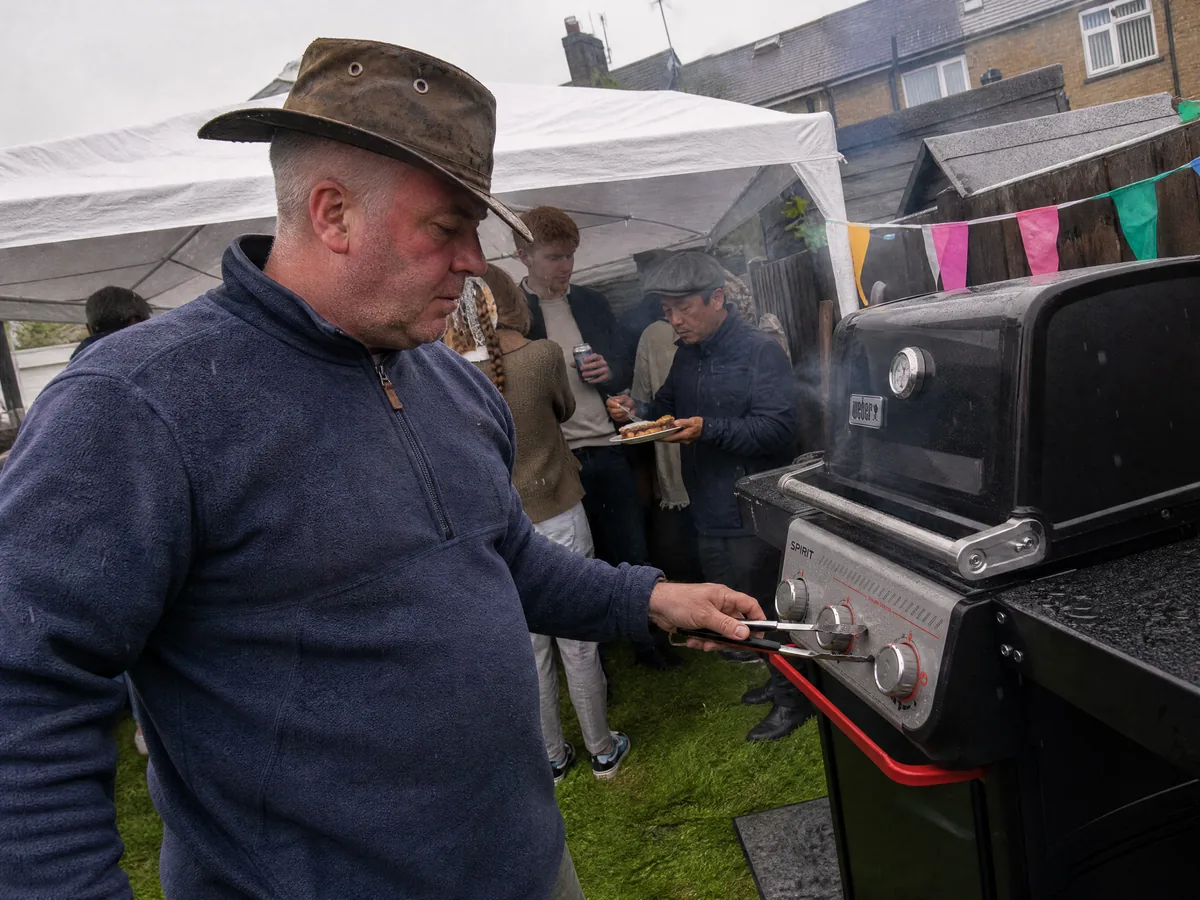
Every summer somebody on our street asks if they can wheel their gas barbecue under the gazebo when it starts to rain. The answer is no, and by the end of this review you'll know why, because I had to say it to my own son-in-law-to-be with thirty guests watching.
That was at our daughter Kayleigh's engagement do in July, cooked on the Weber Spirit E-325. I'd been using it since 8 June, straight after my spring with a pellet smoker, and by 19 July I'd cooked on it 26 times. Weeknight teas, a lot of sausages, one party in the drizzle and a few steaks that finally came out the way I like them.
This is the redesigned Spirit, the first big change to the range in many years, and Weber's headline is a sear zone with two "Boost" burners that Weber says give 40% more heat. I wanted to know what that means on a damp Lancashire evening, not in a catalogue.
Weber Spirit E-325 (2025 model, gas)
About £539 to £559 at the time of writing, RRP £599
- Sear zone grate at 338°C after 15 minutes, even on a 15°C evening
- Lit first time on 25 of 26 cooks
- Pull-out grease tray cleaned in under two minutes
- About £1.25 of gas per cook on our numbers
- Two wheels and two feet, so it drags on flags and lawn
- Front left corner about 25°C cooler than the middle
- Lid thermometer reads well below the grate
- No gas level indicator
Our verdict: the gas barbecue I'd buy for a family of four at this price. The sear zone is the real thing and it's easy to keep clean. Learn where the cool corner is, keep it covered, and keep it out from under the gazebo.
Which E-325 you're actually buying
Barbecue names get messy, so let's sort this first. The model I tested is the 2025 Spirit E-325, Weber item number 1500902, with three burners, the two Boost burners on the right, cast iron grates and a lid thermometer. At the time of writing it's around £539 to £559 at specialist shops, with an RRP of £599.
Some retailers still list older Spirit models with "GBS" in the name or a sear station that works differently. They're not the same barbecue. If the listing doesn't mention the 2025 range or that item number, ask. The model with a side burner and the EP models with a digital thermometer are different again, and I'll come back to those at the end.
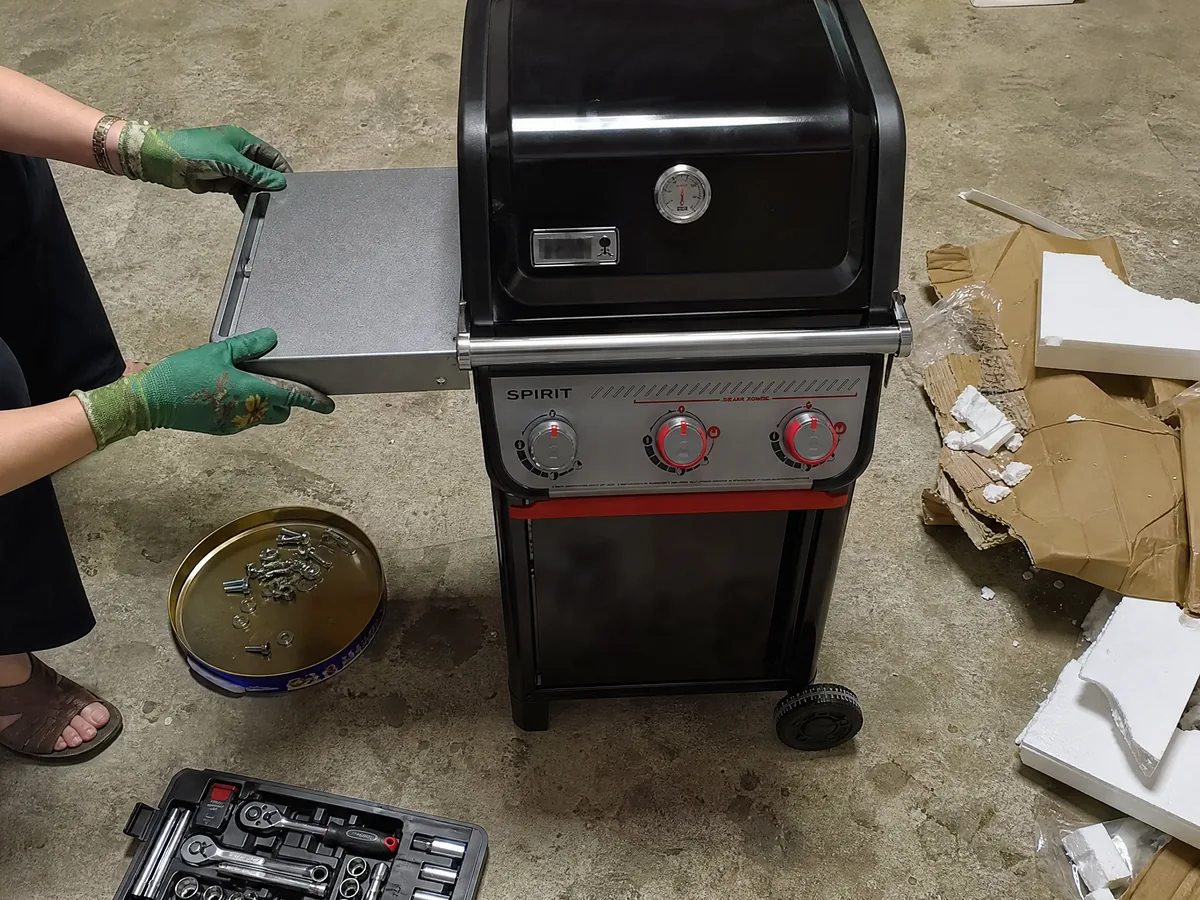
Mine arrived on a pallet in a box the size of a small wardrobe. Assembly took 71 minutes. Bev held the cookbox steady while I did the first cart bolts, which is the one step you really want two pairs of hands for. Every bag of parts is numbered to match a step, and not a single washer was short, which in my experience of flat-pack is close to a miracle.
The first cook, and the sausages
First cook was a Monday tea: Cumberland sausages from the butcher and some burgers. I lit all three burners, turned on the Boost for the right side, closed the lid and gave it ten minutes. Then I did what I've done on every barbecue I've owned. Everything went on together.
The burgers on the right were brilliant, with a proper crust in three minutes a side. The sausages on the right split open like they'd been in a fight and blackened before the middle was cooked. Bev ate hers without comment, which is worse than a comment. The sear zone is simply too fierce for sausages. From then on they lived on the left, burner on low, lid down, and came out perfect every time.
"You've got a barbecue that can do steak like a restaurant and you burned the sausages." Bev, fairly
That first tea told me the right third and the left third of this barbecue are two different tools. To know how different, I measured them.
Crumpets and an infrared gun
I ran the heat tests on evenings between 13°C and 19°C, usually with a breeze, because that's a normal June evening in Burnley. I used the lid dial, an infrared gun on the grates and a probe clipped at grate level, three runs each.
| Test | Result |
|---|---|
| All burners high, lid down: time to 260°C on the dial | 12 min 40 s |
| Sear zone grate after 15 min with Boost on | 338°C |
| Hottest grate reading in the test | 371°C |
| Indirect setup (right on, left off) settled at | 185 to 200°C after 17 min |
| Lid open 30 s, time to recover to 230°C | about 2.5 min |
| Front left corner vs middle of the grate | about 25°C cooler |
| Lid gauge vs grate surface on the right side | gauge about 20°C lower |
For hot and cold spots, the classic test is a grid of white bread. Bev had used the loaf for sandwiches, so I bought twelve crumpets from the corner shop instead, laid them in a grid, all burners on medium, two minutes a side. The middle and right came out golden. The front left crumpet came out pale every single time. It's not a flaw you'll notice with burgers. It just means that corner is for buns and resting food, not chicken thighs.
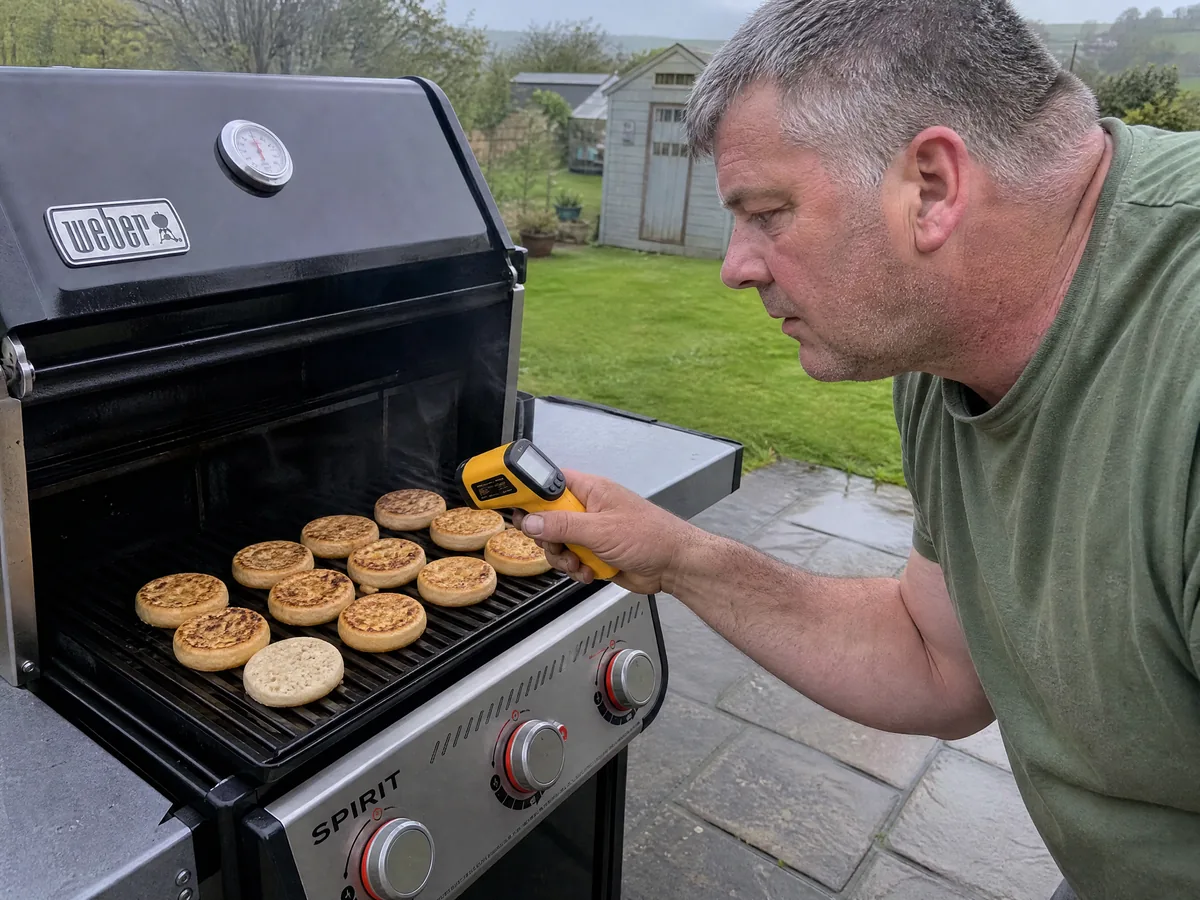
The dial on the lid measures hot air high up under the hood, not the metal your food sits on, and mine averaged about 20 degrees under the grate. A £15 probe thermometer from the supermarket settled every argument about whether the chicken was done. Numbers done, the next test was one the catalogue doesn't cover: British rain.
The gazebo rule
It rained on 11 of my 26 cooks. The E-325 didn't care. The Snap-Jet ignition lit in drizzle, the burners stayed lit in a steady shower, and with the lid down the rain just steamed off the top. What rain does make you want to do is move the barbecue under something. Don't.
Weber's manual is clear that the barbecue shouldn't be used under a combustible overhead cover, and it asks for clearance around the back and sides. A fabric gazebo is exactly that kind of cover. Heat and fat smoke rise, and a gazebo roof is a very good lid for a fire you didn't mean to start. I've seen what a melted gazebo looks like on the allotment after somebody's disposable barbecue. It isn't pretty and it isn't cheap.
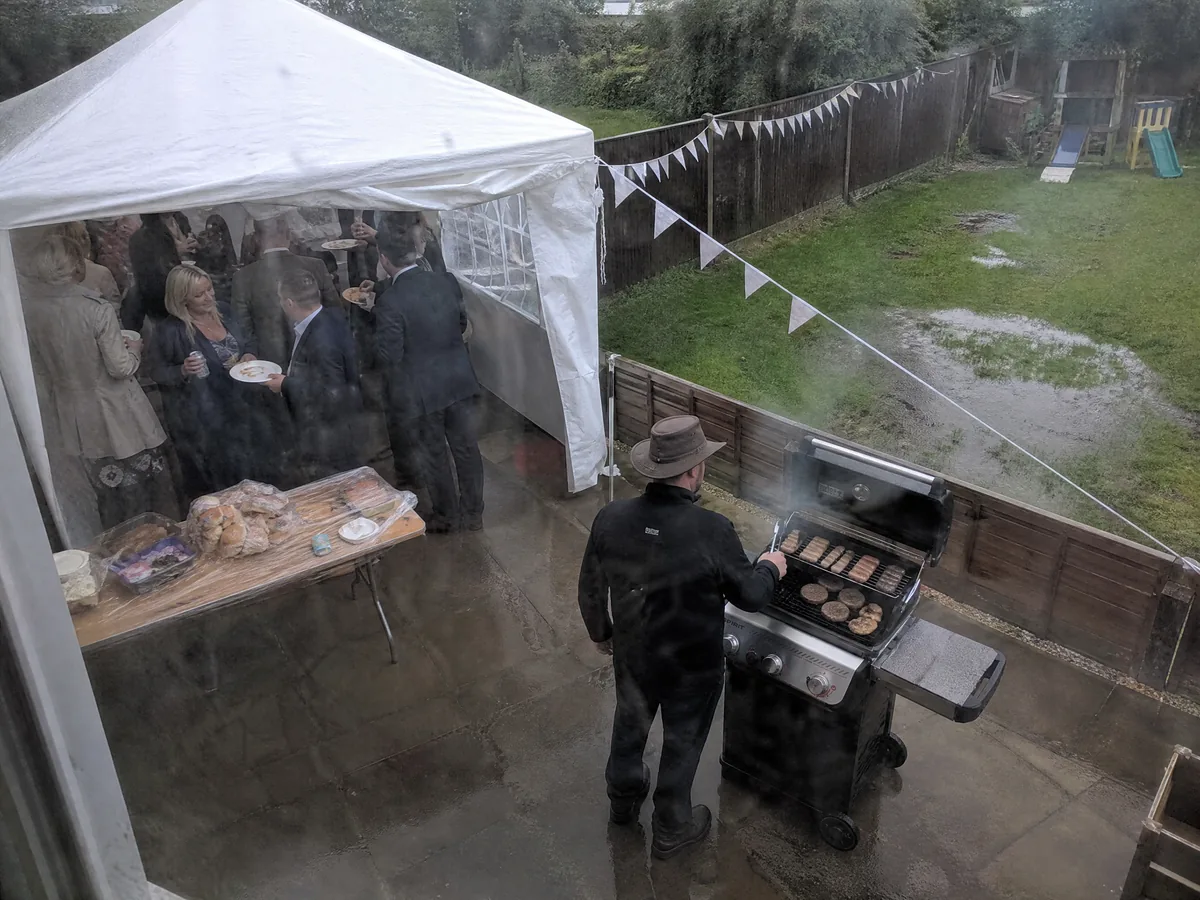
So at Kayleigh's engagement do, the guests were under the gazebo and I was outside it in my waxed hat, 2 metres from the nearest guy rope. Her fiancé, Ryan, offered twice to "just wheel it under for you". I explained the above. He's a good lad. He brought me a brew instead.
Six weeks of weeknight teas, and one party
This is where the Spirit won me over. Weeknights, I'd twist the knobs on my way past with the chicken, and by the time the kettle had boiled and the salad was done it was ready. The main grate is 2,314 cm², plus a 580 cm² warming rack. That fitted eight chicken thighs, a block of halloumi cut into slabs and four corn cobs with room to spare, which is Bev and me with leftovers for two days of lunches.
The engagement do was the stress test. Thirty-one people, 44 sausages and 26 burgers, in light rain. A dozen quarter-pounders is a full grate, so burgers went on in three waves, each one parked upstairs on the warming rack while the next cooked, with a permanent line of sausages ticking along on the left. It coped, and I didn't sit down for two hours. Families who do this every other weekend should be looking at the four-burner E-425.
Cleaning is where it quietly impressed me. Fat runs down into a drawer you pull out from the front, lined with a throwaway foil tray. My routine after a burger night: wire brush over the hot grates, drawer out, foil in the bin, new foil in. I never once took longer than two minutes. The deep clean, with the grates and flavouriser bars lifted out and the cookbox scraped, took 22 minutes in week five. Do that at least once a summer. Old fat in the bottom of a barbecue is the fuel for every flare-up I've ever had to put out.
The damp does show on the grates. After a wet week without the cover, the edges of the cast iron grates had a light orange bloom where the enamel is thinnest. Ten minutes on high, a wire brush and a wipe of oil sorted it. After that, the cover went on every night.
Gas, weighed on the onion scale
The E-325 has no gas gauge, so I weighed the bottle. The only scale in my shed that goes high enough is the hanging one I use for onions on the allotment, so a 13 kg propane bottle has been hanging off a hook in the garage once a week, which the neighbours find very interesting.
Over the 26 cooks I used 8.1 kg of propane. That mixes a lot of 30-minute weeknight cooks on medium with the party and a few long sear sessions, and works out at about 0.31 kg per cook. At the roughly £52 I paid to swap a 13 kg bottle, that's about £1.25 of gas per cook. A full bottle should see most families through a British summer and into the autumn.
If you don't fancy weighing it, the old trick works too: pour a jug of warm water down the side of the bottle and run your hand down it. The metal feels cold at the gas level. It's not precise, but it'll stop you running out halfway through the burgers.
The niggles
The wheels are my main complaint. It rolls on one pair of wheels and stands on a pair of feet, so moving it means lifting the feet end and hauling. At 44.5 kg that's fine on smooth paving. On our uneven stone flags it judders, and on the lawn for the party it dug in. If you move your barbecue about a lot, that matters.
The cool front left corner and the low-reading lid gauge are the other two. Neither stopped me cooking a single meal, but both are things you learn by burning something. The main grate is also a bit smaller than on the older three-burner Spirits. For the Boost burners, I'd make that swap again, but check the cm² if you're replacing an old one and cook for a crowd. The fold-down side tables, on the other hand, are handy in a small yard. With both down it tucks against the wall under its cover.
Specs at a glance
| Spec | Weber Spirit E-325 (2025, item 1500902) |
|---|---|
| Burners | 3 stainless steel, with 2 Boost burners for the sear zone |
| Main burner output | 9.09 kW |
| Cooking area | 2,314 cm² main grate plus 580 cm² warming rack (2,894 cm² in total) |
| Grates | Porcelain-enamelled cast iron |
| Ignition | Snap-Jet, one per burner |
| Thermometer | Lid thermometer |
| Size, lid closed | 117 x 123 x 67.5 cm |
| Weight | 44.5 kg |
| Fuel | Bottled gas, bottle sold separately |
| Warranty | 10 years cookbox and lid, 5 years grates, 3 years electronics, 2 years other parts |
| Price at the time of writing | About £539 to £559, RRP £599 |
Look hardest at the cookbox and lid line. In a climate where barbecues live outside under a cover from April to October, ten years on the parts that hold the fire is worth more than any feature on the list.
Who should buy it, and the alternatives
If slow-cooked pork and brisket are your real passion, a gas barbecue will manage a respectable indirect cook, but it won't give you deep smoke flavour. I spent the spring finding out what does in our Traeger Woodridge Pro review. Weekend smoker, weekday gas is a very common arrangement for a reason.
- Weber Spirit EP-325: the same cookbox and sear zone with a digital thermometer and a smarter finish. Worth it if you want to read the temperature at a glance.
- Weber Spirit E-425: four burners and a much bigger grate. Made for large families or anyone hosting most weekends.
- Weber Spirit E-310: three burners without the Boost, from under £500. Gentler heat and good for chicken and sausages, less exciting for steak.
Every barbecue we test gets the same thermometers, the same toast test and the same Tuesday chicken thighs, as set out on our how we test page. More tested outdoor kit is in our reviews.
Six weeks, 26 cooks and one engagement later, the E-325 is staying in our yard. Next summer, the sausages go on the left from the very first tea.
Questions people ask
Can you use a gas barbecue under a gazebo?
No. Weber says not to use its barbecues under a combustible overhead cover, and a fabric gazebo is exactly that. Keep the barbecue in the open with the clearance the manual gives, and put the gazebo for guests and food a couple of metres away.
What gas does the Weber Spirit E-325 use in the UK?
Bottled gas, sold separately. We used a 13 kg propane bottle. Check with your retailer which regulator and hose you need for the bottle you plan to use before your first cook.
How long does a 13 kg gas bottle last on the Spirit E-325?
In our test, 26 cooks used 8.1 kg, so a full 13 kg bottle should last around 40 typical family cooks. Long sessions on high with the Boost on will empty it faster.
E-325 or E-310: which should I buy?
For steak lovers, yes. In our tests the right-hand sear zone ran far hotter than the rest of the grate, and that's where the crust comes from. For a diet of sausages, chicken and halloumi, the E-310 saves you money and loses you very little.