
Automatic cat feeders UK: which one beat a greyhound and never missed a meal?
Sixty meals per feeder, a conservatory full of weighed kibble and a greyhound who learned the sound of a motor in two days. Only one feeder got every meal into the cat.
 By Janice Pugh, pet tester, two retired greyhounds and a tabby
Tested in Swansea · 26 October 2026 · 13 min read
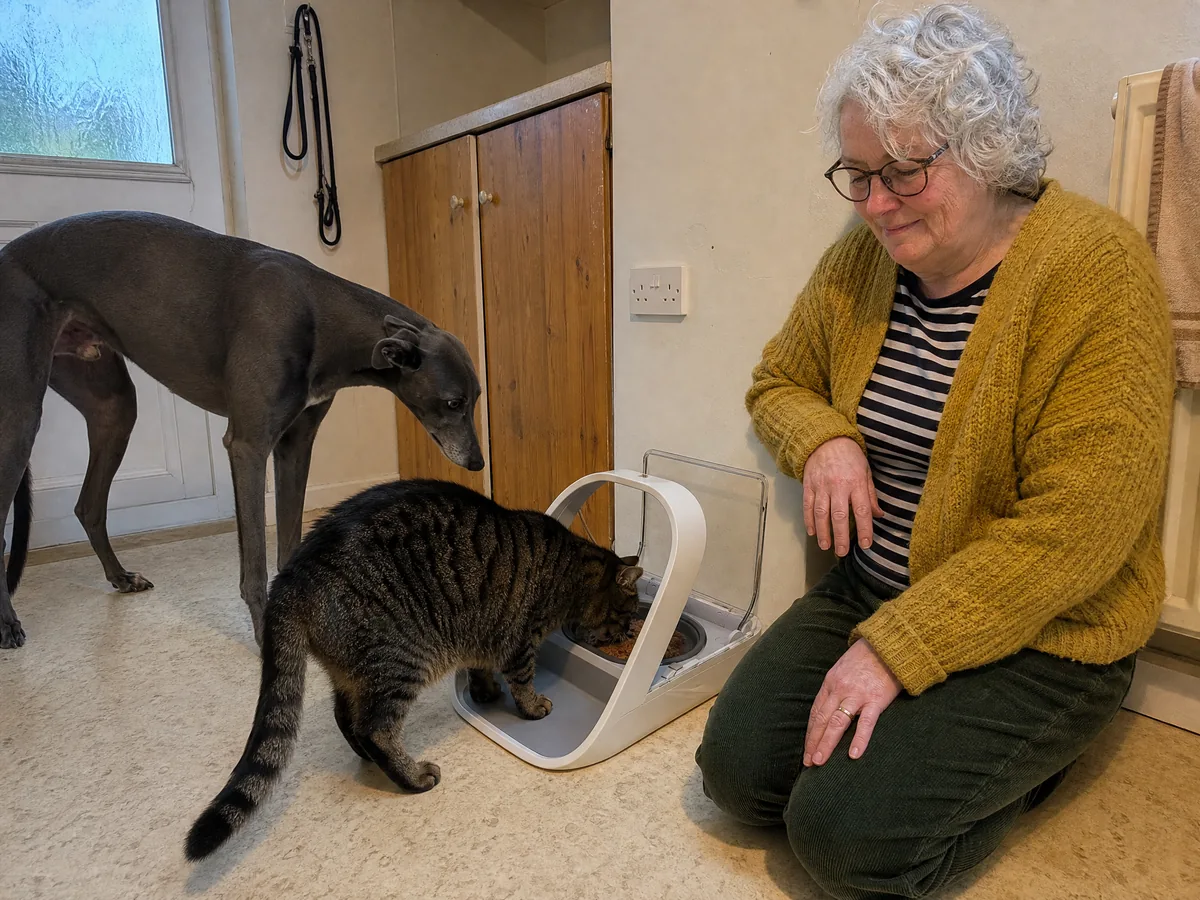
For three years Sid had his tea up on the fridge-freezer. It's the only surface in our bungalow that a greyhound can't reach by putting his front feet on the worktop, and Dai, my younger greyhound, has tested every other one.
Then in July the vet ran her hands down Sid's back legs, looked at me over her glasses and said the fridge-freezer had to go. He's eleven, his hips are stiffening, and a cat who has to jump 1.7 metres for his dinner will eventually decide he isn't hungry. So the bowl came down to the floor, and Dai looked at me as if I'd finally come to my senses.
That gave me two jobs for a feeder. Serve Sid twice a day without fail, even on Wednesday nights when I'm at choir. And keep a 34-kilo ex-racer with a nose like a crowbar out of it. From Thursday 3 September to Monday 19 October, 47 days in all, four of the best-known feeders in the UK lived with us in Swansea. Only one managed both, and it isn't the one with the cleverest timer.
- Opened for Sid's microchip and nobody else's: 60 meals out of 60 went into the cat
- Built-in scales showed what he actually ate, to the gram
- Lid closes between visits, so wet food doesn't crust over or draw flies
- Runs on four C batteries, so a power cut means nothing to it
- No timer: you put the food in, every single meal
- The Hub costs extra, and without it there's no app at all
- A long nose can reach over the back unless it stands against a wall
- Sid needed five days before he trusted the lid
Verdict: if a dog shares your kitchen, the clock isn't your problem. The open bowl is. The SureFeed was the only feeder Dai never ate from once it was pushed into a corner. If there's no dog in your house and you want meals served while you're out, the Petlibro Granary is the one to buy: 60 meals out of 60, on time, and not a single jam.
- Two rooms, two jobs
- The reliability month: 60 meals each
- The greyhound round
- The numbers after 47 days
- SureFeed Connect: a lid that only knows Sid
- Petlibro Granary: never late, never guarded
- Petkit Fresh Element Solo: tidy, and easy to shove
- Cat Mate C500: a cool box with a clock
- Which feeder for which house
- UK prices, and what I'd wait for
- Questions from the rescue group
Two rooms, two jobs
A feeder can fail you in two very different ways. It can jam, skip or serve at the wrong time, which is a machine problem. Or it can serve perfectly on time to the wrong animal, which in our house is a Dai problem. Testing both at once in one kitchen would have told me nothing, so I split the 47 days in two.
- Days 1 to 30, Thursday 3 September to Friday 2 October: the three timed feeders, the Petlibro Granary, the Petkit Fresh Element Solo and the Cat Mate C500, ran side by side in our conservatory with the door to the house shut. Two meals a day each, at half seven in the morning and half five in the evening. Sixty meals per feeder, and I weighed every portion that came out.
- The same 30 days in the kitchen: Sid ate all his real meals from the SureFeed, with both greyhounds wandering about as normal. Sixty meals of wet food, two 85 g pouches a day as the vet suggested.
- Days 31 to 47, Saturday 3 October to Monday 19 October: the greyhound round. The SureFeed went in the cupboard, and each timed feeder took a turn as Sid's only bowl in the same kitchen corner.
The Furbo camera from my summer test with the greyhounds finally earned its shelf. I pointed it at the feeding corner and watched back every kitchen meal, 94 in all, to see who actually ate it. Whenever a dog got there first, Sid had his share topped up by hand straight away. Nobody went hungry except, on principle, Dai.
The rules every tester on our team follows are on the how we test page. Ours had one extra: Sid had to be happy, or the feeder was out. The conservatory was the easy half to set up, so I'll start there.
The reliability month: 60 meals each
The conservatory has a cat flap in the garden door. Sid strolled in on day one, sniffed all three feeders and strolled out. Dai found the flap from the garden side that afternoon, got his head through it as far as his ears and then stood there, half in and half out, wondering where the rest of him had gone. That was the last time he tried.
Every evening I tipped each bowl onto a cheap kitchen scale and wrote the weight in a notebook. The Petlibro and the Petkit were set to 20 g of Sid's senior biscuits per meal, roughly 9 mm across, which sits under the 12 mm limit Petkit gives for its chute. The Cat Mate got wet food and its two ice packs, frozen overnight. Weighed portions went into Sid's allowance for the next day, so the month cost us nothing extra in food.
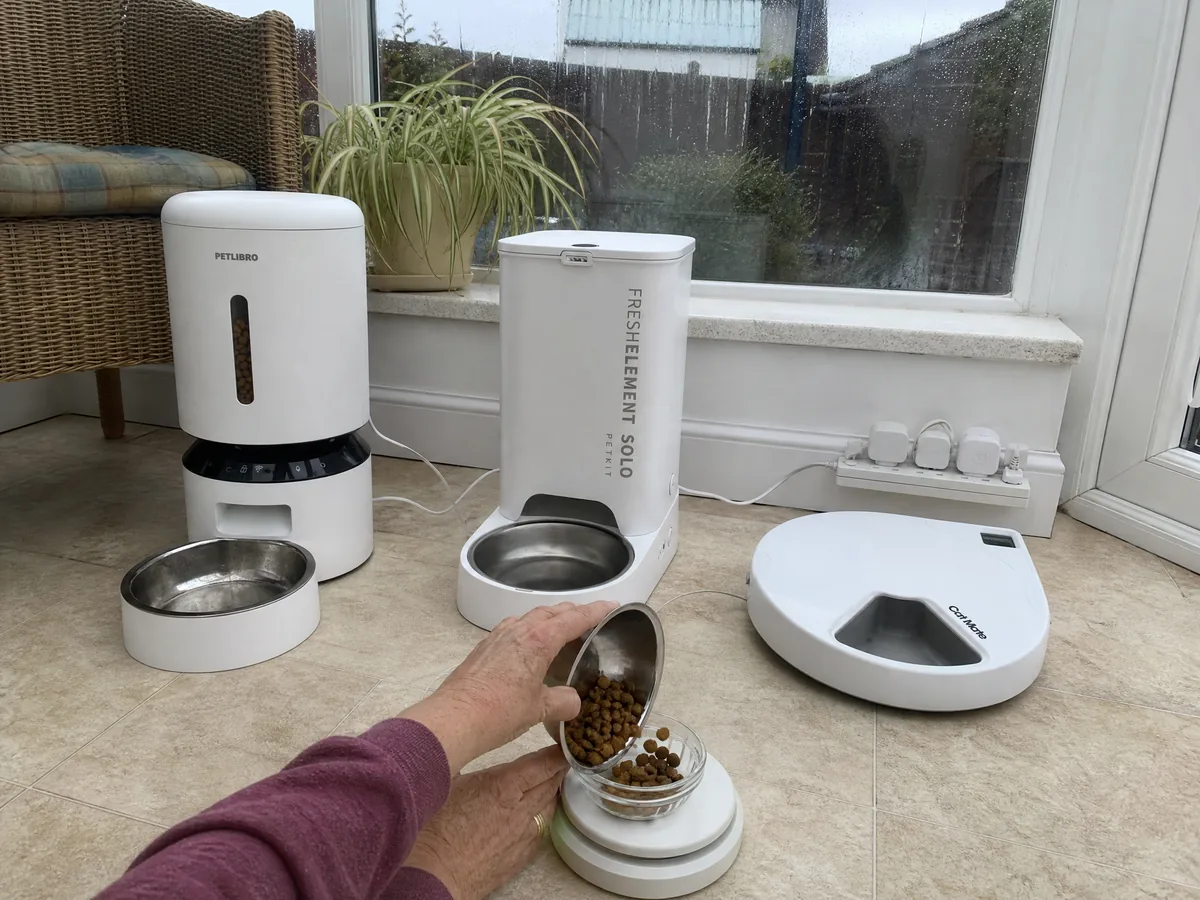
Two things happened that I hadn't planned. On Tuesday 22 September, day 20, the power went off along our road from ten to five until twenty-five to eight in the evening. Both electric feeders switched to their batteries and served the half five meal on time, though neither could talk to my phone until the lights came back. The Cat Mate runs on three AA batteries anyway, so it never noticed.
The other was Sunday 13 September, a warm one, when the conservatory hit 24°C by mid-afternoon. With frozen packs underneath, the wet food in the Cat Mate's evening compartment measured 13°C at half five. I ran the same compartment without packs the following Sunday, a cooler day, and it was already at 19°C. If you're serving wet food on a timer, those packs earn their place. With the machines checked, it was time to let the dogs have a go.
The greyhound round
Greyhounds aren't usually greedy dogs. They're grazers who'd rather nap than nag. Dai is the exception, because on the track he learned that food appears at set times and vanishes fast. A feeder with a motor is, to him, a very small racing kennel.
The Petlibro went first, on Saturday 3 October. Its motor whirrs for a second or two before the biscuits drop, and by the second evening Dai knew that whirr better than his own name. From the Monday he was lying curled round the feeder from about twenty past five, like a draught excluder with ears. Sid would come in from the hall, see him, and sit by the back door with the look of a man whose bus has gone without him.
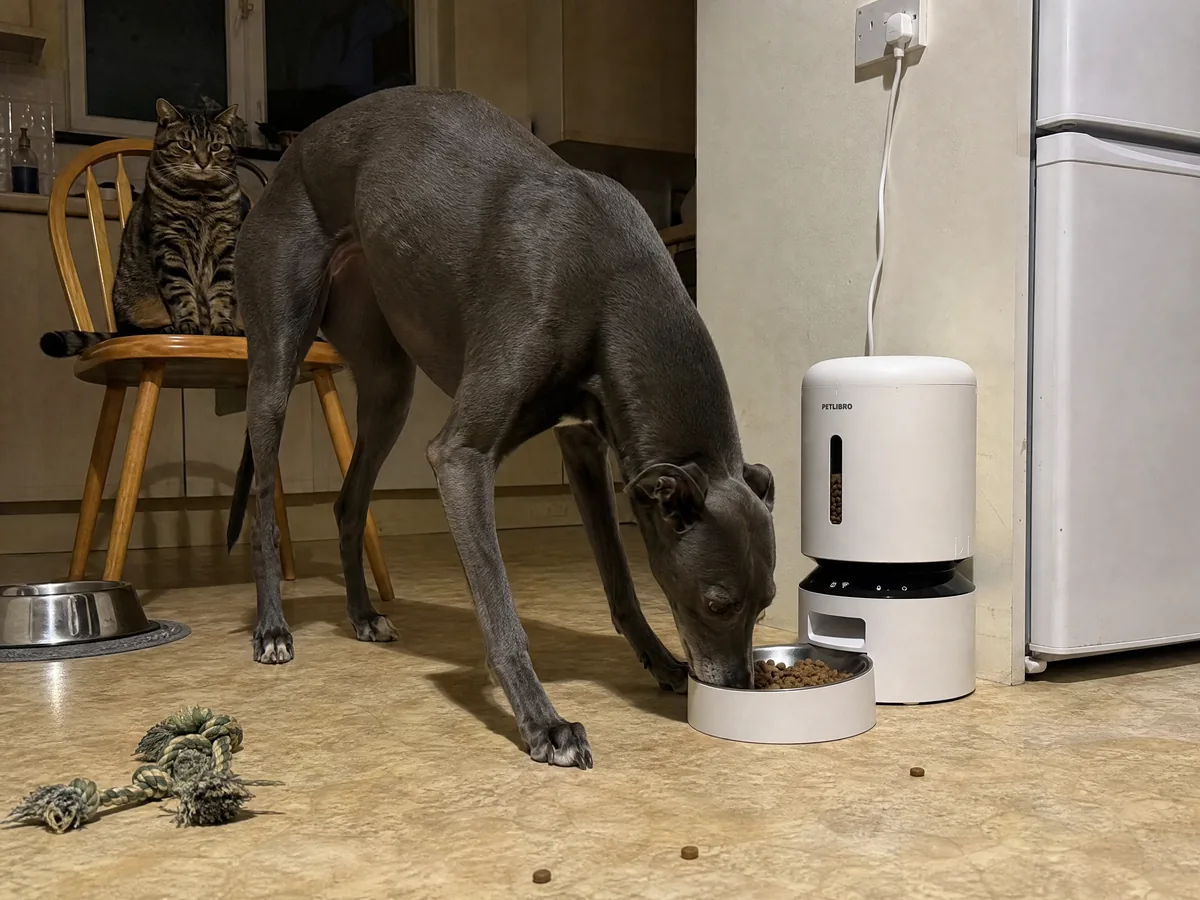
I tried moving the meal times about, ten minutes earlier one day and twenty minutes later the next. It didn't help. Dai simply lay down earlier and waited longer, because a retired racer has nothing but time. Mabel, my older girl, joined in exactly once, on a Sunday, and looked mildly embarrassed about it afterwards.
"He's not stealing, Jan. He's on a schedule. Same as the feeder." Glenys, my neighbour, watching the Furbo clips over a cup of tea on Thursday 8 October
The Petkit and the Cat Mate went the same way, with a twist each that I'll come to. The full picture looks like this.
The numbers after 47 days
The first three columns come from the conservatory month for the timed feeders. The SureFeed doesn't serve food on a schedule, so its "on time" figure means the lid opened for Sid at every meal I put down. The kitchen column counts meals Sid actually ate according to the Furbo footage.
| Feeder | UK price at the time of writing | Meals served on time (of 60) | Jams | Portion range for a 20 g setting | Kitchen meals eaten by Sid | Score |
|---|---|---|---|---|---|---|
| SureFeed Microchip Pet Feeder Connect | £155, Hub £85 extra | 60 | 0 | Filled by hand, weighed by the feeder | 60 of 60 | 8.8 |
| Petlibro Granary Smart Feeder | About £85 to £106 | 60 | 0 | 18.4 to 21.9 g | 3 of 12 | 7.6 |
| Petkit Fresh Element Solo | About £75 to £95 | 59 | 1 | 17.9 to 22.6 g | 2 of 10 | 7.0 |
| Cat Mate C500 | About £40 to £55 | 59 | 0 | Wet food, filled by hand | 4 of 12 | 6.6 |
Read the two halves together and the answer is plain. Three feeders proved they can keep time. Only one proved it can keep a dog out, and in a house like mine that's the half that decides whether the cat eats.
SureFeed Connect: a lid that only knows Sid
The SureFeed Microchip Pet Feeder Connect doesn't do timings at all. It's a white plastic hood over a bowl with a clear lid, and the lid flips open only when it reads the microchip of a cat you've registered. Sid's chip went in at a rescue centre a decade ago and it's still the most useful thing about him, apart from his purr.
Learning his chip took one visit. Trusting the lid took Sid five days, which we did in the last week of August so it wouldn't count against the test. The app has a training mode that leaves the lid open, then closes it a little more each stage, and I needed every stage. On day two of training Sid backed out so fast he sat in the water bowl.
Over the 30 days the feeder logged 268 visits from Sid. The lid opened first time on 261 of them, and on the other 7 he only had to back out and step in again. It never opened for a dog. Dai shoved his nose into the tunnel 41 times in the first fortnight by my count from the Furbo, then gave up in a sulk.
There was one hole in the plan, and it was at the back. On Thursday 10 September, day 8, the camera caught Dai reaching over the top of the hood while the lid was up and Sid was eating, and helping himself to two long licks. I pushed the feeder into the corner with its back flat against the wall, and that was the end of it. Sure Petcare sells a rear cover for £20 if your kitchen hasn't got a handy corner.
The catch is the cost and the effort. You need the Hub for the app, which brings the total to £240, and you fill it yourself, morning and evening. On choir Wednesdays I filled it at half five before I left, and Sid helped himself whenever he fancied. If you need meals served while you're away for days, the next feeder is the better tool.
Petlibro Granary: never late, never guarded
On reliability alone the Petlibro Granary Smart Feeder was the best machine here. Sixty meals out of 60, none more than a minute late, no jams, and the tightest portions of the two dry feeders, 18.4 to 21.9 g for a 20 g setting. The 5-litre hopper with its desiccant pack kept a month of Sid's biscuits crisp, and the app took me about ten minutes to set up.
The power cut on day 20 was its best moment. Three D batteries in the base kept it going, and the half five meal dropped in the dark while I was hunting for candles. I only found out from the notebook, because the app had nothing to tell me until the Wi-Fi was back.
In the kitchen it simply had no defence. A tall cylinder with an open bowl at the front is, for a greyhound, a fruit machine that pays out twice a day and rings first. Sid got 3 of 12 meals, Dai had 8 and Mabel 1. If your cat lives with a dog, it needs a cat-only room or a feeding station that the dog physically can't fit into. Without one, it isn't the answer.
Petkit Fresh Element Solo: tidy, and easy to shove
The Petkit Fresh Element Solo is the neatest-looking of the four, a slim white box with a stainless steel bowl that goes in the dishwasher. The 3-litre hopper holds about a fortnight's food for one cat, and the app shows each meal as it drops. It has a battery backup too, and it served right through the power cut.
Its one jam came on Saturday 19 September, day 17, at the evening meal. I'd opened a new bag that morning and a pair of biscuits had baked together into one fat lump, which wedged at the top of the chute. To its credit, the app sent a blocked-outlet alert at 5:31, so I knew within a minute and cleared it with a teaspoon. A feeder that tells you it failed is much better than one that fails quietly.
In the greyhound round it lost on weight. It's light enough for Dai to push the whole unit along the lino with his nose, which he did most mornings until the bowl sat where he liked it. Sid got 2 of 10 meals, Dai 6 and Mabel 2. Good feeder, wrong house.
Cat Mate C500: a cool box with a clock
The Cat Mate C500 is the old-school one: a flat round tray with five compartments under a lid that turns to open one meal at a time. No Wi-Fi, no app, three AA batteries and a little LCD timer. It's the only one of the four built for wet food on a schedule, thanks to those ice packs.
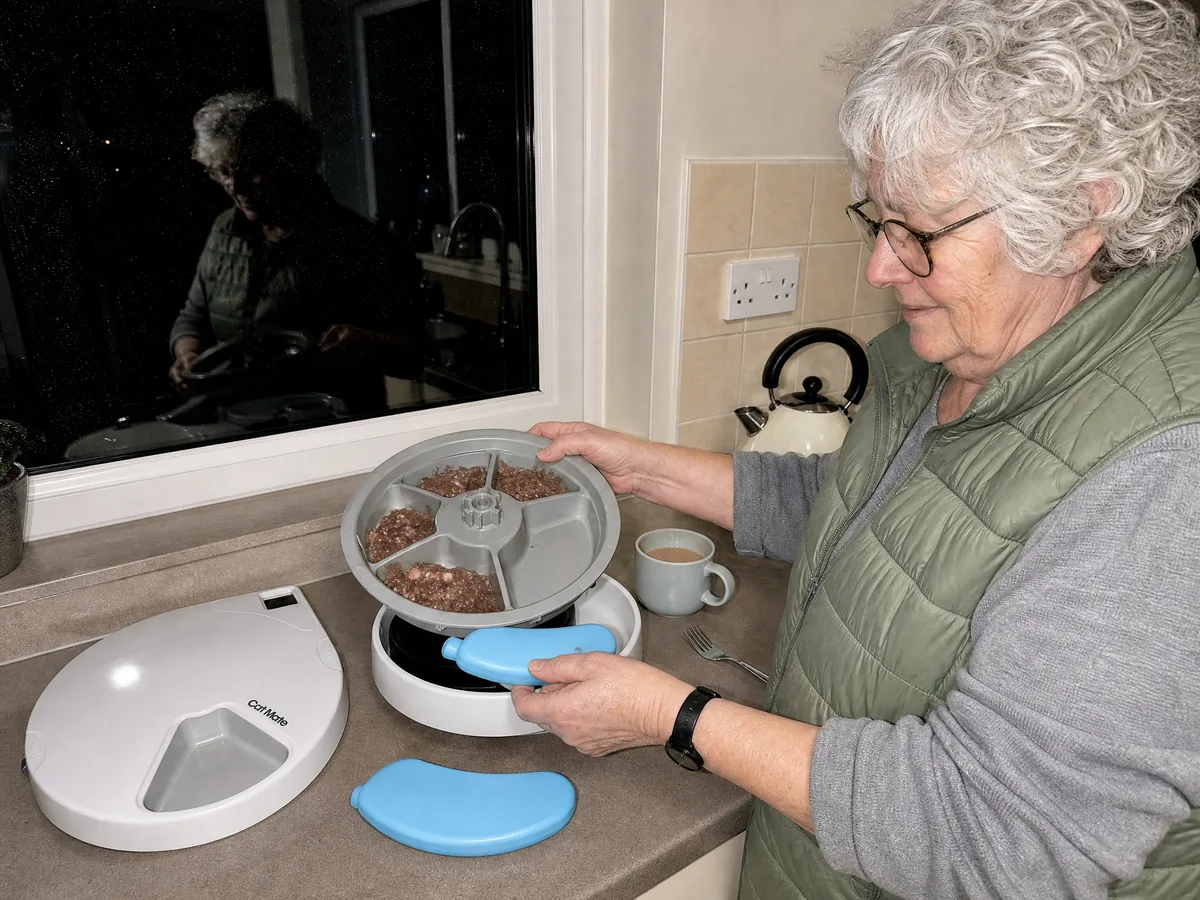
Its missed meal was my fault, and I'd rather say so. Five compartments at two meals a day means refilling every other day, 15 times in the month. On the evening of Monday 14 September I refilled it late, forgot to turn the tray back to its starting point, and on Tuesday morning the lid opened onto an empty compartment. The machine did what I told it. I just told it wrong. The clock also ran fast, by four minutes after 30 days, which is no tragedy but worth knowing.
In the kitchen the turning lid gave a little protection, because only one meal is ever open. Dai still got that one meal 7 times out of 12. Sid ate 4, and Mabel 1. Being low and light, it also travelled: on Saturday 17 October I found it 1.3 metres from where I'd left it, under the kitchen table, empty and very clean.
Which feeder for which house
One combination I can't vouch for from this test, but which a few people in the rescue group swear by: a timed feeder inside a room with a cat flap fitted to the inside door. That's the conservatory trick from our first month, and if you've got a room to spare, it costs a lot less than a Hub.
UK prices, and what I'd wait for
We bought the SureFeed and the Hub from Sure Petcare's own shop, the Cat Mate from Pets at Home, and the Petlibro and Petkit from Amazon.co.uk. Prices below were checked when I wrote this, and the second figure is what I'd be glad to pay:
- SureFeed Microchip Pet Feeder Connect: £155, plus £85 for the Hub, or £240 for the pair. If you already have a Hub for a SureFlap Connect cat flap, the same one works. Good under £210 for both.
- Petlibro Granary Smart Feeder: listed at £105.99 on Petlibro's UK shop, often down to about £85 with a code. Good under £80.
- Petkit Fresh Element Solo: about £75 to £95 depending on the seller. Good under £70.
- Cat Mate C500: about £40 to £55. Good under £40.
Pet tech often drops for Black Friday on 27 November, the Petlibro especially, though I can't promise any of them will. As for us, the SureFeed is back in its corner, Sid is eating at floor level without a fight, and the Petlibro has gone to my daughter in Mumbles, whose two cats have never met a greyhound.
The litter tray side of life with Sid is in my PETKIT Pura Max 2 review, and the rest of my work is in the pets section. What I'm testing next is on our tests in progress page.
Questions from the rescue group
How do I stop my dog eating the cat's food?
Put the cat's food where the dog physically can't reach it. In our 47-day test, a microchip feeder that opens only for the cat (the SureFeed Connect) was the only one our greyhound never ate from, once it stood with its back against a wall. A cat flap fitted to an inside door works too, if you have a room to spare. Raising the bowl rarely works with tall dogs.
Can a microchip cat feeder work with two cats?
Yes. You register each cat's chip, or use the collar tags Sure Petcare sells for cats without one, and the lid opens only for the cats you've added. You can also block one cat from a feeder meant for the other, which is handy if one is on a prescription diet.
Do automatic feeders work in a power cut?
The ones with a battery backup do. On our day-20 power cut of 2 hours 45 minutes, the Petlibro Granary and the Petkit Fresh Element Solo both served their evening meal on batteries, but neither could send alerts until the Wi-Fi came back. The Cat Mate C500 and the SureFeed run on batteries all the time.
Which automatic feeder is best for wet cat food?
For timed wet meals, the Cat Mate C500 with its two ice packs kept food at 13°C on a 24°C day in our test. If someone is home to fill it, the SureFeed Connect keeps wet food under a closed lid between visits, which stops it drying out and keeps flies and other pets off.