
Furbo 360 review: a treat-tossing camera meets two retired greyhounds and a cat
Six weeks, 26 times out of the house and one tabby who sat in front of the lens. What the Furbo 360 showed us about an anxious greyhound, and what Dog Nanny really costs.
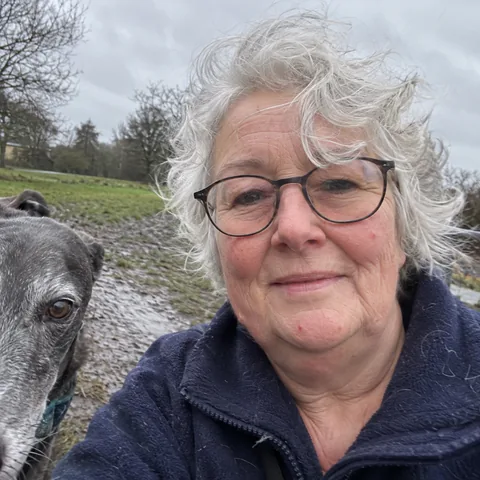 By Janice Pugh, pet tester, two retired greyhounds and a tabby
Tested in Swansea · 12 August 2026 · 12 min read
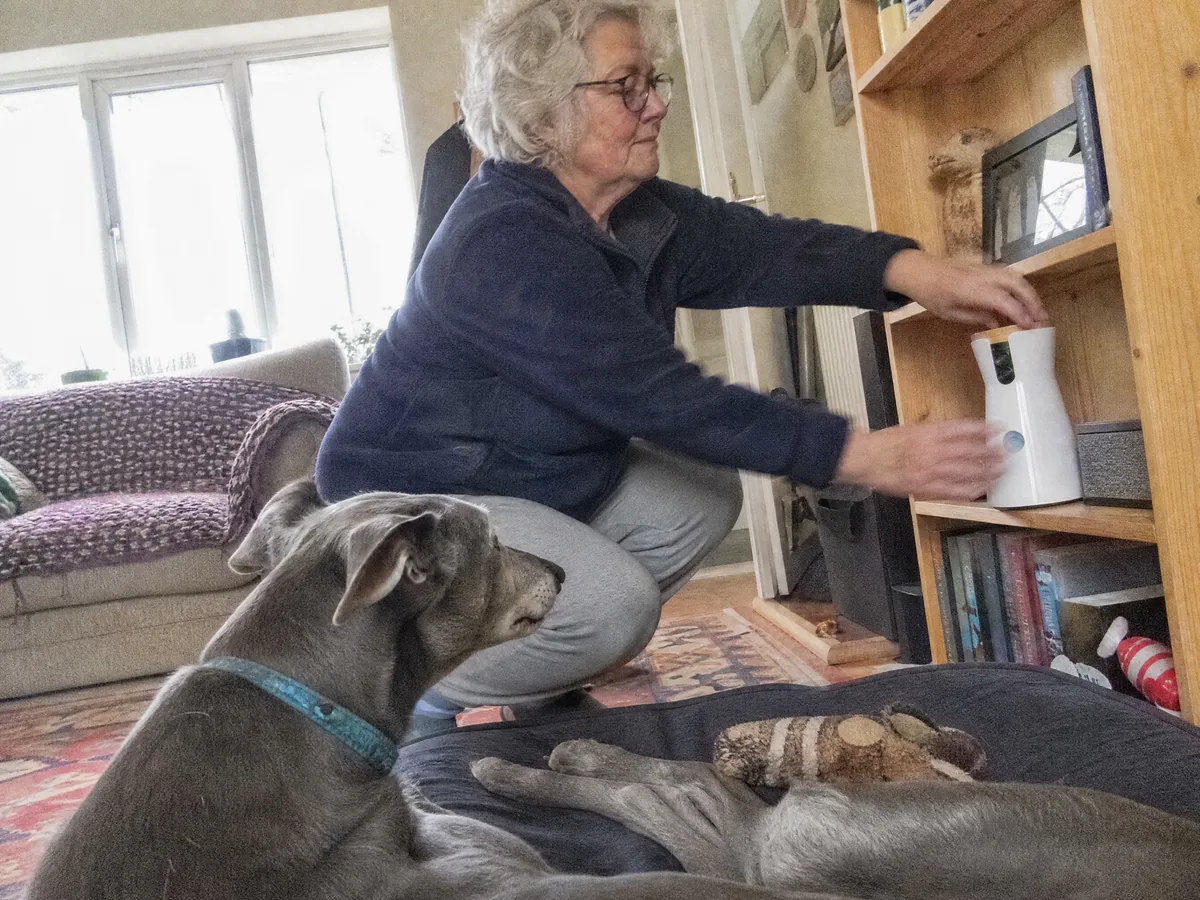
I have told at least forty families at the rescue that greyhounds are the easiest dogs to leave at home. They sleep eighteen hours a day, they rarely bark and they'd rather lie on a duvet than chew your shoes. All true. Mabel, my seven-year-old, is proof of it.
Dai is the exception. He's four, he came off the track eighteen months ago, and he has never quite believed that I'm coming back. My neighbour Glenys mentioned, very gently, that she sometimes hears "a sort of singing" through the wall on Wednesday nights, while I'm at choir. So the dog who doesn't bark was howling, and I had no idea for how long.
That's why I tested the Furbo 360 from 1 July to 11 August. Six weeks, 26 times out of the house, two greyhounds, one tabby called Sid who runs our bungalow, and one simple rule I apply to every pet gadget: if Sid can knock it over, open it or outwit it within a week, it doesn't get recommended.
Furbo 360° Dog Camera
About £109 to £199 depending on the offer, plus optional Furbo Dog Nanny at around £6.99 a month, at the time of writing
- Up and running in 12 minutes, quiet when it turns
- No jams in 64 tosses with small round biscuits
- Colour night vision clear enough to see Dai's ears
- Showed us exactly how long Dai paced after we left
- Can't tilt down, so dogs on floor beds vanish up close
- Seagulls on the roof set off sound alerts
- Crying alerts and recordings need Dog Nanny
- No card slot and no battery, a power cut means no picture
Our verdict: a well made, genuinely useful camera for anyone who worries about a dog left alone. Place it lower than you think, toss treats onto a rug rather than a slippery floor, and try Dog Nanny for its free month before deciding if you need it.
Why a greyhound house is a tricky test
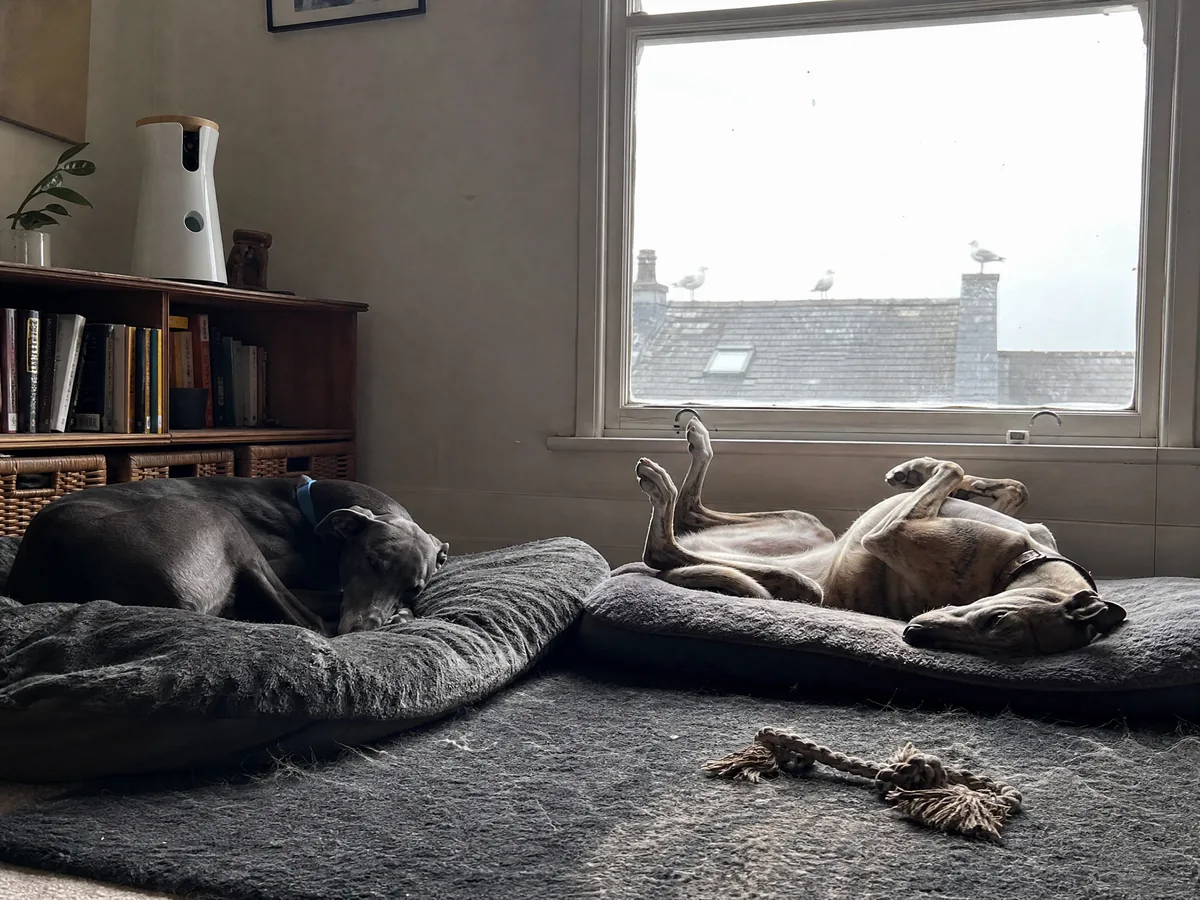
Most dog cameras are built for dogs who stand about and bark at the window. Greyhounds do neither. Mine spend their day flat out on two big floor beds, often upside down with their legs in the air, which the rescue crowd calls "roaching". They're long, they're low and they don't move for hours.
That matters because the Furbo 360 turns all the way round but can't tilt up or down. I first put it on the sideboard, about 85 cm off the floor, facing the beds. From there, the dogs lying closest to it were half out of the bottom of the picture. I moved it to a low bookshelf at about 50 cm, a bit further back, and suddenly I could see both beds, the back door and the start of the hallway where Dai paces.
Placement sorted, the next challenge had whiskers.
Setup, and Sid's first attempt
Setup took 12 minutes: power lead in, Furbo app open, a Bluetooth handshake, then onto the home network. The camera only speaks 2.4 GHz, and our broadband router shouts both bands under one name, so the app failed to connect twice before I switched my phone to the 2.4 GHz network on its own. After that it went straight through.
Sid found it within the hour. He sniffed it, rubbed his cheek on it and then, on day two, pushed it about four centimetres along the shelf with his head while I watched on my phone from the charity shop. He couldn't tip it over. On our kitchen scale the Furbo weighed 0.91 kg with a handful of biscuits inside, which is heavy enough to annoy a cat but not heavy enough to be immovable. A square of rubber drawer liner underneath stopped the sliding for good.
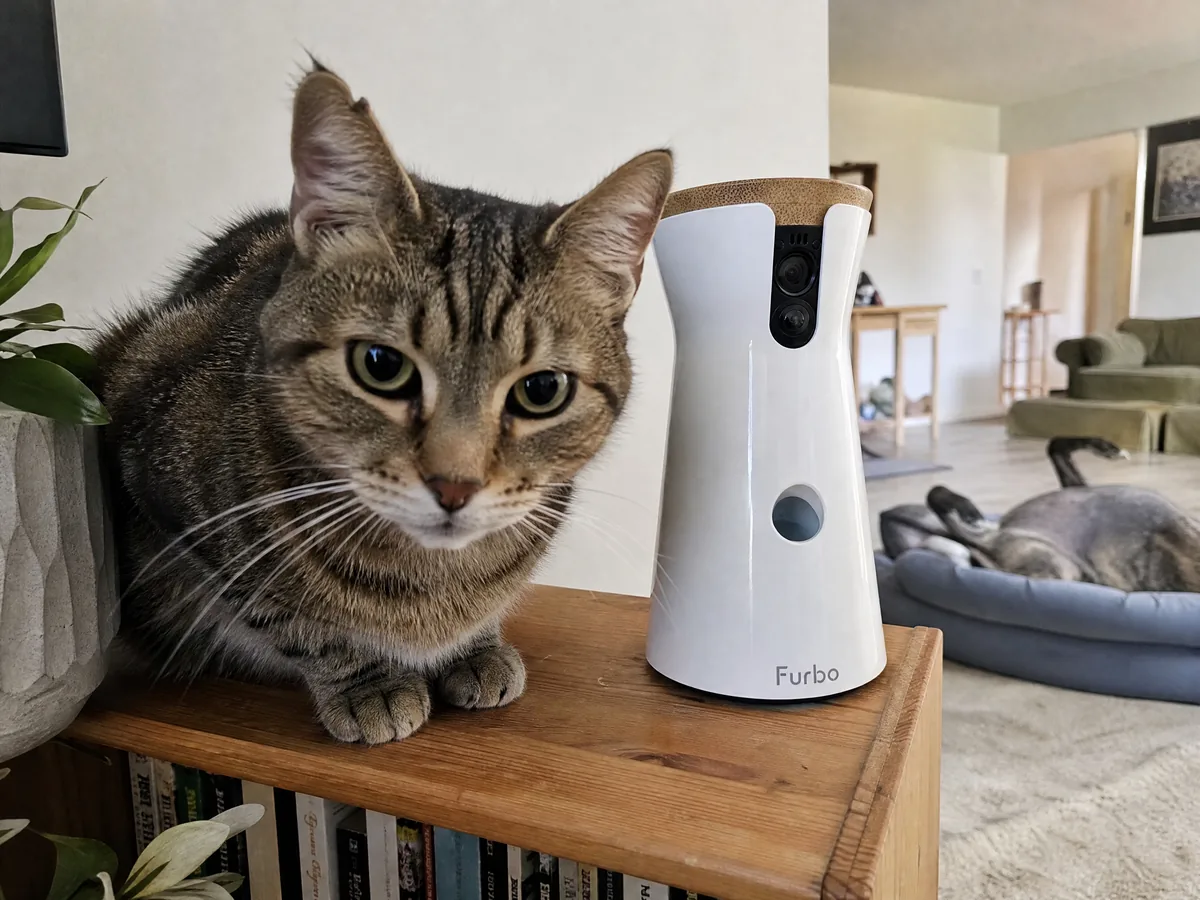
Sid's second tactic was better. Every time the camera turned or made a sound, he sat directly in front of the lens and stared into it. On a fair few afternoons my view of the living room was about 70% tabby. The Furbo passed my week-one rule on a technicality. Sid wasn't done with it, but he hadn't beaten it.
The treat toss, measured on a laminate floor
The treat toss is why most people buy a Furbo. You swipe in the app, it plays a little chime, and a treat shoots out. Over six weeks I sent 79 treats flying over the six weeks and measured where the first 40 landed with a steel tape.
| What we tested | Result |
|---|---|
| Distance on laminate, from the shelf at 50 cm | 1.1 to 2.6 m, average 1.9 m |
| Jams with small round biscuits, about 1 cm | 0 in 64 tosses |
| Jams with soft liver treats cut into cubes | 3 in 15 tosses |
| Time from swipe to treat | about 1 to 2 seconds |
| Days until Dai recognised the chime | 4 |
Every jam came from the liver cubes, which are soft enough to smear inside the chute. Small, firm, round biscuits about a centimetre across never failed once, so that's all I use now, with the app's size setting on small to match.
Here's the thing nobody warned me about. Greyhounds are built to chase a moving object, and a treat skidding across laminate is a moving object. The first time I tossed one, Mabel launched off her bed as if the traps had just opened, and her back legs went sideways on the laminate. She was fine. I wasn't. From then on I pointed the camera so treats landed on the big rug in front of the fire, where they stop dead and dogs keep their footing.
The picture itself is good. Daytime video at 1080p is sharp and the colours look natural, and the colour night vision showed Dai clearly at 11 p.m. when I was on the late bus home from choir. The 4x zoom goes soft quickly, so it's for checking ears and tails, not reading anything. But the picture wasn't the point. What it showed me was.
What the camera showed me about Dai
On the first Wednesday I watched Dai from the church hall during the tea break. He'd paced the hallway for 22 minutes after I left, lain down with his nose against the front door, got up, paced again. Mabel slept through all of it, legs in the air. The "singing" Glenys heard was a proper greyhound roo, a long, wobbly howl that I could hear through the Furbo's microphone perfectly well.
I logged every absence. For each one I noted how long Dai paced before settling. In the first week, the average was 19 minutes. I took the numbers to Carys, the behaviourist who volunteers with our rescue, and her advice was simple: stop making leaving an event, give him a long chew as I put my coat on, and come home just as quietly.
"The camera won't calm him. It'll just tell you if what you're doing calms him." Carys, our rescue's behaviourist, looking at my notebook in the car park
She was right. By the last two weeks, Dai's average pacing time was down to 6 minutes, and on 4 of my last 8 absences he didn't pace at all. Carys's routine did the work. What the Furbo gave me was proof it was working, and that kept me at it when I'd normally have given up after a week.
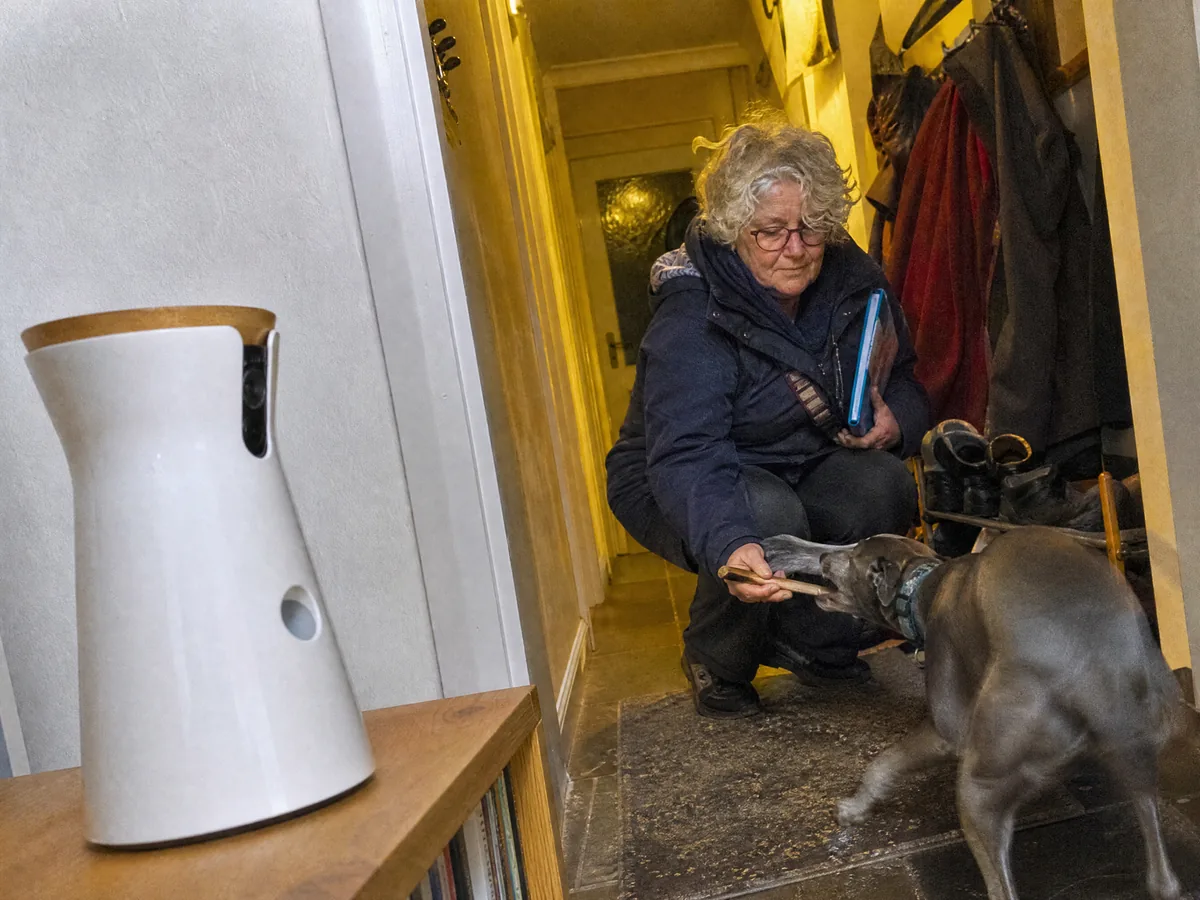
One more lesson. I tried talking to him through the speaker in week one. Mabel ignored me completely. Dai tilted his head and went to look behind the settee for me, then paced harder. The chime that comes before a treat worked much better than my voice, so I stopped calling in. Some dogs love hearing you. For a worrier like Dai, my voice coming out of a shelf was a promise I wasn't there to keep, so watch your own dog's first few reactions closely.
Alerts: the gulls of Swansea Bay
The basic sound alerts are free. In week one, the Furbo sent 31 of them, and I checked every clip. 19 were the dogs, mostly Dai's rooing. The other 12 were: herring gulls on the roof (7), the washing machine on spin in the kitchen (3) and a doorbell on the telly (2). Anyone who lives near the sea knows those gulls. Now my phone knows them too.
Turning the sensitivity down one step and leaving the telly off cut the false alerts to about one every other day. The gulls still get through occasionally. I've made my peace with it.
During the free Furbo Dog Nanny trial I also got the smarter alerts. The dog crying alert was the most useful one for us, because it picked up Dai's whining before it became a full roo. Person alerts told me when Glenys popped in to let the dogs into the garden. The daily highlight video was lovely, and slightly embarrassing, because it's mostly two greyhounds asleep.
Dog Nanny and the real cost in pounds
The camera's list price in the UK is around £199, but it's on offer so often that we've seen it between roughly £109 and £150 on Amazon.co.uk and Furbo's own shop at the time of writing. Furbo also sells bundles tied to a Nanny plan, so read the listing before you pay. The version you want, if you don't plan to subscribe, says the core features work without a subscription.
Without Dog Nanny you keep live view, the 360° turning, two-way audio, treat toss and basic sound alerts. With it you add crying, person and activity alerts, cloud recordings, the highlight video and emergency sound alerts, such as a smoke alarm going off. At the time of writing it's about £6.99 a month or £69 a year, and the camera comes with a 30-day trial.
| Cost over time (camera at £129) | Without Nanny | With Nanny yearly |
|---|---|---|
| Year 1 | £129 | £198 |
| After 2 years | £129 | £267 |
| After 3 years | £129 | £336 |
I let the trial run out and didn't renew. For me, live view and treats covered what I needed once I'd learned Dai's pattern. If your dog has a real anxiety problem you're working on, or you want a record of what happened while you were out, Nanny for a few months is money well spent. You can drop it afterwards.
Two practical things. Without Nanny, nothing gets recorded anywhere, because there's no card slot. And there's no battery inside. When our broadband dropped for an hour one Saturday, the app just showed a spinning wheel.
Specs at a glance
| Spec | Furbo 360° Dog Camera |
|---|---|
| Video | 1080p, 4x digital zoom, colour night vision |
| View | 132° lens that turns a full 360°, no tilt |
| Treats | Hopper for about 100 small dry treats, around 1 cm |
| Audio | Two-way speaker and microphone |
| Connection | 2.4 GHz Wi-Fi, Bluetooth for setup |
| Power | USB mains adapter, no battery |
| Size | About 12.5 x 12.5 x 22 cm |
| Storage | Cloud only, with Furbo Dog Nanny |
Who should get one, and who shouldn't
And cat owners, a word. The Furbo is designed for dogs, and Sid treated it as an audience rather than a feeder. If your cat is your main worry, the thing that tells you most about their health is usually the litter tray, and I've been testing a self-cleaning one on Sid since the middle of July. You can read how that went in our PETKIT Pura Max 2 review.
Alternatives
- Furbo Mini: a cheaper, smaller camera with a fixed wide view and no treat toss. A good second camera for a hallway.
- Petcube Bites 2 Lite: another treat tosser, with a wide fixed lens rather than a turning one. Worth comparing if you prefer a different app.
- An ordinary indoor security camera: often well under £40, many record to a card, and some tilt as well as turn. You lose the treats and the dog-specific alerts.
We test pet kit the way we test everything: weeks in a real home, every result logged, and the costs you'll actually pay, as set out on our how we test page. More tested kit for pets is in our reviews.
Six weeks on, the Furbo lives on the low bookshelf, on its square of drawer liner. Glenys says the Wednesday singing has mostly stopped. Sid still sits in front of the lens, because some things no routine will ever fix.
Questions people ask
Does the Furbo 360 work without a subscription in the UK?
Yes, the standard version does. Live view, the 360° turning, two-way audio, treat toss and basic sound alerts all work without Furbo Dog Nanny. Check the listing, because some cheaper bundles are tied to a Nanny plan.
How much is Furbo Dog Nanny in the UK?
At the time of writing, around £6.99 a month or £69 a year. The camera comes with a 30-day free trial, which is enough to see whether the extra alerts and recordings are worth it for you.
Does the Furbo work on 5 GHz Wi-Fi?
No, it needs 2.4 GHz. If your router uses one name for both bands, connect your phone to the 2.4 GHz network on its own during setup, or split the bands in the router settings.
What treats can you put in a Furbo?
Small, firm, round dry treats around 1 cm across went through 64 times without a single jam. Soft, cut-up liver treats jammed 3 times in 15.