
PETKIT Pura Max 2 review: a self-cleaning litter box in a house with greyhounds
One tabby, two greyhounds who treated the old tray as a snack bar, and a switch from wood pellets. 40 days with the PETKIT Pura Max 2, and what it really costs in pounds.
 By Janice Pugh, pet tester, two retired greyhounds and a tabby
Tested in Swansea · 28 August 2026 · 12 min read
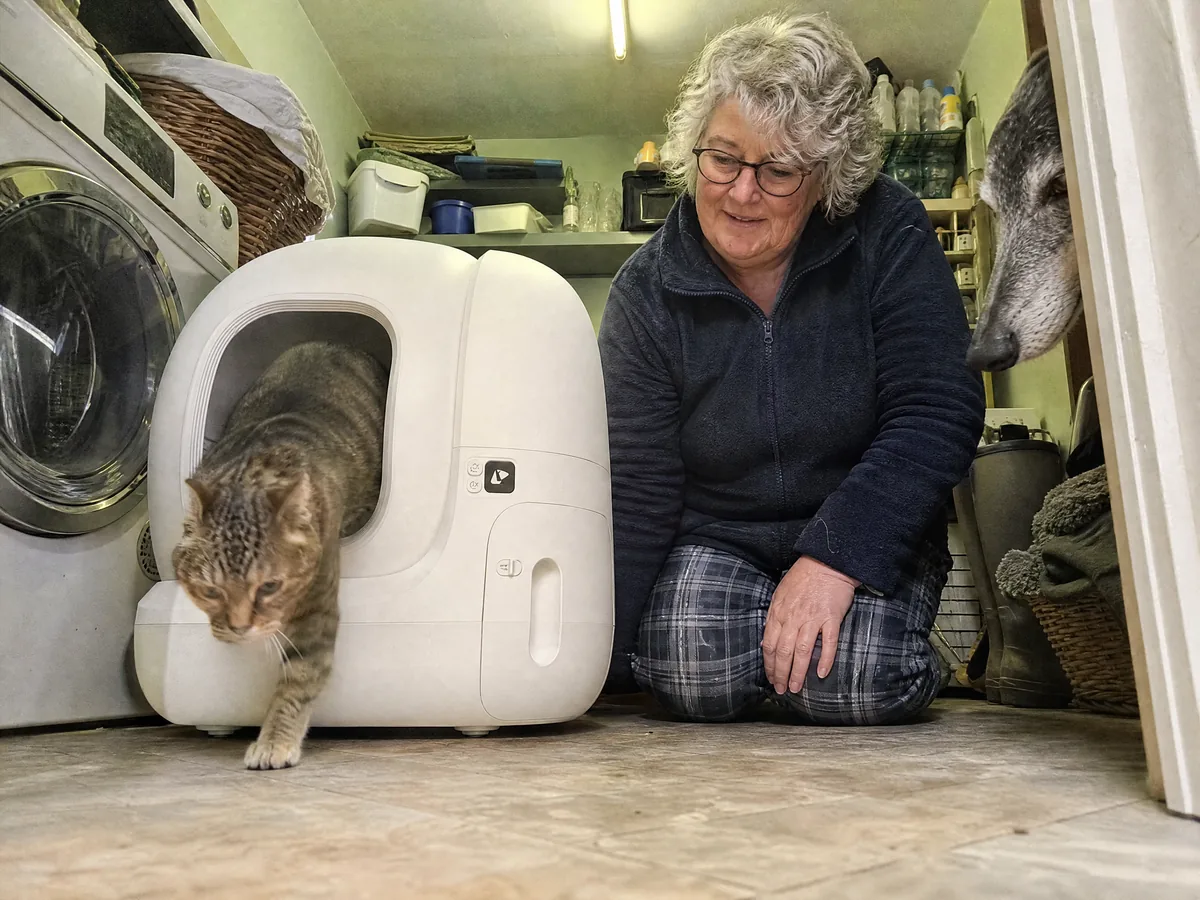
Ten past six on a Tuesday morning in June, and there was a crunching noise coming from the bathroom. I knew what it was before I opened the door. Dai, my younger greyhound, had squeezed his long nose through the gap I leave for the cat and was helping himself to the contents of the litter tray.
If you've never lived with dogs and a cat together, I'm sorry for that sentence. If you have, you're nodding. Dogs think a litter tray is a snack bar, and a greyhound's nose is long enough to reach most of them. For three years I'd kept our tray behind a wedged bathroom door, scooped it twice a day and still lost the odd battle.
So when a self-cleaning tray came up for testing, I didn't just want to know whether it saved scooping. I wanted to know if it could close the snack bar for good. I lived with the PETKIT Pura Max 2 from 17 July to 25 August, 40 days in total, with Sid, our eleven-year-old tabby, and Mabel and Dai, who were not consulted.
PETKIT Pura Max 2 (UK, with N50 odour eliminator)
About £360 to £500 depending on the retailer, around £440 on Amazon.co.uk, at the time of writing
- Waste drawer emptied every 11 days on average with one cat
- Nothing left in the drum for the dogs to find
- Drum stopped instantly for a hand and a greyhound nose
- Weight log caught a secret second breakfast
- Needs clumping litter, so wood pellet users must switch
- 62 x 54 cm footprint, too big for many bathrooms
- 20 cm step in, a stretch for stiff older cats
- 2.4 GHz Wi-Fi only, liners are an ongoing cost
Our verdict: a well made, safe self-cleaning tray that ended the scooping and the dog raids in our house. Plan the switch to clumping litter before the machine arrives, measure your space, and give a set-in-its-ways cat a few days.
The two problems I wanted it to solve
The first was obvious: scooping. With one cat, it's not a huge job, but it's twice a day, every day, and if I'm at the rescue all Saturday it waits for me. The second was the dogs. Any tray where waste sits for a few hours is a temptation, and I'd tried hooded trays, a top-entry tray Sid refused to use, and the wedged door.
A drum-style self-cleaning tray solves both in theory. Minutes after the cat leaves, the waste is sifted out into a sealed drawer in the base. Nothing sits around. Nothing for a nose to find. That was the theory, anyway. There was a catch, and it was in the bag of litter on my utility room shelf.
The catch for UK cat owners: wood pellets
Sid had used wood pellet litter all his life, the cheap, bulky kind you buy in big bags from Pets at Home. Lots of British households use it. It doesn't clump, it breaks down to sawdust, and the Pura Max 2 can't do anything with it. Like every drum tray, it needs clumping litter: clay (bentonite), tofu or a mix. Crystal and silica litters are out, and so are pellets.
That meant Sid faced two changes at once, a new litter and a strange new box, and cats hate change in pairs. So I split them up. Here's the plan that worked for us, day by day.
- Days -7 to -1, before the machine arrived: I mixed fine clumping clay into his old tray, a quarter at first, then half, then all of it. He sniffed it suspiciously on day -6 and then carried on.
- Day 1: the Pura Max 2 went into the utility room next to the old tray, automatic cleaning off, with a scoop of his used litter in the drum so it smelled like his.
- Days 1 to 3: I ran the cleaning cycle by hand from the app, only when Sid was out in the garden, so he never heard it turn while he was near it.
- Day 4: Sid used it at 5:12 a.m., just before demanding breakfast, which is the most Sid thing he could have done. I turned automatic mode on that afternoon with a seven-minute delay.
- Day 8: the old tray went out to the shed. He never looked for it.
What the Pura Max 2 is, in numbers
It's a big white drum on a base. The cat walks in through a wide opening at the front. Once the cat has left and a delay you choose has passed, the drum turns slowly, the litter runs through a sieve, the clumps drop into a 7-litre drawer lined with a bag, and the clean litter settles back. The version sold in the UK comes with PETKIT's N50 odour eliminator block, and the Pura Air spray is an optional extra.
| Spec | PETKIT Pura Max 2 |
|---|---|
| Size | 62 x 53.8 x 55.2 cm |
| Drum | 76 litres inside |
| Waste drawer | 7 litres, up to 15 days with one cat according to PETKIT |
| Entry height | 20 cm |
| Cats | From 6 months and 1.5 kg |
| Litter | Clumping only: clay, tofu or mixed. No crystal, silica or wood pellets |
| Safety | Multiple sensors, including infrared, weight and anti-pinch |
| Connection | 2.4 GHz Wi-Fi and PETKIT app |
| Price at the time of writing | About £360 to £500 |
Setup took me 18 minutes. It comes nearly assembled, and after the Furbo taught me about our router, I split the Wi-Fi bands before I started, since the Pura Max 2 only talks to 2.4 GHz. The size is the thing to check first. It needs 62 by 54 cm of floor plus room above, which ruled out our small bathroom completely. The utility room, beside the tumble dryer, was the only place it fitted.
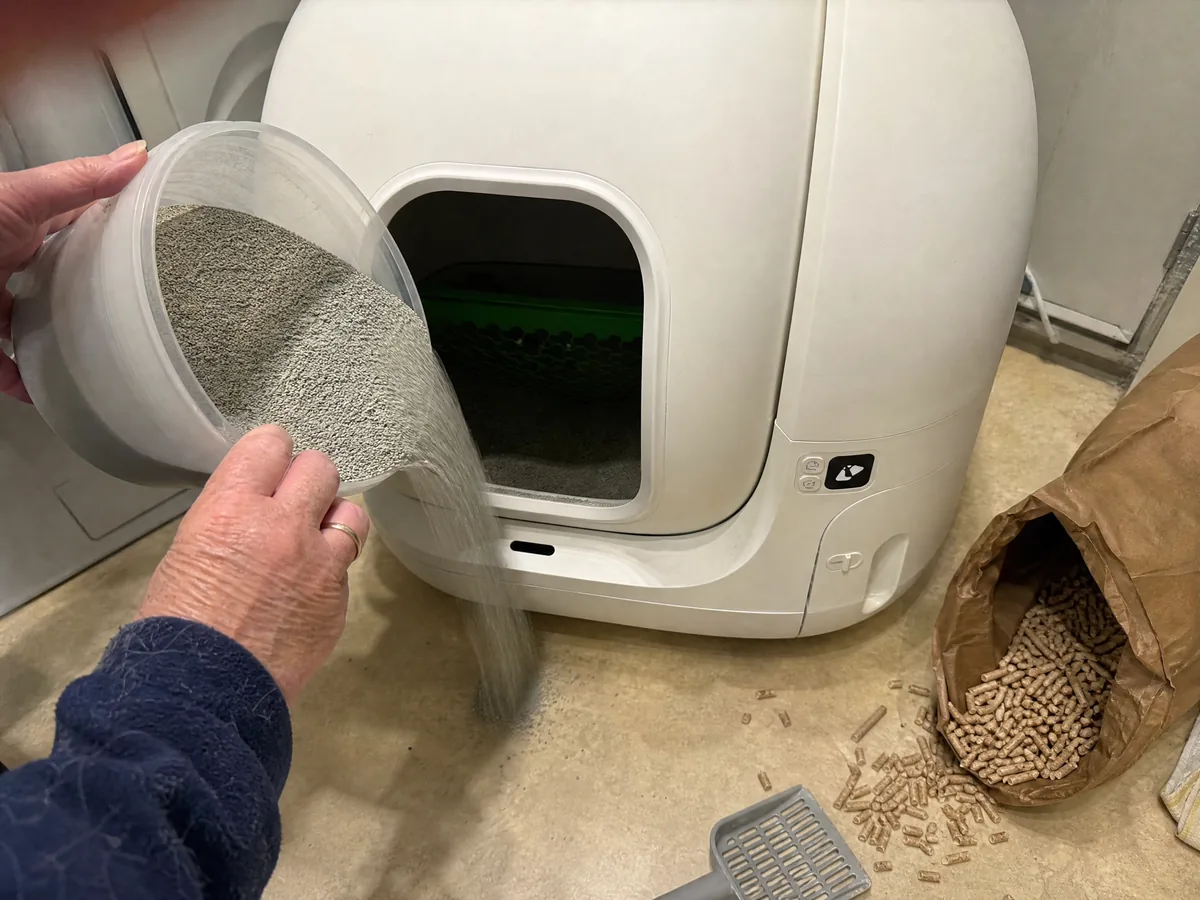
Did it close the snack bar?
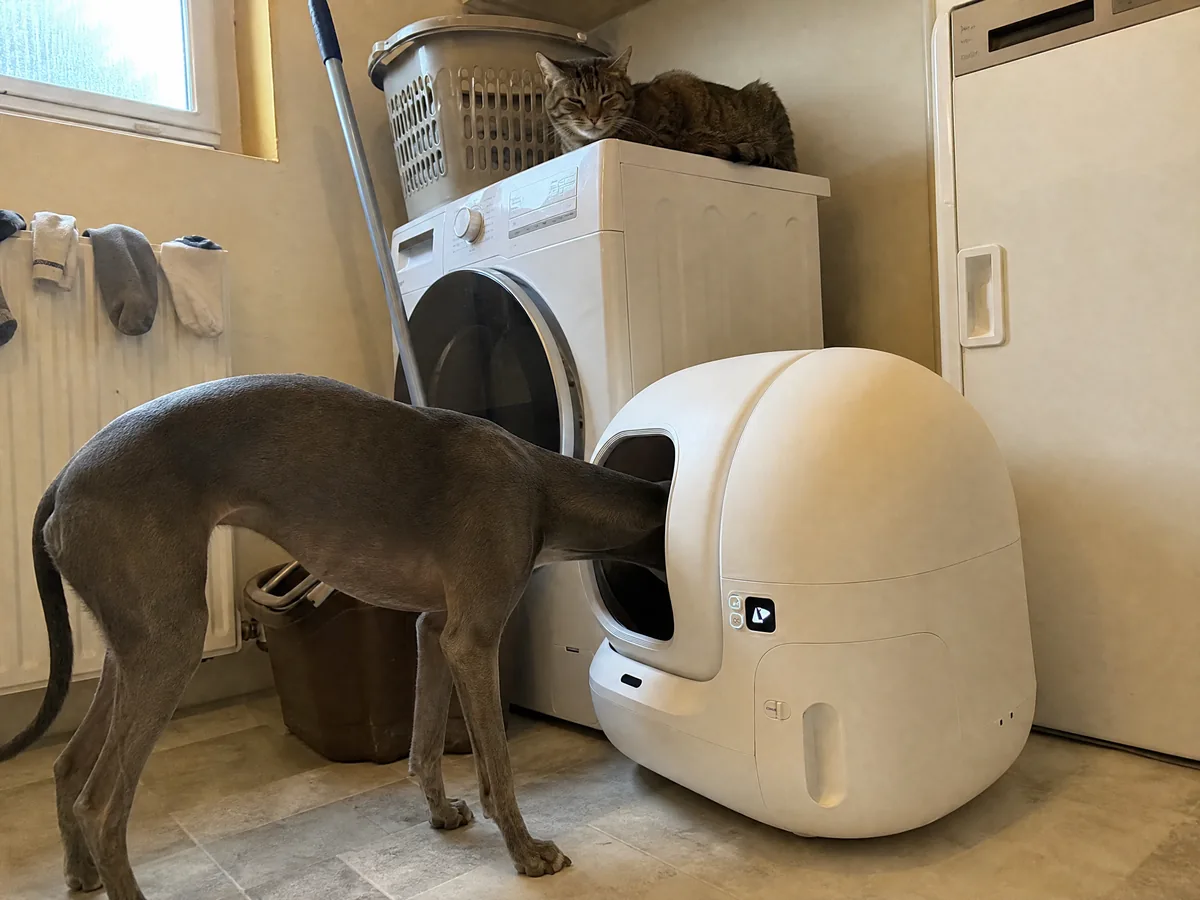
Yes. This was the result I cared about most, and it was clear. In the 40 days I didn't catch either dog with anything they shouldn't have, and I looked. Waste was in the sealed drawer within about ten minutes of each visit, with my seven-minute delay plus the cycle itself.
Dai did test it, of course. On day 6 he pushed his head right into the entrance while a cleaning cycle was starting. The drum stopped dead, and it didn't move again until he'd backed out and wandered off. Mabel, for the record, sniffed it once and went back to bed. She has never seen the point of effort.
Before I trusted it with anyone's face, I'd already tried it with my own hand. I started a manual clean and slid my hand into the opening. The drum stopped before it had turned a couple of centimetres. I tried it three times, and it stopped every time. PETKIT says cats must be at least 6 months old and 1.5 kg, so please stick to that with kittens.
Forty days of drawers, litter and liners
With one cat, the waste drawer needed emptying every 11 days on average, four times in the whole test. The app tells you when it's full. You pull out the drawer, tie the bag and put in a fresh liner. I timed myself at 40 seconds, with breath held for about 30 of them.
The cleaning itself was thorough. I checked the drum and the sieve every few days. On three checks there were bits of clump stuck to the sieve, twice after the litter had dropped below the line, once after Sid had an upset tummy. Otherwise, clumps went where they should.
Now the honest bit about litter. I can't tell you the Pura Max 2 saved me litter, because Sid switched from wood pellets to clay, which costs more. What I can tell you is what it used: 9.4 kg of clumping clay in 40 days. Here's how our running costs compare.
| Per month, one cat | Before: tray and wood pellets | Pura Max 2 and clumping clay |
|---|---|---|
| Litter | about £7 | about £11 |
| Liners and bags | about £1 (poo bags) | about £1 |
| Odour refills (optional) | none | a few pounds |
| Time spent scooping | about 5 hours | about 5 minutes |
So for us it costs a few pounds more a month to run, not less. What I get back is roughly five hours of scooping a month and a dog-proof tray. For me that's worth it. If you're already on clumping litter, you'll probably use a bit less than before, because the drum only takes out the clumps and never throws away clean litter with them.
The smell test, with a neighbour
I'm used to the smell of my own house, so I don't trust my nose. On day 30 I asked Glenys from next door to come in with her eyes closed, walk from the front door to the kitchen, and tell me where the litter tray was.
She guessed the bathroom. The Pura Max 2 was in the utility room, three metres from where she stood. I call that a pass.
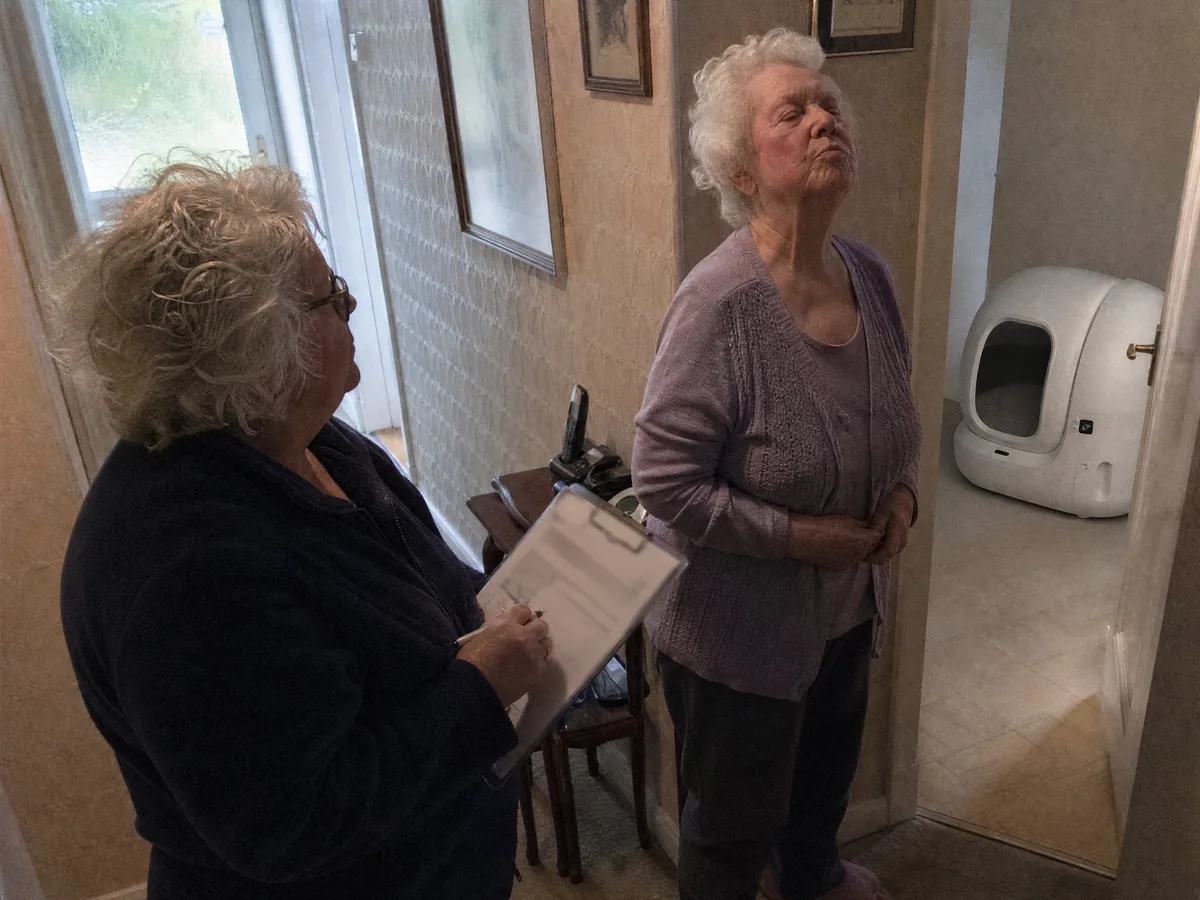
"I'd never have known you had a cat, love. Apart from the cat." Glenys, pointing at Sid, who was sitting on the kitchen worktop where he's not allowed
It isn't magic. Right after a big visit there's a smell for a few minutes until the cycle runs, and when you open the drawer to change the bag, you know exactly what's in there. But the background litter-tray smell in the utility room, the one I'd stopped noticing, went away. The N50 block had noticeably less effect by the end of week five, which is about when you'd replace it.
What the app knew that I didn't
The app logs every visit: time, how long, and the cat's weight. With one cat you'd think that's a gimmick. It turned out to be the funniest part of the test.
Sid weighed 5.3 kg on day 1. By day 33 the app said 5.7 kg. His food hadn't changed. I weighed him on the bathroom scales holding him, then without him, and the app was right. Then I watched where he went after breakfast. He went over the back wall to number 14, where Mr Hopkins, who is new to the street, had been feeding him ham because he thought Sid was a stray.
Sid is not a stray. He has a microchip, a collar and a woman who writes about litter trays for a living. Mr Hopkins now knows all of this, and the ham has stopped. The weight graph matters for more serious reasons too. A cat going to the tray much more often, or losing weight without explanation, is worth a call to the vet, and this is the first tray I've had that would actually tell me.
Noise and the niggles
PETKIT quotes about 35 dB. At one metre I measured 44 dB while the drum turned, a low, steady hum like a dishwasher in another room. From the living room with the door ajar, I couldn't hear it. There's a quiet-hours setting in the app if the tray has to live near a bedroom.
The niggles are about bodies and space. The 20 cm step in is fine for Sid at eleven, but my friend's arthritic sixteen-year-old would struggle, and a low step in front helps. The footprint is big and it won't fit inside a litter cabinet. Every four weeks it needs a proper clean, which means emptying the litter, wiping out the drum and refilling, about 25 minutes. And our retailer offered one year of warranty, which feels short on something with a motor, so check what yours offers.
Who it suits, and the alternatives
- A top-entry tray: the cheapest answer to dogs raiding the litter, under £30. Many cats accept it. Sid, sadly, did not.
- Neakasa M1: an open-top self-cleaning tray without a drum, good for nervous or large cats, but wider and no help with a dog's nose.
- Litter-Robot 4: the well-known American drum tray, very refined, but usually well over £600 in the UK.
Every product we review is bought at the normal price and lived with for weeks, as explained on our how we test page. If you're wondering what your dog gets up to while you're out, I spent six weeks finding out in our Furbo 360 review. And there's more tested pet kit in our reviews.
Forty days in, the bathroom door isn't wedged any more. Dai has found other hobbies, mainly sleeping. Sid is back to 5.4 kg and furious about it.
Questions people ask
Can you use wood pellet litter in the PETKIT Pura Max 2?
No. It needs clumping litter, such as clay, tofu or a mixed clumping litter. Wood pellets, crystal and silica litters don't work. If your cat is on pellets, switch the litter gradually in the old tray a week before the machine arrives.
Is the Pura Max 2 safe if I have dogs?
In our test, yes. The drum stopped instantly when our greyhound pushed his nose into the opening, and waste is sealed in the drawer within minutes, so there's nothing left for dogs to raid. Keep puppies supervised around it all the same.
How often do you empty the PETKIT Pura Max 2?
With one cat, every 11 days on average in our test. PETKIT says up to 15 days for one cat. With two cats, expect roughly twice as often.
How long does it take a cat to get used to a self-cleaning litter box?
Anything from minutes to a couple of weeks. Sid took four days. What helped us most was changing the litter a week early, then letting the old tray and the new machine sit side by side while I triggered cleans from the app only when Sid was outside.