
Best pellet grill for cold weather? 5 grills, 30 overnight cooks, one flat line
Five grills, one Pennsylvania driveway and a Halloween night at 28°F. Only one held 225°F within a few degrees for ten straight hours, and it never got me out of bed.
 By Rodney Frankenfield, grill and yard tester, volunteer firefighter
Tested in Harrisburg, Pennsylvania · November 4, 2026 · 13 min read
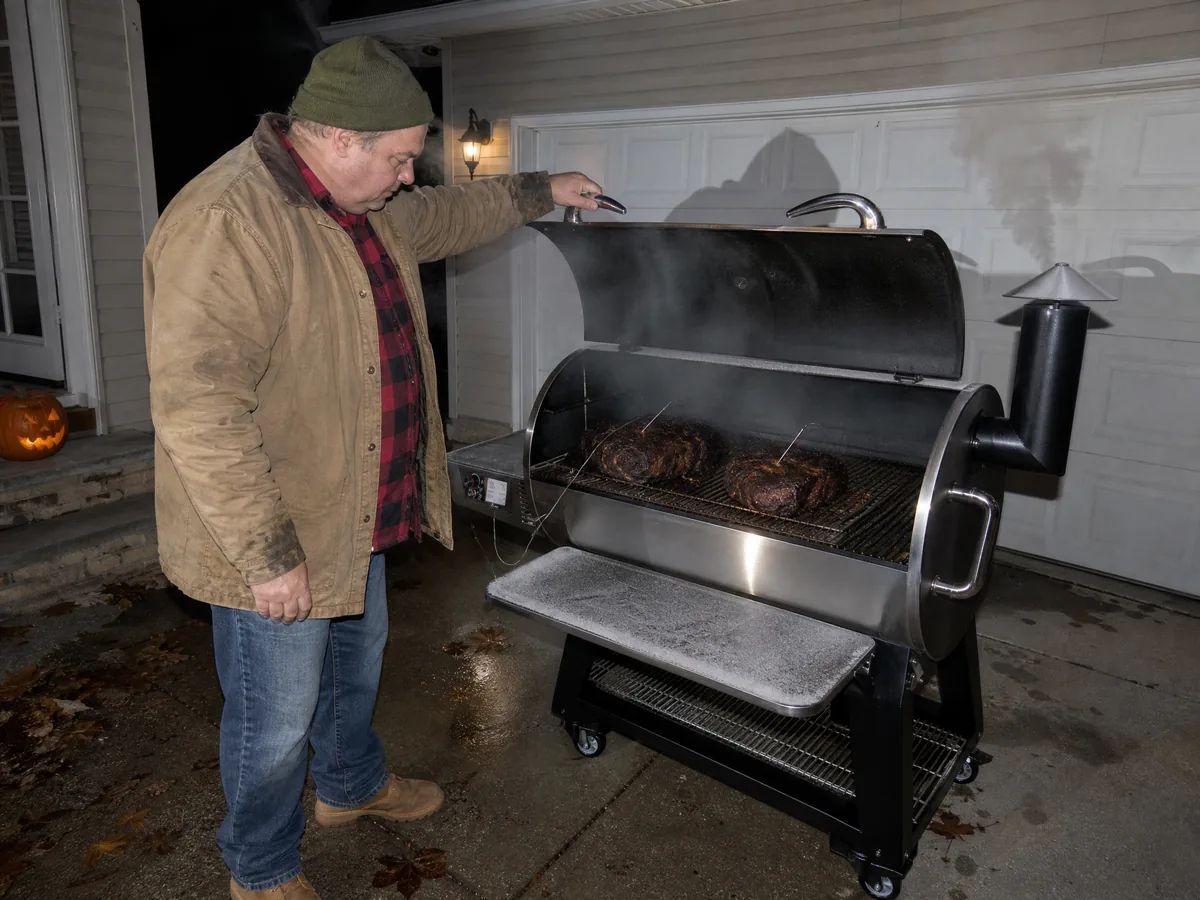
At 2:00 a.m. on November 1, my phone quietly decided it was 1:00 a.m. again. Daylight saving time was over, and five grills in my driveway had just been handed one extra hour of a 28°F night.
I was standing between them in a beanie, holding a mug of coffee that had gone cold an hour earlier, and I remember thinking this was either the best test I'd ever run or the dumbest. Janet had gone to bed at eleven with one sentence: "Don't let the neighbors call it in."
Every fall, somebody at the firehouse asks me the same thing. Can you really smoke a pork butt overnight in November, or does the grill give up when it gets cold? So this year I tested exactly that. From August 14 to November 2, 81 days in all, I ran 10-hour low-and-slow cooks on five grills here in Harrisburg, Pennsylvania, first on warm summer nights and then on four cold ones. The question was simple. Which grill holds a steady 225°F through a cold night? One of them drew a line so flat I checked the probe twice.
recteq Flagship 1100
$1,199.99 at recteq.com at the time of writing (list $1,399.99), about $1,299 on Amazon
- Biggest swing on the coldest night was 19°F, top to bottom
- The 40 lb hopper got through every 10-hour cook without a refill
- Back to 225°F six minutes after I opened the lid
- Stainless barrel, cart and grates that shrugged off a night of rain
- The hungriest of the pellet grills at 28°F, 2.6 lb an hour
- The controller screen is small and hard to read in gloves
- Big and heavy. Two of us lifted it off the truck
- Costs about twice as much as the Pit Boss
Our verdict: if you want to start a pork butt at 8 p.m. in late fall and sleep until the alarm goes off at six, this is the grill I'd buy. Budget for pellets. If the price stings, the Weber Searwood 600 came second for about $300 less, as long as you top up its smaller hopper.
- Why cold air is hard on a grill
- How I ran 30 ten-hour cooks
- Four cold nights in one table
- recteq Flagship 1100: ten hours of flat line
- Weber Searwood 600: small barrel, smart brain
- Traeger Woodridge Pro: easy to love, feels the wind
- Pit Boss Navigator 1150: a lot of grill and a 3 a.m. alarm
- Weber Spirit E-325: why a gas grill was here
- Six cold-night habits that helped every grill
- Which one I'd buy, and for whom
- US prices and where to buy
- Questions I get at the firehouse
Why cold air is hard on a grill
A pellet grill is a fan, an auger and a steel box. The controller reads a probe inside the barrel and decides how many pellets to drop into the fire pot. On a 70°F evening that's easy. At 28°F, every square inch of that steel box is leaking heat, and a gust of wind strips it off even faster.
So the controller feeds more pellets, the fire flares, the temperature overshoots, and the whole thing starts to wobble. The good controllers, the ones called PID, make lots of small corrections instead of a few big ones. That's the theory. I wanted to see it on a graph at three in the morning.
Gas has its own winter problem. On the lowest setting the flame is small, and a strong gust can put it out. That matters to me more than most. In 20 years with our fire company I've been to two garage fires that started with somebody smoking meat "out of the wind." Inside the garage. So every grill in this test lived on the driveway, a good ten feet from the house, in whatever weather Pennsylvania sent.
How I ran 30 ten-hour cooks
The test had two halves. From August 14 to September 30, each grill did two 10-hour cooks on warm nights between 61°F and 72°F. That gave me a baseline, so I'd know what each one looked like on an easy night. Then I waited for real cold, and it showed up right on time in October.
Four nights, all five grills side by side, lit at 8 p.m. and logged until 6 a.m.:
- Saturday, October 17: low of 39°F, light wind. The warm-up round.
- Saturday, October 24: low of 33°F, northwest wind at 14 mph, gusts to 23. The wind comes straight down my driveway.
- Wednesday, October 28: 41°F and steady rain all night, 0.9 inches in the gauge. I took Thursday off.
- Saturday, October 31: 28°F, frost by midnight, trick-or-treaters gone by 8:30. The night with the extra hour.
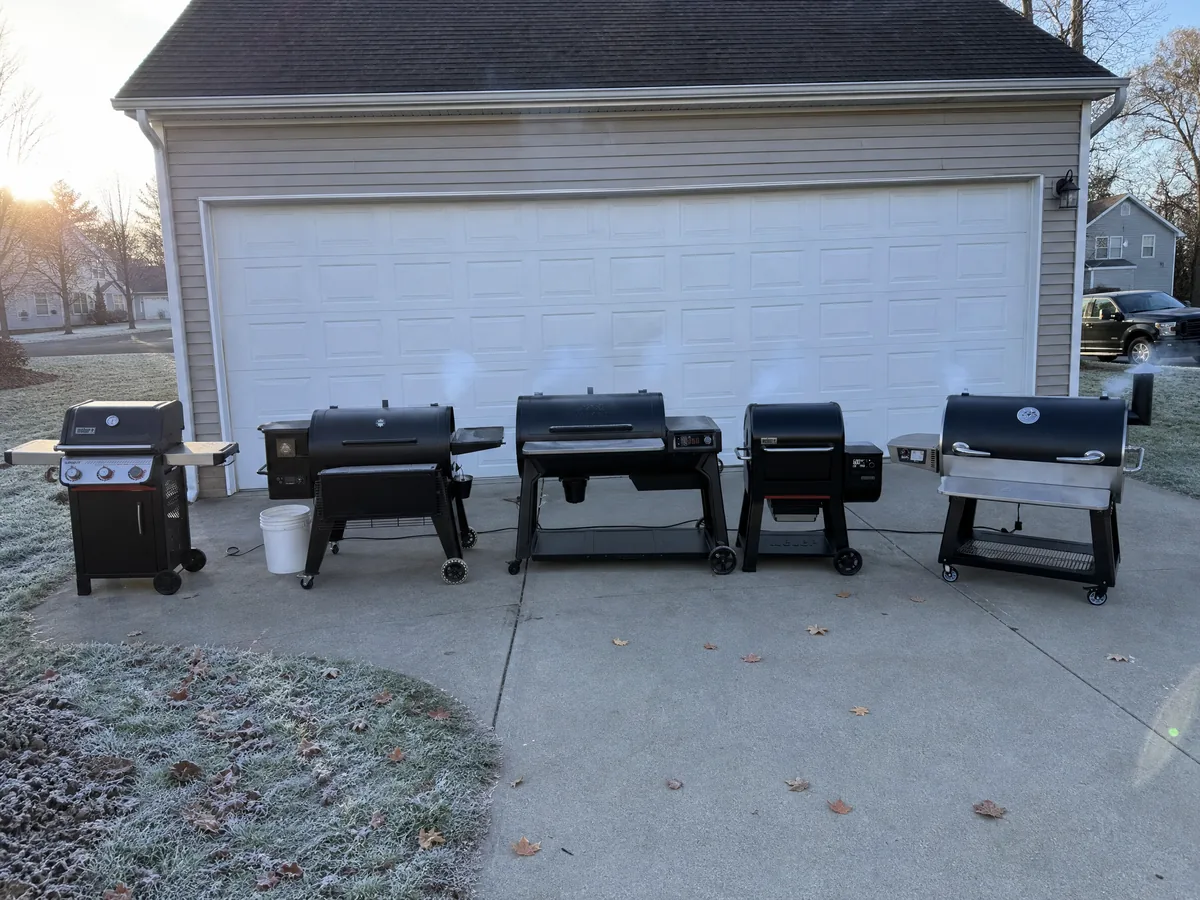
Every pellet grill was set to 225°F and burned the same pellets, Lumberjack 100% hickory, from the same pallet, kept in sealed five-gallon buckets. Every grill got two bone-in pork butts of 8 to 9 pounds from Weis, salt and pepper only. Same butcher, same rub, same start time.
The referee was a pair of ThermoWorks Signals units, one air probe per grill clipped an inch above the grate in the middle, logging every minute. I never trusted a grill's own display. At hour five I opened every lid for exactly 60 seconds to spritz, the way most of us do, and timed how long each grill took to get back. The rest of the scoring follows our usual testing routine.
Four cold nights in one table
The swing column is the gap between the highest and lowest reading in a single night, leaving out the 60 seconds with the lid open. The gas grill can't idle as low as 225°F, so its numbers are measured around its own lowest steady setting.
| Grill | US price at the time of writing | Average distance from 225°F | Biggest swing in one night | Minutes more than 15°F off, per night | Fuel per hour on the 28°F night | Refills or restarts | Score |
|---|---|---|---|---|---|---|---|
| recteq Flagship 1100 | $1,199.99 | 4°F | 19°F | 0 | 2.6 lb pellets | None | 9.1 |
| Weber Searwood 600 | About $899 to $999 | 7°F | 31°F | 22 | 2.1 lb pellets | 1 refill | 8.4 |
| Traeger Woodridge Pro | $1,149.99 | 9°F | 38°F | 47 | 2.3 lb pellets | 1 refill | 8.0 |
| Pit Boss Navigator 1150 | About $700 to $820 | 16°F | 52°F | 148 | 2.5 lb pellets | 1 flameout | 6.8 |
| Weber Spirit E-325 (gas) | About $549 | Lowest steady: 262°F | 61°F | Can't reach 225°F | 0.43 lb propane | 1 flame blown out | 6.1 |
On the warm baseline nights, all four pellet grills stayed within 3 to 12°F of the set point and burned between 1.1 and 1.4 pounds an hour. Cold nearly doubled the fuel for every one of them. What it didn't do was spread them out evenly. The cheaper the controller and the thinner the barrel, the more the cold showed on the graph.
recteq Flagship 1100: ten hours of flat line
The recteq Flagship 1100 arrived on a pallet in mid-August, and it took me and two guys from the fire company to get it off my pickup. That weight is mostly stainless steel. The barrel, the fire pot, the grates and the big front shelf are all 304 stainless, with a black lid on top and two chrome handles that the neighbor kids call "the bull horns." It has about 1,100 square inches of grate, a range of 180°F to 700°F, Wi-Fi and a PID controller.
On the four cold nights its average distance from 225°F was 4°F. The biggest swing in any night was 19°F, top to bottom, on the windy Saturday. It never once went more than 15°F off. When I opened the lid at hour five, it was back at 225°F in six minutes, the fastest of the pellet grills.
Halloween night was the one that sold me. I stayed out longer than I needed to, mostly because of the clock, and the recteq graph on my phone was so flat that I tapped the screen to check the app hadn't frozen. Its biggest swing that night was 11°F. The time change didn't bother it. The app simply logged the one o'clock hour twice, and the ten hours ended at 5 a.m. on the new clock. I finally went to bed at 2:30. The Traeger and the Weber both got me up again before four. The recteq never did.
"That's the only one you didn't go out to check." Janet, Sunday, November 1, handing me a coffee at the kitchen window
The catch is fuel. Stainless looks great and doesn't rust, but this barrel isn't insulated, and at 28°F it burned 2.6 pounds of pellets an hour, the most of the four. The good news is the 40 lb hopper. A full 10-hour cook took about 27 pounds, so I never refilled it at night. The controller screen is small and hard to read with gloves on, and I used the recteq app instead. Plain, but it works. The runner-up is a much smaller grill with a cleverer trick up its sleeve.
Weber Searwood 600: small barrel, smart brain
The Weber Searwood 600 is Weber's second go at pellet grills after the SmokeFire, and you can tell they listened. It's compact, with 648 square inches over two grates, a 20 lb hopper on the right side and a range of 180°F to 600°F. The party trick is DirectFlame, a mode that lets the flame reach the food for real searing. I used it for smash burgers on a Tuesday in September, and they were the best burgers of the whole test.
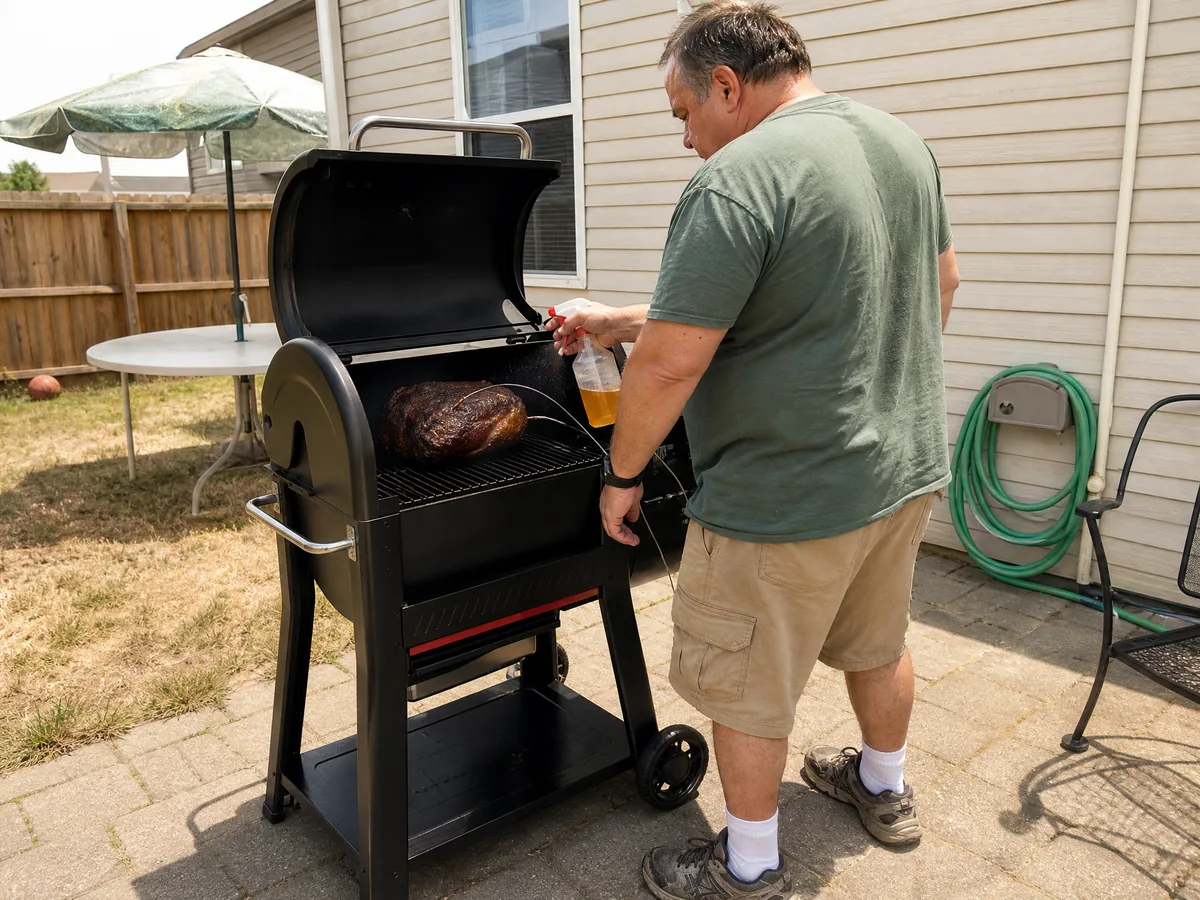
In the cold it was the clear number two. Average distance from 225°F was 7°F, with a biggest swing of 31°F. The one bad moment came on October 24 at 3:10 a.m., when a gust caught it side-on and the grate dropped to 207°F. It stayed low for 22 minutes, and then the controller pulled it back on its own. I watched the whole thing from bed on the Weber app.
The smaller barrel paid off on fuel. At 28°F it used 2.1 pounds an hour, the least of the pellet grills. But 21 pounds over ten hours is more than its hopper holds once you count the startup, so on Halloween the app pinged me at 3:30 a.m. to top it up. If you smoke for two to four people and also want a real sear, this is the one I'd look at first. The next grill felt the wind more than its price suggests.
Traeger Woodridge Pro: easy to love, feels the wind
Randall spent last spring with the Traeger Woodridge Pro, and his full review found a friendly grill with a weak spot on cold, windy nights. My October backs him up. It's the easiest of the five to live with: 970 square inches, a 24 lb hopper with a pellet sensor, Super Smoke for the first hours, and the best app of the group.
On calm nights it was close to the Searwood. On the windy Saturday it wasn't. The northwest wind hit its left side all night, and twice it dipped to 196°F before the controller caught up. Over the four nights it averaged 9°F off, with a biggest swing of 38°F and 47 minutes a night more than 15°F away from the target. Its own display read about 13°F higher than my grate probe, almost the same as Randall found in March.
Here's the tip that saved it. On Halloween I rolled it into the corner where the garage wall blocks the wind, still well away from the house, and its swing that night dropped to 21°F. The pellet sensor warned me at 3:05 a.m. that the hopper was getting low, so that was one more trip outside. If you have a sheltered spot, it's a lovely grill. The next one costs a lot less and asks a lot more of you.
Pit Boss Navigator 1150: a lot of grill and a 3 a.m. alarm
For the money, the Pit Boss Navigator 1150 is a big piece of steel. You get about 1,158 square inches of grate, a 31 lb hopper, a 180°F to 500°F range and a slide plate that opens the fire for direct searing. Pit Boss lists it at $699, and I've seen it between $700 and $820, though it's getting harder to find new. What you don't get is Wi-Fi or a PID controller. The Navigator has a simpler dial controller with a P-setting button, a holdover from older pellet grills, and it corrects in bigger steps.
That showed on the graph. It averaged 16°F off, with swings up to 52°F and about two and a half hours a night more than 15°F away from 225°F. With no app, I set my phone alarm for 2 a.m. and went out with a flashlight to read the dial. Janet asked whether I was dating it.
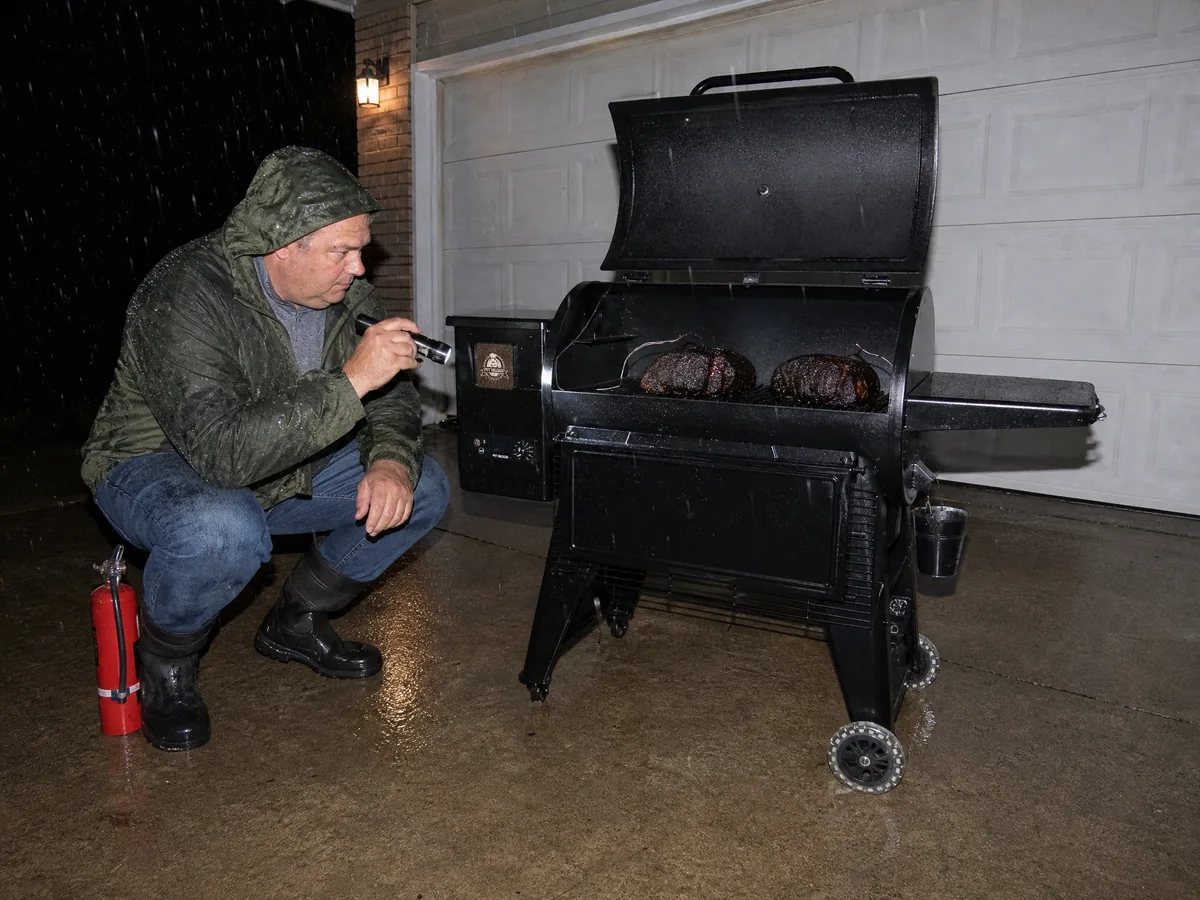
The rainy Wednesday is when it went wrong. Water got in around the hopper lid, the pellets at the bottom swelled into sawdust paste, the auger choked and the fire went out. By 3:40 a.m. the grate read 141°F. This is the part where I put my firefighter hat on. Don't just press start on a hot pellet grill after a flameout. The fire pot is full of unburned pellets, and lighting that in a warm, closed barrel can make a puff of smoke ignite and throw the lid up. I shut it down, let it cool, cleaned out the fire pot, dumped the wet pellets and restarted it with the lid open. That cost 70 minutes, and the pork still came out fine two hours late.
In fair weather and under a cover it's good value for big crowds. Which brings me to the grill that was never supposed to win.
Weber Spirit E-325: why a gas grill was here
I've cooked on my Weber Spirit E-325 since May, and you can read my Spirit E-325 review for the full story. It went into this test because more of you asked about gas than about any pellet grill. Can a regular three-burner smoke overnight?
Short answer: not at 225°F. With only the left burner on low and a stainless smoker box of hickory chips over it, the lowest it would hold was 238°F in August and 262°F on the cold nights, because the burner simply can't go lower. On the windy Saturday a gust at 1:50 a.m. blew out the small flame. If that happens to you, turn the knobs off, open the lid and wait five minutes before relighting, as Weber's manual says. Never light into a closed lid that's been filling with gas.
The chips needed a refill about every 50 minutes, and the pork was done in about seven hours at 262°F to 300°F. It tasted good, with a thin smoke ring. A 10-hour cook used 4.3 pounds of propane, so a full tank is no worry. For a real overnight smoke, though, it's the wrong tool. Whatever you cook on, a few habits made a bigger difference than I expected.
Six cold-night habits that helped every grill
- Find the lee. The same Traeger swung 38°F in the open and 21°F behind the garage corner. Wind matters more than temperature.
- Keep pellets in a sealed bucket. And don't leave a full hopper out in the rain. The Pit Boss flameout started with a damp hopper.
- Empty the fire pot before every long cook. Ash from the last cook smothers the fire when the controller is working hard.
- Count on twice the pellets. At 28°F every pellet grill burned close to double its summer rate. Do the math before you go to bed.
- Don't keep opening the lid. Every 60 seconds open cost the slowest grill 17 minutes to recover.
- Always run the shutdown cycle. Pulling the plug on a lit pellet grill can let the fire creep back up the auger tube toward the hopper.
None of this is fancy, and all of it is free. Now, the part you came for.
Which one I'd buy, and for whom
The Weber Spirit E-325 stays my favorite for weeknight steaks, burgers and chicken. For brisket and pork butt overnight, pair it with a pellet grill, or a lot of coffee.
US prices and where to buy
We bought all five ourselves. Here's what each one costs as I write this, and the price I'd wait for:
- recteq Flagship 1100: $1,199.99 at recteq.com, list $1,399.99, around $1,299 on Amazon. Good under $1,150.
- Weber Searwood 600: about $899 to $999 at Weber.com, Lowe's, Home Depot and Ace Hardware. Good under $850.
- Traeger Woodridge Pro: $1,149.99 at Traeger.com, sometimes more at other stores. Good under $1,000.
- Pit Boss Navigator 1150: list $699, about $700 to $820 where it's still in stock, including Walmart. Good under $700.
- Weber Spirit E-325: about $549, list $599, at Home Depot, Lowe's and Weber.com. Good under $500.
Grills often drop for Black Friday on November 27, and pellet grills sell slower in winter, which helps. The recteq is staying in my driveway, the Pit Boss went to a buddy at the firehouse, and 40 pork butts went into sandwiches, freezers and the neighbors' Halloween parties. My next project is already running, and you can follow it on our tests in progress page. Everything else we've tested for the yard is in the outdoor section, including my Solo Stove Bonfire review for the nights you'd rather sit by a fire than tend one.
Questions I get at the firehouse
Can you use a pellet grill in cold weather?
Yes. All four pellet grills we tested finished 10-hour cooks at 28°F. The difference is how steady they stay and how much fuel they burn. The recteq Flagship 1100 held within 4°F of 225°F on average, while the Pit Boss Navigator 1150 drifted 16°F and needed checking at night.
How many more pellets does a pellet grill use in winter?
In our test, close to double. At 225°F on warm nights the four grills burned 1.1 to 1.4 pounds an hour. At 28°F they burned 2.1 to 2.6 pounds an hour, so a 10-hour cook can take 21 to 27 pounds. Check that your hopper holds that much, or plan a refill.
Do I need an insulated blanket for my pellet grill?
It helps, but shelter from the wind helped more in our test. Moving the Traeger Woodridge Pro behind the garage corner cut its swing from 38°F to 21°F. If you buy a blanket, get the one made for your grill model, never a moving blanket or anything that isn't rated for heat.
Can you smoke low and slow on a gas grill overnight?
Not well. Our Weber Spirit E-325 couldn't hold lower than 262°F on cold nights with one burner on low, the wood chips needed a refill every 50 minutes, and a gust blew the low flame out once. It makes good pork in about seven hours if you stay with it, but it's no overnight smoker.