
Traeger Woodridge Pro review: a 13-hour brisket, a cold night and the honest numbers
Ten weeks, 21 cooks and 146 pounds of pellets. Our grill tester lived with the Traeger Woodridge Pro from March frost to June heat. Here is what it gets right.
 By Randall Plunkett, outdoor and grill tester, dad of two
Tested in Kansas City, Missouri · June 16, 2026 · 11 min read
Traeger Woodridge Pro
About $1,150 at the time of writing (list $1,149.99)
- Held 225°F within about 12°F on calm days
- Pellet sensor and app let you sleep through a brisket
- 970 sq in fit 4 pork butts with room left
- Super Smoke adds a visible, tasty difference
- Single-wall body struggles on cold, windy nights
- Display read about 15°F high vs our probe
- Topped out at 478°F, not a searing machine
- Some ash still ends up in the barrel
Our verdict: if you want smoked ribs, pork and brisket without babysitting a fire, this is the Traeger we'd buy. Set the dial 15°F higher than you think, keep it out of the wind in winter, and use something else for steak crusts.
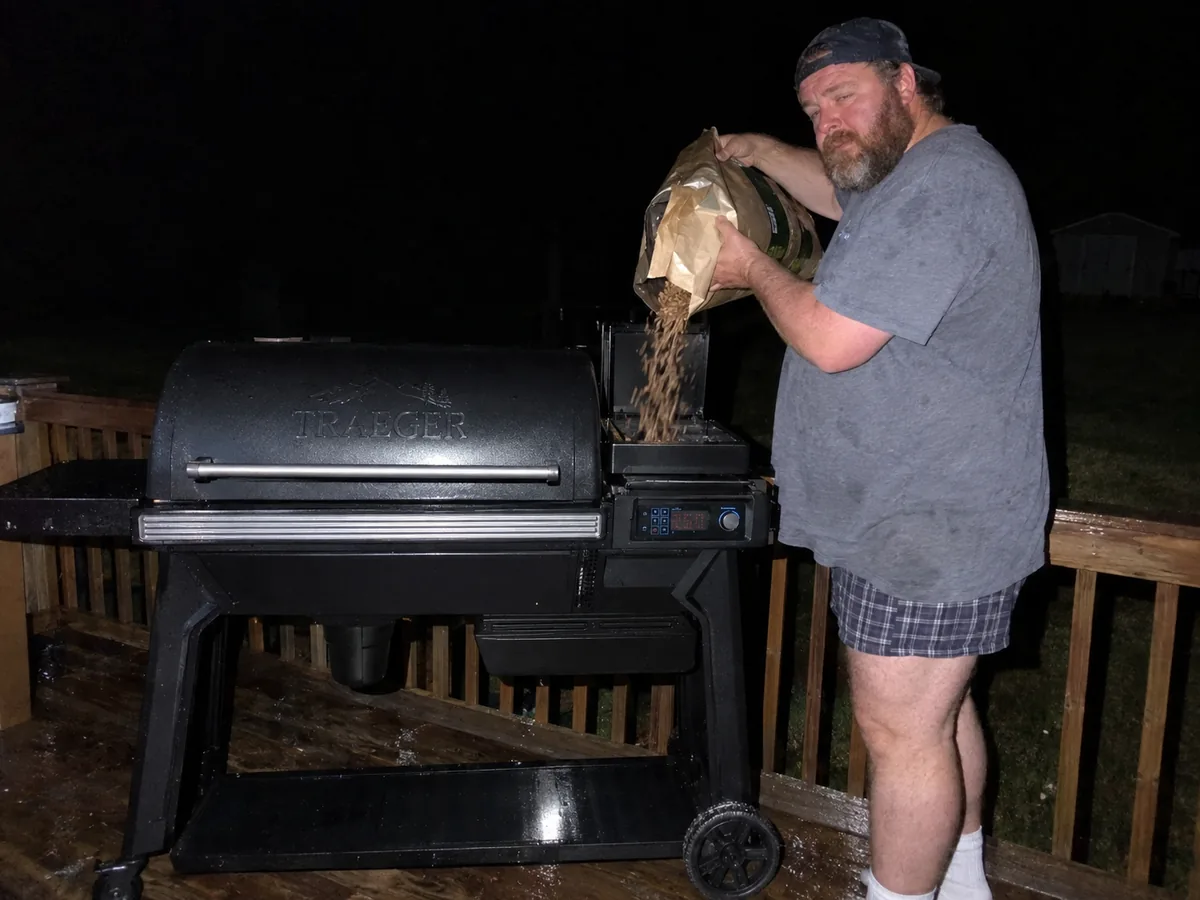
At 4:40 a.m. my phone lit up on the nightstand. Not a work email, not a kid with a bad dream. It was the grill, telling me the hopper was getting low.
I walked out in socks, poured in half a bag of hickory and was back in bed by 4:46. The brisket kept going without me. That little moment is the whole pitch of the Traeger Woodridge Pro, and after ten weeks with it I can tell you where that pitch holds up and where it gets a little thin.
I tested it from the first week of March, when we still had frost on the deck, to early June. That's 21 cooks, from 90-minute chicken wings to a 13-hour brisket, and 146 pounds of pellets. I've cooked on gas and charcoal for twenty years, so I came in curious and a bit skeptical. Let's start with the cook that settled most of my doubts.
The brisket that started it
Brisket is the final exam of barbecue. A 14.2 lb packer from the warehouse store, salt and pepper, on the grill at 9:15 p.m. I set the Woodridge Pro to 225°F, turned on Super Smoke for the first four hours and put the wired probe in the thickest part of the flat.
Then I did something I'd never done with a charcoal smoker: I went to bed. The WiFIRE app showed a flat line all night, with small wiggles. At 6 a.m. the brisket sat at 164°F internal and had a dark, crackly bark. I wrapped it in butcher paper, bumped the grill to 250°F and pulled it at 10:20 a.m. at 203°F.
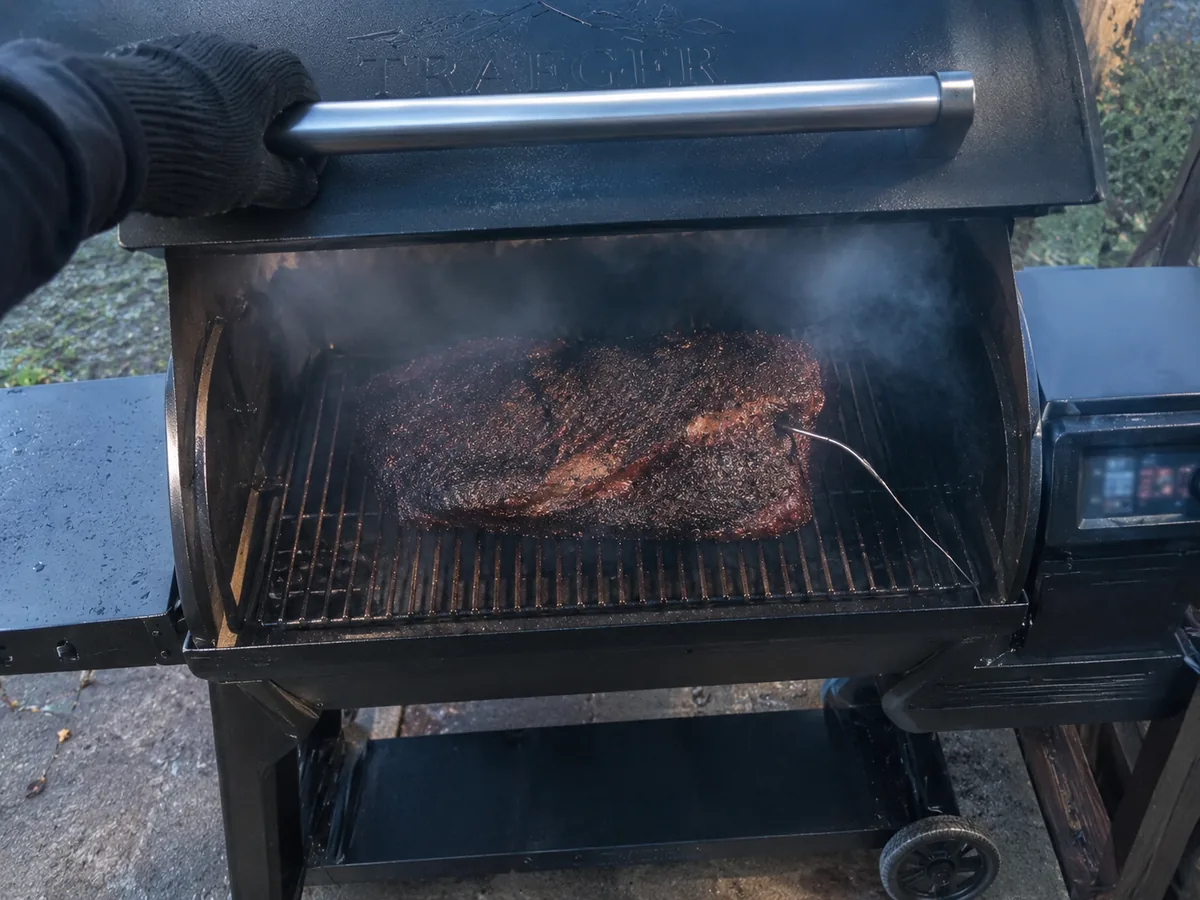
It had a real smoke ring, about a quarter inch deep, and the flat was juicy enough that my father-in-law, who has opinions about brisket, asked for the leftovers. The whole cook burned about 17 lbs of pellets, a bit less than one 18 lb bag.
"You slept through this? I used to sit up all night with mine." My father-in-law, holding his second slice
One perfect brisket could be luck, of course. So for the next nine weeks I checked the grill's claims against my own thermometers.
How steady is steady?
I clipped a leave-in probe at grate level in the middle of the main rack and logged it next to the Traeger's own display. These are the averages over several cooks on days between 55°F and 78°F with light wind.
| Test | Result |
|---|---|
| Startup to 225°F (from pressing ignite) | about 12 min |
| Startup to 450°F | about 19 min |
| Swing around a 225°F setpoint, calm day | plus or minus 12°F |
| Display vs our grate probe at 225°F | display about 15°F higher |
| Highest temp we reached at the grate | 478°F on a 70°F day |
| Pellet use at 225°F | about 1.1 lb per hour |
| Pellet use at 450°F | about 3.2 lb per hour |
The swing is normal for a pellet grill. The controller feeds pellets in pulses, so the temperature breathes up and down a little. Your meat doesn't care about 12 degrees over a 10-hour cook.
The offset matters more. When the display said 225°F, my probe at the grate usually read 208 to 212°F. There's no way to calibrate the controller, so I just set it 15°F higher for low and slow cooks. Other owners report the same thing, which makes me think it's the probe placement, not a faulty unit.
Those numbers came from mild spring days. The next test was the one I'd been dreading.
The cold-night test
The Woodridge Pro is a single-wall grill. Traeger's pricier Ironwood and Timberline lines have insulated walls, and that's a big reason they cost so much more. I wanted to see what that difference feels like on a bad night.
On March 19 it was 38°F with gusts of about 15 mph, and I put two pork butts on at 250°F. The display kept saying 250. My probe said something else: it wandered between 222°F and 268°F, and every gust knocked it down before the controller caught up. Pellet use jumped to about 2.4 lbs per hour, more than double a calm spring day.
The pork came out fine, but it took 11.5 hours instead of the 9 I'd planned. My wife found me at 10 p.m. holding a sheet of plywood against the side of the grill like a riot shield. We've agreed not to talk about it.
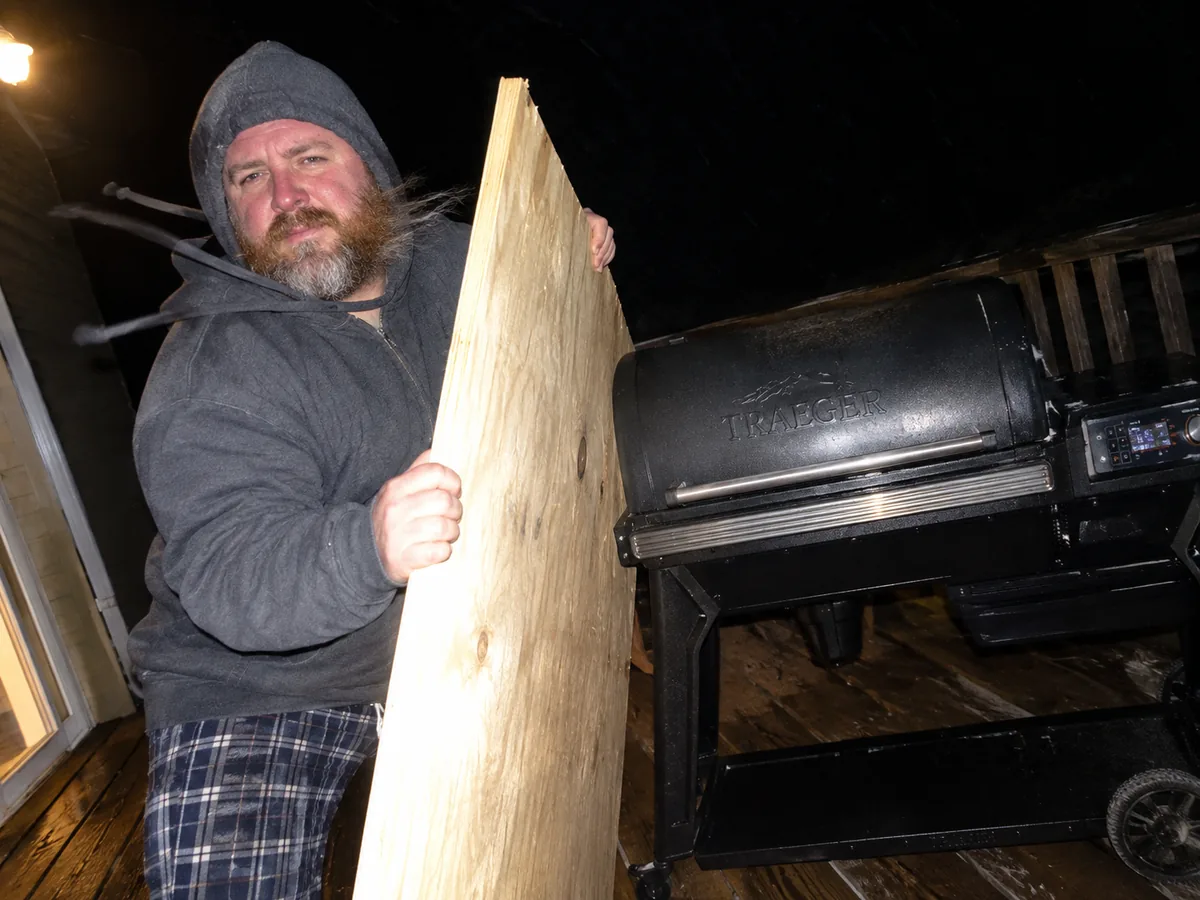
The fix was easy the next time: I moved the grill against the house, out of the wind, and the swing dropped to about 20°F. If you live somewhere with real winters and you want to smoke in January, look at an insulated model or budget for an insulation blanket. If you mostly cook from April to October, this is a non-issue. And most of us cook on Saturdays in May, which is where this grill really shines.
What it's like on a normal Saturday
Here's a typical day. At 8 a.m. I fill the 24 lb hopper, press ignite, and go make coffee. By 8:15 the grill is at temperature and the ribs go on. Then I leave for my son's soccer game with the app open in my pocket.
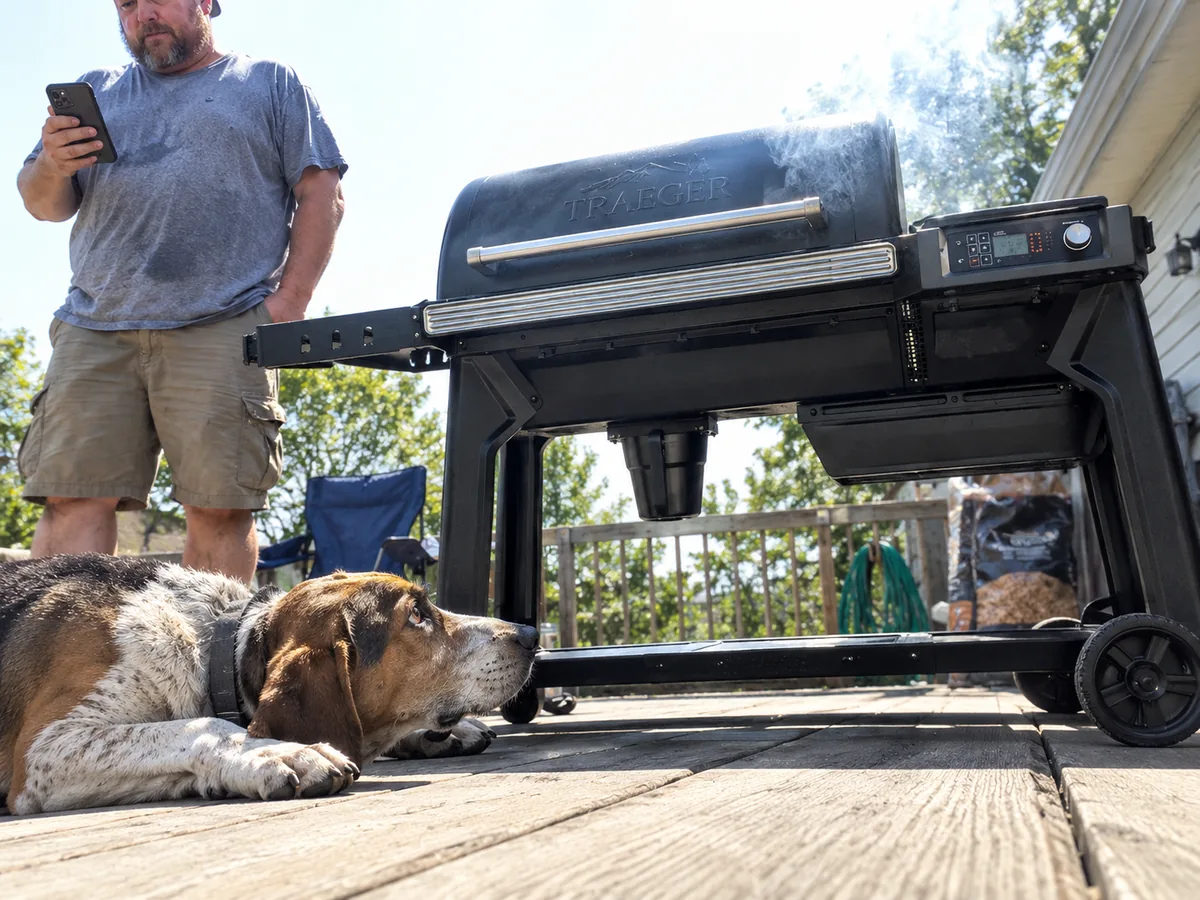
That's the thing no spec sheet captures. I checked the grill from the sideline twice, bumped the temperature once, and got an alert when the ribs hit 195°F. Our dog Rosie, a hound mix with a gift for waiting, spent the day lying next to the grill. She didn't get any ribs. She considers this a grave injustice.
Space was never a problem. The main rack is 585 square inches and the upper rack adds 385, for 970 in total. I fit four pork butts at once for a church fundraiser, and three racks of baby backs without cutting them. The upper rack runs a little cooler and gets less airflow, so I used it for sides and chicken wings, not for the main event.
Cleanup is simpler than any smoker I've owned. The EZ-Clean keg under the barrel catches grease and some ash in one container. I emptied it every three or four cooks. A fair amount of fine ash still lands in the bottom of the barrel, so I ran a shop vac through it every 5 cooks or so. Ten minutes, cold grill, no drama.
Food-wise, the smoke flavor is clean and noticeable without being bitter. Pork shoulder and ribs were the stars. Chicken thighs at 375°F came out juicy with decent skin. Where things got less impressive was anything that needs real high heat.
Where it falls short
Traeger says 500°F. The best I saw at the grate was 478°F, after 25 minutes of heating on a warm day. That's fine for pizza on a stone and roasted veggies. It isn't enough for a deep steak crust. My ribeyes looked grilled but not seared. The workaround is a reverse sear: smoke the steak at 225°F to about 115°F internal, then finish it in a ripping-hot cast iron pan on the stove or on a gas grill.
The build is the other place you feel the price. The lid flexes a little when you open it, there's no gasket so smoke leaks along the seam, and there's no light inside the barrel. None of this affected the food. It just doesn't feel as solid as the number on the receipt.
The smoke flavor also fades as the heat goes up. Above roughly 325°F, the pellets burn clean and hot and you get less of that wood taste. That's how pellet grills work, not a Traeger flaw, but it's good to know before you expect smoky burgers.
And the first startup took longer than expected because of a firmware update in the app. It took 11 minutes, on a Sunday, while the kids waited for wings. Do the setup the night before your first cook. Once that's done, the rest of the specs are pretty simple.
Specs at a glance
| Spec | Traeger Woodridge Pro |
|---|---|
| Cooking area | 970 sq in (585 main + 385 upper rack) |
| Temperature range | 165°F to 500°F (we reached 478°F) |
| Hopper | 24 lbs, with digital pellet sensor |
| Connectivity | WiFIRE app control and alerts |
| Smoke mode | Super Smoke, 165°F to 225°F |
| Probe | 1 wired meat probe included |
| Cleanup | EZ-Clean Grease and Ash Keg |
| Weight | 174 lbs |
| Warranty | 10-year limited |
| Price at the time of writing | About $1,150 |
The price went up since launch, when it sold for about $999. At $1,150 it faces tougher questions, which is why who it's for matters more than ever.
Who it's for
If you're torn between this and a gas grill, it comes down to what you cook most. This season Rodney, our grill and yard tester, cooked on a gas grill with a very hot sear zone for our Weber Spirit E-325 review, and honestly, a lot of families end up with both. The Weber does weeknights and steaks, the Traeger does weekends. If you can only have one, the next section might help.
Other Traegers to consider
- Traeger Woodridge (about $899): same idea, 860 sq in, but no Super Smoke, no pellet sensor and no side shelf. If you don't mind checking the hopper by hand, you save around $250.
- Traeger Woodridge Elite: the top Woodridge, with more convenience features. Worth a look only if those extras matter to you.
- Traeger Ironwood (around $2,000): double-wall insulation holds temperature far better in cold and wind. For year-round smokers in cold climates, it's the one we'd save up for.
Every grill in our tests goes through the same routine: logged temperatures, weighed pellets or gas, and real family meals, as laid out on our how we test page. You'll find our current outdoor favorites in the reviews.
After ten weeks, the Woodridge Pro earned its spot on my deck. It isn't perfect. But it gave me a 13-hour brisket and a full night's sleep in the same weekend, and I don't know any other grill that can say that.
Questions people ask
Is the Traeger Woodridge Pro worth it over the regular Woodridge?
For most people, yes. The pellet sensor alone saves you from waking up to a dead fire on long cooks, and Super Smoke makes a visible difference on ribs and pork. You also get 110 more square inches and a side shelf, for about $250 more.
How many pellets does the Woodridge Pro use per hour?
In our test, about 1.1 lbs per hour at 225°F and about 3.2 lbs per hour at 450°F on mild days. On a cold, windy night at 250°F it went up to about 2.4 lbs per hour.
Can you sear a steak on a Traeger Woodridge Pro?
Not very well. We maxed out at 478°F at the grate, which browns but doesn't give a deep crust. Smoke the steak low first, then finish it in a very hot cast iron pan or on a gas grill.
Does the Woodridge Pro work in cold weather?
It works, but it burns more pellets and the temperature swings more. At 38°F with wind we saw swings of over 40°F. Keep it out of the wind, or look at the insulated Ironwood if you smoke all winter.