
Solo Stove Bonfire 2.0 review: a firefighter lights 23 fires and checks the smoke
I've spent 20 years putting fires out. This summer I lit 23 in my own backyard to see if the Solo Stove Bonfire 2.0 is really smokeless, and what it gets wrong.
 By Rodney Frankenfield, grill and yard tester, volunteer firefighter
Tested in Harrisburg, Pennsylvania · September 20, 2026 · 12 min read
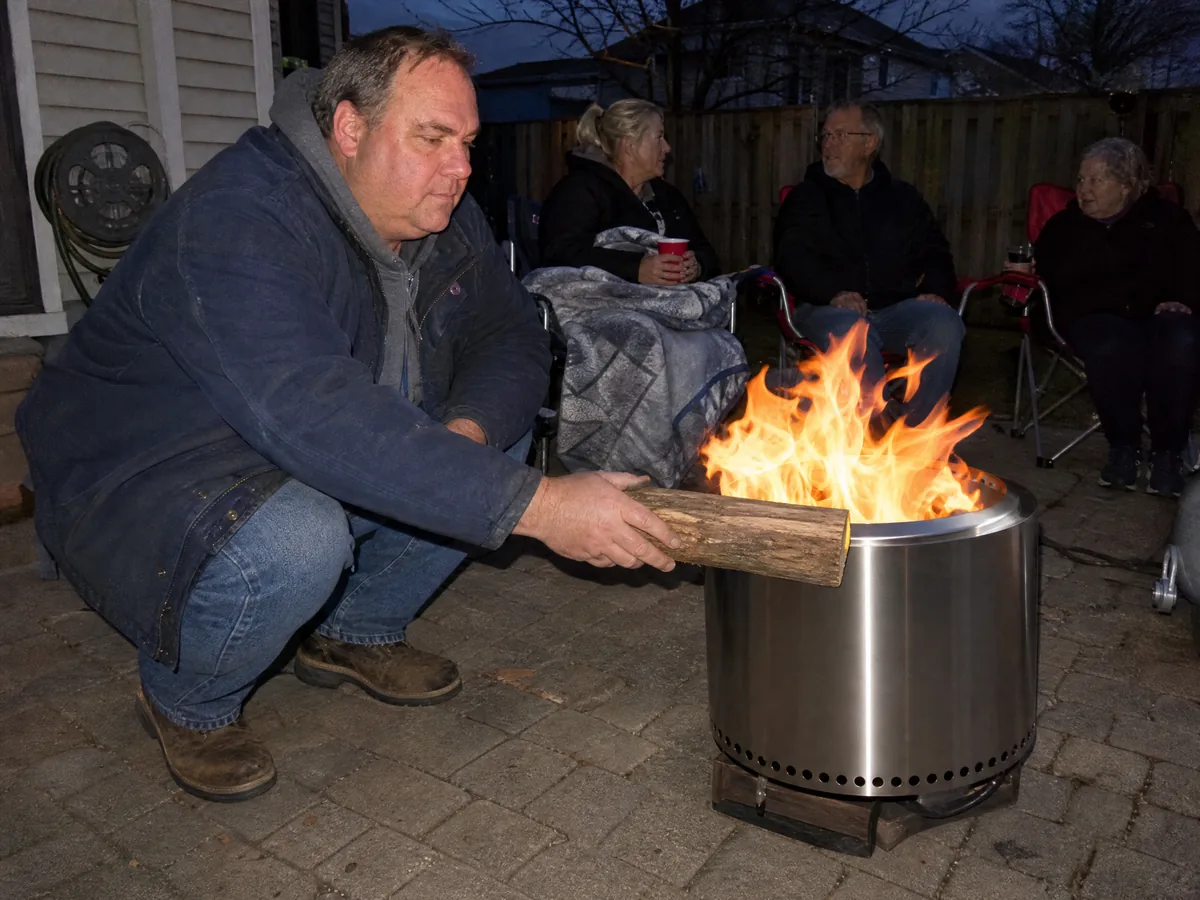
Solo Stove Bonfire 2.0 (19.5-inch) with Stand
$299.99 with the stand at Solo Stove at the time of writing, $299.95 at Amazon
- With kiln-dried oak, smoke was gone about 9 minutes after lighting
- Ash pan lifts out, cleanup took 3 minutes
- About 23 lbs, one person carries it
- Lifetime warranty on the pit
- Heat goes up more than out, legs stay cool at 6 feet
- Damp wood makes it smoke like any fire pit
- Eats wood: about 6.5 lbs per hour
- The stainless turns gold and blue after the first fire
Our verdict: for a small backyard, a patio or a deck (with the stand), the Bonfire 2.0 gives you a real wood fire that doesn't chase your guests around the circle. Feed it dry wood and keep your chairs close. If you want to warm a big group on a cold night, you'll want a bigger pit or the heat deflector.
- Why a firefighter tested a fire pit
- How "smokeless" works
- What my thermometer and scale said
- Decks, stands and the 15-foot rule
- Living with it: wood, ash and wind
- Bonfire 2.0 or the new Summit 19.5?
- Specs at a glance
- Holiday deals, gifting and returns
- Who should buy it, and who shouldn't
- Questions people ask
Why a firefighter tested a fire pit
Most of the backyard fires I've seen up close were the kind that end with a hose. A fire ring too close to a shed. A pile of leaves someone thought was "basically out." A deck board with a black circle burned through it from a fire pit sitting right on the wood. So when my neighbor asked me if those "smokeless" steel fire pits were safe, I gave him the answer I give everybody: depends who's using it.
Then Janet, my wife, pointed out that I'd never actually used one. Fair. So in mid-July we set up a Solo Stove Bonfire 2.0 on its stand on our back patio in Harrisburg and I lit 23 fires in it over 8 weeks. I timed the smoke, weighed the wood, pointed an infrared thermometer at everything and put a few boards of scrap decking under it on purpose.
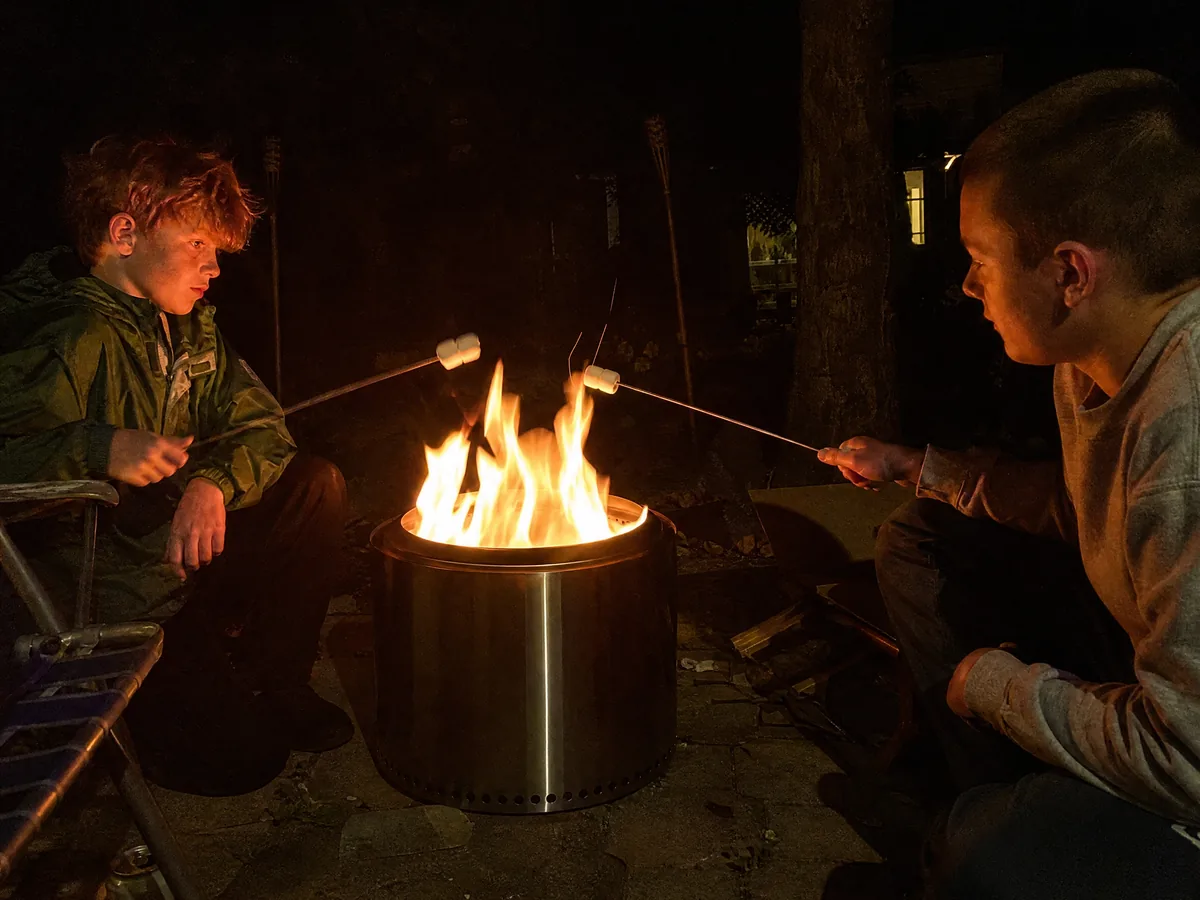
Our two teenage boys helped, mostly by eating s'mores. Evan, our 12-year-old neighbor and my assembly partner on the Weber back in May, took over as the official marshmallow tester. Here's what I found, starting with what makes this thing different from the old steel ring in your uncle's yard.
How "smokeless" works
The Bonfire is a double-walled stainless steel cylinder, 19.5 inches across and about 14 inches tall. There's a row of holes around the bottom of the outer wall and another row around the inside top rim. Air comes in at the bottom. Some of it feeds the fire from underneath, through the base plate. The rest travels up between the two walls, heats up, and comes out of the top holes as a ring of hot air.
That hot air meets the smoke rising off the logs and burns it. That's called a secondary burn, and when it's working you can see little jets of flame at the top holes, like a gas burner. Smoke is mostly unburned fuel. Burn it a second time, and there's a lot less of it.
The key word is "when it's working." A secondary burn needs the pit to be hot, and it needs wood that isn't full of water. Solo Stove itself says a little smoke at startup is normal. I wanted to know how much, and for how long.
What my thermometer and scale said
I used two kinds of wood: kiln-dried oak splits from the hardware store, and seasoned oak from a tree we cut down last fall, which I measured at 24% moisture with a cheap meter. Kiln-dried was around 11%. Every fire started the same way: three or four splits, two fire starters, a log cabin stack below the top holes, like Solo Stove recommends.
| Measurement | Kiln-dried oak | Our own seasoned oak (24%) |
|---|---|---|
| Lighting to visible secondary flames | about 7 min | about 14 min |
| Lighting to no visible smoke | about 9 min | 16 min, some smoke all night |
| Wood burned per hour (steady fire) | about 6.5 lbs | about 7 lbs |
| Outer wall, mid-height, after 30 min | up to 410°F | up to 360°F |
| Averages over | 17 fires | 6 fires |
With dry wood, it really is close to smokeless once it's going. After about nine minutes I could sit on any side of the pit without my eyes watering, and Janet's book club sat through a three-hour fire without anybody playing musical chairs. The next morning our clothes smelled only a little of campfire, which is the first thing Janet noticed.
With our own wood, it smoked like any fire pit for the first quarter hour and puffed on and off whenever I added a log. That's not the Bonfire's fault. It's physics. Wet wood spends its energy boiling water instead of burning, and a cool fire can't run a secondary burn.
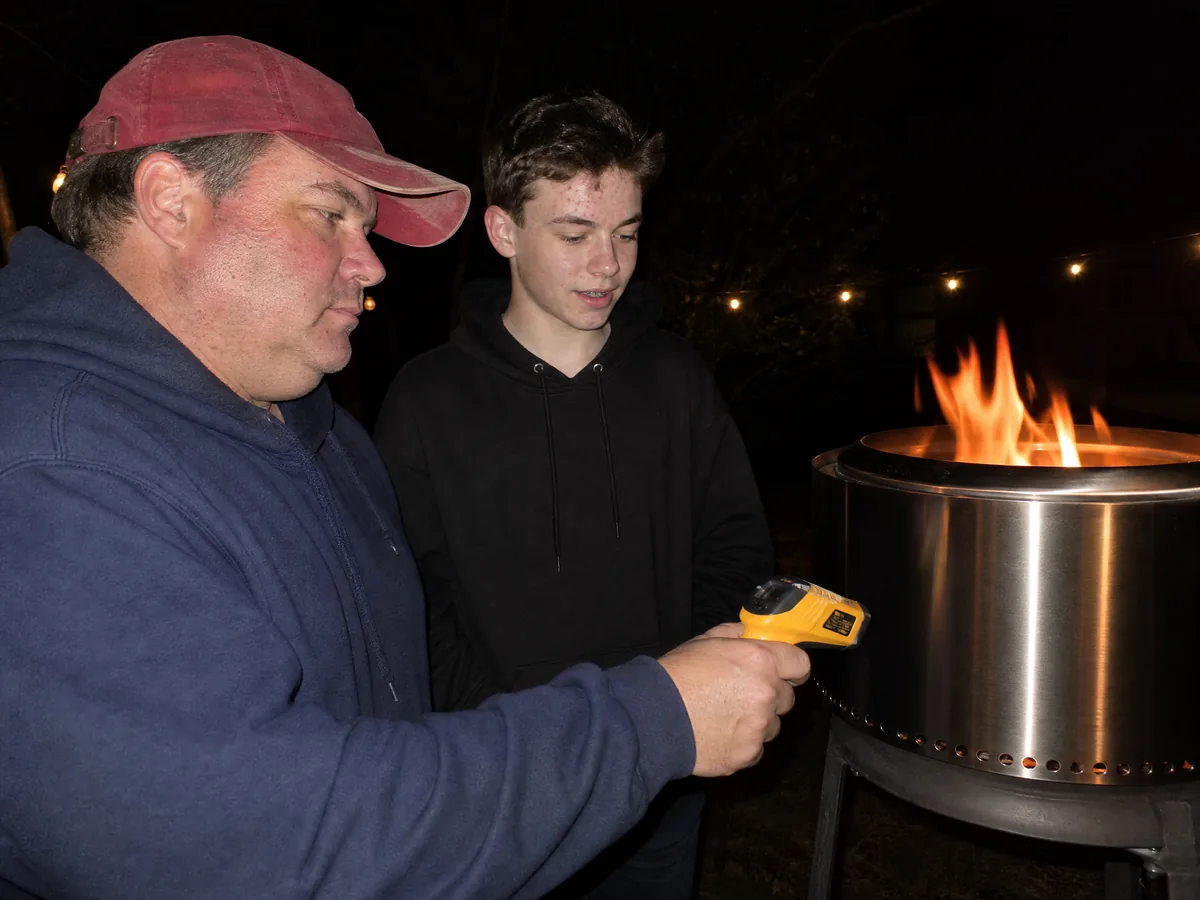
Heat is the Bonfire's weak spot. The design sends hot air straight up, and you feel it. With the IR thermometer aimed at the knee of my jeans, I got about 104°F at 3 feet from the rim and barely 80°F at 6 feet on a 58°F September night. If you sit close, you're warm. If your chairs are in a wide circle, the people at the back are wearing hoodies. Solo Stove sells a heat deflector ($159.99) that sits on top and pushes heat outward. We didn't test it, but it exists for exactly this reason.
The outside wall reached 410°F. That's hot enough to burn skin in a fraction of a second, which is the part I cared about most as a firefighter, and it's why the next section exists.
Decks, stands and the 15-foot rule
The bottom of any fire pit gets hot, and what's under it matters. I tested that on purpose. I set the Bonfire on a scrap board of composite decking, with and without the stand, and measured the surface after a 90-minute fire.
- Without the stand, on concrete pavers: the pavers under the base reached 243°F. Fine for concrete. Not fine for anything that melts or burns.
- With the stand, on composite decking: the board under the stand peaked at 118°F. Warm, no marks, no softening.
So the stand does its job, and Solo Stove says clearly that you shouldn't burn on a wooden deck without it. My advice is simple: if it's not concrete, stone or bare dirt, use the stand. The Bonfire 2.0 bundle comes with it, which is the way I'd buy it anyway.
Distance matters more than people think. The fire code many townships follow keeps portable outdoor fireplaces at least 15 feet from buildings and anything combustible. That means the house, the shed, the fence, the patio umbrella and the pile of cushions. Check your own township's rules too. Some ban all burning during dry spells, so check before the first fire of the season.
"Smokeless doesn't mean fireproof. It's still a fire. Treat it like one." What I told Evan, and what I'll tell you
And please, keep a hose or a full bucket of water nearby, even though you'll probably never use it. Solo Stove recommends letting the fire burn out instead of dumping water into the hot pit, and I agree for normal nights. The water is for the ember that lands where it shouldn't. With that covered, here's what the Bonfire is like on a Tuesday night.
Living with it: wood, ash and wind
Wood. The Bonfire burns hot and fast. At about 6.5 pounds of kiln-dried oak per hour, a typical $12 bundle from the hardware store lasted a little over an hour and a half. For a three-hour fire, plan on two bundles, or buy a bigger load of seasoned hardwood in the fall and dry it properly.
Ash. This is where the 2.0 earns the number. There's a removable ash pan under the base plate. The morning after, once everything is cold, you lift out the plate, pull the pan and dump it. It took me about 3 minutes, and the pan held the ash from three normal fires before it was full.
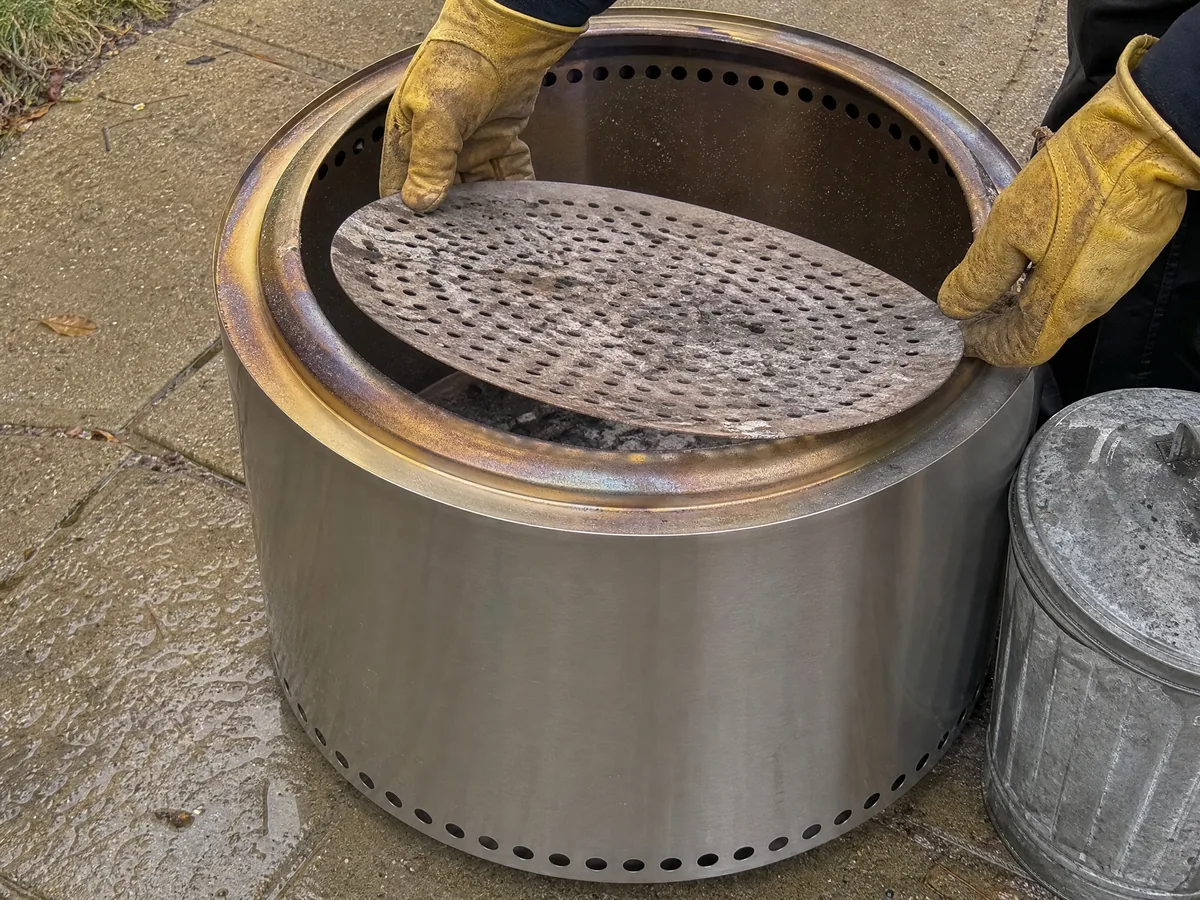
One firefighter note: ashes can hold live embers for days. Dump them into a metal can with a lid, never a paper bag or a plastic trash can. I've been on two garage fires that started exactly that way.
Wind. On gusty nights the Bonfire throws sparks like any wood fire, and pine throws more than oak. Solo Stove sells a spark shield. I'd buy it if you have dry grass, a wooden fence nearby or dogs who like to lie close. My younger son tried to feed it a pizza box on night four. The box went up in a whoosh of sparks, and he got the lecture he's been hearing since he was six.
Looks. The polished stainless turned a golden, rainbow-blue color at the top after the first fire. Solo Stove calls it a natural patina. It doesn't hurt anything, and I actually like it. If you want it shiny, you'll be scrubbing with stainless cleaner.
Cover. Left outside uncovered, rain collects in the pit and sits on the base plate. Solo Stove sells a lid ($79.99) and a fabric shelter ($49.99). I used a cheap round grill cover and a flower pot tray underneath. Covered, it's fine outside all season. The bigger question this fall is whether to buy the Bonfire at all, now that Solo Stove has a newer pit.
Bonfire 2.0 or the new Summit 19.5?
Solo Stove now sells the Summit 19.5, part of what it calls the Summit Series. Same 19.5-inch diameter, a built-in stand, lower walls for more visible flame, and a new "Quick-Strike" base plate that Solo Stove says lights three times faster. It's $399.99 at the time of writing. The Bonfire 2.0 is still sold, and Solo Stove still calls it its most popular fire pit.
We haven't burned a Summit yet, so I can only compare what's on paper. The Bonfire 2.0 with stand is $100 cheaper and has years of track record. The Summit's big promise is an easier start. With good wood and a log cabin stack, my Bonfire fires were going in about 7 minutes, which isn't a problem I'd pay $100 to solve. If lighting fires frustrates you, the Summit is worth a look. If you're comfortable with a match and dry wood, the Bonfire is the better buy today.
Both use the same 19.5-inch accessories, so a lid or shelter fits either one.
Specs at a glance
| Spec | Solo Stove Bonfire 2.0 with Stand |
|---|---|
| Diameter | 19.5 in |
| Height | 14.3 in, plus 2.8 in stand |
| Weight | About 23.3 lbs, stand 1.7 lbs |
| Material | 304 stainless steel |
| Fuel | Wood (pellet adapter sold separately) |
| Ash | Removable ash pan under the base plate |
| Seats | 4 to 6 people (Solo Stove's figure) |
| Warranty | Lifetime, per Solo Stove |
| Price at the time of writing | $299.99 with stand at Solo Stove, $299.95 at Amazon |
Four to six people matches what I saw. Six adults in camp chairs pulled in close was the limit for everyone to feel warm. For the neighborhood crowd on Labor Day, people stood in two rings and the back ring went for sweaters.
Holiday deals, gifting and returns
A fire pit feels like a summer buy, but fall is fire pit season in Pennsylvania, and it's one of the most common "for the guy who has everything" gifts. I didn't track the Bonfire's price last Black Friday, so I won't give you a made-up discount. Here's what I can tell you.
- The Bonfire 2.0 with stand is $299.99 at Solo Stove and $299.95 at Amazon at the time of writing.
- Solo Stove runs sales often. At the time of writing its site had "Fall Deals" running on other models, not on this bundle.
- The newer Summit 19.5 is $399.99, which puts pressure on the older Bonfire's price.
My rule of thumb: the Bonfire with stand under $250 is a good buy, and around $200 is a great one. Bundles with the lid and shelter are worth it if the extras come in at less than $50 over the pit alone.
As a gift, it's great for families with a patio or small yard, for people who camp by car (it fits in a trunk) and for anyone whose current fire ring makes the neighbors close their windows. It's a bad gift for someone in an apartment with a balcony, where it's almost certainly against the lease and the fire code. Good things to add:
- A bundle of kiln-dried hardwood and a pack of fire starters, so the first fire works
- A lid or shelter, because rain in the pit is the fastest way to a rusty base plate
- Long roasting sticks and a metal ash can with a lid
On returns: Solo Stove takes returns within 30 days on orders shipped in the lower 48 states. Amazon's holiday return period for late-fall orders normally stretches into January. Light one fire before that window closes. Once it's patina-gold, it's yours in spirit anyway.
Who should buy it, and who shouldn't
If you're outfitting the backyard for next season, my Weber Spirit E-325 review covers the grill that sits ten feet from this pit. And if smoke is something you actually want, for flavor rather than for your eyes, Randall's Traeger Woodridge Pro review is the other end of the spectrum.
Other options worth a look, all at Solo Stove's prices at the time of writing: the Ranger 15 with stand ($229.99) for two to four people or camping, the Summit 19.5 ($399.99) if easy lighting matters most, and the Yukon 27 with stand ($499.99) for big groups who want more heat. Every outdoor product we test gets the same thermometer, scale and safety checks, as explained on our how we test page, and you'll find our other yard picks in the reviews.
Twenty-three fires in, my neighbor finally got his answer. It's safe. It's clean. And it's still a fire, so act like it.
Questions people ask
Is the Solo Stove Bonfire really smokeless?
Almost, with dry wood. In our tests with kiln-dried oak, visible smoke was gone about 9 minutes after lighting. With home-seasoned wood at 24% moisture it took 16 minutes and puffed smoke whenever we added logs. Wood under 20% moisture is the key.
Can you use a Solo Stove Bonfire on a wood or composite deck?
Only with the stand. With the stand, our composite deck board peaked at 118°F after a 90-minute fire with no marks. Without it, the surface under the pit reached 243°F on concrete, which would damage decking. Keep it well away from railings and walls too.
Does the Solo Stove Bonfire give off heat?
Yes, but mostly upward. We measured about 104°F at the knee 3 feet from the rim and barely 80°F at 6 feet on a 58°F night. Sit close, or add Solo Stove's heat deflector to push more heat outward.
What's the difference between the Bonfire 2.0 and the Summit 19.5?
Same diameter. The Summit 19.5 adds a built-in stand, lower walls and a Quick-Strike base plate that Solo Stove says lights three times faster. It costs $399.99 against $299.99 for the Bonfire 2.0 with stand at the time of writing.
How do you put out a Solo Stove fire?
Solo Stove recommends letting it burn out. Stop adding wood about an hour before you want to go in, and let the pit cool completely before emptying the ash. Keep water nearby for stray embers, and store ash in a metal can with a lid.