
Which running watch is most accurate? 5 tested against a chest strap in Welsh rain
Five watches, one chest strap and 46 days of rain under Bute Park's trees and between Rhondda terraces. One stayed closest on pace and pulse. The runner-up costs a third as much.
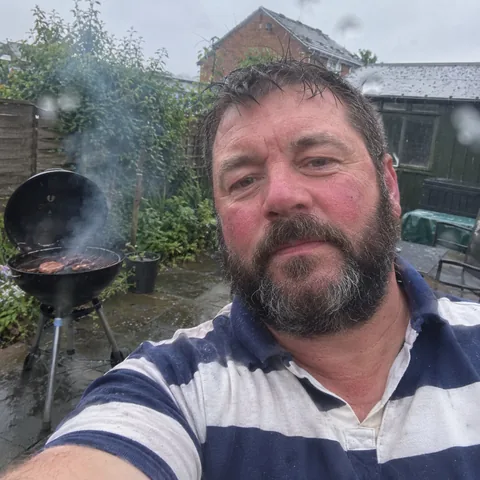 By Gareth Pennock, outdoor, barbecue and fitness tester
Tested in Cardiff · 12 October 2026 · 12 min read
- Measured 4.00 km of Rhondda terraces as 4.03 km, the best of the five
- Steady-run pulse 2.1 bpm from the chest strap on average
- Five real buttons that work with wet, cold fingers
- Torch and proper maps for the dark mornings and the woods
- Three times the price of the runner-up
- The Apple Watch read steady pulse slightly closer
- About 8 days per charge in my routine, not the 15 on the box
- Menus that take a weekend to learn
Verdict: the only watch that finished in the top two for both pace and heart rate, in the conditions most of us actually run in. If you train by numbers and run where the sky is narrow, this is the one. If the price stings, the Coros Pace 3 came remarkably close for under £200.
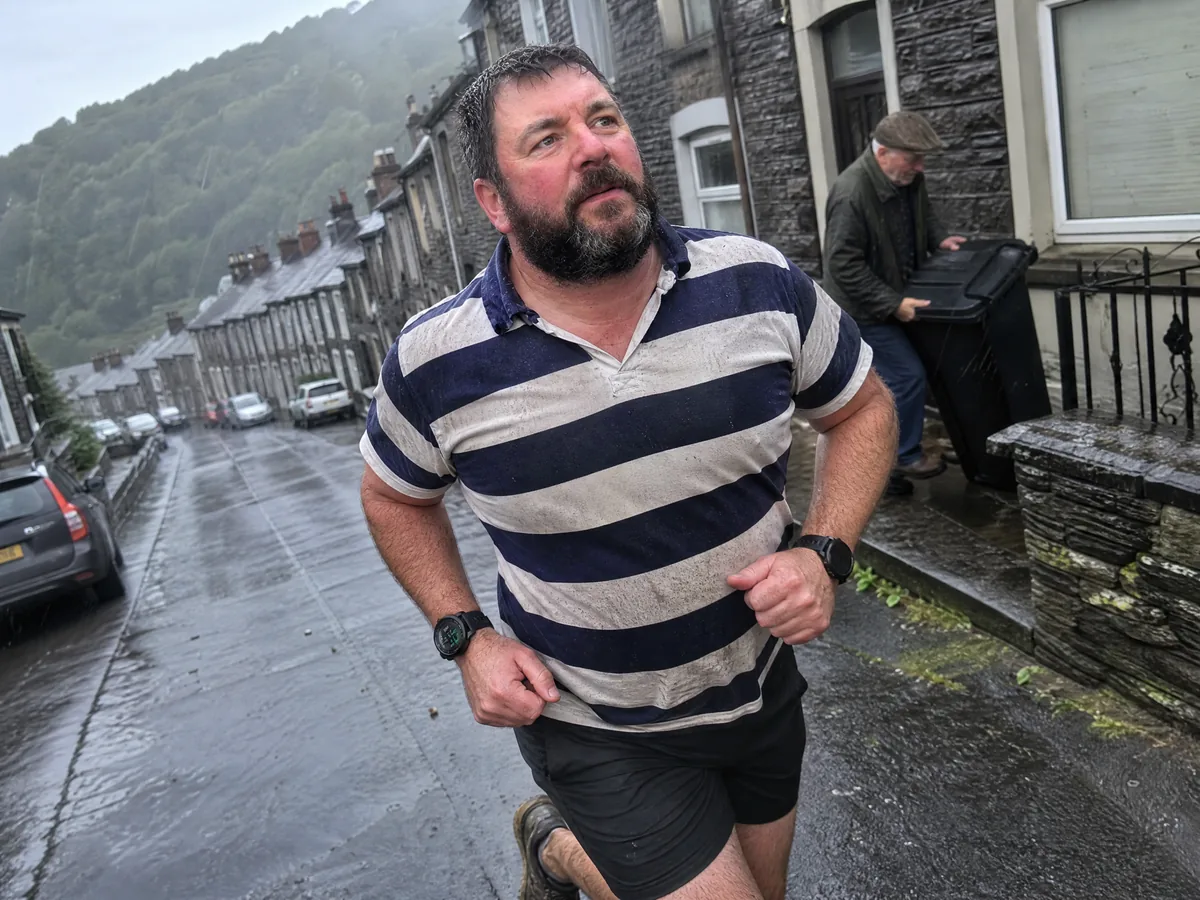
There's a man in Treorchy who thinks I'm on probation. He was putting his bins out on a grey Tuesday in early September when I came past his house for the third time in an hour, soaked, with a watch on each wrist and a strap round my chest. On the fourth lap he was waiting at the gate. "You on a tag, butt?"
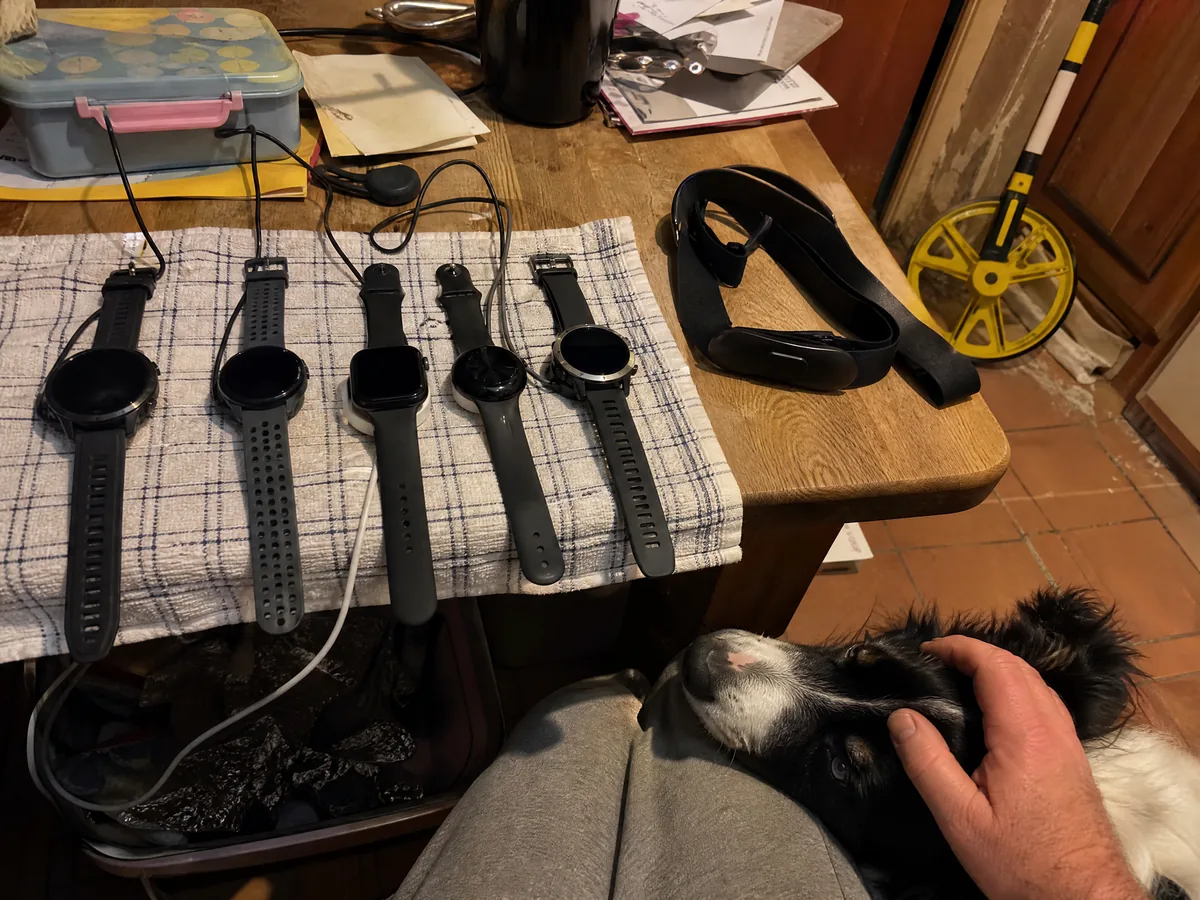
I wasn't. I was checking which of five running watches could tell me the truth in the places watches find hardest: under a roof of wet leaves, and in a narrow valley where rows of stone terraces and a mountain block half the sky. From 22 August to 6 October, 46 days in all, the Apple Watch Series 11, Garmin Forerunner 970, Samsung Galaxy Watch8, Google Pixel Watch 4 and Coros Pace 3 took turns on my wrists.
The question was the one that sat on our tests in progress page all summer: which one gets GPS pace and heart rate closest to a chest strap on wet runs under trees and between terraces? It turned out to be two questions, with two different answers. Only one watch was near the top of both.
A chest strap doesn't know your pace
Here's the catch I had to sort before day one. A chest strap is the yardstick every wrist sensor gets judged by, because it reads the electrical signal of your heart rather than guessing from light bounced off your wrist. Mine is a Polar H10, and for once in my life a piece of kit that needs to be damp to work properly was in the right country.
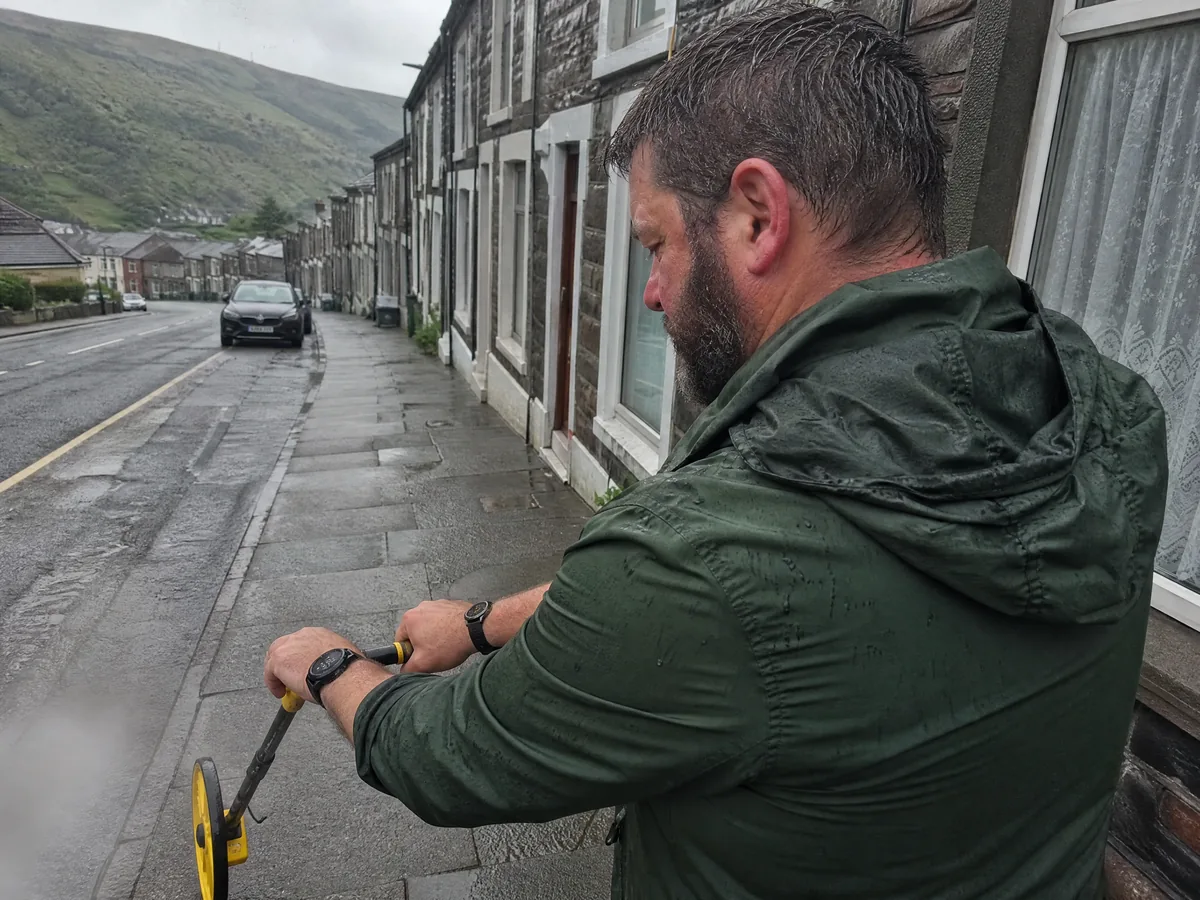
But a strap can't tell you how far or how fast you've gone. So for pace I needed routes where I knew the real answer to the metre. My brother-in-law Owain lays patios in Caerphilly and owns a yellow surveyor's measuring wheel. I borrowed it, with a lecture, and wheeled two loops.
- The tree loop, Bute Park: 3.00 km from the Blackweir footbridge, down the river under the big limes and planes, and back through the arboretum. In September it's a tunnel of wet leaves.
- The terrace loop, Treorchy: 4.00 km up and down the streets at the top of the Rhondda Fawr, where the houses climb the valley side in rows and the mountain fills most of the view.
Then the rules. Two watches per run, one on each wrist, swapped every time so no watch always had my better arm. Every watch on its most accurate GPS setting. The strap on for every single run, and nothing counted unless it was raining or the trees were still dripping from it. In late summer in South Wales that was not a hard condition to meet.
The five watches on test
We bought all five at normal UK shop prices, like we always do. The prices below are what they cost at the time of writing, and running watches move around a lot, especially with Black Friday on the way.
| Watch | Size tested | GPS | Works with | UK price |
|---|---|---|---|---|
| Garmin Forerunner 970 | 47 mm | Multi-band, all systems | iPhone and Android | £629.99 RRP, around £589 to £599 |
| Coros Pace 3 | 42 mm, nylon strap | Dual-frequency, all systems | iPhone and Android | about £179 to £199 |
| Apple Watch Series 11 | 46 mm GPS | Single-band | iPhone only | £399 at launch, now around £279 to £299 at Argos and Amazon.co.uk |
| Google Pixel Watch 4 | 45 mm Wi-Fi | Dual-frequency | Android only | £399 RRP, often around £300 to £330 in sales |
| Samsung Galaxy Watch8 | 44 mm Bluetooth | Dual-frequency | Android only | £349 RRP, around £249 to £279 at Currys and Amazon.co.uk |
Two of these needed different phones. The Galaxy and the Pixel paired with my Android, and the Apple Watch lived on Rhian's old iPhone 13, which spent six weeks zipped into my running belt. On Apple days I ran with two phones, two watches and a strap, and rattled like a tool box down the Taff.
That word "dual-frequency" matters more than anything else in the table, and the woods showed why.
Under the trees in Bute Park
Wet leaves soak up and scatter the satellite signal. A watch that only listens on one band, the old L1 signal, gets a weaker, messier fix and has to guess more. Dual-frequency watches also pick up the newer L5 signal, which is easier to tell apart from its own echoes. In theory that helps. On my tree loop, it was obvious.
Over 12 or 13 laps each, here's how the 3.00 km loop came out on average:
- Garmin Forerunner 970: 3.01 km. On-screen pace on a steady effort swung by about 5 seconds per km either side.
- Coros Pace 3: 3.02 km, with a swing of about 8 seconds.
- Pixel Watch 4: 3.04 km. Fine on the open stretch, jumpier under the limes.
- Galaxy Watch8: 3.05 km, and live pace that could jump 16 seconds between glances.
- Apple Watch Series 11: 3.06 km, with the biggest swings of all, about 19 seconds per km.
A 2% error sounds tiny. On a 10 km race plan it's 200 metres, and on a steady 5:15 per km run, a 19-second swing means your wrist flicks between "too slow" and "too fast" while you're running exactly the same speed. That's how you end up surging under every tree and blowing up by the castle.
The Apple Watch's final distances were never wild, to be fair. Apple smooths the numbers cleverly afterwards. It was the live pace, the number you actually run by, that wandered. And under the trees was the easy half of the test.
Between the terraces in the Rhondda
Treorchy is a different problem. The signal doesn't get soaked up, it bounces. It hits the stone fronts of the terraces and the hillside and arrives at your wrist a fraction late, from the wrong direction. Engineers call it multipath. I call it the reason my old watch once had me running through somebody's front room.
On the 4.00 km terrace loop the Garmin averaged 4.03 km and the Coros 4.04 km. Both drew my route on the map neatly down the right side of the road. The Pixel came in at 4.10 km, mostly from a few zigzags at the narrowest top end.
The Apple Watch read 4.13 km, and on two runs its track cut straight through a terrace and out the back gardens. The Galaxy did the opposite and came up short at 3.88 km, rounding off the sharp corners at the bottom of each street as if I'd taken a shortcut. Over a half marathon, that kind of error adds up to more than half a kilometre.
The man with the bins never did ask what the watches said. I'd have told him: two of them knew exactly where I was. Pace sorted, I turned to the harder half, the bit inside my chest.
Heart rate: cold wrists, wet sleeves and a cadence lock
Wrist sensors shine light through your skin and read the blood flow underneath. Rain itself doesn't upset them much. Cold does. On the 8°C mornings in late September, the blood pulls back from your hands and every one of the five watches struggled for the first few minutes.
Once warmed up, on steady runs, the averages against the Polar strap looked like this: Apple Watch 1.6 bpm off, Garmin 2.1, Coros 2.7, Pixel 3.3 and Galaxy 4.8. So yes, the Apple Watch was the best of the five on steady pulse, and by a decent margin.
Intervals told a similar story with bigger gaps. At the start of each hard 400 m rep the strap jumps straight away, and the wrist follows when it can. The Apple Watch caught up in about 4 seconds, the Garmin in 5, the Coros in 7, the Pixel in 9 and the Galaxy in 12.
The Galaxy had one proper wobble too. On two wet tempo runs it locked onto my cadence, the number of steps I take a minute, and showed 168 bpm for nearly three kilometres while the strap said 151. It's a known trick of wrist sensors when the watch moves slightly with every footstrike. Tightening the strap two holes fixed it, but Samsung wants it tighter than the others to read well.
"Most runners do their easy days too hard already. If your watch reads you five beats low, you speed up to get into zone 2, and that's how an easy week turns into a tired one." Darren Ackroyd, our physio in Huddersfield, when I sent him the Galaxy graphs
Put pace and pulse side by side, and the picture of the whole test gets very clear.
All the results in one table
Lower is better on every row except the final score. Each watch did 12 or 13 runs with the strap over the 46 days, 31 runs and 284 km in total, or about 176 miles.
| Measure | Forerunner 970 | Coros Pace 3 | Apple Series 11 | Pixel Watch 4 | Galaxy Watch8 |
|---|---|---|---|---|---|
| Bute Park loop error, 3.00 km | +0.3% | +0.7% | +2.0% | +1.3% | +1.7% |
| Treorchy loop error, 4.00 km | +0.8% | +1.0% | +3.3% | +2.5% | 3.0% short |
| Live pace swing, steady run | 5 s/km | 8 s/km | 19 s/km | 13 s/km | 16 s/km |
| Steady pulse vs strap | 2.1 bpm | 2.7 bpm | 1.6 bpm | 3.3 bpm | 4.8 bpm |
| Delay at start of a rep | 5 s | 7 s | 4 s | 9 s | 12 s |
| Days per charge, my routine | 8 | 17 | 1 | 1.5 | 1.5 |
| Final score | 9.1 | 8.6 | 8.0 | 7.6 | 7.1 |
So the Apple Watch reads your heart best and your pace worst. The Garmin was never more than half a beat behind it on pulse and miles ahead on pace. That's the whole result in one line, and the reason the Garmin won.
The winner: Garmin Forerunner 970
I've run with a Garmin for years, so I went in looking for reasons to mark it down. I didn't find many. On the terrace loop its line on the map looked like I'd drawn it with a ruler, and its live pace sat so still that I could run a whole tempo session by it under the trees without looking at the strap data once.
Then there's the rain. The three phone-style watches lean on their touchscreens, and a touchscreen in a downpour is a lottery. Twice the Pixel paused my run because a raindrop landed on the right spot. The Garmin has five buttons, and you can press them with cold, wet fingers through a sleeve. The torch on the front sounds like a gimmick until it's 6:30 on a dark October morning in Bute Park and the path along the river disappears.
The maps helped too. On a hilly heart rate run through Fforest Fawr, the woods behind Castell Coch, the paths split every few hundred metres. One glance at the watch told me which one went down to the car park. On my own Forerunner 570, which I reviewed in August, that's a phone-out moment.
Then there's the money. At around £589 it's three times the price of the Coros and nearly £200 more than my 570, which does most of the same running. And it lasted about 8 days between charges with five runs a week, not the 15 Garmin quotes for smartwatch use. Good, just not magic.
The best test came at the end.
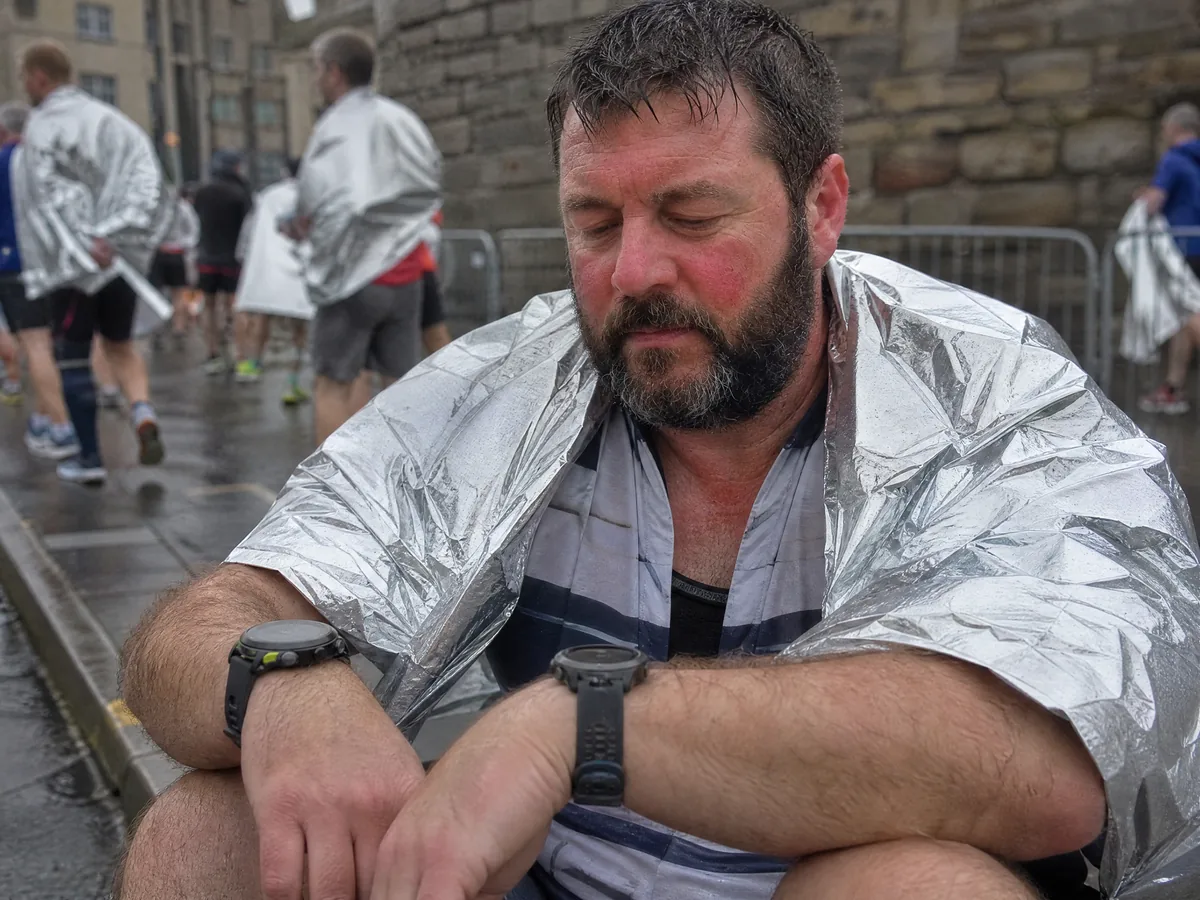
On 4 October I ran the Cardiff Half with the Garmin on my left wrist and the Coros on my right. The course is certified at 21.1 km. The Garmin said 21.27 km, the Coros 21.29 km, which is about what you'd expect from someone who doesn't run perfect tangents round the lake. My time was 1:40:12. My 570 had predicted 1:39 back in August, so I'll take the blame for that one, not the GPS.
Coros Pace 3: almost as good, for a third of the money
If one watch surprised me, it was this. The Pace 3 is the oldest model here and by far the cheapest, and it finished second on pace in both woods and terraces, with the Garmin only just ahead. Its pulse was 2.7 bpm from the strap on steady runs, a little behind the Garmin but ahead of the Pixel and the Galaxy.
It weighs about 30 g on the nylon strap, which is nothing. By week two I forgot it was there. The battery is silly: 17 days between charges, which means I charged it twice in the whole test. Its screen is the old memory-in-pixel kind, not as pretty as the others but perfectly clear in rain and grey light, and the touchscreen switches itself off during runs, so no raindrop accidents.
The downsides: it looks and feels like a budget watch, the app is plainer than Garmin's, and the nylon strap holds water like a sock after a downpour. On intervals it lagged a couple of seconds more than the Garmin. If you want a running watch and don't care much about the rest, this is the one I'd tell my mates at the club to buy. Two of them already have.
Apple Watch Series 11: best on the heart, shakiest on the map
On steady pulse, nothing beat it. 1.6 bpm from a chest strap is excellent for a wrist sensor, and it was the quickest to react at the start of a rep. If heart rate zones are how you train, and you run on open roads, it's very good.
The single-band GPS is what let it down here. Under the Bute Park trees and between the Treorchy terraces, live pace wandered more than on any other watch. Then there's the battery. I charged it every night and once more before a long Sunday run. If you already live on an iPhone and run mostly in town, it's a lovely all-rounder, and now the Series 12 is out, the 11 has dropped to sensible money.
Google Pixel Watch 4: good, until you push
The Pixel is a smarter running watch than the last one. Dual-frequency GPS came with this generation, and you can tell: in the woods it was third, closer to the Coros than to the Apple Watch. On steady runs its pulse was a respectable 3.3 bpm from the strap.
Intervals were its weak spot, with a 9-second delay at the start of every rep. And that domed glass looks lovely but gets very slippery when wet. It lasted about a day and a half per charge, and it charges quickly, which helps. For Android users who want one watch for everything and run a few times a week, it's a fair choice.
Samsung Galaxy Watch8: tighten it, then tighten it again
The Galaxy has a bright, sharp screen and a running coach that builds a plan from a short test run, which I liked. But it finished last on heart rate, with the cadence lock and a 12-second lag on reps, and it shaved corners off every terrace in Treorchy.
Wear it two finger-widths above the wrist bone, really snug, and the numbers improve a lot. For Samsung phone owners who want a smartwatch first and a running watch second, it's fine. For training by the numbers, the other four are better.
So which one is for you?
- Garmin Forerunner 970 if you train by pace and heart rate, run in woods, valleys or a city of tall buildings, and want maps and a torch for the dark months.
- Coros Pace 3 if you want almost the same accuracy for under £200, a battery that lasts weeks, and you can live without the smartwatch extras.
- Apple Watch Series 11 if you have an iPhone, run mostly on open roads, and care more about pulse than live pace.
- Google Pixel Watch 4 if you're on Android, run a few times a week, and want one good-looking watch for everything.
- Samsung Galaxy Watch8 if you have a Samsung phone and want a smartwatch first. Wear it tight.
Every score above comes from the same routine and scoring sheet we use for all our tech tests, written down on our how we test page.
After 46 days
On 6 October I gave Owain his wheel back, cleaned, with a bag of Welsh cakes by way of apology for the mud. The Forerunner 970 stays on my wrist for our long-term check through the winter, and my 570 has gone back in the drawer, sulking.
The Apple Watch never came back to me at all. Rhian took it off the charger on day 47, paired it to her own iPhone and went for a walk. She says it's "for the sleep tracking". Our nine-year-old says Mum is now competing with her step count. Both may be true.
My next test is already under way and it's a warmer one: heated jackets for the early dog walk and the touchline, which you can follow on our tests in progress page. Everything else we've finished testing is in our reviews.
Running watch questions, answered
Which running watch has the most accurate heart rate?
In our test the Apple Watch Series 11 was closest to a Polar H10 chest strap on steady runs, 1.6 bpm off on average, with the Garmin Forerunner 970 just behind at 2.1 bpm. On intervals every wrist watch lagged the strap by 4 to 12 seconds at the start of each rep.
Is dual-frequency GPS worth it for running?
If you run under trees or between buildings, yes. On our measured loops the Garmin and the Coros stayed within 1% of the real distance, while the single-band Apple Watch was 2 to 3.3% out, and their live pace swung far less. On open roads the difference is much smaller.
Is the Garmin Forerunner 970 worth it over the cheaper Coros Pace 3?
Only if you'll use the extras. The Garmin was slightly more accurate on pace and pulse and adds maps, a torch, a brighter screen and better coaching. The Coros came very close on accuracy for about a third of the price, with twice the battery life.
Does rain affect running watch accuracy?
Rain itself barely affects the heart rate sensor, but cold does: on 8°C mornings every watch was off for the first few minutes. Wet leaves weaken the GPS signal, and touchscreens can pause or lap your run by accident. Watches with buttons coped best.