
Which espresso machine makes a flat white in 3 minutes? 6 tested before the school run
Seventy-five days, 214 flat whites and a nine-year-old on the stopwatch. Only one of these six machines got a proper flat white into my hand in under three minutes on every school morning.
 By Tracey Hebblethwaite, home and kitchen tester, mum of two
Tested in Leeds · 4 November 2026 · 13 min read
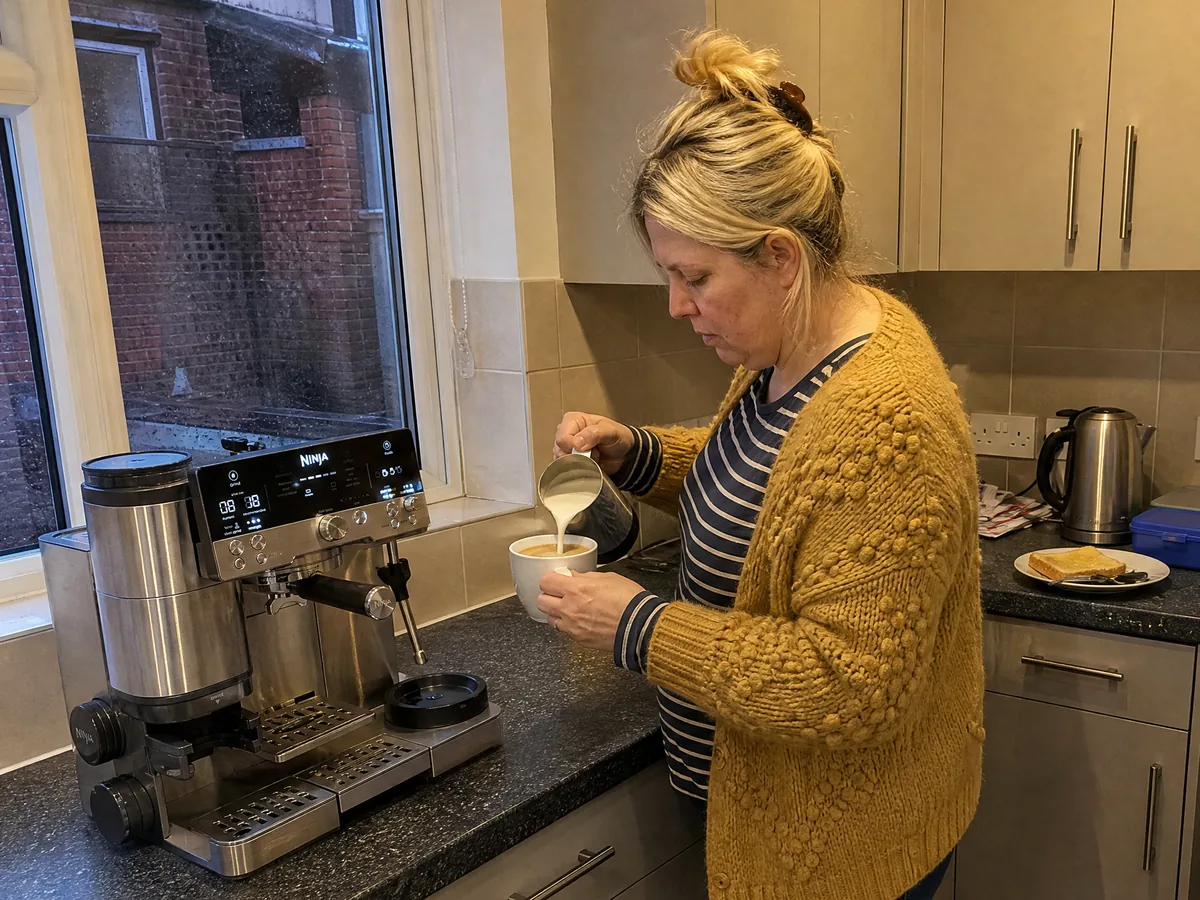
There's a gap in our mornings. It opens at about 7:32, when the last packed lunch is zipped shut, and it closes at 7:35, when Freddie announces he has one shoe. Three minutes. That's my coffee window, and for most of this year I spent it putting my coat on to buy a flat white at Leeds station instead.
When the De'Longhi bean-to-cup from my Magnifica Evo review went back in August, the station habit came straight back with it. I'd got used to good coffee at home, but I'd also learned something. What I actually want isn't a cappuccino at the press of a button. It's a proper flat white: a strong double shot, a thin layer of glossy milk, hot but not scalding.
So this was the question for six espresso machines under £600. Which one lets a beginner make a proper flat white in under three minutes, from a cold machine, before the school run? From Thursday 20 August to Monday 2 November, 75 days in all, they took turns on the worktop of our terraced house in Leeds. One of them never missed the window.
- Grinds, weighs and tamps for you, so the shot is right on a bleary Monday
- The milk froths on its own while you butter the toast
- It suggests a grind setting for each new bag of beans
- Median 2 minutes 46 seconds from a cold machine to a flat white in my hand
- 346 mm wide, the biggest footprint of the six
- The grinder is loud enough to wake a lie-in
- No hot water button on the UK version
- A lot of buttons for the first week
Verdict: if you've never made an espresso and you want a real flat white before you leave the house, this is the one I'd buy. It does the fiddly bits for you and still tastes like coffee from a good café. If you already own a decent grinder, the Sage Bambino Plus is faster and cheaper. If you just want milky coffee at a button, the Philips 3300 LatteGo is quicker still, but it never made a flat white.
- The three-minute rule
- Seventy-five days in one table
- Ninja Luxe Café: the one that never missed
- Sage Bambino Plus: quickest real flat white, with a bean problem
- Sage Barista Express Impress: best coffee, slowest learner
- De'Longhi Dedica Arte: tiny, cheap, wobbly milk
- Philips 3300 LatteGo: fastest, but not a flat white
- Gaggia Classic Evo Pro: lovely, for somebody else
- Lee's half-term challenge
- Five things I'd tell myself on day one
- Which one I'd buy, and for whom
- UK prices and where to buy
- Questions from the school gate
The three-minute rule
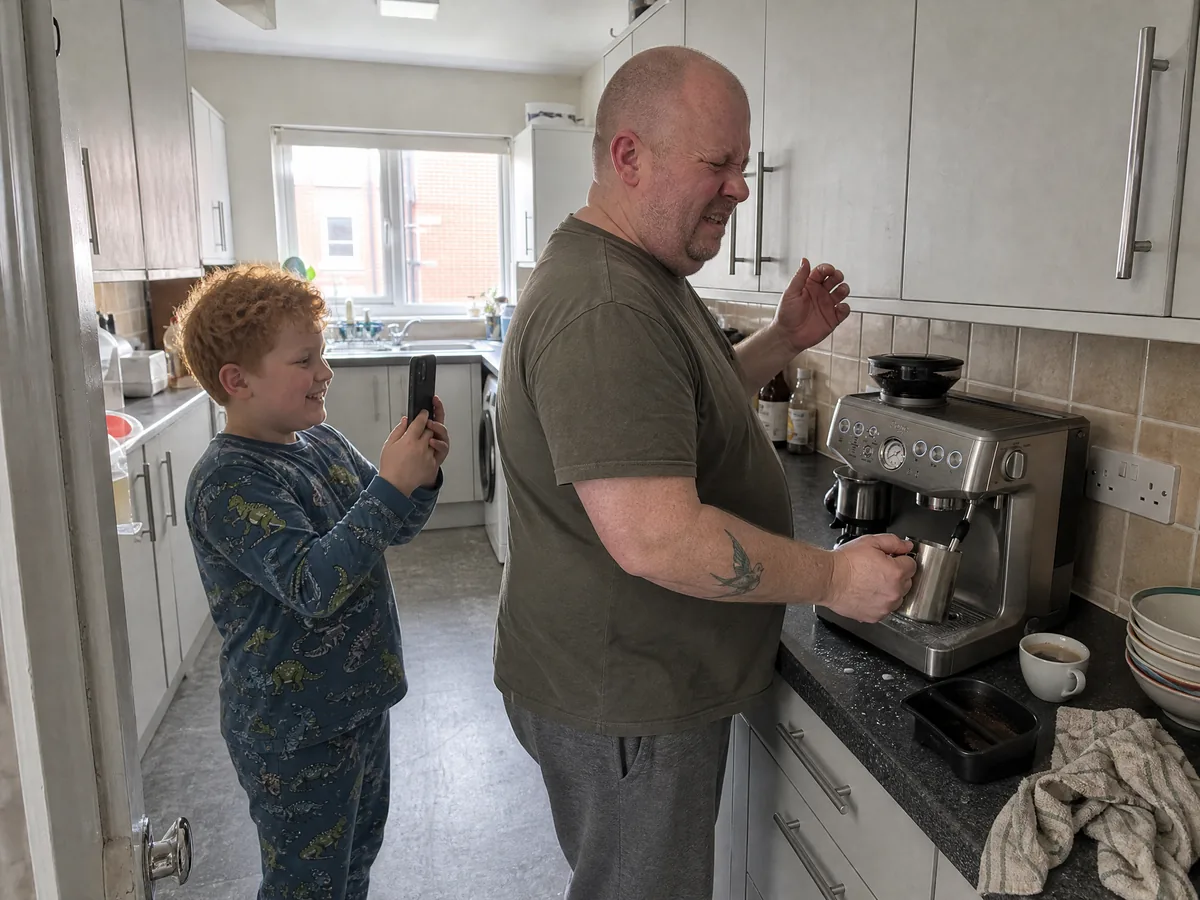
Three minutes sounds generous until you try it. The clock started when I pressed the power button on a machine that had been off all night, and it stopped when the finished flat white was in my hand. Freddie, who's 9, ran the stopwatch on my old phone and shouted the time like a racing commentator. Kai, 12, mostly ate cereal and heckled.
Then the cup had to pass. My flat white rules, agreed with the barista at the station kiosk who has watched me order the same thing for three years:
- A double shot that tastes neither sour nor bitter, about 36 to 40 g of espresso from the single-wall baskets
- Milk between 55 and 65°C in the cup
- Foam no thicker than about 1 cm, glossy, with no bubbles you can see
For the milk I borrowed the Thermapen my colleague Gareth uses as his referee in our wireless meat thermometer test. He wanted it back by Bonfire Night. He's getting it back.
The first twelve days, during the summer holidays, were for learning. Every machine got two practice days, with all the coffee and mistakes that involves. From the first day back at school on Thursday 3 September to Friday 23 October, each machine then got six school mornings on the clock, spread so every one of them had a Monday and a Friday. Half term was for the beginner test, which I'll come to. That made 214 flat whites, all logged in the notes app on my phone.
The three machines without a grinder got the same beans, ground for espresso by a roaster in town every Saturday. That decision turned out to matter more than I expected.
Seventy-five days in one table
Times are the median of six school mornings, from the power button to the cup in my hand. A flat white "passed" when it met all three rules above.
| Model | UK price at the time of writing | Median time, cold machine | School mornings under 3 min | Flat whites that passed | Score |
|---|---|---|---|---|---|
| Ninja Luxe Café ES601UK | About £400 to £480 (list £549.99) | 2 min 46 s | 6 of 6 | 6 of 6 | 9.1 |
| Sage Bambino Plus | About £349 to £399 | 2 min 21 s | 6 of 6 | 4 of 6 | 8.6 |
| Sage Barista Express Impress | About £599 to £729 | 3 min 34 s | 1 of 6 | 5 of 6 | 8.0 |
| De'Longhi Dedica Arte | About £165 to £249 | 3 min 17 s | 2 of 6 | 3 of 6 | 7.5 |
| Philips Series 3300 LatteGo | About £349 to £400 (list £550) | 1 min 58 s | 6 of 6 | 0 of 6 | 7.2 |
| Gaggia Classic Evo Pro | About £450 to £500 | 17 min 40 s for a good shot, 3 min 52 s with a smart plug | 0 of 6 | 3 of 6 | 7.0 |
Only two machines got both columns right most of the time, and only one got both right every time. That's the winner.
Ninja Luxe Café: the one that never missed
The Ninja Luxe Café ES601UK is a big brushed-steel box with a grinder on the left, a black control panel along the top and a frothing jug that sits on its own little plate on the right. It makes espresso, drip coffee and cold brew. I only cared about one drink.
What makes it work for a beginner is that it does the three jobs people usually get wrong. The grinder has 25 settings, and the screen shows the setting you're on next to the one it recommends, so with a new bag of beans you just turn the dial until the numbers match. A scale inside weighs the coffee as it lands in the portafilter, so the dose is the same every morning. Then you pull a lever on the side and it tamps for you. On our first practice day, Tuesday 25 August, my third shot was already better than any I'd made on the Gaggia.
The milk is the bit that wins the school run. You fill the jug, choose dairy and the thin froth setting, press a button and walk away. A whisk inside the jug does the texturing and the steam stops by itself. In that minute I can butter two rounds of toast and find a shoe. The thin froth setting gave me 61°C on average with the Thermapen, glossy, with almost no foam on top. That's a flat white.
Its fastest morning was 2 minutes 31 seconds, on Friday 9 October, and its slowest was 2 minutes 58 seconds, the day a new bag of beans needed two clicks finer. Six flat whites out of six passed. The downsides are its size, 346 mm wide, which sent our poor bread bin back up onto the fridge, and a grinder that sounds like a food blender at ten to eight. Lee, who leaves at quarter past six, never heard it. Kai, who would sleep until noon if allowed, heard it every time.
One fair warning: the UK version has no hot water button, so it won't do an Americano without the kettle. The next machine is quicker than the Ninja, if you solve one problem first.
Sage Bambino Plus: quickest real flat white, with a bean problem
The Sage Bambino Plus is under 20 cm wide and heats up in about 3 seconds, which Sage calls ThermoJet. It's true. The light stopped flashing before I'd got the milk out of the fridge. Its party trick is an automatic steam wand: you stand the jug on a sensor in the drip tray, pick one of three temperatures and one of three textures, and it stops when the milk is ready.
On the best mornings it was the quickest proper flat white of the test, 2 minutes 9 seconds on Wednesday 16 September. Its median was 2 minutes 21. The milk was lovely, 60°C on average and silky, the closest of any machine to what I get at the station.
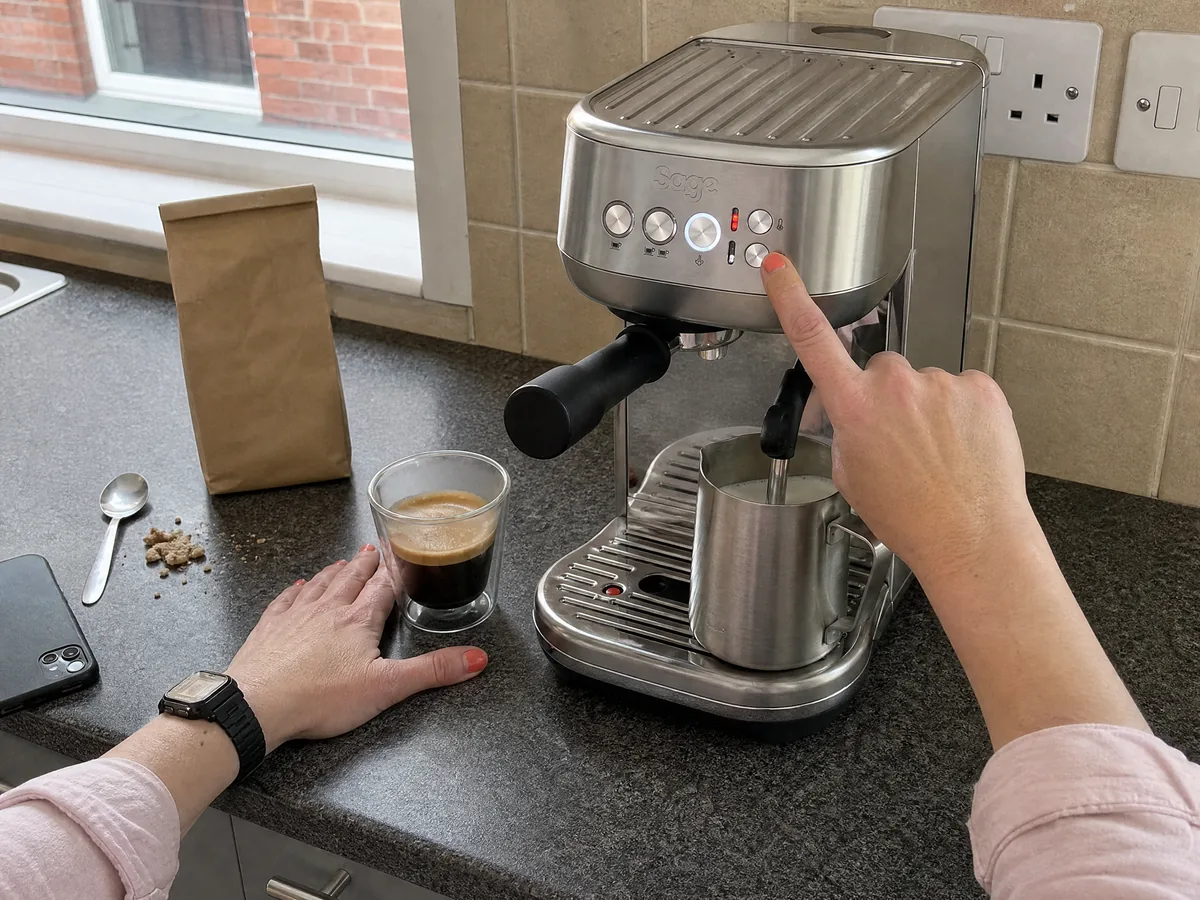
So why two failed cups? The Bambino has no grinder. On a Thursday and a Friday, six and seven days after the roaster ground my beans, the shots started running fast, thin and sour. Ground coffee goes stale quickly, and a single-wall basket shows it. The dual-wall basket in the box rescued the taste a bit but made a fizzy, thinner crema.
If you buy fresh ground twice a week, or you already own a decent grinder, this is the best value here. Budget roughly £150 to £250 more if you need a grinder too. The next Sage has one built in, and makes the best espresso of the six.
Sage Barista Express Impress: best coffee, slowest learner
The Sage Barista Express Impress is the machine most coffee fans told me to buy. It has a grinder on top, a pressure gauge in the middle and a lever on the left that tamps the coffee at a set pressure and tells you on a little dial whether the dose was too much or too little. It corrects the next dose on its own. Clever, and it works.
Its espresso was the best of the test. Chocolatey, sweet, and every shot within 2 g of my target from the second week on. Five of its six flat whites passed. The problem was the clock. The steam wand is fully manual, and texturing milk by hand is a skill. For the first fortnight I made either scalded milk or a bubbly meringue, and on the school mornings my median was 3 minutes 34. I beat three minutes once, 2 minutes 48 on Friday 2 October, and I was so pleased I made Freddie take a photo of the stopwatch.
We bought it for £598.99, which is the only reason it fits an under-£600 test. Its list price is £729.95. If you enjoy the learning, it's the one you'll still love in five years. If you need speed this month, it isn't. The next machine has the same kind of wand on a much smaller budget.
De'Longhi Dedica Arte: tiny, cheap, wobbly milk
The De'Longhi Dedica Arte EC885 is 15 cm wide, the narrowest machine here, and about £165 to £249 depending on the colour and the shop. Ours was grey. It has no grinder, but its pressurised baskets are forgiving, so shots stayed drinkable even with week-old grounds. That's the good news.
The wand is a proper manual one, better than the old foamy sleeves on cheap machines, but it's weaker than the Sage's. Texturing 130 ml of milk took me about 50 seconds, and it gurgled if I let the tip rise. Three of six flat whites passed, and two school mornings came in under three minutes. The drip tray is small too. On Monday 28 September I filled it to the brim with rinse water and didn't notice until it reached the toaster.
For a small kitchen, a tight budget and someone happy to practise, it's a decent start. The next machine needs no practice at all, which was exactly its problem.
Philips 3300 LatteGo: fastest, but not a flat white
The Philips Series 3300 LatteGo is a bean-to-cup, so you press a picture on a touch panel and it grinds, tamps and pours for you. It won the speed race easily, a median of 1 minute 58 seconds from cold. The LatteGo milk jug has no tubes and rinses clean under the tap in about 15 seconds. My mum would love it.
There's no flat white button, though. It makes cappuccino and latte macchiato, and the milk comes out as a thick, stiff foam. I tried a short cappuccino with the strength turned up, less milk, every combination the menu allows. The foam was always 2 to 3 cm thick, so zero of six passed my rules. They were nice milky coffees, and Lee, who takes his coffee very milky, rated them highest of anything all autumn.
If cappuccino at a button is what you want, the Philips is quick, cheap to run and easy. If you want a flat white, keep reading. The last machine is the opposite of the Philips in every way.
Gaggia Classic Evo Pro: lovely, for somebody else
The Gaggia Classic Evo Pro is a steel box made in Italy with three rocker switches, a 58 mm commercial portafilter and a steam wand like the ones in a café. Coffee forums adore it, and I understand why. On a Saturday, with time, it made a lovely shot, and its steam is strong.
On a school morning it was hopeless. The forums say give it 15 to 20 minutes to warm up properly. On its first two school mornings a shot pulled at the two-minute mark was sour, and on practice weekends my median for a good shot from cold was 17 minutes 40 seconds. Freddie started calling it "the toaster" because it sits there warming up and nothing happens.
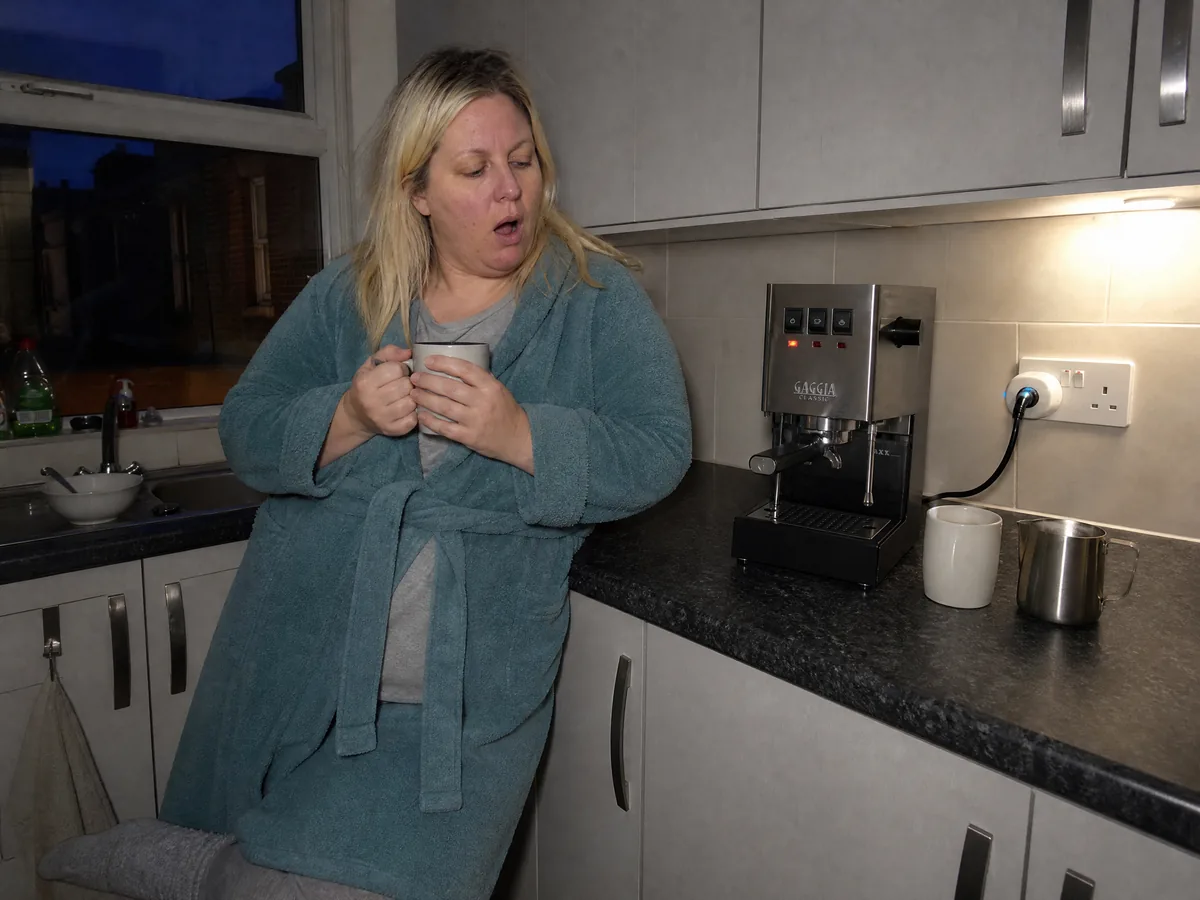
So I cheated, a bit. For its other four school mornings I plugged it into a smart plug from Argos that switched it on at 7:05. Even then, brewing, then waiting for the boiler to heat up for steam, then steaming by hand took a median of 3 minutes 52 seconds. Three of its six school-morning flat whites passed, all of them smart plug mornings. It's a machine for a hobby, not a hurry. Which brings me to the person in our house with the least patience for coffee.
Lee's half-term challenge
I'd had nine weeks of practice by half term, so my times flattered every machine. Lee had never made an espresso in his life. On Tuesday 27 October he took the day off, read each quick start guide once, and made one flat white on each machine while I sat on my hands. Freddie ran the stopwatch.
- Philips 3300 LatteGo: 1 min 50 s, a nice cappuccino, not a flat white
- Sage Bambino Plus: 2 min 51 s, passed
- Ninja Luxe Café: 3 min 12 s, passed, and the best tasting of his six
- De'Longhi Dedica Arte: 4 min 5 s, big bubbles, failed
- Sage Barista Express Impress: 5 min 40 s, the milk screamed, failed
- Gaggia Classic Evo Pro: one sour shot, then he refused to steam
"The Ninja's the only one that didn't make me feel thick. It just tells you what to do next." Lee, Tuesday 27 October, holding the jug like a trophy
The Bambino was quicker for him too, but that was on Saturday's fresh grounds. With a full bag of beans and no help, the Ninja was the one he'd use on a Thursday. Whatever you buy, a few habits make a big difference.
Five things I'd tell myself on day one
- Fresh coffee matters more than the machine. Grounds more than five days old ruined shots on every machine without a grinder.
- Start with cold milk and a cold jug. It gives you more time to texture before it gets too hot.
- Fill the jug to just under the spout. About 130 ml is right for one flat white in a 180 ml cup.
- Lay it all out the night before. Cup, jug and portafilter on the worktop saved me 15 to 20 seconds a morning.
- Empty the drip tray every evening. Ask the Dedica and my toaster.
Every score here comes from the same routine we use for our kitchen tests, written down on our how we test page. Now, the shopping bit.
Which one I'd buy, and for whom
The De'Longhi Dedica Arte suits a tiny kitchen and a small budget. The Gaggia Classic Evo Pro suits someone who wants coffee as a hobby and has time on a weekend. If you'd rather skip all of this and use pods, my Nespresso Vertuo Pop review is the easy route.
UK prices and where to buy
We bought all six ourselves. Here's what each costs as I write this, and the price I'd wait for:
- Ninja Luxe Café ES601UK: £549.99 list, about £400 to £480 at Argos, Currys, John Lewis and Ninja's own UK shop. Good under £420.
- Sage Bambino Plus: £399 at John Lewis, around £349 at independent cookshops. Good under £330.
- Sage Barista Express Impress: £729.95 list, from about £599 when it's on offer. Don't pay full price.
- De'Longhi Dedica Arte: about £165 to £249 at Argos, Habitat and John Lewis, depending on the colour. Good under £180.
- Philips Series 3300 LatteGo: £550 list, about £349 to £400 at Argos and Amazon.co.uk. Good under £350.
- Gaggia Classic Evo Pro: about £450 to £500 at specialist coffee shops. Add a grinder.
Most of these drop for Black Friday on 27 November. Lee has worked out that the Ninja costs the same as 118 station flat whites, or "three weekends in Whitby", and that at my rate it pays for itself in about eleven months, beans and milk included. The Ninja stays on our worktop, and the bread bin stays on the fridge. You can see what else we're testing on our tests in progress page, and everything we've reviewed for the kitchen is in the home and kitchen section.
Questions from the school gate
What is the best espresso machine for a beginner in the UK?
In our 75-day test the Ninja Luxe Café was the easiest for a beginner. It recommends a grind setting, weighs the dose, tamps for you and froths the milk on its own. It made a flat white that met our rules in under three minutes on six school mornings out of six, and a complete beginner managed one on his first try.
Is the Ninja Luxe Café better than the Sage Bambino Plus?
For a beginner with whole beans, yes, because the Ninja has a grinder built in. The Bambino Plus was faster, with a median of 2 minutes 21 seconds against 2 minutes 46, and its milk was just as good. But it has no grinder, and its shots went sour once our pre-ground coffee was six days old. With fresh grounds or your own grinder, the Bambino Plus is better value.
Can a bean-to-cup machine make a proper flat white?
Not the Philips 3300 LatteGo we tested. It has no flat white setting, and its milk always came out as a thick foam of 2 to 3 cm, more like a cappuccino. It was the fastest machine in the test and made very nice milky coffee, just not a flat white.
How long does a Gaggia Classic Evo Pro take to heat up?
Its light comes on quickly, but shots pulled after two minutes were sour in our test. Owners usually give it 15 to 20 minutes, and our median for a good shot from cold was 17 minutes 40 seconds. A smart plug that switches it on before you get up solves most of that.