
De'Longhi Magnifica Evo review: did it end my £40-a-month coffee habit?
I was spending over £40 a month on coffees on my office days. So we logged 276 cups from De'Longhi's best-selling bean-to-cup to see if it could stop that.
 By Tracey Hebblethwaite, home and kitchen tester, mum of two
Tested in Leeds · 30 July 2026 · 12 min read
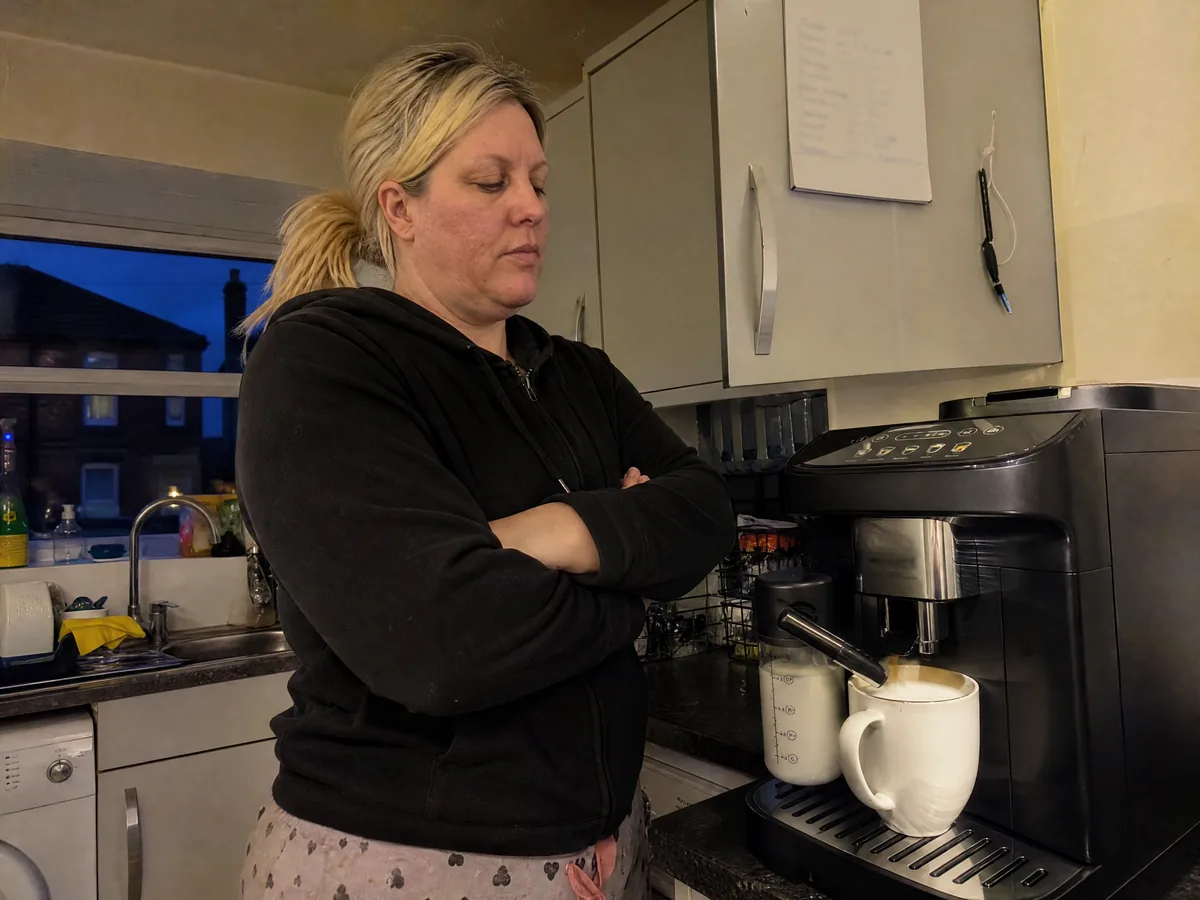
- A short, strong espresso that didn't drift over six weeks
- One twist of a dial and the milk pipe cleans itself
- The brewing unit pops out so you can rinse it properly
- Only 24 cm wide, so it squeezes into a terraced-house kitchen
- The long "Coffee" button tastes stewed
- A tall latte glass won't stand under the spout
- The drip tray and grounds bin fill up fast
- Its hot water is too cool for a decent cup of tea
Verdict: for flat whites, cappuccinos and espresso at quarter past six, with buttons instead of an app, this is the one we'd buy for under £500. Tall-glass latte drinkers and households who each want their own saved settings should spend a bit more.
My banking app has a feature that sorts your spending into little coloured circles. I wish it didn't. In April, the circle for "eating out" said £41.60, and when I tapped it, it wasn't eating out at all. It was coffee. A flat white at the kiosk in Leeds station, another at the place by the office, three days a week, every week.
Lee read it over my shoulder. "That's a weekend in Scarborough," he said, which is how Lee measures all money. He wasn't wrong. So when the De'Longhi Magnifica Evo came up for a test, I had my question ready: can a £400-odd bean-to-cup machine in a terraced kitchen in Leeds pay for itself, and still make a coffee I'd rather drink than the one at the station?
Kai, who's 12, appointed himself head of scoring on day one. He taped a sheet of paper inside the cupboard door above the machine, hung a biro off it on a bit of string, and made a rule that every drink gets a mark out of five. Six weeks later the sheet had turned into four sheets and 276 drinks, some of them with comments I'll share.
Which Magnifica Evo we tested
Shopping for one is confusing, because "Magnifica Evo" is printed on several different machines. The one people usually mean, and the one we used, is the ECAM290.61 with the LatteCrema milk jug on the front. It's sold as ECAM290.61.B in plain black and ECAM290.61.SB with a silver front, and inside they're identical. The ECAM290.21 is its cheaper sibling with an old-fashioned steam wand, and De'Longhi has launched newer Evo versions since, which we haven't tried.
On the front of the 290.61 are five buttons with little pictures: Espresso, Coffee, Cappuccino, My Latte and Hot Water. My Latte is the one you tailor, choosing the strength and how much coffee and milk go in. You won't find a screen or an app. I liked that. If you enjoy menus and settings, you might not.
The numbers
| Spec | De'Longhi Magnifica Evo ECAM290.61 |
|---|---|
| Price | £529.99 list, often around £400 to £450 at the time of writing |
| Buttons | Espresso, Coffee, Cappuccino, My Latte, Hot Water |
| Milk | LatteCrema jug, goes in the dishwasher |
| Grinder | Conical steel burrs, 13 settings |
| Water tank | 1.8 litres |
| Beans | Holds about 250 g |
| Pressure and power | 15 bar, 1,450 W |
| Footprint | About 24 cm wide, 44 cm deep and 36 cm tall, 9.6 kg |
| Where to buy | Currys, John Lewis, Argos, Amazon.co.uk, De'Longhi |
It slotted between the kettle and the bread bin like it had been measured for it. Check the depth, though: the milk jug hangs off the front.
Dialling it in: the first eleven cups
The first shot was a letdown. With our beans, a medium roast from a little roaster in Leeds, the espresso raced into the cup in 17 seconds and tasted like hot sour water. Kai gave it a one, and wrote "WHY" next to it.
The fix is the grinder dial inside the bean hopper. You only turn it while the grinder's running, and you move one click at a time, because the next cup or two still use coffee that was ground on the old setting. It took me eleven cups to walk it down to setting 4. There, the shot took 27 seconds to pour about 38 ml, with a thick golden-brown layer on top that was still there when I'd buttered my toast.
Water hardness is the other day-one job, and it's quick. Dip the strip from the box in a glass of tap water and tell the machine the result. Ours said 1, the softest, because Yorkshire water round here is soft. That number sets when the machine asks to be descaled, and getting it right is one of the cheapest ways to keep a bean-to-cup tasting good for years.
Black coffee, and the button to avoid
Straight espresso is this machine's strong suit. Ours came out rich and cocoa-ish with a toasted, nutty finish, and no scorched aftertaste. Better still, the 88 espressos on Kai's sheet average 4.2, and the early ones score the same as the late ones. In our house, consistent is the highest compliment going.
The "Coffee" button is a different story. To fill a mug it pushes a lot of water through a single dose of grounds, and what comes out is thin at the front and harsh at the back. Its average on the sheet was 2.8. Lee, who needs a big mug before he leaves for work at quarter past six, was not impressed.
"It's not bad. It's just what you'd get off the M62 at four in the morning." Lee, cup 41, 6.14am
What worked instead: press Espresso with the mug underneath, then press Hot Water and let it top the mug up. In a café they'd call that a long black. Kai's sheet gave it 4.0, and Lee now makes one every morning and acts as if he came up with it. If you like a big mug of black coffee, learn this on day one.
I also stuck a probe thermometer in a few cups. With the machine on its hottest setting, an espresso measured 65°C in a cup I'd warmed first and 59°C in one straight from the cupboard. It's on the hottest of its three settings now and staying there.
Milk: the LatteCrema jug
The milk jug is a clear plastic carafe with a lid that plugs into the front of the machine. Press Cappuccino and it sucks up milk, froths it straight into your cup, then sends the espresso through on top. Button to finished drink took 61 seconds.
The froth is soft and tight-bubbled, the kind you get in a decent coffee shop, not the kind that sighs flat as you carry it to the table. Latte art is beyond it, and beyond me. The milk in a finished cappuccino read 60°C, which you can drink straight away. I'm from Yorkshire, though, and I like a drink hot enough to warm both hands, so I warm the cup first.
Whole milk from the back of the fridge gave the best froth. Semi-skimmed, which is what we normally buy, came out looser, with bigger bubbles. A barista-style oat drink was nearly as good as whole. Freddie, who is 9, discovered that if he stands next to me at the right moment he gets the froth off the top of my cup with a teaspoon. I've given up fighting it.
Two niggles. The spout won't lift high enough for my 15 cm latte glass, so the glass goes in at an angle and I hold it there, which is nobody's idea of a calm morning. And there's no two-cup button for milk drinks, so if Lee and I both want one, we queue.
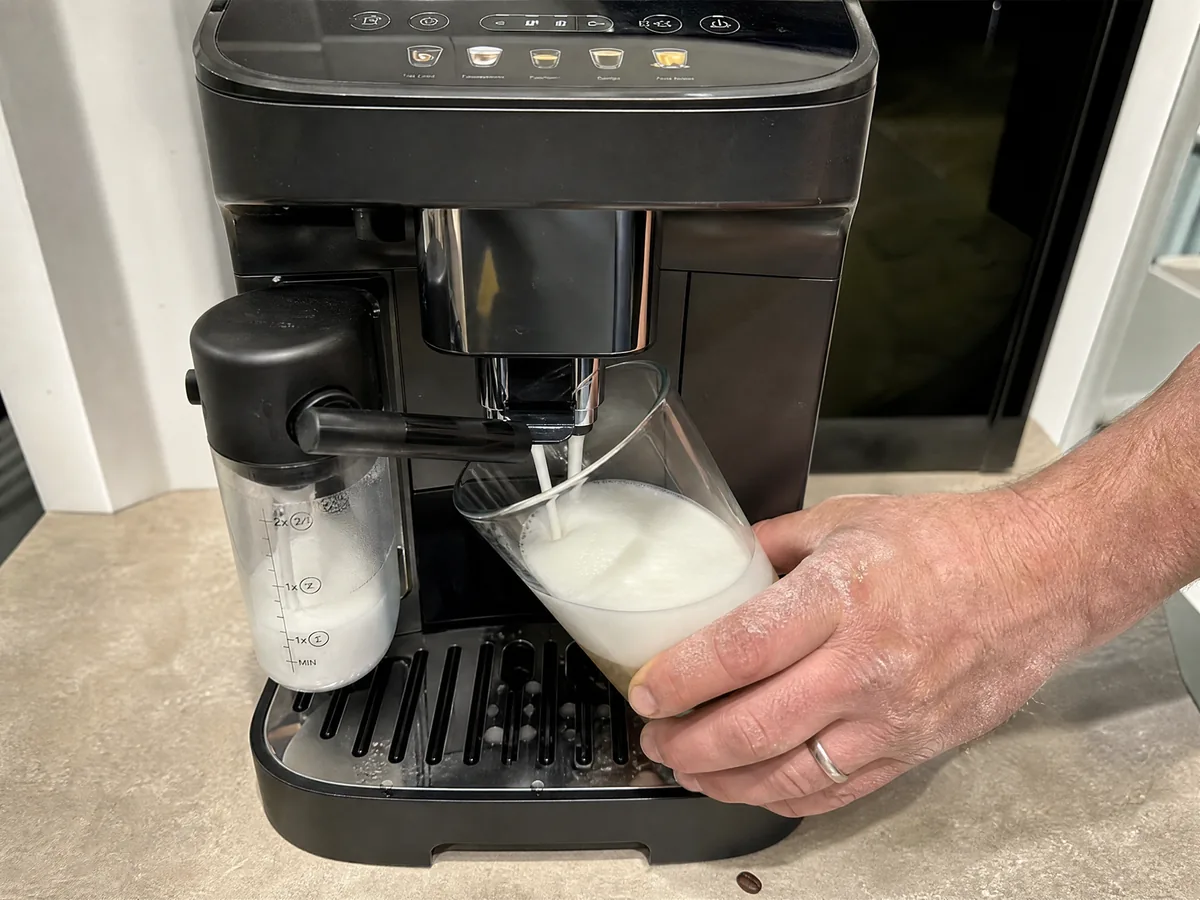
What I love is the cleaning. Turn the little dial on the jug to Clean and the machine blows steam back through the milk pipe for a few seconds. The whole jug, milk and all, goes back in the fridge door until tomorrow. Every evening it goes in the dishwasher. No crusty milk, no fiddly tubes.
The hot water button and the tea incident
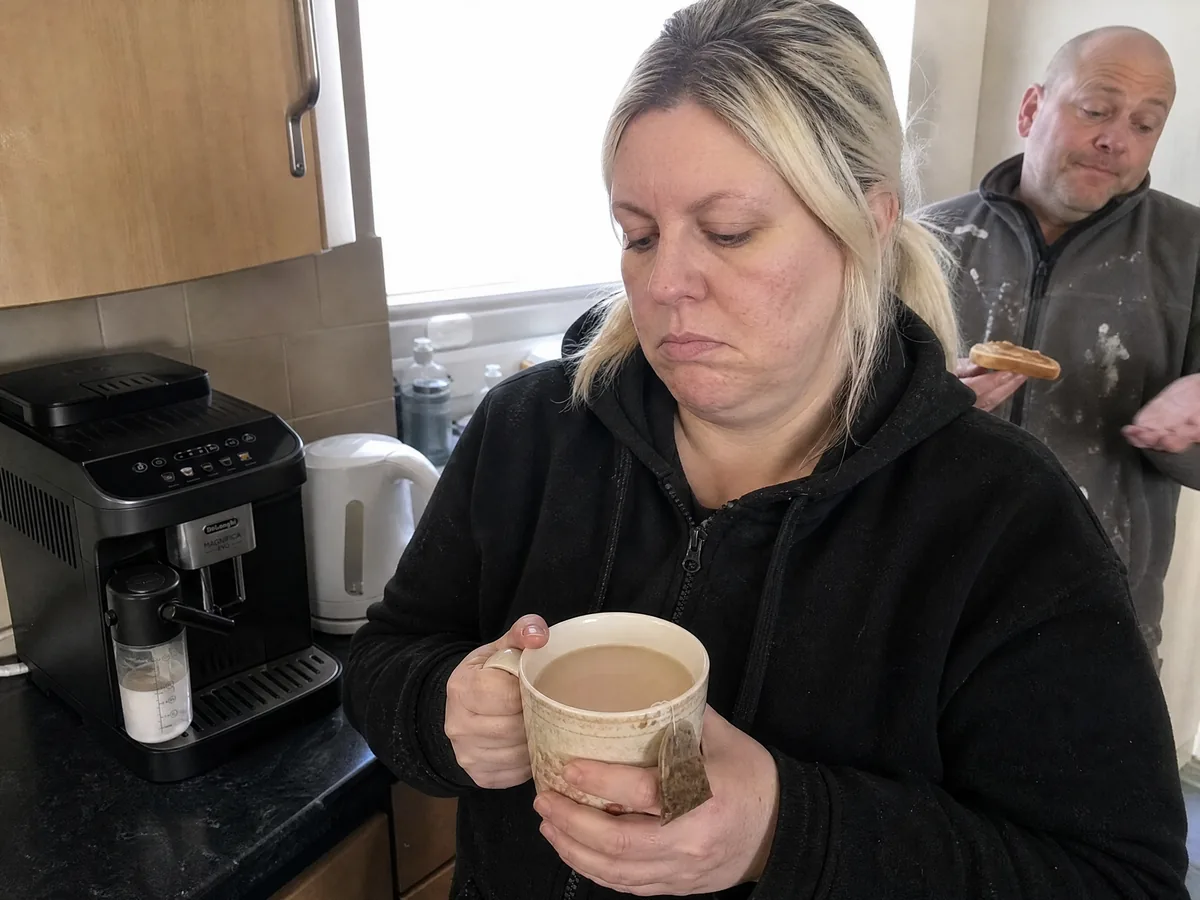
This is a British review, so I have to report it. In week two, Lee tried making his tea with the Hot Water button to save boiling the kettle. I measured the water in the mug: 82°C. A tea bag in 82°C water doesn't brew, it sulks. The result was pale, sad and, in Lee's words, "a crime against Yorkshire".
The hot water button is fine for topping up an espresso or warming a cup. For tea, the kettle stays. Nobody in our house has tried it since, and Freddie now tells everyone who visits "don't make tea with the coffee machine" as if it's a family rule. I suppose it is.
Keeping it clean
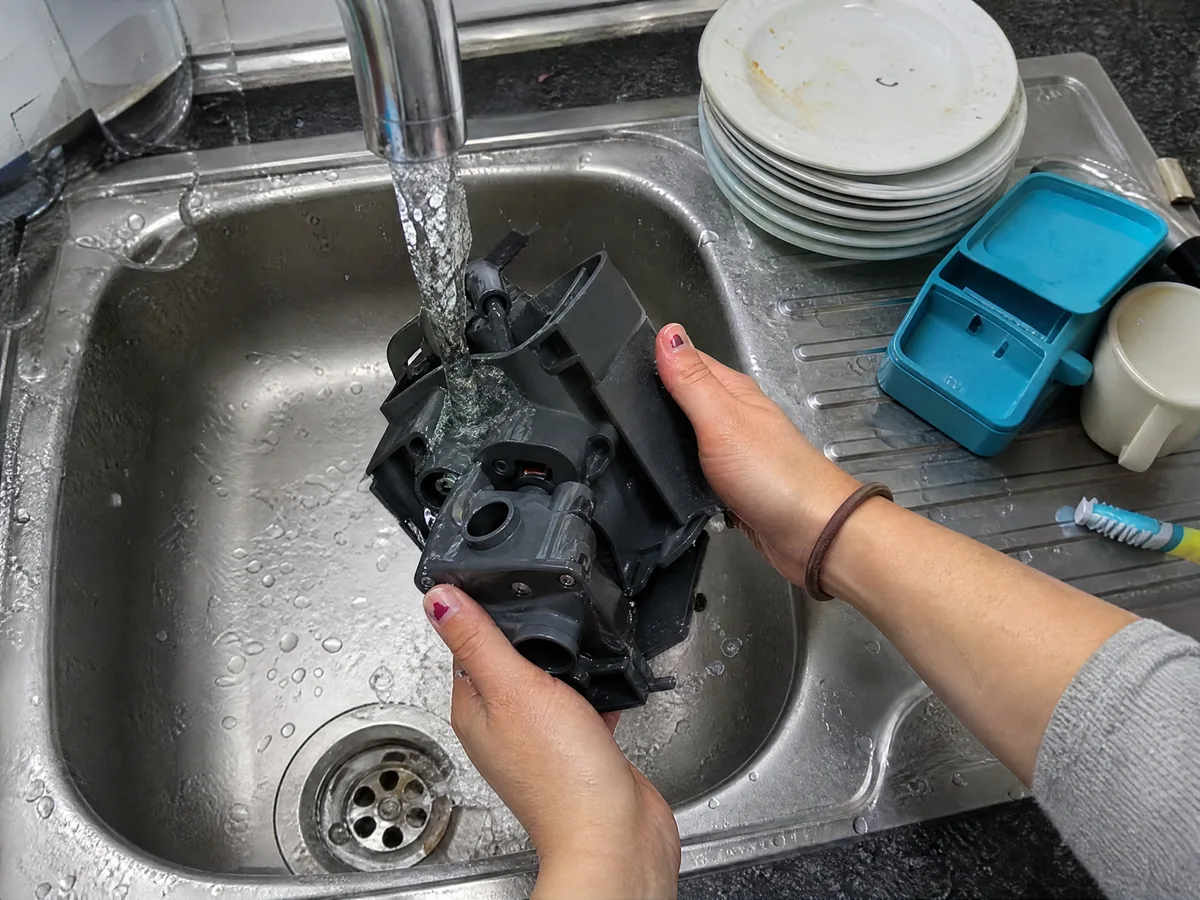
Open the little door on the right-hand side and the whole brewing unit slides out in your hand. On machines where it's sealed in, you never see the coffee gunk building up inside. Ours came out every Sunday night for a rinse under a lukewarm tap, no soap, then sat on the drainer to air-dry. Six weeks in, it still looked brand new.
The smaller containers keep you busy. The grounds bin asks to be emptied after about a dozen drinks. The drip tray catches the little rinse the machine does every time it switches on or off, and in our kitchen it needed tipping out every day or two. Coffee sludge collects in its corners, so an old toothbrush now lives behind the machine.
Descaling is where soft water pays off. In a hard-water area, people often get the first descale warning after a few hundred drinks. After 276 cups on our soft Leeds water, it still hadn't asked. It will, eventually, and a descale takes about 25 minutes and a bottle of descaler.
Noise at quarter past six
Kai's bedroom is directly above the kitchen, and a 12-year-old woken early is everybody's problem. My meter put the grinder at 69 dB from a metre, which is loud, a bit like someone running a hand blender. It's over in about eleven seconds, though, and the rest of the process is a low hum and some gurgling.
Kai says he never heard it once in six weeks. Kai also says he never hears us calling him for school, so I take his evidence with a pinch of salt. From cold, it was ready in 40 seconds, including a quick rinse through the spout that you'll want a cup under.
What a cup really costs
I did the sums with our real shopping prices: beans at about £16 a kilo, and semi-skimmed at about £1.55 for four pints.
| Drink | What goes in | Cost per cup |
|---|---|---|
| Espresso | 9 g beans | about 14p |
| Long black | 9 g beans plus hot water | about 14p |
| Cappuccino | 9 g beans, 130 ml semi-skimmed | about 23p |
| For comparison: a coffee pod | a branded pod | about 35p to 50p |
| For comparison: a café cappuccino | a high street chain | about £3.80 to £4.20 |
I was buying about six coffees a week. Swap those for a homemade flat white in a travel mug and I save around £22 a week. At £420 for the machine, it pays for itself in about 19 weeks. Lee, naturally, has turned this into how many fish and chip suppers on the seafront it adds up to.
Is it the right machine for you?
Other machines worth a look
Magnifica Evo with a steam wand (ECAM290.21). The same grinder and brewing unit, but you froth the milk yourself with a wand. It costs less, and if you mostly drink black coffee, you'll never miss the jug.
De'Longhi Eletta Explore. A colour touchscreen, far more drinks and cold coffee options. It's a big step up in price, and for a family like ours it's more machine than we'd ever use.
Philips 3300 or 4400 with LatteGo. The milk system is simpler than De'Longhi's jug, with fewer parts to wash. When we tasted them side by side in the past, we preferred the De'Longhi's espresso.
If you're tempted by something much bigger for the kitchen, I spent 40 days with a £1,349 machine in my Thermomix TM7 review. All the kitchen kit we've scored is in our reviews, and how we test explains how we measure noise, temperature and taste.
After 276 cups
What sold me wasn't the price or the buttons. It was that the espresso on a wet Monday in week six tasted like the one on the first Saturday, and I'd happily hand it to my mum. The things that annoyed me are all small: a button to ignore, a glass that needs tilting, a tray to tip out and a kettle that stays on the worktop.
And the little coloured circle? In June, coffee came to £6.40. One emergency flat white on a day the train was cancelled, and a hot chocolate for Freddie after swimming. Lee has already worked out that's most of a weekend in Scarborough. He's started looking at B&Bs.
Your Magnifica Evo questions, answered
ECAM290.61 or ECAM290.21: which Magnifica Evo should I buy?
Inside, they share a grinder and a brewing unit. The 290.61 adds the LatteCrema jug, so milk drinks are one press. The 290.21 has a steam wand you work by hand and normally costs less. Mostly black coffee? Save the money.
How often will a Magnifica Evo need descaling?
That depends on your tap water and the hardness level you set on day one. On soft Leeds water, ours hadn't asked after 276 drinks. In a hard-water area it'll ask much sooner, and a water filter in the tank stretches the gap.
Why is coffee from my Magnifica Evo bitter?
Nine times out of ten it's the "Coffee" button, which runs lots of water through one dose of grounds. Make an espresso and top it up with the Hot Water button instead. If even the espresso is bitter, turn the grinder one click coarser and give it two cups to settle before you judge.
Can you make tea with the hot water on a bean-to-cup machine?
You can, but it won't be good. The hot water from our Magnifica Evo measured 82°C in the mug, well below boiling, so a tea bag barely brews. It's fine for topping up coffee or warming cups. For tea, use the kettle.