
Do posture correctors actually work? A physio tested 4 on his patients for 59 days
Four of my patients, four posture correctors and 59 days at desks and kitchen tables. Only one stayed comfortable from start to finish and still showed on camera in week 4.
 By Darren Ackroyd, physiotherapist
Tested in Huddersfield · 19 October 2026 · 13 min read
Seven. That's how many posture correctors patients carried into my treatment room in Huddersfield between Easter and the school holidays. Two were still in the Amazon packet. One came out of a coat pocket, and one was worn under a work shirt so tightly that the lad inside it had red grooves under both arms.
Every one of them came with the same two questions, usually asked while doing their buttons back up. Can I wear this at work all day? And will it have done anything by the time I see you again in a month?
I had a hunch, not an answer, so this summer I turned those two questions into a test. From Tuesday 18 August to Thursday 15 October, 59 days in all, four of my patients wore four of the best-known correctors through real working days at desks and kitchen tables, and I wore them on my paperwork Wednesdays. One corrector managed both, and I'll name it straight away.
- Worn from start to finish on 27 of 30 working days
- Neck angle up 5° at week 4 on its main tester, and most of it still there three weeks later
- Nothing round your shoulders or under your arms
- Adjustable buzz delay, so reaching for a file doesn't set it off
- Fiddly to place without a second pair of hands
- Pads struggle on a hairy back
- Needed charging every second evening in real use
- Pads are an ongoing cost
Verdict: if your chin creeps towards the laptop as the afternoon wears on, buy this one. It was the only corrector that changed how my patient sat once it came off. If you'd rather have a strap with no app and no charging, the BackEmbrace Original is a comfortable runner-up. The Truweo and Marakym are fine for half an hour, not for a shift.
- Four patients and a test I could actually run
- How I measured week 4
- The scoreboard after 59 days
- Upright Go S: nothing to dig in
- BackEmbrace Original: comfy, with a catch
- Truweo: a good first hour on a small frame
- Marakym: beaten by a laptop stand
- My Wednesdays at the kitchen table
- Which one I'd hand you in clinic
- UK prices and where we bought them
- What patients ask me
Four patients and a test I could actually run
I didn't want models in good office chairs. I wanted the backs I treat every week, so I asked patients whose neck and shoulder pain is mostly a desk problem. Four said yes, read this page before it went live and are happy to be named. We bought every corrector ourselves on Amazon.co.uk, the same way you would.
- Rukhsana Mir, 44, payroll officer. Three days a week at her kitchen table in Lindley, on a laptop with no separate screen. She first came to me in June with an ache that crept from her neck into her right shoulder blade by teatime. Main model: Upright Go S.
- Callum Firth, 29, CAD technician at an engineering firm in Brighouse and a second-row forward at the rugby league club where I volunteer on Saturdays. Six foot three, two monitors, and a chest that needed the XL. Main model: BackEmbrace Original.
- Ellie Sutcliffe, 23, on the phones for an energy supplier at a call centre in town, headset on for eight-hour shifts. Size 8, narrow shoulders. Main model: Truweo.
- Lorraine Haigh, 61, does the books for her son's plumbing firm from the kitchen table of a stone cottage in Marsden. Reading glasses on, chin forward, every single afternoon. Main model: Marakym.
The plan had three stages. For the first 28 days, up to Monday 14 September, each patient lived in their own model every working day, 19 of them once the August bank holiday was taken out. Then came a swap fortnight, where each patient spent three working days in each of the other three. And from Monday 28 September to the end, 14 working days corrector-free, because the real question is what's left when the corrector goes back in its box.
A day only counted as full if the corrector went on at the start of work and came off at the end, lunch aside. Taking it off for an ache, an itch, a rub or a flat battery meant it didn't count. Everyone wrote down when the first ache arrived, and rated how their neck and shoulders felt, 0 to 10, as they clocked off.
The rules every tester on our team follows are on the how we test page. The second half of the question needed a bit more kit.
How I measured week 4
"I feel straighter" is lovely to hear and useless as data. So I used a measurement physios use in clinic, the craniovertebral angle. You stand side-on to a camera, relaxed, looking ahead. I put a small sticker on the bony bump at the base of your neck and another on the tragus, the little knob of cartilage at the front of your ear, then measure the angle between the line joining them and the horizontal.
The further your head pokes forward, the smaller that angle gets. People without much forward head posture tend to sit around 50° or above, and plenty of my desk patients walk in well below it. I took three photos of each patient on day 1, day 28 and day 59, always without the corrector, with the phone on the same tripod at the same tape mark on my treatment room floor, and kept the middle reading.
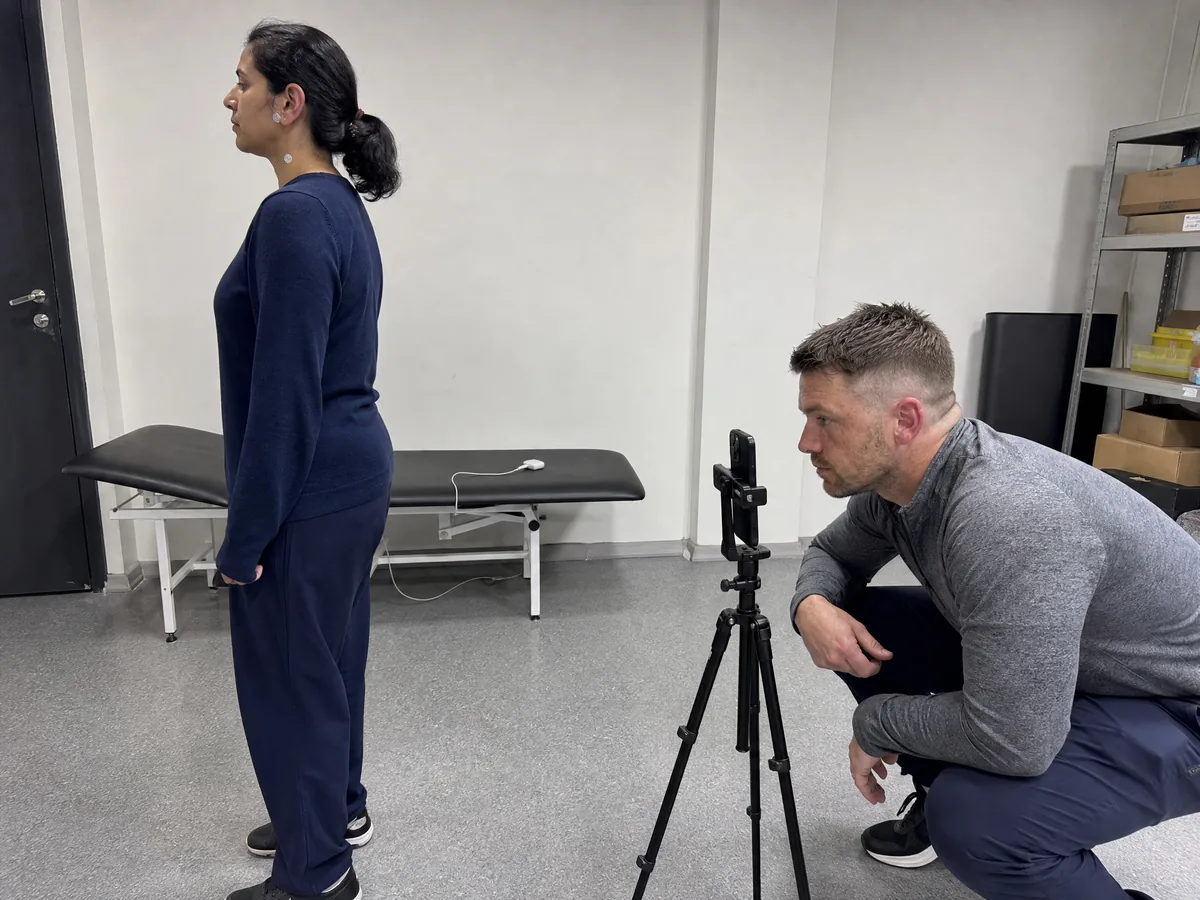
When I repeat the photo on the same person on the same morning, the angle wanders by about 1.5°. Anything smaller than that is noise.
At lunch all four did one identical three-minute routine: chin nods against the back of the chair, a doorway stretch for the chest and ten slow wall slides. That left the corrector as the one variable. By the end of week one I could already guess the order. By week four I could show it.
The scoreboard after 59 days
Days worn start to finish and time to the first ache include everyone who wore that model, across the first month, the swap fortnight and my Wednesdays. The neck angle and the end-of-day score come from each model's main tester.
| Model | UK price when we bought | Days worn start to finish | Average time to first ache | Neck angle, day 1 → 28 → 59 | End-of-day score, week 1 → 4 | Score |
|---|---|---|---|---|---|---|
| Upright Go S | About £60 to £70 | 27 of 30 | No rubbing anywhere, one itchy afternoon | 43.5° → 48.5° → 47.5° | 6.2 → 2.8 | 8.7 |
| BackEmbrace Original | About £50 to £65 | 22 of 31 | 5 h 40 min | 45° → 47.5° → 45.5° | 4.4 → 2.9 | 7.6 |
| Truweo | About £13 to £25 | 6 of 30 | 2 h 35 min | 49° → 50° → 49.5° | 3.6 → 3.2 | 6.1 |
| Marakym | About £15 to £22 | 3 of 29 | 1 h 55 min | 41.5° → 42° → 44° | 5.9 → 5.5 | 5.0 |
Four people is a small test, which is exactly why the swap fortnight mattered: every corrector tried every back, my own too, and the comfort order never changed. The one odd number is Lorraine's 44° on day 59, and her corrector had nothing to do with it. I'll get to that.
Upright Go S: nothing to dig in
No loops, no Velcro. The Upright Go S is a small white pebble of plastic, about the length of your thumb, held on your upper spine by a reusable glue pad. Sit up tall, press calibrate in the phone app, and that position becomes its idea of upright.
Training mode gives you a little vibration whenever you sink below that line. Tracking mode keeps its opinions to itself and simply records. You can set how long it waits before buzzing, and I put Rukhsana on 15 seconds so that leaning in to check a payslip wouldn't set it off.
Day one still went badly. Nine till five on training mode meant 117 buzzes. From day two, buzzing was allowed for 45 minutes after she sat down in the morning and 45 after lunch, and the rest of the day it only watched. That rhythm is the single best tip I can pass on.
In week two her mother-in-law came over from Bradford for a fortnight, spotted the edge of the pad above her collar and decided it was a nicotine patch. She spent a whole evening telling Rukhsana how proud she was of her for giving up. Rukhsana has never smoked in her life, and she let her finish.
"The day it clicked was the end-of-month payroll run. I looked up at quarter to four and my shoulders weren't up round my ears for once." Rukhsana, test diary, Friday 28 August
The app put her upright time at 57 percent in week one and 83 percent by week four. On camera, her neck angle went from 43.5° to 48.5°, the biggest shift I measured and well clear of my 1.5° of noise. After 14 working days without it, it was still 47.5° on day 59. Her end-of-day score fell from 6.2 to 2.8, and the shoulder blade ache she first came to me with went from most days to one or two a week.
The reason is simple once you see it in clinic. Each buzz asks for one tiny piece of work from the deep neck flexors at the front of your neck and the lower trapezius between your shoulder blades, and a few hundred of those a week add up. A strap takes that work off them, so it's comfortable and they learn next to nothing.
Its three failed days were all in the swap fortnight, and none of them was about pressure. Callum's pad peeled off by 11 a.m. on his first morning, because his back is, in his words, "a rug". That evening his girlfriend trimmed a square with his own beard trimmer, the lads in the changing room christened it the helipad, and the sensor stayed put for his other two days.
Lorraine took it off at 2:40 one afternoon with an itchy red patch that had faded by morning. And Ellie forgot to charge it, so it died at ten past three.
Upright quotes about 20 hours per charge. With long days and a mix of modes, Rukhsana charged it every second evening. Each pad lasted her eight to ten working days before the grip faded, and five come in the box, so it's a small cost that keeps coming. Its nearest rival needs no charging at all.
BackEmbrace Original: comfy, with a catch
Think of the BackEmbrace Original as a pair of braces made from wide, flat elastic, minus the trousers. Nothing padded, nothing that clips or sticks. The shoulder loops meet in a cross behind you, and the tail wraps round your ribs, where you decide how firm it feels. It goes over or under clothes, and it's sold by chest size, so measure round the fullest part of yours before you order.
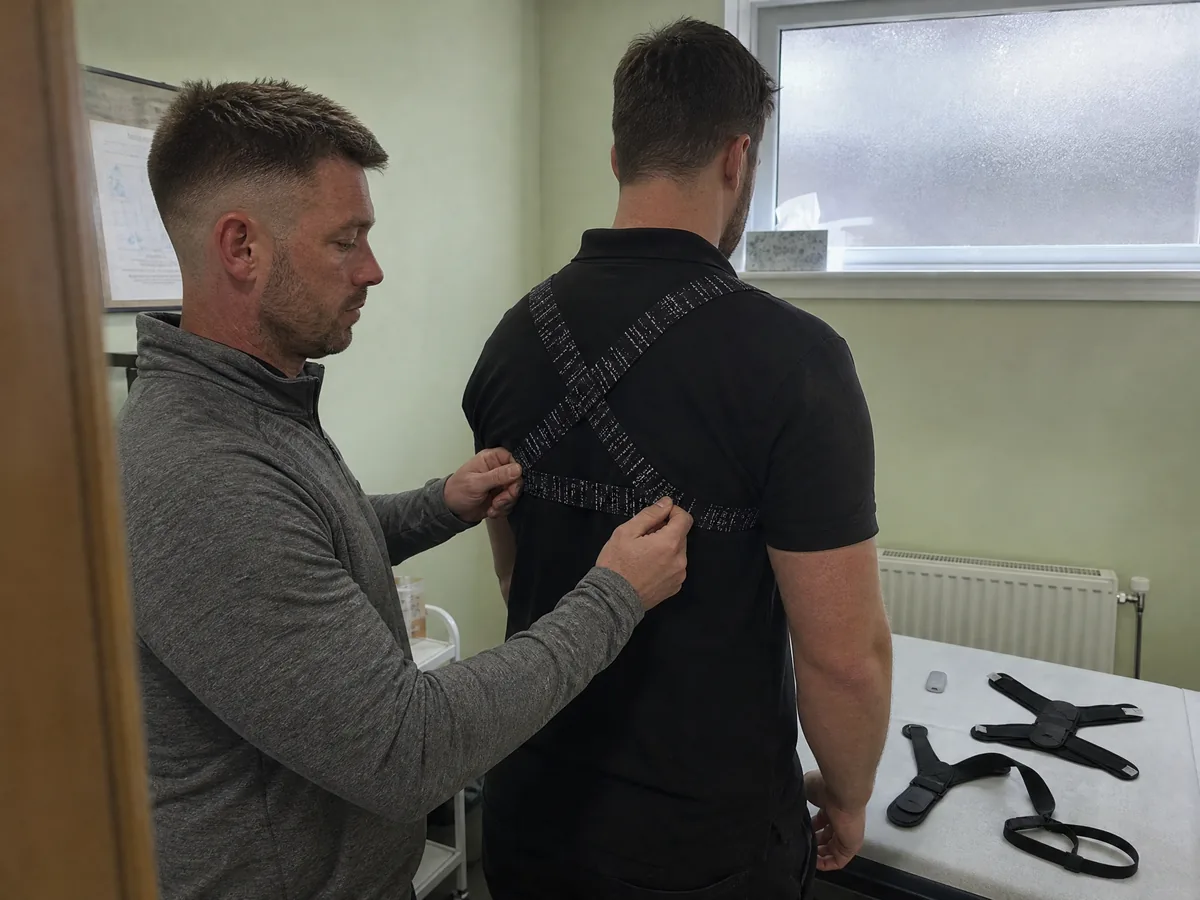
On his first morning Callum wore it over his black work polo, and his manager asked whether he'd come in by parachute. From the second day it went under a shirt and nobody said a word. By day four he was getting into it alone quicker than he could make a brew.
Comfort is the BackEmbrace's strong suit. The elastic breathes far better than the foam and neoprene of the cheaper pair, and Callum kept it on all day for 15 of his 19 working days. The four times it came off, all long CAD sessions, the front of his shoulders had started to ache under the loops after about six hours. Across everyone who tried it, 22 of 31 days start to finish and 5 hours 40 minutes on average before the first ache, the best of the straps by a distance.
The camera was less kind: Callum's neck angle went from 45° to 47.5° at day 28, only just outside my noise, and his end-of-day score dropped from 4.4 to 2.9. Three weeks without it, and he was back at 45.5°. I see it with straps in clinic all the time. While the strap does the holding, the muscles that should be learning the job get the afternoon off.
A couple of practical notes. Ellie found the loops sat right on her bra straps and rubbed by mid-afternoon, so it's worth trying it with what you actually wear to work. Callum washed his twice in a laundry bag on a cool cycle and dried it flat on the airer, and it came out looking new. The next strap costs a fraction of the price, and lasts a fraction of the day.
Truweo: a good first hour on a small frame
You've probably seen the Truweo in your Amazon suggestions. It's a figure of eight in black fabric with foam inside each shoulder loop and Velcro ends to pull it tighter, and at well under £30 it was the cheapest thing on my couch. Even the maker's own guidance tells you to begin with short spells and work up, which tells you something.
On Ellie's narrow shoulders it fitted straight out of the bag, and her first couple of hours were good. Then the padded loops started pressing into the hollows under her arms, on average 2 hours 35 minutes in, right where the headset cable ran down her side. She managed 5 full shifts out of 19, nearly all on cooler days in a thin top.
On Callum it looked like a child's school bag. Even on the loosest setting the loops dug in within the hour, and he gave it three days out of fairness and not one more. Across everyone, 6 of 30 full days.
If you try one, you should be able to slip two fingers under each loop, and if your fingers tingle, take it off straight away. That's the armpit squeezing the nerves that run down to your hand.
By week three Ellie had worked out the smart way to use it: on for the first 40 minutes of her shift, as a signal that the working day had started, then into her locker. Two people on her bank of desks had ordered one by the end of September. Her neck angle went from 49° to 50° to 49.5°, all inside my noise, though she did start closest to normal of the four. The last model had a harder time still.
Marakym: beaten by a laptop stand
The Marakym is a brace in black neoprene, the rubbery foam fabric you'll know from a laptop sleeve, with Velcro adjustment for chests from about 71 to 122 cm. Soft, machine washable and roomy enough for most body shapes. On paper, it suited Lorraine well.
Her cottage in Marsden is cool even in August, so heat wasn't the problem I'd braced for, rubbing was. Each time she leaned towards the calculator, the brace rode up towards her neck, the edges chafed under her arms, and the Velcro snagged her cardigans. Her first twinge came after 1 hour 55 minutes on average, and she managed 2 full days out of 19. Her husband Geoff said she looked like she was wearing a rucksack with nowt in it.
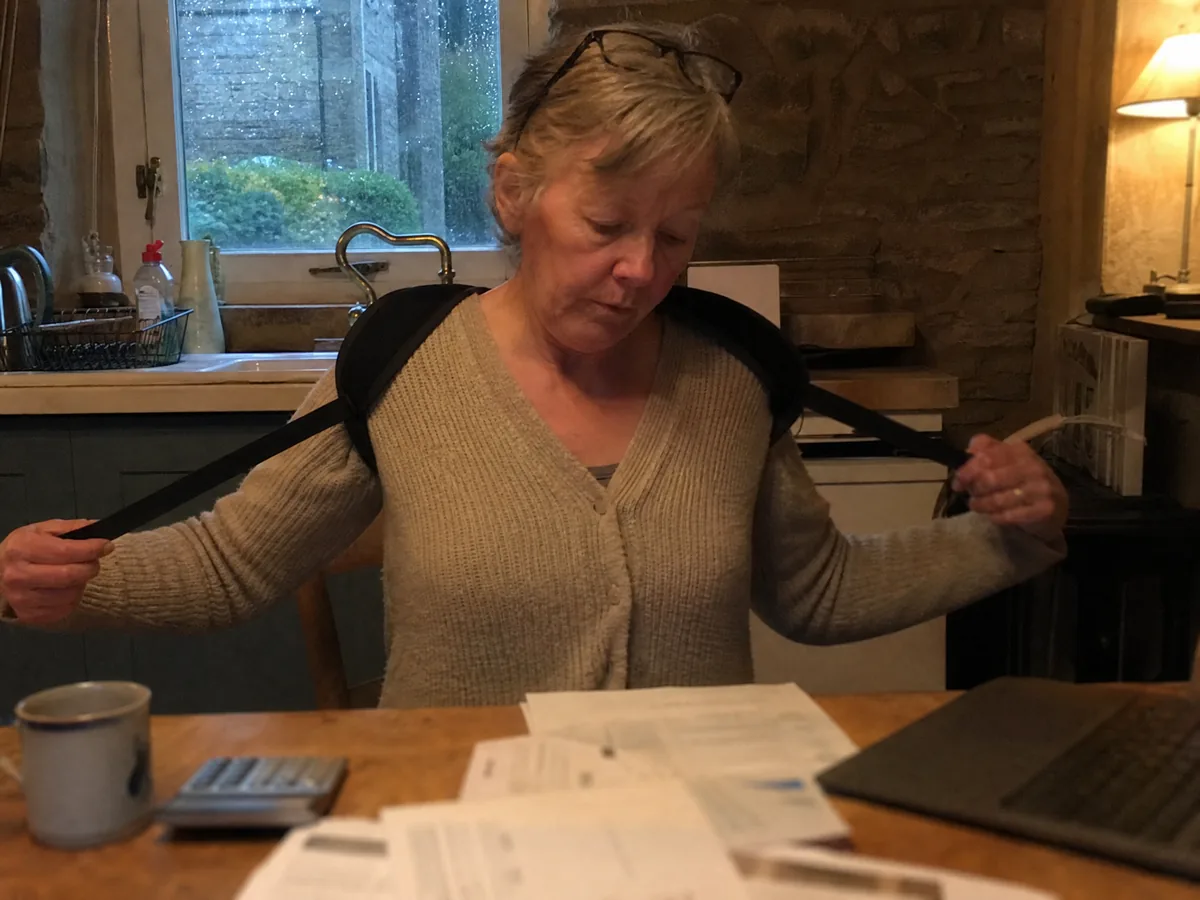
Across all testers, 3 of 29 full days. Lorraine's neck angle went from 41.5° to 42° at day 28, which is nothing, and her end-of-day score barely moved, from 5.9 to 5.5. Then, at her appointment on Friday 18 September, I asked to see a photo of where she works. Laptop flat on the table, dining chair a touch too low, and her head angled down at the screen for six hours a day.
That weekend her son brought round a laptop stand from Argos, about £20, plus the old keyboard and mouse from his bedroom. By day 59, still corrector-free, she measured 44°, and her end-of-day score in the final week was 3.9. If your screen sits too low, no strap in the world will fix it. I had a fair idea of that before, but I've never seen it so clearly in one person's numbers.
My Wednesdays at the kitchen table
I don't see patients on Wednesdays. That's when I write up clinic notes and medico-legal reports at the kitchen table at home, eight hours of reading, typing and frowning at small print. Of the nine Wednesdays in the test, I wore a corrector on eight: the BackEmbrace three times, the Upright and the Truweo twice each, and the Marakym just the once, for reasons you can guess.
I had the Marakym off by 10:40 a.m. on 30 September. The Truweo got me to lunch on 19 August and to just after one on 9 September. The BackEmbrace lasted the whole day twice, and on 16 September it came off at 3:20 with Callum's ache, in exactly Callum's spot.
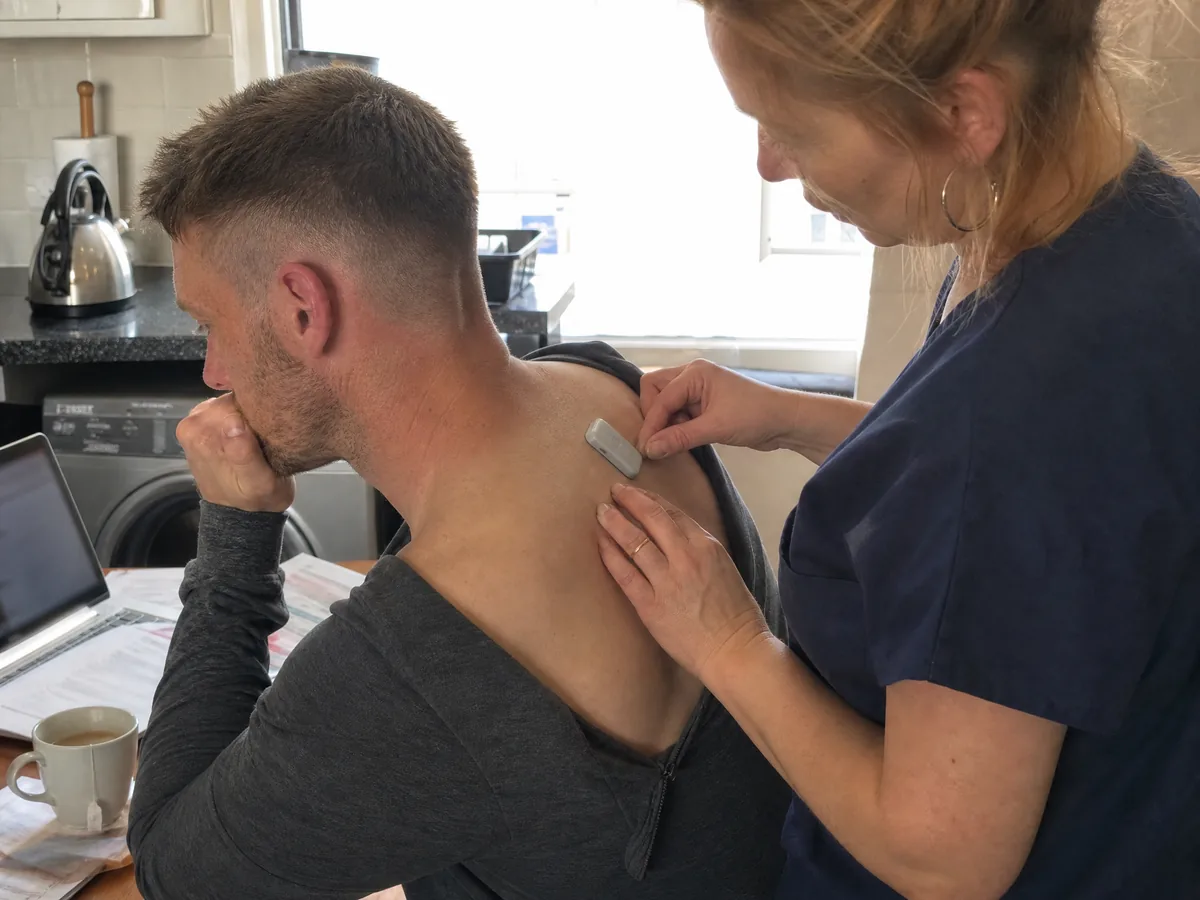
The Upright lasted both days without a murmur from my shoulders, but I couldn't put it on myself. Jodie, my partner, was home from nights both times and stuck it on before bed with the words "Hold still, you're worse than my patients." At ten past two that afternoon it buzzed while I was writing three pages about somebody else's forward head posture. I sat up and said nothing.
The difference I felt matches the camera. A strap does the holding, and after a few hours you feel held rather than helped. The sensor is more like a polite colleague who keeps clearing their throat, and it's you who sits up every time. That's the part that sticks.
Which one I'd hand you in clinic
And park all four if you've got pain that gets you up in the night, pins and needles or weakness down an arm, dizziness, or pain that started after a fall. That's a job for your GP or a physio first, and many NHS areas now let you refer yourself to physio without seeing the GP. If none of that applies and you're weighing up the cost, here's what we paid.
UK prices and where we bought them
Boots and Argos both sell posture supports, mostly own-brand and Futuro, but we didn't find any of these four there. All four came from Amazon.co.uk. Below is what each cost when I wrote this, and the figure I'd hold out for:
- Upright Go S: about £60 to £70. Good under £55. Budget roughly £1 to £1.50 a pad for spares in multipacks. The necklace holder, for days you don't want anything stuck on, is sold separately.
- BackEmbrace Original: about £50 to £65 depending on size, and it ships from abroad, so check the delivery date. Good under £45.
- Truweo: about £13 to £25, and it's on offer a lot. Good under £16.
- Marakym: about £15 to £22. Good under £15.
Gadgets like the Upright often dip for Black Friday on 27 November, though I can't promise it will this time. If you're buying for someone else, check the returns policy first, as plenty of sellers won't take back a worn strap.
As for the four of them, Rukhsana keeps the Upright for payroll weeks. Callum wears the BackEmbrace on Mondays, his longest CAD day. Ellie still starts her shift with the Truweo, and Lorraine's Marakym lives in the dresser drawer while the laptop stand lives on the table.
Next on my list is a batch of massage guns for sore legs after a Saturday parkrun, on our tests in progress page. If you can't wait, my Theragun PRO Plus review covers the top end, and the rest of my work is in the health section.
What patients ask me
Do posture correctors actually work?
Some do. In our 59-day test, only the Upright Go S sensor changed how our tester sat once it came off: 5° better neck angle at week 4, mostly still there three weeks later. The straps felt good while worn, and the change faded once they came off.
How many hours a day should you wear a posture corrector?
For a strap, start with 30 to 60 minutes and build up only if it stays comfortable. In our test the Truweo and Marakym rubbed within roughly two hours. The Upright, being a sensor, can stay on all day, with the buzzing switched on for short blocks only.
Can a posture corrector make your back worse?
A strap that's too tight can rub, press on the nerves under your arm and cause tingling in your fingers, so you should always be able to slip two fingers under each loop. Relying on a strap all day can also leave the muscles that hold you up with less to do. Pair any corrector with a few simple exercises and a screen at the right height.
Which posture corrector do physios recommend?
For lasting change, I'd pick a sensor that reminds you to sit up over a brace that holds you there, and in our test that was the Upright Go S. If you want a strap, the elastic BackEmbrace Original was the comfiest over a working day.