
Garmin, Apple Watch or Pixel? 5 smartwatches checked on 38 sweaty Kansas City runs
Five smartwatches, one chest strap and three loops measured by a USATF course certifier. After 63 humid days, one watch stayed honest on both pace and pulse. Another only on pulse.
 By Randall Plunkett, outdoor, grill and fitness tester
Tested in Kansas City, Missouri · October 26, 2026 · 12 min read
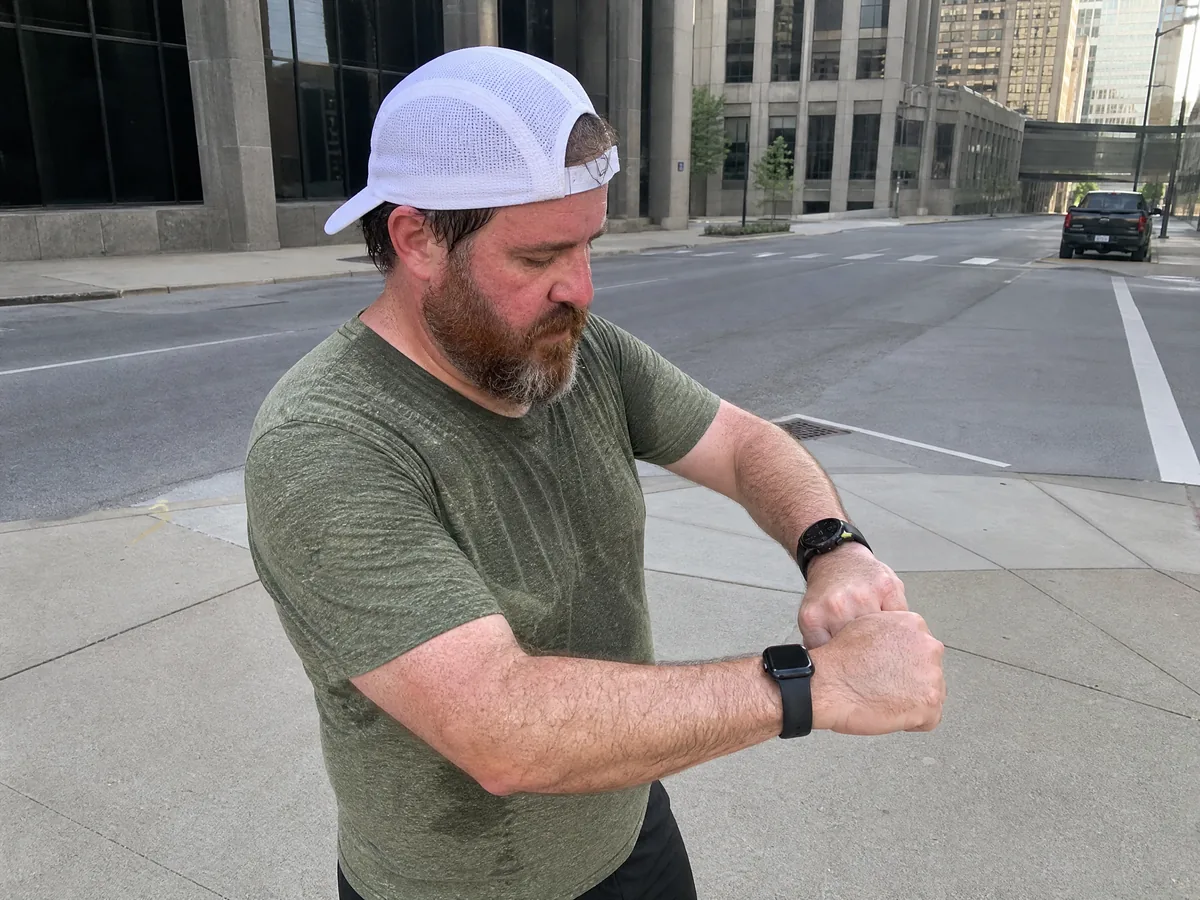
My chest strap said 161. My left wrist said 128. I was halfway up Cliff Drive on a September morning, sweat running off my beard in a steady drip, and one of these watches was telling me I was out for a nice stroll.
That gap is the whole reason for this test. From August 22 to October 23, 63 days in all, I ran with five smartwatches through the last of the Kansas City heat and into the first cold mornings of fall: the Garmin Forerunner 970, the Apple Watch Series 11, the Google Pixel Watch 4, the Samsung Galaxy Watch8 and the Coros Pace 3. Two at a time, one per wrist, and a strap around my ribs on every outing.
The goal we posted in July was plain: find the watch whose GPS pace and heart rate land nearest to a chest strap on real runs. Not treadmill runs. Humid 5:45 a.m. runs, downtown blocks, wooded trails and one half marathon with a watch brand's name on the start banner. The winner comes first, the long sweaty story after.
Garmin Forerunner 970
$749.99 list price, often $649.99 at Amazon, Best Buy and REI at the time of writing
- Measured our 2.00-mile downtown loop as 2.02 miles, best of the five
- Live pace held within 8 seconds per mile between the towers
- Steady-run pulse 2.2 bpm from the strap
- Five physical buttons that work with sweaty fingers, plus a flashlight and real maps
- Costs about what the Coros, the Galaxy and a pair of shoes cost together
- Apple's sensor beat it on steady pulse by 0.4 bpm
- Nine days on a charge for me, while Garmin's spec sheet promises 15
- Settings menus that take a rainy Sunday to learn
Our verdict: if your training plan is built on pace and heart rate and you run where buildings or branches crowd the sky, this is the watch I'd trust. If $650 is too much, the Coros Pace 3 got surprisingly close for about $200.
- Three loops, one strap and a bike wheel
- The five watches and what they cost
- Brush Creek: where everybody passes
- Under the oaks in Swope Park
- Downtown, where GPS gets lost
- Heart rate at a 72-degree dew point
- The full scoreboard
- Garmin Forerunner 970: the winner
- The other four, one by one
- Which one belongs on your wrist
- Prices and holiday deals
- Questions people ask
Three loops, one strap and a bike wheel
For pulse, the referee was a Polar H10. A strap picks up the tiny electrical pulse of each heartbeat through your skin, while a watch shines green light into your wrist and works backward from blood flow. Brenda borrowed this same H10 in July for her earbuds test. I set it to log to its own memory, so it never paired with any of the five. Each watch had to earn its numbers with its own sensor.
Pace was the harder half. No strap knows how far you've gone, so I needed loops with a known length, down to the foot. That's where Bev Hollister came in. Bev is a retired math teacher from my Thursday running group, and she certifies race courses for USATF. Her tool is a bicycle with a Jones counter, a little gear-driven counter clamped at the front wheel hub that she calibrates on a steel-taped stretch before every ride. On August 22, day 1, she rode three loops for me:
- The open loop, 3.00 miles: the Brush Creek trail near the Plaza. Flat, wide open, almost no shade. The control group.
- The tree loop, 2.50 miles: dirt and gravel trails in Swope Park under thick oak and hickory cover, with two tight switchbacks.
- The downtown loop, 2.00 miles: city blocks between the office towers north of Crown Center, with eight 90-degree corners and one long straight past the tallest building in Missouri.
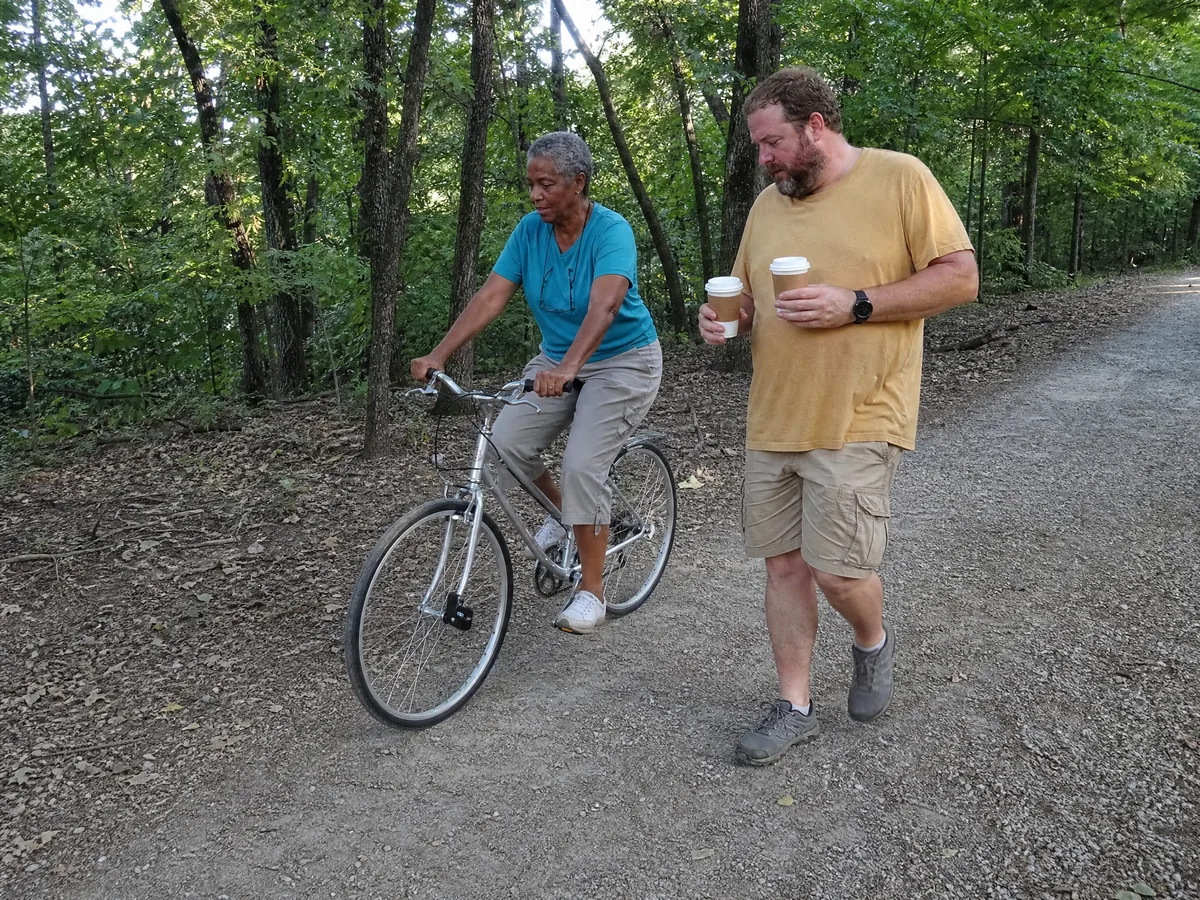
Bev rode each loop twice and the two rides agreed within 4 feet. She also told me, kindly, that the "5K" loop I've run from my house for three years is a tenth of a mile short. I'm still not over it.
The house rules were simple. Two watches per run. My nine-year-old drew the pairings out of an old ball cap every Sunday night, wrote them on the fridge and flipped left and right each week, so no watch got my "good" wrist more often. GPS on the highest-accuracy mode each watch offers. Heart rate only counted from minute 10, once the sensors had settled. Everything else follows our usual testing routine.
One confession. Garmin's headquarters is in Olathe, about 25 minutes from my driveway, and half my running group has a cousin who works there. So the Garmin got zero benefit of the doubt. Every tie went to the other watch. Now meet the field.
The five watches and what they cost
All five came from regular stores at regular prices. Expect the numbers below to shift between now and Black Friday, sometimes by a lot.
| Watch | Version we wore | Satellite bands | Pairs with | Price at writing |
|---|---|---|---|---|
| Garmin Forerunner 970 | 47 mm | Multi-band (L1 + L5) | iPhone or Android | $749.99 list, often $649.99 |
| Apple Watch Series 11 | 46 mm, GPS model | L1 only | iPhone | $429 at launch, about $299 to $329 since the Series 12 arrived |
| Google Pixel Watch 4 | 45 mm, Wi-Fi model | L1 + L5 | Android | $399.99 list, often $299 to $349 |
| Samsung Galaxy Watch8 | 44 mm, Bluetooth model | L1 + L5 | Android | $379.99 list, often $249 to $299 |
| Coros Pace 3 | 42 mm on the nylon band | L1 + L5 | iPhone or Android | $229 list, about $199 on sale |
I'm an iPhone guy, so the Pixel and the Galaxy needed help. Brenda lent me two Android phones from her review drawer, along with a short speech about screen protectors. On Pixel and Galaxy days my running belt held three phones and bounced like a tool bag. That "satellite bands" column ends up deciding a lot, though you'd never guess it from the first loop.
Brush Creek: where everybody passes
On wide open ground, every one of these watches is good. Over 12 to 14 laps each of the 3.00-mile Brush Creek loop, the worst watch was off by about 1 percent. The Garmin averaged 3.01 miles, the Coros 3.01, the Pixel 3.02, the Apple Watch 3.02 and the Galaxy 3.03.
If you run on open roads, country blacktop or a high school track, you can stop worrying. Any of these five will measure your miles fine. The gaps only opened once something got between my wrist and the sky.
Under the oaks in Swope Park
A thick summer canopy weakens satellite signals and scatters them. Watches that also listen on the newer L5 frequency have a cleaner signal to work with, because L5 is better at telling a direct signal from a reflected copy. The Apple Watch Series 11 is the only one here that hears L1 alone. On the 2.50-mile tree loop, you could see it:
- Garmin Forerunner 970: 2.51 miles on average. Its track sat on the trail through both switchbacks.
- Coros Pace 3: 2.52 miles, just a little wider on the turns.
- Pixel Watch 4: 2.54 miles. Solid on the straights, loose on the switchbacks.
- Galaxy Watch8: 2.44 miles, short. It cut both switchbacks like it knew a shortcut.
- Apple Watch Series 11: 2.57 miles, with a track that zigzagged off the trail under the thickest cover.
Two or three percent sounds harmless. On a 10-mile long run it's a quarter mile, and it shifts the pace on your wrist by 15 to 20 seconds per mile. That's how you speed up to hit a number you were already hitting. And the woods were the easy part.
Downtown, where GPS gets lost
Between tall buildings the problem flips. The signal isn't weak, it's bouncing. It ricochets off glass and concrete and reaches your wrist a hair late, so the watch thinks you're somewhere you aren't. My son calls it "the watch getting lost in the buildings," and I can't improve on that.
On the 2.00-mile downtown loop, the Garmin averaged 2.02 miles and the Coros 2.03. The Pixel read 2.06, mostly because it was slow to react to the 90-degree corners and drew them as wide curves. The Galaxy came in short at 1.93. The Apple Watch read 2.09 and twice put me running through the lobby of an office tower.
The number I care about most is live pace, because that's what you run by. On a steady effort at about 9:05 per mile, the Garmin's on-screen pace wandered up to 8 seconds either way. The Coros wandered 12, the Pixel 21, the Galaxy 26 and the Apple Watch 33. Thirty-three seconds is the difference between "back off" and "pick it up," on the same legs at the same speed.
To be fair to Apple, its saved distance was never as wild as its map. Apple tidies the data once you stop. Mid-run, though, the single band showed. So much for my legs. The harder question was what was going on under the strap.
Heart rate at a 72-degree dew point
Late August in Kansas City means 76°F at 5:45 a.m. and a dew point near 72. I'm 47, I weigh 236 pounds and I run 9-minute miles on a good day. On those mornings I sweat like a dropped glass of iced tea. If a watch can read my pulse through that much sweat and arm hair, it can read yours.
The heat itself didn't hurt the sensors. Warm skin has more blood near the surface, which is easier to read. What hurt was slippage. Sweat lets a watch slide a few millimeters with every stride, and on the smooth backs of the bigger watches it pooled under the sensor. Here's the average gap to the strap on steady runs:
- Apple Watch Series 11: 1.8 bpm. The best of the five.
- Garmin Forerunner 970: 2.2 bpm.
- Pixel Watch 4: 2.6 bpm, a nice surprise.
- Coros Pace 3: 3.1 bpm.
- Galaxy Watch8: 5.4 bpm, and that's the average after one bad morning I'll get to.
Heat also showed me something I'd never paid attention to. On a 7-mile run at the same pace all the way, the strap climbed from 142 to 158 as I got hotter. That's cardiac drift, and it's normal. The Apple, the Garmin and the Pixel followed the climb within a few beats. The Galaxy flattened it out and stayed around 147, which would have told me to speed up in the worst part of a hot run.
"In the heat, drift is the number that keeps you out of trouble. If your watch hides it, you'll push your easy runs into the red without knowing it, and that's when people end up sitting on a curb feeling awful." Gary Szymanski, the physical therapist on our team, when I showed him the Galaxy graph
That Cliff Drive morning from the top of this story was the Galaxy too. Hill repeats, strap at 161, watch at 128 for almost four minutes. I pulled the band two holes tighter and the gap shrank to 4 beats. Samsung clearly wants the Watch8 worn snugger than the rest. Hill sprints sorted them the same way: the strap shot up the moment I took off, and the Apple matched it 4 seconds later, the Garmin after 5, the Pixel after 7, the Coros after 8 and the Galaxy after 13.
The cold came in October. On the 46°F mornings every watch read low for the first few minutes, then settled. Put every number in one grid and the story tells itself.
The full scoreboard
For every row but the last two, smaller numbers win. Each watch ran 15 or 16 times with the strap: 38 runs and 241.6 miles in total.
| What we measured | Garmin 970 | Coros Pace 3 | Apple S11 | Pixel 4 | Galaxy 8 |
|---|---|---|---|---|---|
| Brush Creek error, 3.00 mi | +0.3% | +0.3% | +0.7% | +0.7% | +1.0% |
| Swope Park error, 2.50 mi | +0.4% | +0.8% | +2.8% | +1.6% | 2.4% short |
| Downtown error, 2.00 mi | +1.0% | +1.5% | +4.5% | +3.0% | 3.5% short |
| Live pace wander downtown | 8 s/mi | 12 s/mi | 33 s/mi | 21 s/mi | 26 s/mi |
| Steady pulse gap to strap | 2.2 bpm | 3.1 bpm | 1.8 bpm | 2.6 bpm | 5.4 bpm |
| Catch-up on a hill sprint | 5 s | 8 s | 4 s | 7 s | 13 s |
| Battery, days in my routine | 9 | 19 | 1 | 1.5 | 1.5 |
| Our score | 9.0 | 8.4 | 7.9 | 7.7 | 6.9 |
So Apple wins the heart and loses the map. The Garmin trailed it by 0.4 beats on pulse and beat it by a mile, nearly literally, on pace. Even with every tie handed to its rivals, that's why the Garmin comes out on top.
Garmin Forerunner 970: the winner
I've worn the cheaper Forerunner 570 since May, so I went in expecting the 970 to be "the 570 plus maps." On accuracy it's a clear step up. Downtown, its track hugged the sidewalks I actually ran, and the pace on screen stayed calm enough that I ran a whole tempo session between the towers without once checking it against the strap.
The buttons matter more than I expected. The Apple, the Pixel and the Galaxy mostly want you to tap and swipe, and glass covered in sweat takes orders from anybody. The Pixel paused my run twice when a drop rolled off my wrist onto the screen. The Garmin has five real buttons, and they work with wet fingers. The AMOLED screen was easy to read in full noon sun, and the flashlight earned its keep in October, when my 5:45 a.m. runs started a good hour and a half before sunrise.
Maps helped too. On a long run in Swope Park, where the trails fork every few hundred yards, one glance told me which branch led back to the truck. The ECG app, the sapphire lens and Garmin's training scores are all there if you want them.
Now the downsides. At $649.99 on sale, you could buy three Coros watches for about the same money. It weighs about 56 grams, and I noticed it in bed. And with five runs a week plus nightly sleep tracking and notifications on, mine needed the charger every 9 days or so. Fine, but well short of the brochure. The real exam came at the end.
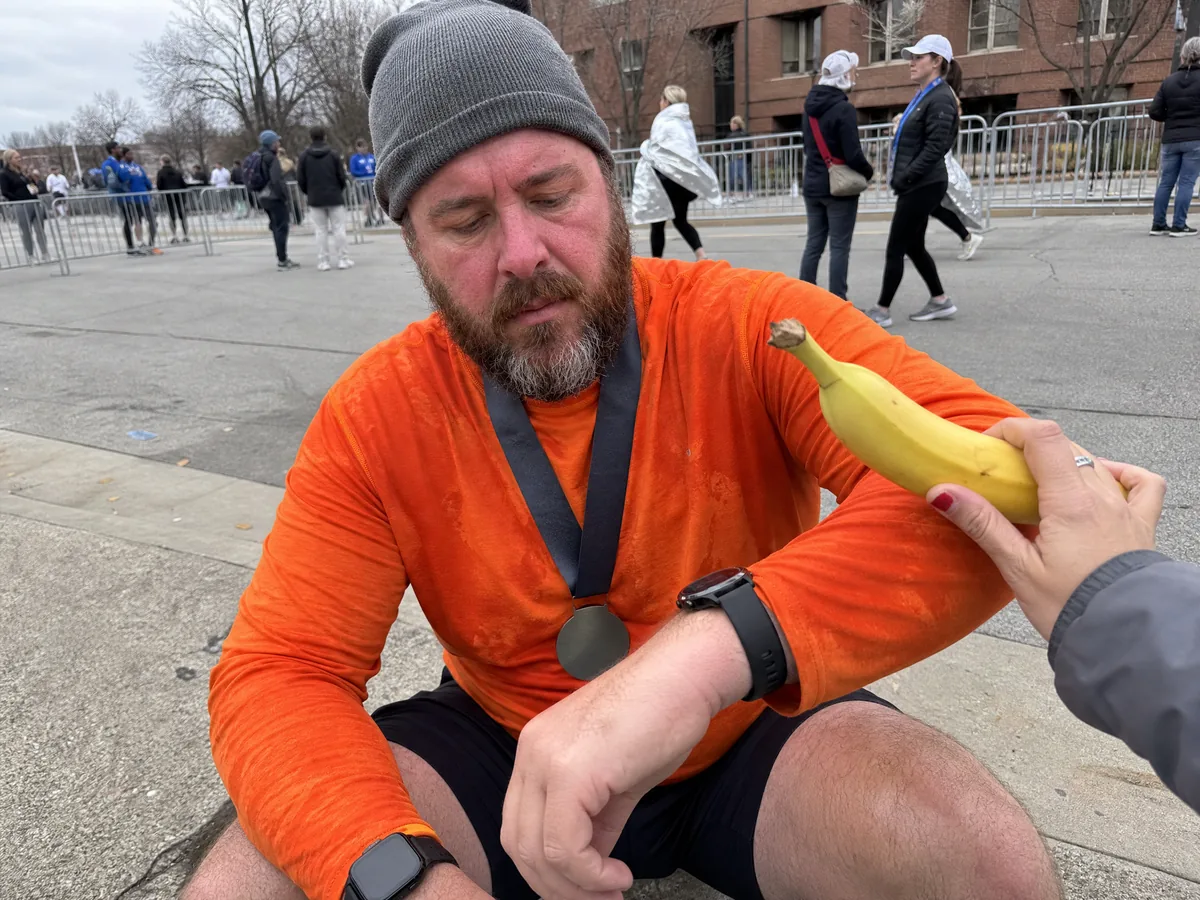
On October 17 I ran the Garmin Kansas City Half Marathon (yes, the one with Garmin's name on it) wearing the 970 on the left and the Apple Watch on the right. A certified half is 13.1 miles. The Garmin logged 13.19, a normal overage for a guy who swings wide on the turns. The Apple logged 13.38, and most of the extra piled up between tall buildings. I finished in 1:49:37. The 970 had predicted 1:48:10, so I'm blaming the hills, not the GPS.
The other four, one by one
Coros Pace 3: the bargain that nearly won. The oldest and cheapest watch in the test finished second on pace on every loop, close behind the Garmin. At about 30 grams on the nylon band, I forgot it was on my wrist by the second week. The battery is silly: 19 days between charges, so I charged it four times in 63 days. Its memory-in-pixel screen isn't pretty, but it's sharp in full sun, and the touchscreen switches off during runs, so sweat can't pause anything. The catches: it feels like a $200 watch, the phone app is basic, and on steady pulse it came fourth. For runners who want a training tool and nothing else on their wrist, this is my pick. Two guys from my Thursday group bought one before I'd finished writing.
Apple Watch Series 11: the best heart, the shakiest map. Nothing beat it on steady pulse, and it reacted fastest when a hill sprint started. If you train by heart rate zones and mostly run open roads, it's a lovely watch, and the bright screen and the iPhone tie-in are hard to give up. The L1-only GPS is the weak spot, downtown and under trees. So is the battery: it went on the charger every single night. With the Series 12 in stores, last year's model now sells for a lot less. Gary compared the two in his Series 12 vs. Series 11 review if you're torn.
Google Pixel Watch 4: better than I expected. Its two-band GPS put it third in the woods, and it took third on steady pulse too, ahead of the Coros. Its weak spot was downtown, where it rounded every corner, and that big domed glass gets slippery and jumpy with sweat on it. Expect to charge it every day and a half, though it fills up quickly. For Android runners after a single good-looking watch for work, weekends and three or four runs a week, it makes sense.
Samsung Galaxy Watch8: wear it snug or don't bother. Bright screen, a guided running program that adapts as you go, and the slimmest feel of the smartwatches. But it was last on heart rate, it flattened the cardiac drift on hot days, and it came up short on both the tree loop and the downtown loop. Strapped high and tight, well above the wrist bone, it improves a lot. Samsung phone owners who mostly want notifications and sleep data will be happy. If you run by the numbers, look at the other four first.
Which one belongs on your wrist
Summer runners, one more thing: the neck-cooling tricks from my heatwave guide are what got me through the August half of this test. Now, the money.
Prices and holiday deals
Watches from last year's lineups get the deepest cuts in November and December. Here's where prices stood when I wrote this, plus my "buy now" number for each:
- Garmin Forerunner 970: $749.99 list, often $649.99 at Amazon, Best Buy, REI and garmin.com. Buy at $649 or less.
- Coros Pace 3: $229 list, about $199 at Amazon and REI. Buy under $200.
- Apple Watch Series 11 (46 mm): about $299 to $329 at Best Buy, Amazon and Target while stock lasts. Buy under $300.
- Google Pixel Watch 4 (45 mm): $399.99 list, often $299 to $349 at Best Buy, Amazon and the Google Store. Buy under $300.
- Samsung Galaxy Watch8 (44 mm): $379.99 list, often $249 to $299 at Samsung, Best Buy and Amazon. Buy under $250.
As for the five watches: the 970 is staying on my left wrist for a winter long-term check, and my 570 went to Tanya, who says it "fits better anyway." Bev got a pulled pork dinner for her bike rides and asked if she could certify my backyard next. The Coros is on loan to my son for cross-country season, and he wants to know why Dad's watch has a flashlight and his doesn't.
I've already started the next one, and it involves a lot of smoke. It's listed with our other open projects on the tests in progress page, and the rest of our gadget reviews are in the tech section.
Questions people ask
Which smartwatch is most accurate for running?
In our 63-day test, the Garmin Forerunner 970. It stayed within 1 percent of the certified distance on all three loops, including downtown, and on steady runs its heart rate was 2.2 bpm from a Polar H10 chest strap. The Apple Watch Series 11 edged it on heart rate at 1.8 bpm, but lost a lot of ground on pace among tall buildings and under trees.
Is the Apple Watch accurate for running pace?
On open roads, yes: it was within 0.7 percent on our open loop. Downtown and under thick trees its L1-only GPS struggled, with live pace wandering up to 33 seconds per mile on a steady effort. The distance saved after the run looks cleaner than the live pace, because Apple smooths the data once you stop.
Does sweat affect smartwatch heart rate readings?
Sweat doesn't block the sensor, but it lets the watch slide on your wrist, and that causes most bad readings. In our humid runs, tightening the band a notch and drying the sensor before the start fixed most of the gaps. Cold is a bigger problem: on 46°F mornings every watch read low for the first few minutes.
Should I get the Forerunner 970 or save money with the Forerunner 570?
Get the 970 if you explore new trails, run in the dark or want the steadiest GPS downtown. It adds maps, a flashlight, ECG and a sapphire lens. If your runs are familiar routes in daylight, the 570 covers nearly everything for about $200 less.