
Most reliable automatic pet feeder? We ran 4 for 496 meals to find out
Two meals a day, four feeders, a cat, two rescue dogs and a garage that hit 93°F. After 496 scheduled meals, only one feeder had a perfect sheet: no skips, no jams, no surprises.
 By Sheila Tuttle, pet tester, two rescue dogs and a tabby
Tested in Knoxville, Tennessee · November 4, 2026 · 12 min read
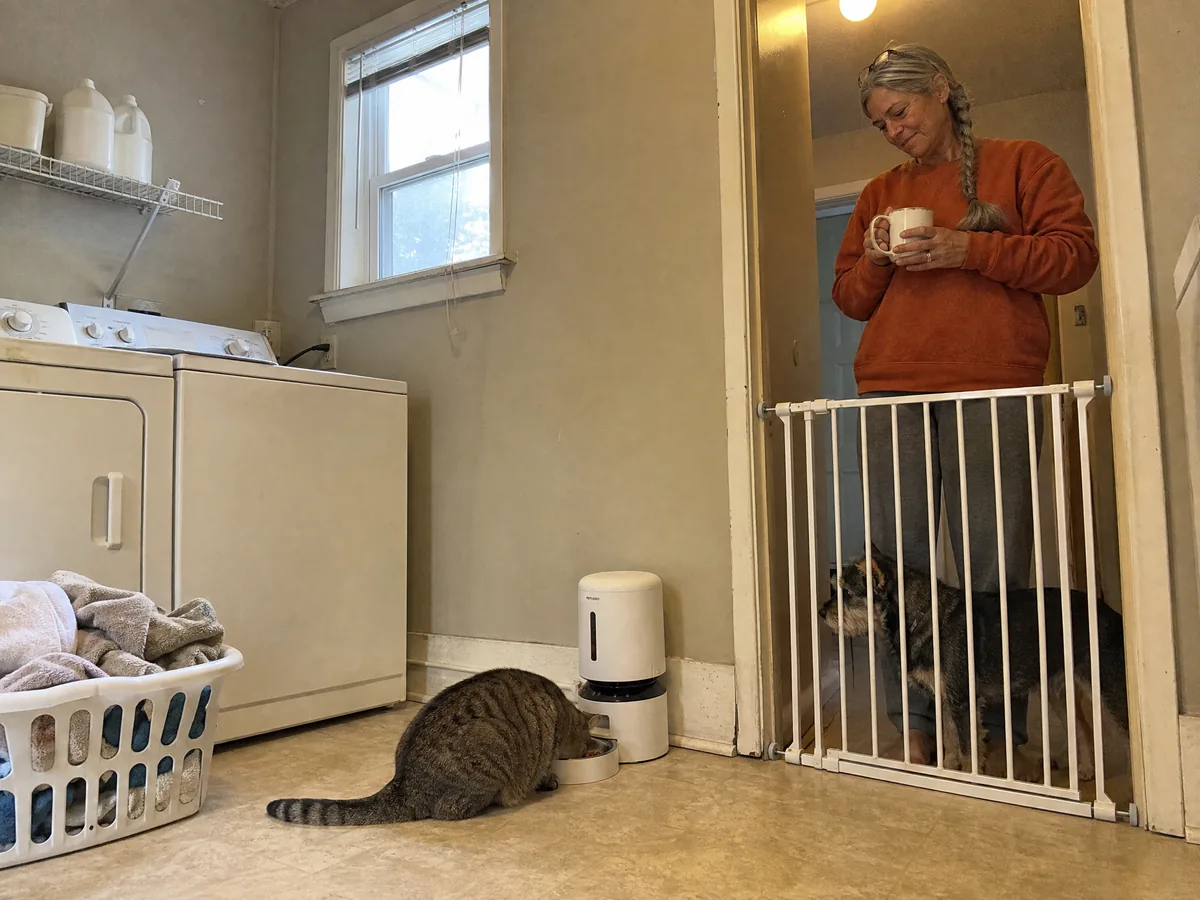
There's a dry-erase board on our fridge with three columns: Biscuit, Duke, Waffles. Whoever feeds an animal draws a check mark. In theory. In practice Earl forgets the board, I forget the board, and at 6 p.m. somebody says "did anybody feed the dog?" while the dog in question sits there looking tragic and underfed. He's a beagle mix. He always looks underfed.
An automatic feeder solves that, but only if you can trust it. A feeder that works 29 days out of 30 is worse than no feeder, because on day 30 you're not checking. So this fall I set one plain question for four of the best-known feeders sold in the US: which one can feed an animal twice a day for 30 days without a single skipped meal or jam?
The test ran from Thursday, September 3, to Tuesday, November 3, here in Knoxville. That's 62 days, 124 scheduled meals per feeder and 496 in total. One feeder got every single one of them right.
- No skipped meals, no late meals, no jams in 124 tries
- Meals landed within 2.4 g of the 27 g target on the bench
- Kept feeding through a 3 hour 39 minute power cut on D batteries
- The only one of the four that joined our 5 GHz Wi-Fi without a fight
- Flat or very large kibble is a gamble (it's rated for 2 to 15 mm)
- Crumbs collect in the corners under the hopper
- No scale, so it can't tell you what the cat actually ate
- The desiccant needs changing every two weeks, and it tells you so
Verdict: if reliability is the whole point, buy the Granary. It was the only feeder with a clean sheet, and it isn't the most expensive. For one cat in a small space the Petkit Fresh Element Solo came close for less money. For a dog that inhales dinner, the PetSafe Smart Feed's slow feed is worth a look, as long as the kibble isn't big.
- How you test "never" in a real house
- 62 days in one table
- Petlibro Granary: the clean sheet
- Petkit Fresh Element Solo: small, quiet, nearly perfect
- WOpet Patrol F07 Pro: cheap, big, a little confused by the clock
- PetSafe Smart Feed: the dog feeder with one bad evening
- The storm that tested all four at once
- Which one I'd buy, and for whom
- US prices and what to pay
- Questions people ask
How you test "never" in a real house
You can't learn much from a feeder in a week. Jams come from humidity, from the bottom of the hopper and from the one bag of kibble that's a little different. So every feeder had to run twice a day for the full 62 days, at 7 a.m. and 5:30 p.m.
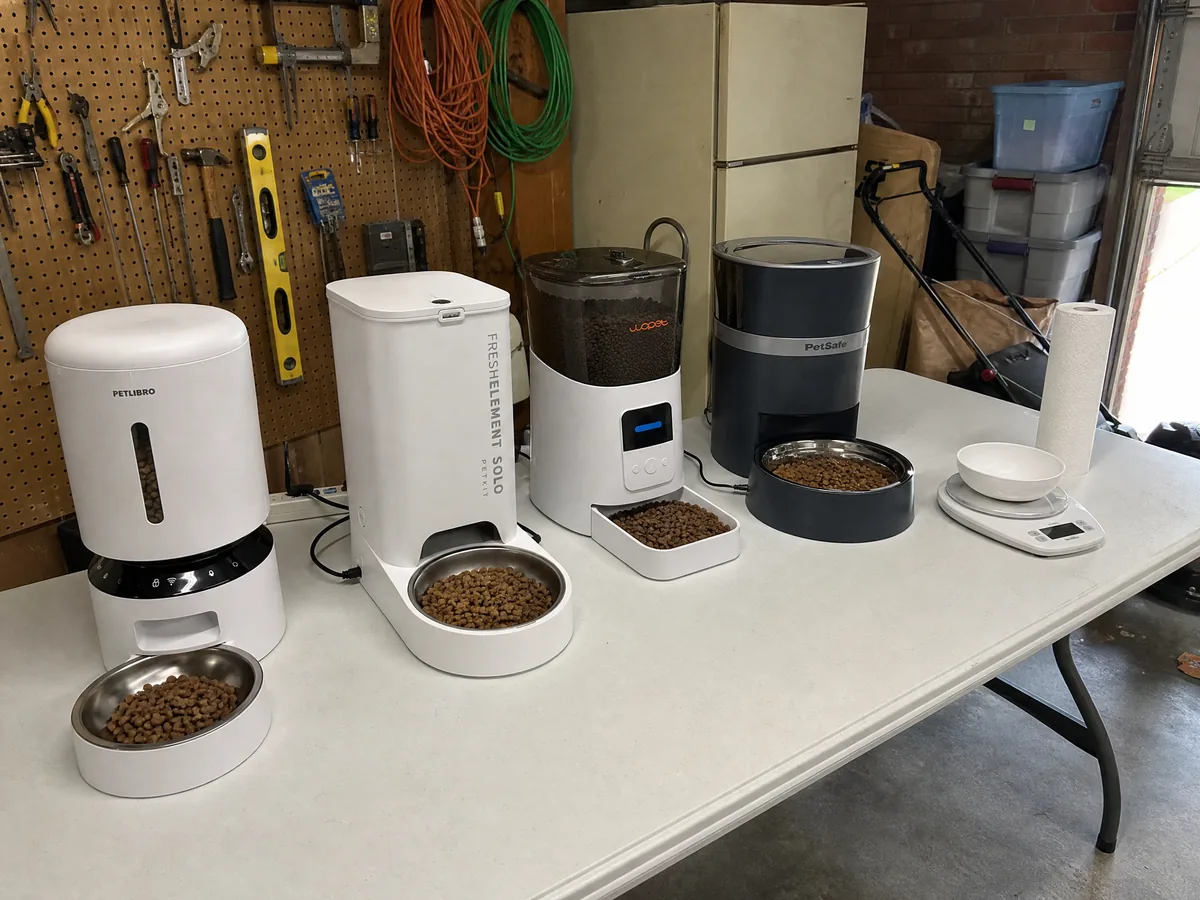
We have three animals and four feeders, so they took turns. For 30 days each feeder served a real animal. The rest of the time it sat on "the bench," a folding table in our garage, dropping its meals into a bowl that I weighed and then poured back in the bag. Earl weighed the evening ones. He complained about it for exactly two days, then started writing the numbers neater than I do.
- Round one, September 3 to October 2: the Petkit fed Biscuit, the PetSafe fed Duke. The Granary and the WOpet were on the bench.
- October 3: everybody on the bench while I washed all four.
- Round two, October 4 to November 2: the Granary fed Biscuit, the WOpet fed Waffles. The Petkit and the PetSafe moved to the bench.
- November 3: last bench day, then a teardown and one more wash.
Each feeder kept the food of the animal it served, on the bench too. Biscuit eats a round cat kibble about 9 mm across, 27 g per meal. Waffles, our scruffy terrier, gets a small-breed food about 8 mm across, 50 g per meal. Duke, our old beagle mix, eats a senior dog food in flat triangles about 16 mm wide, three quarters of a cup per meal. Remember those triangles.
A skip meant no food at the scheduled time. A jam meant the motor ran and the food didn't come. A late meal was anything more than five minutes off. The garage wasn't kind: on September 9 the thermometer on the pegboard read 93°F with the door down, and the humidity in a Tennessee September is no joke for dry food.
62 days in one table
Here's the whole test on one screen. "Bench average" is the mean of every bench meal I weighed against its target, 64 meals per feeder.
| Feeder | Meals on time | Skips | Jams | Bench average (target) | Lightest and heaviest |
|---|---|---|---|---|---|
| Petlibro Granary WiFi | 124 of 124 | 0 | 0 | 27.4 g (27 g) | 25.3 to 29.4 g |
| Petkit Fresh Element Solo | 124 of 124 | 0 | 0 | 26.3 g (27 g) | 14.8 to 29.9 g |
| WOpet Patrol F07 Pro | 123 of 124 | 0 | 0 (2 cleared on its own) | 49.1 g (50 g) | 43.5 to 53.8 g |
| PetSafe Smart Feed (2nd Gen) | 123 of 124 | 1 | 1 | 80.2 g (78 g) | 70.6 to 88.9 g |
Two feeders never skipped and never jammed. Only one of those two also got the amount right every time, and that's where the race was decided.
Petlibro Granary: the clean sheet
Some of you know this feeder from my Petlibro Granary review this summer. Biscuit has used one since July. For this test I bought a brand new unit so it started from zero like the others, and the old one went to my daughter's house in Maryville, where her cat has opinions too.
On the bench in September it ate the heat without a hiccup. In October it fed Biscuit in the laundry room, behind the baby gate that she hops and Waffles can't. Every meal came at 7:00 and 5:30 on the dot, and three portions of her food weighed between 25.3 and 29.4 g. That's the tightest spread in the test by a distance.
"I wrote 27-something in that notebook so many times I started to think the scale was broken." Earl, evening weigher
Setup took 7 minutes, and it was the only feeder that joined our KUB Fiber router without me splitting the Wi-Fi into a separate 2.4 GHz network. It played my voice at each meal, which Biscuit ignores. It flagged the desiccant on day 14 and day 28, which I didn't ignore, because I learned that lesson the hard way in July.
The weak spots haven't changed. Crumbs pile up in the corners under the hopper and want an old toothbrush every couple of weeks. And it's rated for kibble from 2 to 15 mm, so Duke's 16 mm triangles were never going in it. That limit matters more than you'd think, as the PetSafe found out. First, though, the feeder that came closest.
Petkit Fresh Element Solo: small, quiet, nearly perfect
The Petkit is the compact one: a 3 liter white box with a stainless steel bowl, and the quietest motor of the four at about 45 dB from 3 feet. It fed Biscuit all of September, and she took to it on day one, mostly because it lived where her old bowl used to be.
It never skipped and never jammed. Not once in 124 meals. The problem showed up on the bench in October. When the hopper got down to the last inch or so, three meals came out light: 14.8, 16.2 and 17.5 g instead of 27. The kibble seemed to bridge over the opening near the end. Each time, the next meal was normal, and after a refill the problem vanished.
For one cat that's a small thing. Biscuit would have had a smaller breakfast, not no breakfast. But it means you shouldn't run this one close to empty, and with only 3 liters you refill it more often anyway: about every three weeks for Biscuit's 54 g a day, against five for the Granary.
Setup took 11 minutes over Bluetooth, and it only joins 2.4 GHz Wi-Fi. At about $53 on Petkit's own site, it's a lot of feeder for the money. The next one costs a bit more and holds twice as much.
WOpet Patrol F07 Pro: cheap, big, a little confused by the clock
The WOpet is the tall one with the smoky grey hopper. It holds 6 liters, drops 5 g portions, and takes up to 15 meals a day. It spent September on the hot bench and October feeding Waffles in the kitchen, ten portions per meal.
It never skipped a meal. Twice, though, I heard the motor stop, spin backward with a little growl, then go forward again. That's WOpet's anti-jam move, and it worked: both meals came complete, 40 and 55 seconds late. I'm counting those as jams it fixed itself, not as failures. Waffles counted them as the longest minute of his life.
The one real slip came on Sunday, November 1, the morning the clocks went back. Our WOpet served breakfast at 6 a.m. by the new time, an hour early, until I opened the app and saved the schedule again. Waffles had no complaints. The other three feeders switched on their own.
Portions were fine, between 43.5 and 53.8 g for a 50 g meal. The app took 14 minutes and the 2.4 GHz network to set up. At $76.99 on WOpet's site, a little less when Amazon runs a coupon, it's the budget pick for a small dog. The dog feeder that cost the most had the worst evening of the test.
PetSafe Smart Feed: the dog feeder with one bad evening
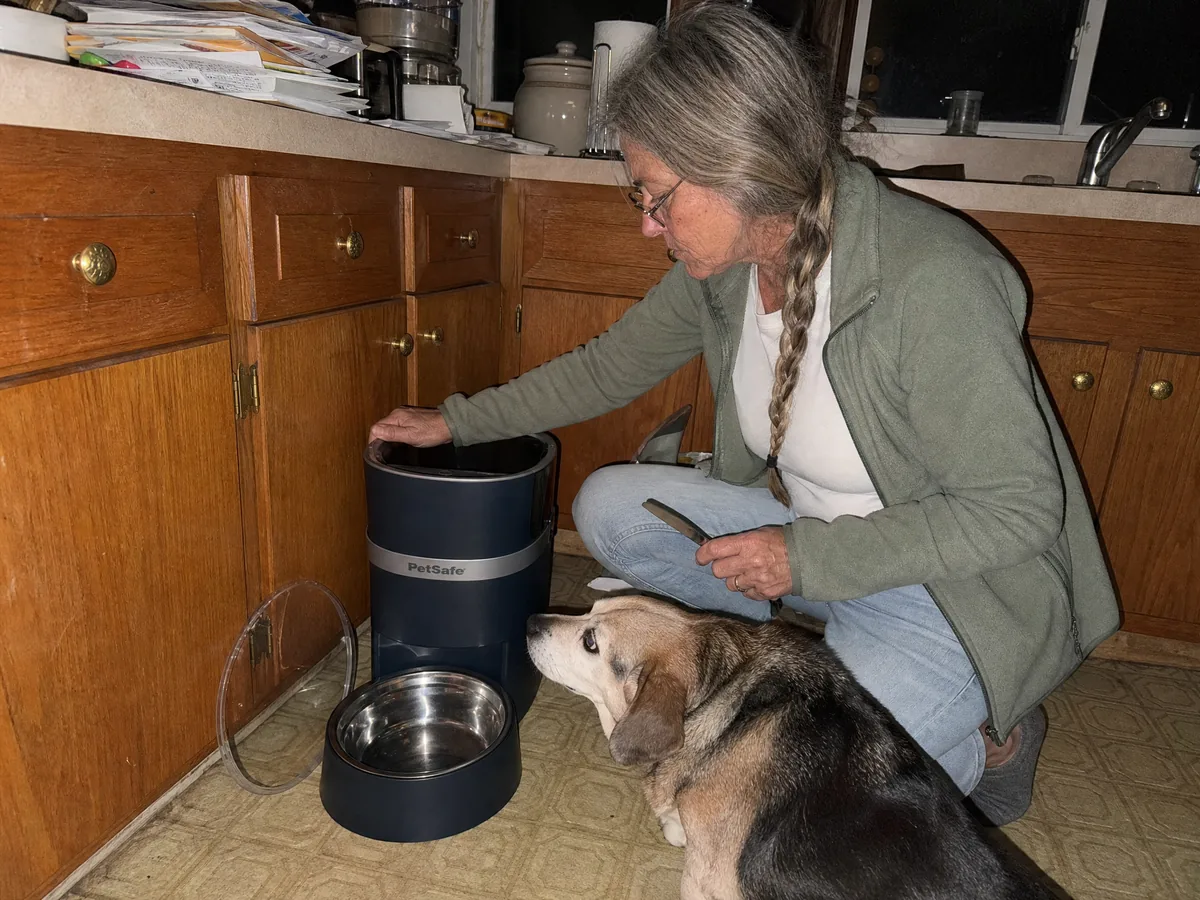
The PetSafe looks the most like a kitchen appliance: dark slate, a silver band and a 24-cup hopper. It's the only one that can spread a meal over 15 minutes, which PetSafe calls slow feed. For Duke, who eats like somebody might take it back, that was the best feature in the test. His after-dinner hiccups went from most nights to twice in a month.
Then came Monday, September 21. I was at our grandson's ball game and Earl was at his bowling league. I got home at 7:20 p.m. to Duke sitting in front of an empty bowl, and the app showed a warning for the 5:30 meal. Under the lid, one of his flat triangles had wedged itself sideways at the opening and the next ones had stacked on top.
Two minutes with a butter knife fixed it, and Duke ate at 7:24. It never happened again in the other 103 meals. But the question of this test was "never," and that one evening is exactly the kind of thing an automatic feeder is supposed to save you from.
To be fair to PetSafe, Duke's food is big and flat, near the limit for any feeder, and the same triangles went through it 103 more times without trouble. Portions in cups ran a little generous, 80.2 g on average for a 78 g meal. The bowl, hopper and lid go in the top rack of the dishwasher, the easiest cleanup of the four. Setup was the slowest at 22 minutes, mostly fighting 2.4 GHz again. Three days after that jam, a storm put every feeder through the same test on the same evening.
The storm that tested all four at once
On Thursday, September 24, a thunderstorm rolled up the valley and the power went out at 4:52 p.m. KUB got it back at 8:31. That's 3 hours and 39 minutes, right across the 5:30 meal.
I'd loaded backup batteries in all four on day one: 3 D cells each in the Granary and the WOpet, 4 in the PetSafe, and the Petkit's own set. None of them come with batteries, so buy them with the feeder. All four served the 5:30 meal on battery. None of them could tell my phone about it, because Wi-Fi goes off on battery, so I checked by flashlight like it was 1985.
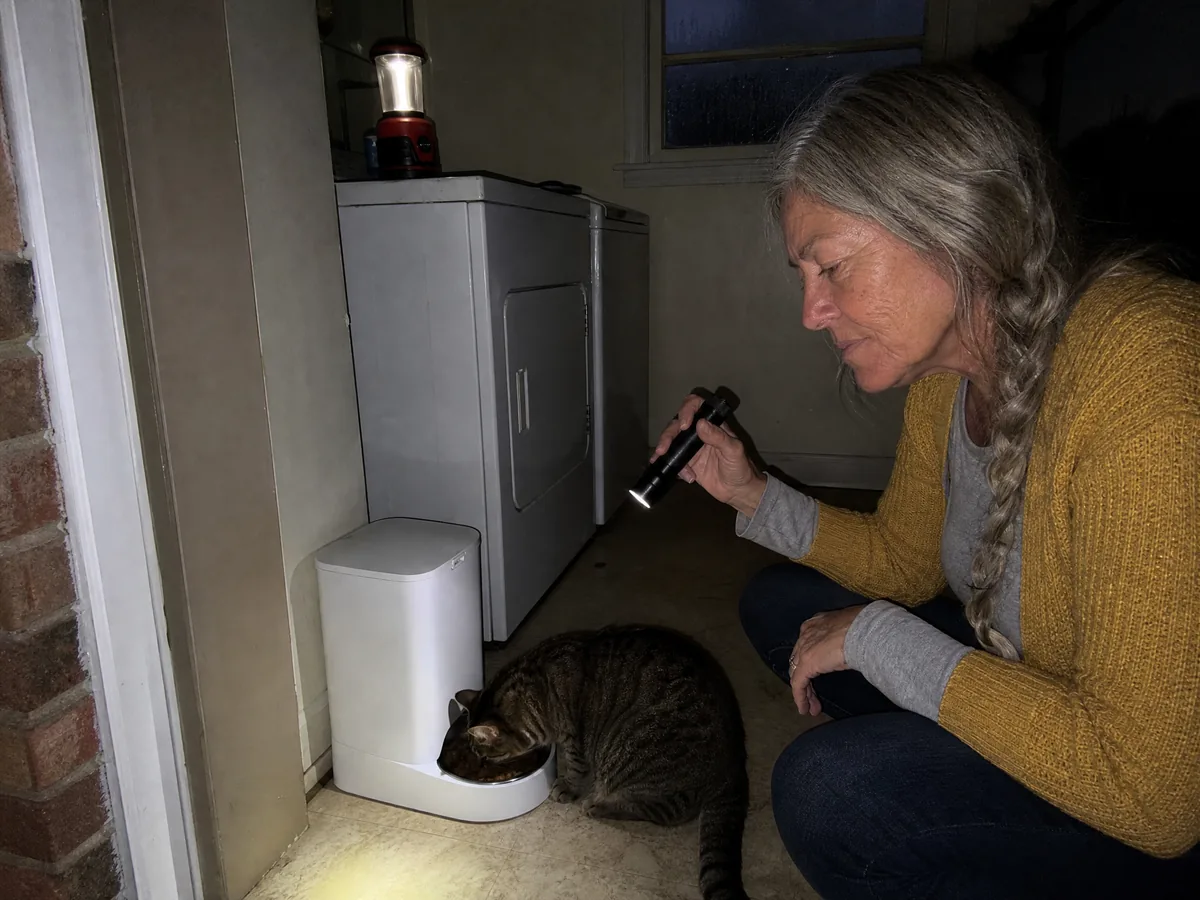
Biscuit didn't notice the storm. She noticed the flashlight, and gave it the look she usually saves for the vacuum. If power cuts are common where you live, the batteries matter more than any app feature. That's one of the things we check in every pet test, as you can read on our how we test page. So, which one would I actually put money on?
Which one I'd buy, and for whom
If you want to see your pet at mealtime and toss a treat from work, a feeder isn't the tool for it. Our Furbo 360 review covers that side of things, and the rest of our animal tests are in the pets section.
US prices and what to pay
We bought all four ourselves. Here's what they cost as I write this, and the price I'd wait for:
- Petlibro Granary WiFi (5L): $89.99 at Chewy and Best Buy, often $65 to $75 on Amazon. Good under $70.
- Petkit Fresh Element Solo (3L): $52.99 on Petkit's site, list $69.99, around $51 to $54 at Chewy, Target and Sam's Club. Good under $50.
- WOpet Patrol F07 Pro (6L): $76.99 on WOpet's site, list $99.99, often less on Amazon. Good under $60.
- PetSafe Smart Feed (2nd Gen): $134.99 at PetSafe, about $130 at Target and PetSmart. Good under $110.
Black Friday is November 27 this year, and pet tech usually drops then. Add a pack of D batteries to the cart either way. The Granary is staying in the laundry room, the Petkit went upstairs as a spare, and the board on the fridge has a new column that just says "feeder." It has a check mark every day. My next pet test is already running, and you can follow it on our tests in progress page.
Questions people ask
What is the most reliable automatic pet feeder?
In our 62-day test the Petlibro Granary WiFi was the only one of four with no skipped meals, no jams, nothing late and tight portions, 124 meals out of 124. The Petkit Fresh Element Solo also never skipped or jammed, but served three light meals when its hopper was nearly empty.
Why does my automatic feeder keep jamming?
Most often it's kibble that's too big or too flat for the opening, food that has clumped in humidity, or a hopper run almost empty. Check the kibble size your feeder is rated for, change the desiccant if it has one, and refill at a quarter full. Our only full jam came from 16 mm flat kibble in the PetSafe.
Do automatic feeders work when the power goes out?
Yes, if you put backup batteries in. None of the four we tested include them. All four kept feeding through a 3 hour 39 minute outage on batteries, but Wi-Fi turns off on battery, so you get no app alerts until the power is back.
Is an automatic feeder OK for a large dog?
It depends on the meal size and the kibble. The PetSafe Smart Feed handles up to 4 cups per meal and 24 cups in total, so it suits medium and many large dogs. The Granary, Petkit and WOpet are built for cats and small to medium dogs, with portions of 5 to 10 g.