
Kärcher WV 6 Plus review: 11 windows, a stopwatch and a spaniel's nose prints
The window cleaner comes every fourth Thursday and it rains on the Friday. So Clive timed a £70 window vac against his old bucket and squeegee, pane by pane.
 By Clive Hepplewhite, former appliance repair engineer
Tested in Sheffield · 9 July 2026 · 11 min read
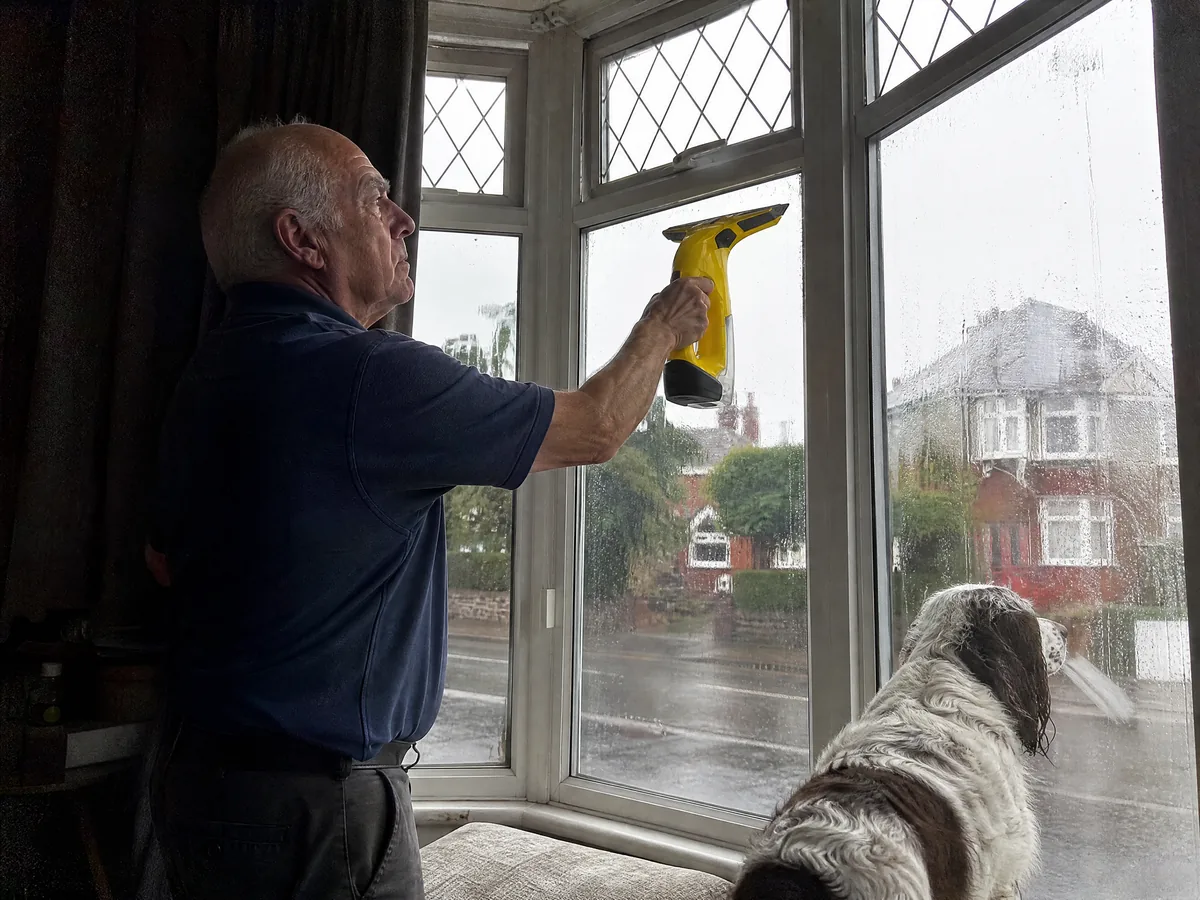
- Every window in the house, plus the back door, in 52 minutes instead of 96
- Painted sills stay dry because the water never reaches them
- Counts down the battery in minutes: 36 still showing after the big clean
- Clears a steamed-up window or a shower screen in seconds
- At 28 cm across, it's hopeless on small leaded panes
- The bottom rail always keeps a thin line of water
- Drips on your head if you try it on overhead glass
- Almost three hours on the charger from empty
Verdict: on large panes, glass doors, streaming winter windows and the bathroom, it takes a slow, drippy job and makes it quick and dry. You still wash the glass yourself, and anything with small panes stays a cloth job. At around £70, it's the window vac I'd put in my own cupboard.
Our window cleaner, Mick, comes every fourth Thursday. It rains on the Friday. Pauline says this is a law of nature in Sheffield, like the hills and the parking. Mick does the outsides. The insides are mine, and in our house the insides are the problem.
The problem has four legs. Bramble, our springer spaniel, watches the street from the bay window and the garden from the glass back door, and he does both with his nose touching the pane. By Wednesday the lower half of the back door looks like it's been finger-painted by a toddler with a cold.
So I'd been eyeing the Kärcher WV 6 Plus, the yellow window vac that seems to hang on a hook in every other British utility room. After 19 years repairing appliances, my honest first thought was "a hoover for glass, what next". I gave it five weeks, a stopwatch and every pane of glass we own.
A squeegee with a straw
That's the simplest way I can put it. In the box there's the vac, a spray bottle with a fluffy microfibre head, a charger and a little bottle of cleaning concentrate. You still do the washing: spray, scrub with the fluffy head, loosen the muck. The vac only comes in at the end.
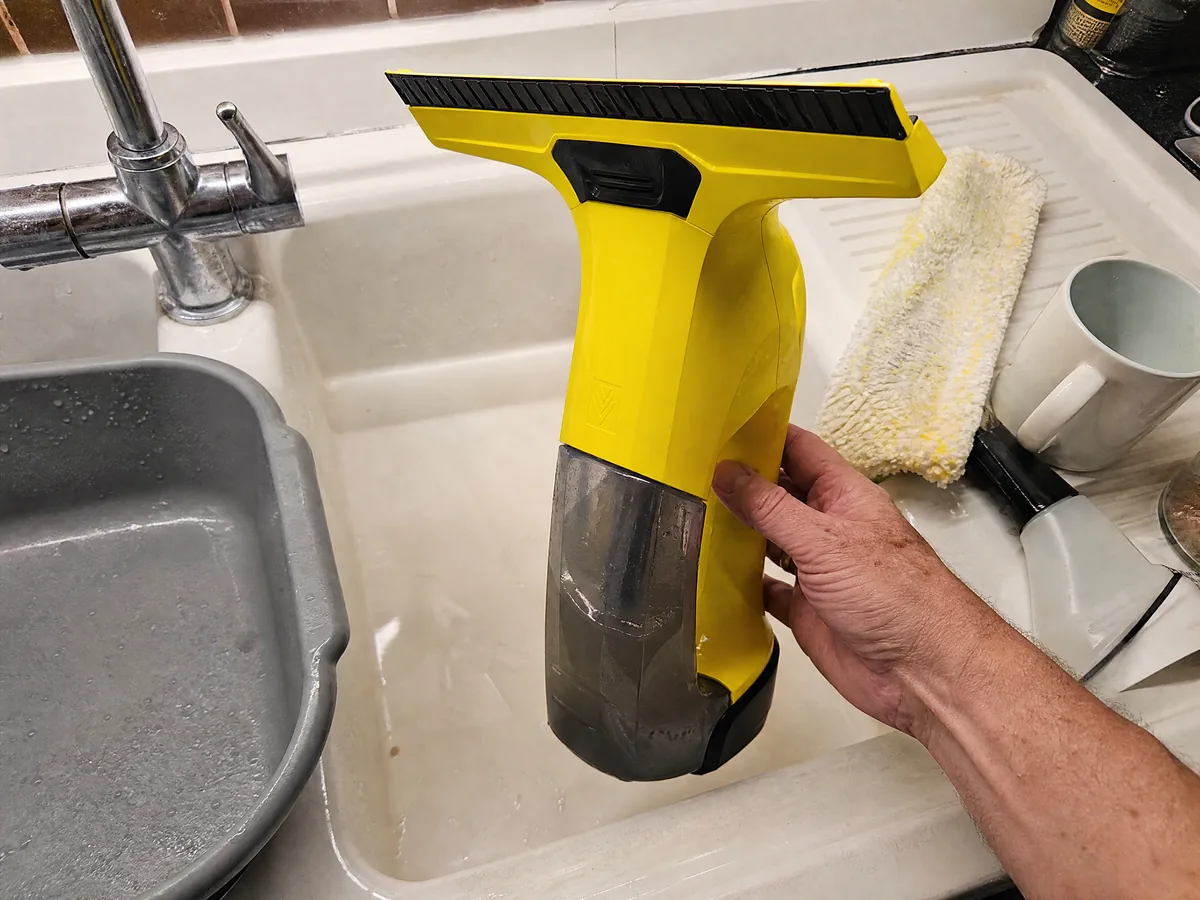
What it does then is the clever part. As you draw the rubber blade down, a small fan behind it pulls the dirty water off the glass and up into a clear 150 ml tank. With an ordinary squeegee, that same water runs to the bottom of the pane, over the frame and onto the sill.
I spent a good chunk of my working life being called out to damp problems that weren't really damp problems. Grey, soft window boards, black corners, peeling paint. In most of those houses the culprit was water sitting on the inside sill, day after day, from cleaning or condensation. So for me, the drip that never happens is the whole selling point.
What you get for about £70
Kärcher sells a ladder of these, from the entry WV 2 Plus to the WV 7 Signature Line. The WV 6 Plus sits one rung from the top: the same long-running battery as the flagship, fewer bits in the box.
| Spec | Kärcher WV 6 Plus |
|---|---|
| Price | About £70 at Amazon.co.uk and Currys at the time of writing, up to £110 at other shops |
| Run time | Up to 100 minutes (Kärcher figure) |
| Charging | About 170 minutes from empty |
| Glass per charge | Up to 300 m² (Kärcher figure) |
| Blade width | 280 mm |
| Tank | 150 ml |
| Weight | About 0.8 kg, battery included |
| Display | Minutes of battery left |
| Also in the box | Spray bottle with microfibre head, charger, 20 ml concentrate |
I never once ran it flat on a real job, and that's the figure that matters.
Condensation first, because this is Britain
In my repair years, if a house in Sheffield had one of these, nine times out of ten it was bought for condensation, not for cleaning. January mornings, single-skin extensions, windows streaming, water pooling on the sills. That's the job it was really made for in this country, and it does it very well.
Our test ran through June, so I had to make my own weather. A Sunday dinner with two pans of veg on the boil, and an extractor that mostly makes noise, soon had the kitchen window running. The Kärcher pulled 24 ml off that one pane in about twenty seconds. Early in the test there were two cold mornings when the north-facing back bedroom window misted up too, and it cleared that in less time than it took me to find my slippers. By January, I expect this will be the job it does most.
Timing the lot: 96 minutes against 52
Before the Kärcher came out of its box, I did every window inside the house the old way, and Pauline ran the stopwatch on her phone. Warm water and a squirt of washing-up liquid in a bucket, a sponge, my old squeegee, a tea towel over my shoulder. Eleven windows, counting the front bay's three tall casements and the three little leaded lights above them, plus the glass back door. Total: 1 hour 36 minutes, sills wiped and bucket emptied.
Two weeks later I did the same round with the WV 6 Plus: 52 minutes. Where did 44 minutes go? Hardly any of it came from the glass. It came from the jobs around the glass. Carrying a bucket upstairs without slopping it. Mopping sills. Wringing the tea towel, then fetching a dry one.
- The big bay casements: 2 minutes 20 seconds each on average, against 4 minutes 50 the old way.
- The glass back door: 2 minutes 30 against 5 minutes 10, with a dry doormat for once.
- The leaded lights: no quicker at all. They get their own section.
I tipped the tank out twice along the way. It unclips with one hand and pours straight into the sink. Pauline looked at the colour of the first lot and said it was going on the list of things she wished she hadn't seen.
Streaks, edges and the sunny side
Across the middle of a big pane, the finish beat anything I've managed with a squeegee. The blade is mounted so it can tilt a little, which means it stays flat on the glass even when your wrist wanders. I stopped fussing about the angle within a day.
The corners are another matter. The head can't get right down into the bottom corner of the frame, so every pane finishes with a wet line along the bottom rail, about a centimetre deep. On our uPVC frames the sides were fine. On the one old timber frame in the back bedroom, the deeper beading left a wet edge down the sides as well.
The front of the house faces south. I did two bay panes at lunchtime on a hot June day and got faint streaks on both. That's physics, not Kärcher. In full sun the glass dries itself before any blade reaches it.
Bramble's nose prints turned out to be easy. Mist, give it a few seconds, one pull from top to bottom, done. The back door now takes me about ninety seconds after one of his mornings on guard duty. That's also about how long it stays clean.
The shower screen, in a soft-water city
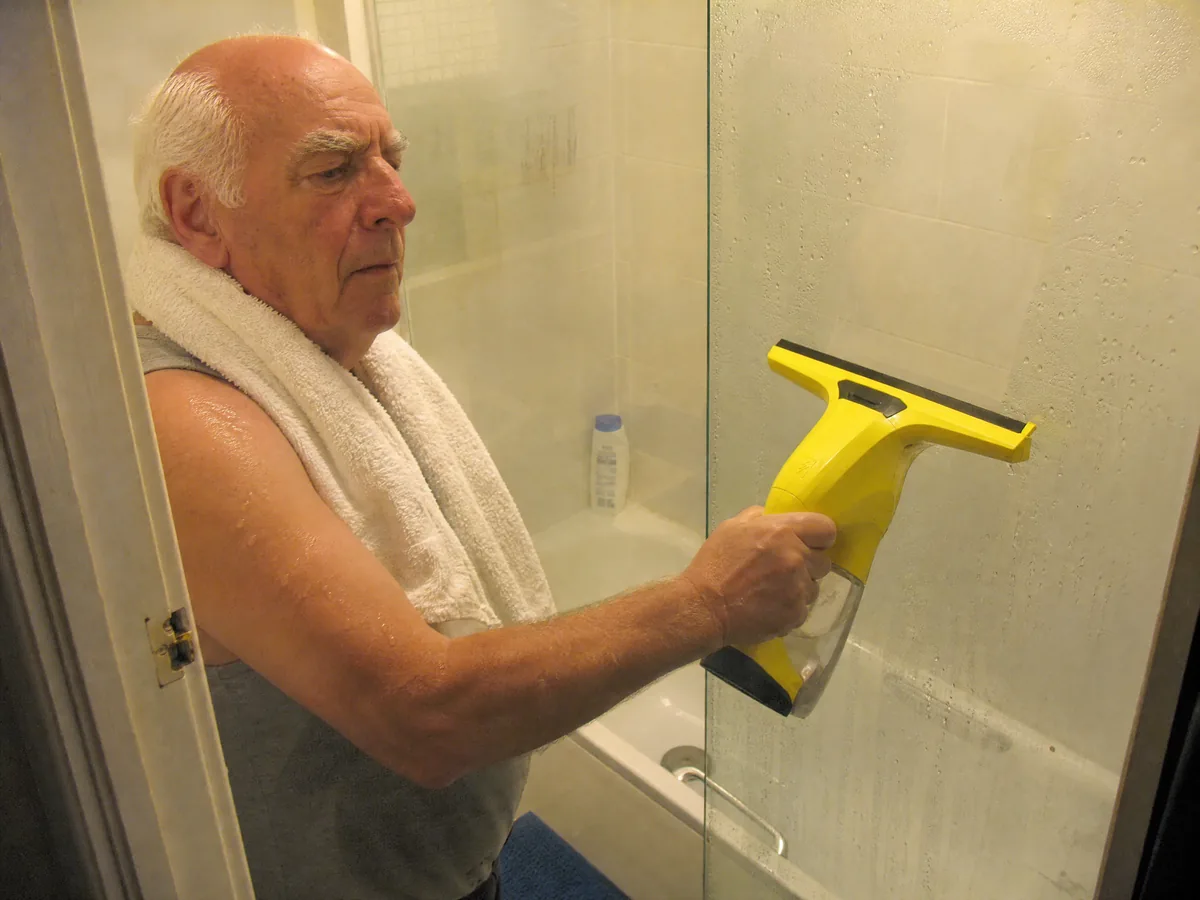
By the end of week two, the Kärcher had quietly moved house. It spent more time in the bathroom than anywhere near a window. We have a bath with a fixed 80 cm glass shower screen. Sheffield's water is soft, so limescale isn't our fight the way it is further south. Ours is the black line of mould that creeps along the bottom seal when water sits there every day.
So now, towel still round my neck, I run the vac down the screen before I get dressed. Half a minute, and there's nothing left to drip. Five weeks on, the seal is still white. The mirror gets two passes too, and stops dripping onto the basin.
"Forty years of you bringing gadgets home, and that's the first one I'd miss." Pauline, week three
Battery, noise and your shoulder
With the big clean done, the little screen still said 36 minutes. I then used it on the shower screen and mirror every morning for twelve days before I bothered plugging it in. Having an actual number of minutes on the display, rather than a row of bars, means you know before you start whether it'll see you through the patio doors.
From empty to full took 2 hours 50 minutes on my stopwatch. That's slow, and it only matters if you forget to charge it before a big session. The one day it nearly caught me out, Alfie had found it first. He'd done the oven door, the glass on the telly cabinet and, for reasons he couldn't explain, the patio table. He's six. The table has never looked better.
On my sound meter it read 53 dB from a metre, roughly the hum of a fridge when you're stood next to it. Bramble couldn't have cared less, which is more than can be said for the postman. It's 0.8 kg, so you barely notice it at first. After three quarters of an hour of reaching up to the top of the bay casements, my shoulder was noticing it for me. I'm 66. Yours might be fine.
Leaded lights, the conservatory roof and upstairs outsides
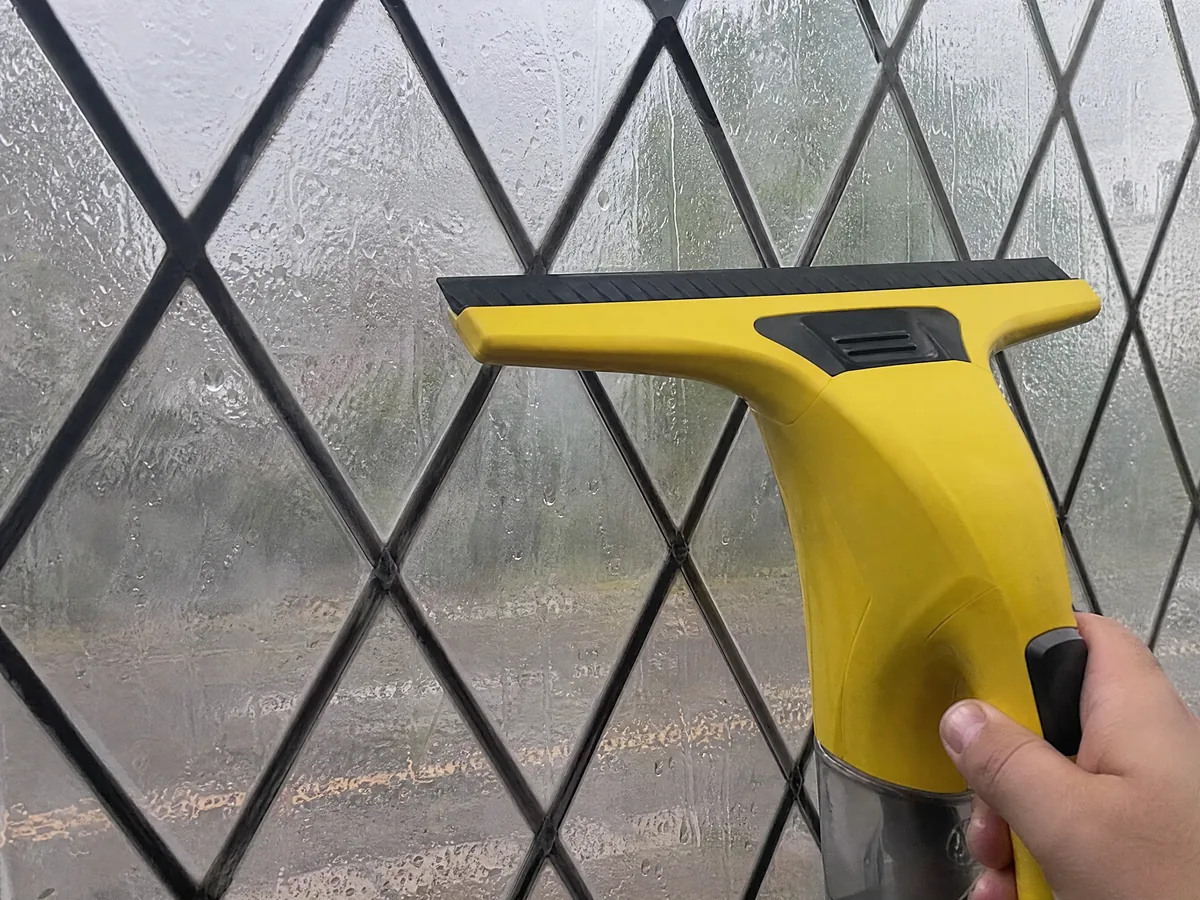
Above our bay are three leaded lights, each a lattice of small diamond panes about 14 cm across. The blade is twice as wide as each diamond. There's no clever way round that. A cloth was quicker there, and always will be. Kärcher sells a narrow 170 mm blade as an extra, and the WV 7 Signature Line comes with one, but even that won't fit our diamonds.
Then there's the little lean-to conservatory with its glass roof. Hold the vac upside down over your head and the water can't climb up into the tank, so it runs back out of the blade and lands on you. On the sloping side panels it was fine. Flat overhead, forget it.
Outside, the vac works just as well as inside, as long as you can reach safely. I did the downstairs outsides myself. Upstairs means leaning out of a 1930s casement, and at my age that's a no. That's what Mick is for.
Keeping it working into year three
From the dead ones I saw in my repair days, the rules are simple. Empty the tank after every job and give it a rinse, because dirty water left in there turns sour within days. Keep the body away from the tap. The motor is sealed, but the charging socket isn't built for a dunking.
The rubber blade is the bit that wears. Give it a wipe after use, because a speck of grit caught on the edge will score a line down every pane you do next. New blades cost a few pounds and clip in without tools. Over winter, keep it indoors. A frosty shed does the battery no favours and turns the rubber hard.
Other window vacs, and the one you already own
Kärcher WV 7 Signature Line. Identical battery, tank and suction, with extras: the narrow blade, a spare microfibre head, a scraper and a box to keep it all in. Normally a little dearer. Worth it for lots of small panes, glass cabinets or a glass balcony.
Kärcher WV 2 Plus or WV 5 Plus. Less money, shorter battery, and bars instead of minutes. For a flat with a handful of windows, you won't miss much.
Vileda and Leifheit. Often a few pounds cheaper. We haven't put either through the same five weeks yet, so I won't pretend to know how they compare over time.
Your old bucket and squeegee. If you do the windows twice a year and never see condensation, stick with the kit you already have. The Kärcher earns its money through regular use, not once in spring.
If your battle is less with glass and more with what your dog leaves on the floor, Bramble and Dyson's strongest stick went head to head in our Dyson V16 Piston Animal review. Everything else we've scored is in our reviews, and our how we test page explains why we time jobs instead of guessing.
Is it for your house?
After five weeks
The WV 6 Plus knocked 44 minutes off a full inside clean and took over a daily bathroom job I'd been doing badly. It won't wash the glass, it leaves a wet line on the bottom rail, the leaded lights are beyond it and it charges like it's in no hurry. I'd still buy it tomorrow.
The best review it got came from an unexpected place. On his last visit, Mick spotted it on its hook, picked it up, had a go on our back door and asked where I'd bought it. For his conservatory, he said. Bramble, meanwhile, has already re-decorated the back door.
Your Kärcher WV 6 Plus questions, answered
Do I still need the spray bottle with a Kärcher window vac?
You do. The vac lifts water, it doesn't scrub. Mist the glass and work the dirt loose with the microfibre head first. On glass that's only lightly grubby, plain water with a couple of drops of concentrate does the job.
Does the Kärcher WV 6 Plus help with condensation?
It's one of the best uses for it. On a steamed-up kitchen window it collected 24 ml in about twenty seconds in our test, into the tank rather than onto the sill. If your windows stream every winter morning, that alone justifies it.
Is washing-up liquid OK in a window vac?
Keep it to a drop, or leave it out. Suds can be pulled up into the machine. Kärcher's concentrate or a low-foam glass cleaner is better. Too much cleaner doesn't give you cleaner glass, it gives you streaks.
When does the rubber blade need replacing?
Most owners say somewhere between one and two years with ordinary use. New blades are a few pounds and clip in without tools. Ours still looked new after five weeks of daily use, and wiping it after every clean helps.