
ghd Chronos review: I swore off hot plates, then tried the £299 straightener anyway
After a summer with air-powered styling, I wanted glossy hair for a wedding. So I measured the ghd Chronos with a thermometer, a stopwatch and a very honest second tester.
 By Gillian Scrivens, health and beauty tester
Tested in Bristol · 18 September 2026 · 12 min read
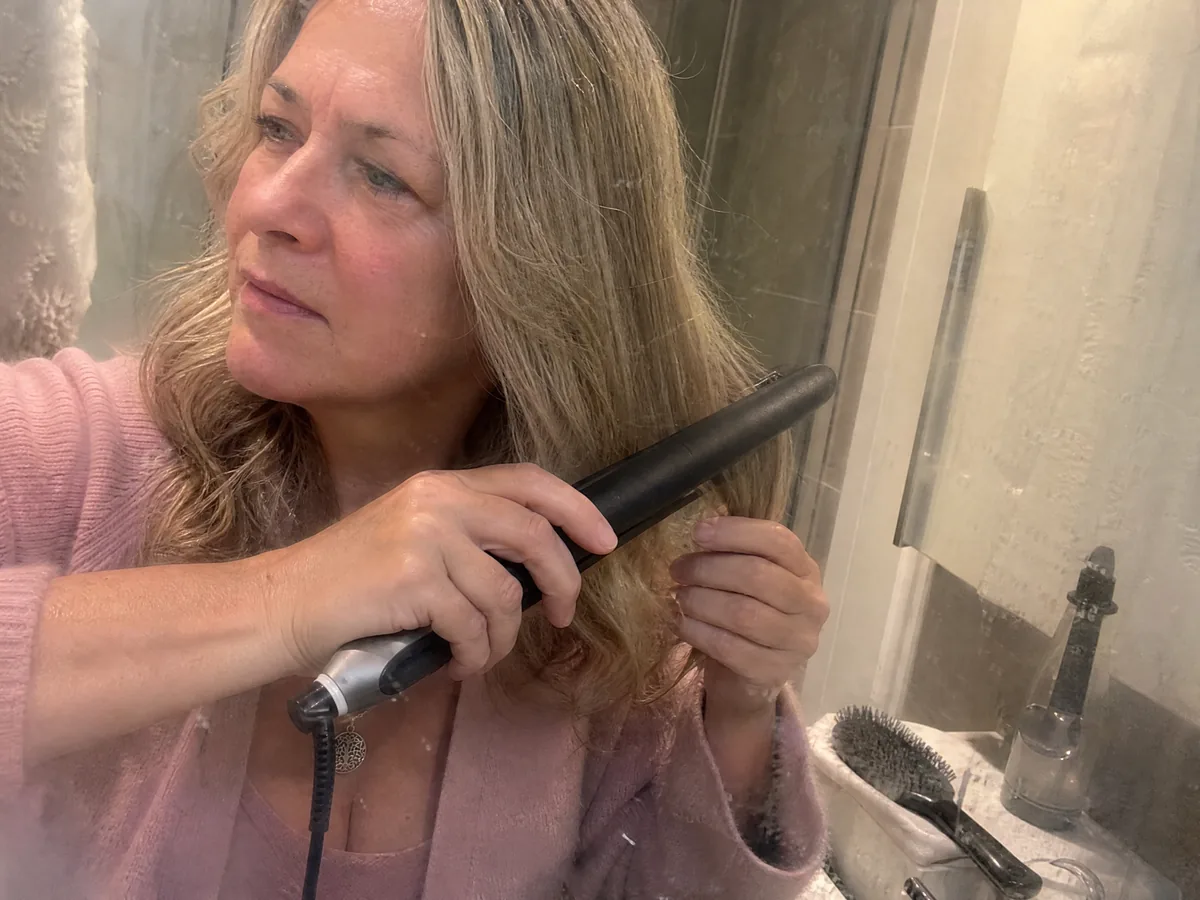
- My shoulder-length hair done in 6 min 45 s, down from 11 min 20 s
- Plates held 184 to 187°C on our thermometer, no overshoot
- Glassy shine that survived a damp day at a Clifton wedding
- Switches itself off after 10 minutes, which it did, twice
- One fixed temperature: thick, coily hair needed 2 to 3 passes
- £299 is a lot when it was £199 last Black Friday
- No heat mat or case in the standard box
- Still 185°C: kinder than cheap plates, not kind like air
Short version: for fine, medium or thick straight and wavy hair, the Chronos is the quickest, glossiest straightener I've used, and it does the job in one pass. If your hair is very thick or tightly coiled, the fixed 185°C will slow you down. Don't pay £299: under £230 is a fair price, under £200 a great one.
I'd made my peace with it. A few weeks into testing Dyson's air-powered styler, I'd decided my ends were healthier, my hairdresser was cautiously pleased, and the straighteners that had cooked my hair at 200°C for twelve years could stay in the drawer. Then my niece Hannah sent round the photos from her hen do, three weeks before her wedding.
My hair looked nice. Soft. Neat. And slightly matt next to my sister's, which was so shiny it was reflecting the fairy lights. "It's just the ghd, Gill," she said on the phone. "Straight out of the box, one go."
I bristled, and then I bought one. The ghd Chronos is ghd's current flagship straightener, and it works at one fixed temperature, 185°C, that ghd says is the sweet spot between styling and damage. My question was simple: is that low enough to be kind to hair like mine, fine, drying and going grey in patches, and is it worth £299?
Five weeks, from 10 August to 14 September, with a wedding in the middle. Before the results, a quick look at what ghd claims.
What the Chronos claims to do
ghd's marketing is enthusiastic, so here are the claims, with their small print translated:
- 3x faster styling compared with ghd's original straightener, from "one-stroke" results. In other words: one pass per section instead of three.
- Up to 85% more shine than naturally dried hair, in ghd's lab test on brunette hair.
- 2x less frizz, again against hair left to dry naturally.
- Up to 3x more breakage protection than a rival straightener working at 235°C.
The tech behind it is what ghd calls HD motion-responsive technology: sensors in the plates that notice when you're gliding through hair and top up the heat instantly, so the plates don't cool mid-stroke. The plates are ceramic and "floating", so they flex slightly to grip each section evenly. It heats up in 20 seconds, it runs on any voltage, and it turns itself off if you leave it for 10 minutes.
Notice what the comparisons are against: hair dried naturally, and a straightener at 235°C. Neither of those is my old pair. So I ran my own comparisons.
How we tested it
I straightened my own hair 27 times across the five weeks, on a mix of wash days and second-day hair. My hair is shoulder length, fine, a bit coarser at the parting where the grey is coming through, and it frizzes if someone mentions the word drizzle. I live in Bristol, so that's most days.
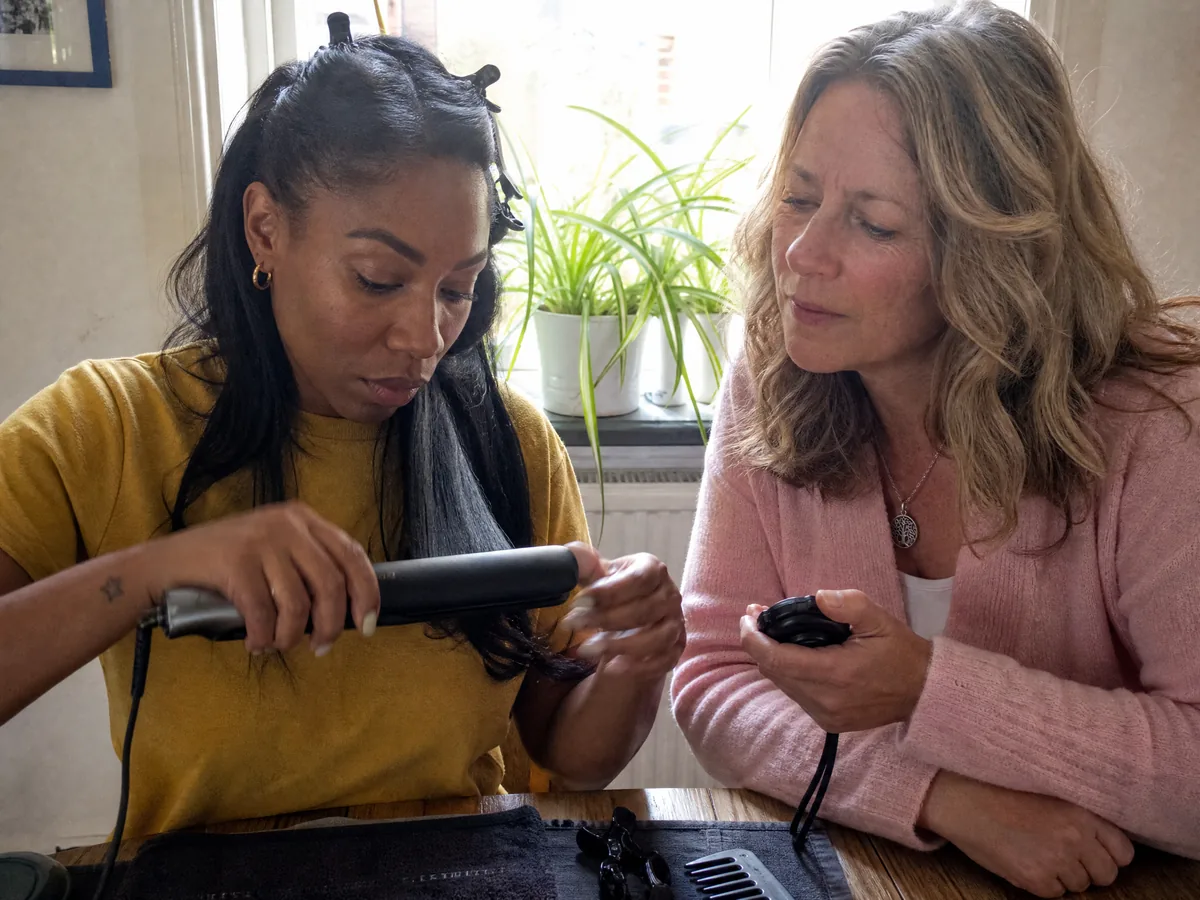
Because my head isn't every head, I asked Funmi, who lives three doors up and works as a teaching assistant, to test it too. Funmi is 38, has thick, tightly coiled hair past her shoulders when it's straightened, and does a silk press every two weeks with her own iron set to 210°C. She did six full silk presses with the Chronos. My neighbour Priya, whose thick, poker-straight hair was so useful last time, had a couple of goes as well.
For each session we noted the time with a stopwatch, the number of passes per section and a photo in daylight at the top of the stairs, then another the next morning. I used an infrared thermometer to measure the plate temperature, and the same cheap hygrometer on the bathroom shelf as last time, which read between 58% and 86% humidity over the test. All of it follows our usual testing rules, and I bought the Chronos myself, full price, from a ghd stockist.
The first thing I measured was the thing I was most worried about.
How hot it really gets
My old straighteners, a £40 pair from a chemist, were "set" to 200°C. My thermometer read 212°C in the middle of the plate after five minutes, and it wandered up and down by nearly 10 degrees during use. So for twelve years I'd been styling hotter than I thought, and less evenly.
The Chronos was reassuringly dull by comparison. It reached temperature in 22 seconds on my stopwatch, close to ghd's 20. Across the five weeks, it never read below 184°C or above 187°C in the centre of the plate, even after running through a thick section of Funmi's hair, which is exactly the moment cheaper plates cool down and you end up going over the same bit again.
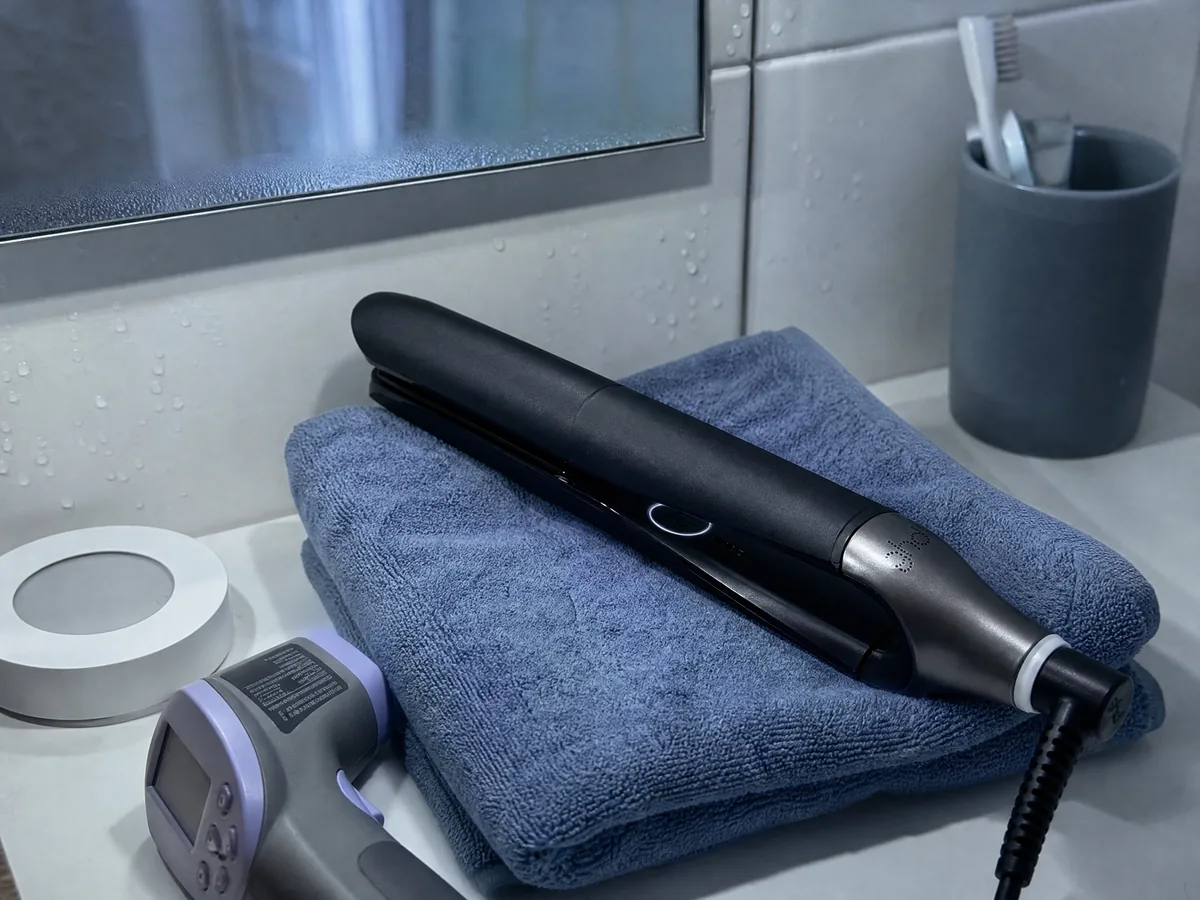
That steadiness matters more than the number on the box. Fewer passes means less time under heat. And a plate that doesn't overshoot means no scorching the thin bits around your face. Is 185°C "healthy"? No heat is. But it's a good deal cooler than what most of us have been using, and it gets the job done in one go. That's the next thing I timed.
Speed: one pass, and I mean one
On my hair, the one-stroke claim is true. With my old pair I'd go over each section two or three times, and the ends always needed an extra pass. With the Chronos, one slow, steady glide left each section smooth. On 22 of my 27 sessions I didn't go back over a single piece, apart from the front section by my parting, where the grey hair is springier.
| What we measured | ghd Chronos | Our old straighteners |
|---|---|---|
| Plate temperature, centre | 184 to 187°C | 203 to 212°C, "set" to 200°C |
| Heat-up time | 22 s | 58 s |
| My hair, full head, dry to straight | 6 min 45 s on average | 11 min 20 s on average |
| Passes per section, my hair | 1.2 on average | 2.5 on average |
| Funmi's silk press, straightening stage | 38 min | 31 min with her own iron at 210°C |
| Passes per section, Funmi's hair | 2.6 on average | 1.5 with her own iron |
| Auto switch-off | 10 min 04 s | None |
Four and a half minutes a session doesn't sound like much. Three times a week, it's roughly 12 hours a year. I've decided to spend mine in bed.
Funmi's result is the honest counterweight, and it's the most useful thing in this review for anyone with hair like hers.
Funmi's silk press, and the fixed temperature
Funmi's hair is thick and tightly coiled, and her usual routine is a careful blow-dry followed by her own iron at 210°C, in small sections. With the Chronos she needed 2 to 3 passes per section, against 1 to 2 with her own iron, and the straightening stage took her 7 minutes longer.
The result was lovely, she said so herself: smooth, swingy, with a real glow to it. And the finish lasted as long as her usual press, 11 days before she felt it needed redoing. But more passes at 185°C isn't obviously better for hair than fewer passes at 210°C, and she knows her hair better than any marketing department does.
"It's beautiful at the end, I'll give it that. But I'm not doing three passes every time. If it went up to 200 I'd buy one tomorrow." Funmi, after her third silk press with it
My hairdresser, Sian, agreed when I told her. For fine, thin, coloured or grey hair, she said, a fixed 185°C is a feature: it stops you cranking it up. For very thick, coarse or coily hair, it's a limit, and a straightener you can turn up slightly is often the better tool. ghd's own Chronos Max, with wider plates, helps with length and thickness, but it runs at the same temperature.
So, fast for most of us, slower for some. What about the finish, the reason I bought it?
Shine, frizz and a damp wedding in Clifton
The shine is the Chronos's real gift. In the daylight photos, my hair looked noticeably glossier than after my old straighteners, and much glossier than the soft finish I got from Dyson's air straightener. Martin, who has never commented on my hair unprompted in 31 years of marriage, said "that's shiny" on day three. I wrote it down.
Then the proper test. Hannah's wedding was on Saturday 29 August at a church in Clifton, with photos on the green afterwards. The hygrometer at home said 84% when I left. It drizzled during the confetti and stayed muggy all evening. I'd done one pass with a heat protection spray, plus a light serum on the ends.
At 11 p.m., after a ceilidh I don't want to discuss, my hair was still smooth, with a little lift at the crown and a few flyaways at the parting. The photos show it shining next to my sister's, which, I'll admit, was the whole point. The next morning it was about 80% there, and a quick pass at the front was enough for a family lunch.
Frizz on normal Bristol days was well controlled. On the six days the hygrometer read above 80%, my hair lasted until mid-afternoon before the parting started to rebel, against lunchtime with my old pair. It's not magic, but it's better. There's more to living with it than hair, though.
Waves, safety and living with it
The rounded barrel means you can do waves and bends by twisting the straightener as you glide down. I learned it from a two-minute video and did loose waves for the wedding in nine minutes. They're not as bouncy as an Airwrap curl, but they're glossier and they held all night. The hinge lets you tilt the plates slightly, which makes the twist easier on short sections near the face.
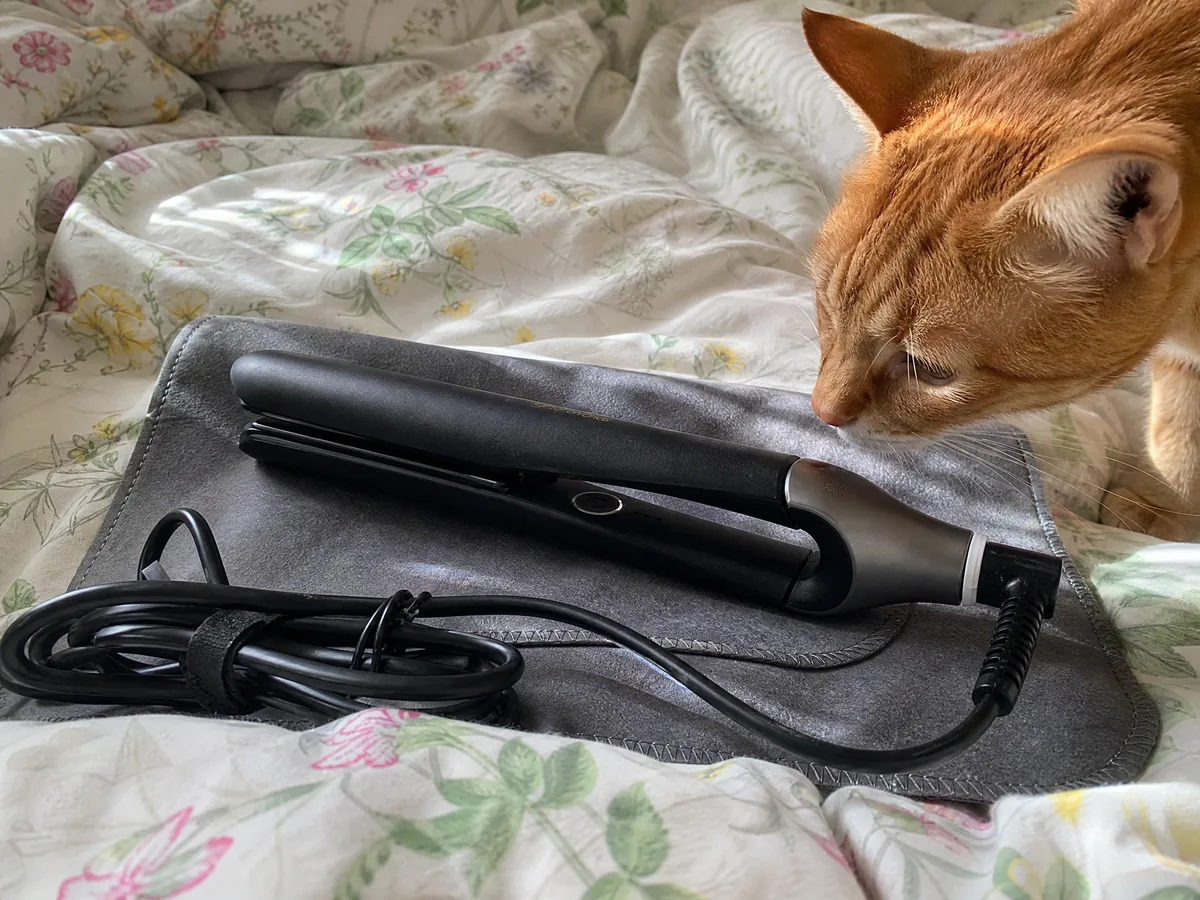
The auto switch-off worked twice without being asked. Once I left it on the bathroom shelf while answering the door to a parcel, and once when Pickle, our cat, needed urgently letting out. Both times it had turned itself off by the time I got back, after 10 minutes and 4 seconds, on my stopwatch. The swivel cable is long enough to reach from the socket by the mirror to the stool, and it never tangled.
The standard box has the straightener and not much else. No heat-resistant mat, no pouch. The gift sets add a bag, and so does this year's festive set, which I'll come to. I used a folded old towel on the shelf, which works, but a proper heat mat is a few pounds and much safer if you have children or a curious cat.
So I like it. The question is what to pay for it, and when.
What to pay, gift sets and the fakes
At the time of writing the Chronos is £299 at ghd, John Lewis, Lookfantastic and Very, and around £222 at Amazon.co.uk according to PriceSpy. Price trackers show it dipping to £169.99 at one point in the past three months. Two Black Fridays ago it went to £199 from £289 at several stockists, and last year ghd's own Black Friday sale took roughly a quarter off many of its tools. It wasn't cut directly in this summer's Prime Day. So the pattern is clear: big discounts come in November.
| Price for the standard Chronos | Our view |
|---|---|
| £299 | List price. There's no need to pay it |
| £230 to £250 | An ordinary discount |
| £200 to £229 | A good price |
| Under £200, from an approved stockist | Excellent. Buy it |
This year the discounts should peak between Friday 27 and Monday 30 November. The Chronos Hair Straightener Festive Gift Set in Cashmere Beige is already listed at £309 at John Lewis, with a bag included. Gift sets are usually discounted over Black Friday along with everything else, and if it's a present, the bag and the colour make it feel more like one.
It's a lovely gift for someone who already straightens their hair and is using something old or cheap. It's a riskier one for someone with very thick or coily hair, for the reasons Funmi gave. Buy a heat protection spray and a heat mat with it and you've covered everything.
And if £200 or more is still too much, ghd and others make cheaper options that are nearly as good.
Right for your hair? And the cheaper options
- ghd Platinum+, £186 to £249 at John Lewis at the time of writing. The previous flagship, still very good, same 185°C, a bit slower.
- ghd Gold, £149 to £199 at John Lewis. Simpler, no motion sensors, but the same temperature and the same trusted plates. The best value ghd.
- ghd Chronos Max, £224 to £299 at John Lewis. Wider plates for long, thick hair. Same temperature.
- Dyson Airwrap with the Air Straightener 2x attachment. No hot plates at all, about 95°C in our test, softer finish. I wrote it up in my Dyson Airwrap Co-anda2x review, and it's still my everyday tool.
John Lewis also lists ghd's newer, dearer Sculpt Interactive at £369. We haven't tested it yet. Everything we have tested is on our blog.
So, did I go back to hot plates?
Partly. The Airwrap still does my everyday hair, because it's gentler and I use it five times a week. The Chronos comes out two or three times a week, for work, for dinners and for anything with a camera. That's a compromise my ends and my hairdresser are both happy with.
The ghd Chronos is the best straightener I've used: fast, steady, glossy and well thought through. At 185°C it's cooler and more even than the cheap pair it replaced, and on fine hair it really does work in one pass. At £299 it's overpriced. At £199 on Black Friday, it's a present I'd be glad to receive.
Hannah's wedding album arrived last week. In the group photo, my sister and I are standing side by side, both shiny. She's already asked what I paid for mine. I told her it was for work, which, for once, is true.
ghd Chronos questions people ask
Is the ghd Chronos worth it?
If you straighten your hair regularly and it's fine to thick, yes: in our test it halved my styling time and gave a glossier finish than cheaper plates at a lower, steadier temperature. At the full £299 it's expensive. Under £230 it's good value.
What temperature is the ghd Chronos?
It's fixed at 185°C, and you can't change it. Our infrared thermometer read between 184°C and 187°C on the plates throughout five weeks of use.
Is the ghd Chronos good for thick or afro hair?
It works, and the finish was beautiful in our silk press test, but thick, tightly coiled hair needed 2 to 3 passes per section at 185°C, against 1 to 2 with a 210°C iron. If you have very thick or coily hair, a straightener with adjustable heat may suit you better.
How much was the ghd Chronos on Black Friday?
In 2024 it dropped to £199 from £289 at several stockists, and in 2025 ghd's own Black Friday sale took roughly a quarter off many tools. We'd treat anything under £200 from an approved stockist as an excellent price this year.
What's the difference between the ghd Chronos and the Chronos Max?
The Chronos Max has wider plates for long and thick hair. The technology and the 185°C temperature are the same. For shoulder-length hair or shorter, the standard Chronos is easier to handle.