
Theragun PRO Plus review: what $650 buys you that a $99 massage gun doesn't
Six weeks, one physiotherapist, one $99 knockoff on the same table. Where the Theragun PRO Plus really pulls ahead, and where the cheap gun keeps up just fine.
 By Darlene Hufnagel, health and beauty editor
Tested in Milwaukee, Wisconsin · June 9, 2026 · 11 min read
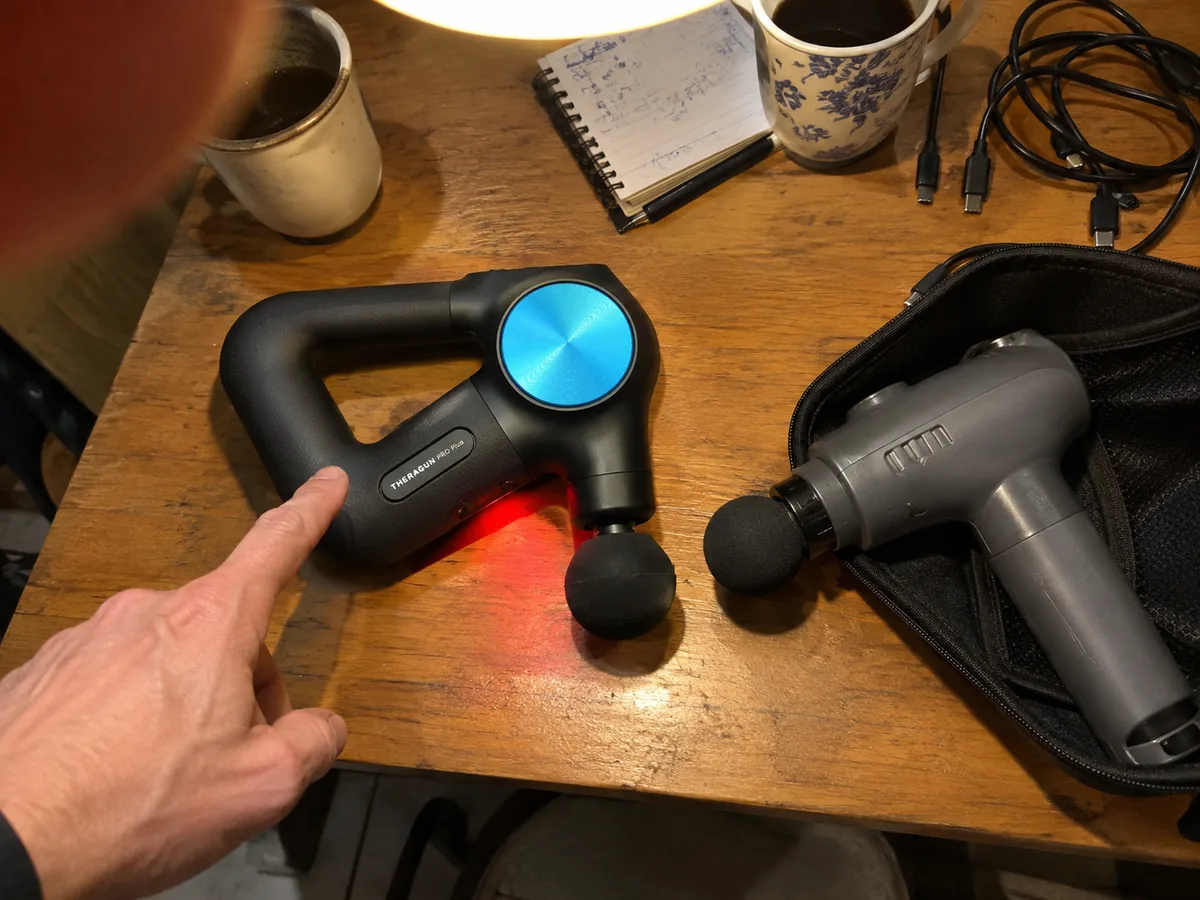
Gary put two massage guns on the table in front of me. On the left, a black triangle the size of a small drill: the Theragun PRO Plus, $649.99. On the right, a gray no-name gun I'd bought online for $99, with a carry case that smelled like a new shower curtain.
"One of these is six and a half times the price," he said. "Our job is to find out if it's six and a half times the massage."
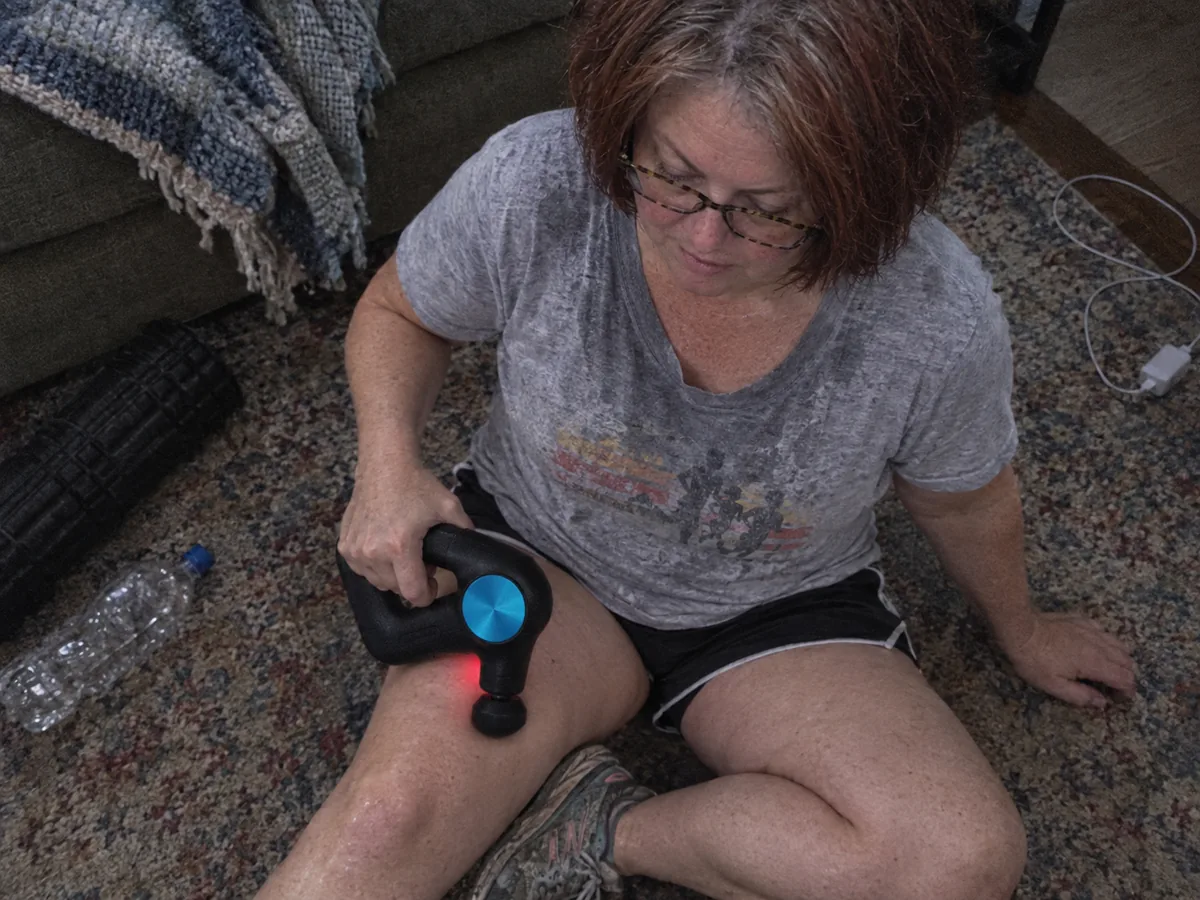
Gary Szymanski is the physiotherapist on our team. I'm the one who got very sore legs this spring training for a 10K, so I became the main test subject. For six weeks we used both guns side by side, on the same muscles, on the same days. Here's what we found, including the parts Therabody doesn't put on the box.
- Still running at 41 lb of pressure, where the $99 gun stalled at 19 lb
- The heated head is the feature we used most, by far
- 2 hours 21 minutes of real battery, charged by USB-C
- Screen routines make it easy to use well, not just hard
- 3.6 lb in the hand, tiring on your own shoulders and back
- Cold attachment costs $99.99 extra
- The LED and breathwork features felt more nice than necessary
Our verdict: the best massage gun we've used, and the heat head makes a real difference on stiff muscles. But most people will get 80% of the benefit from a gun that costs half as much. Buy it if you'll use it daily and want the heat.
What makes it the flagship
Therabody sells seven or so Theraguns, from the pocket-size Mini to this one. The PRO Plus sits at the top, and the difference isn't just a stronger motor. It's a percussion gun with extra therapies built in: a heated attachment, a vibration attachment, a panel of near-infrared LEDs on the body, an optional cold head, and a heart rate sensor in the handle that feeds guided breathing sessions.
The core numbers are the ones physios care about. A 16 mm amplitude, which is how far the head travels with each hit. Five speeds from 1,750 to 2,400 percussions per minute. And a claimed 60 lb of force before the motor stalls. Cheap guns tend to have 10 to 12 mm of travel, which feels more like fast tapping than deep work.
On paper, then, it's a clear win. The question was whether those numbers still mattered on a real, sore, slightly grumpy human.
How we tested it
I used both guns after every run, three times a week, and on my upper back and shoulders on desk days. Gary used them on himself after his weekend soccer games and, with permission, on three of his regular clients who were already used to percussion work. We kept a simple sheet: muscle, gun, speed, minutes, and a soreness score from 0 to 10 before and the next morning.
Then the measured stuff. Noise at 3 feet on every speed. Battery run-down on mixed use. Heat-up time on the heated head. And a stall test I'll explain in a second, because it turned out to be the most revealing thing we did. All of it follows the same rules we use for every product, laid out in our how we test page.
The bathroom scale test
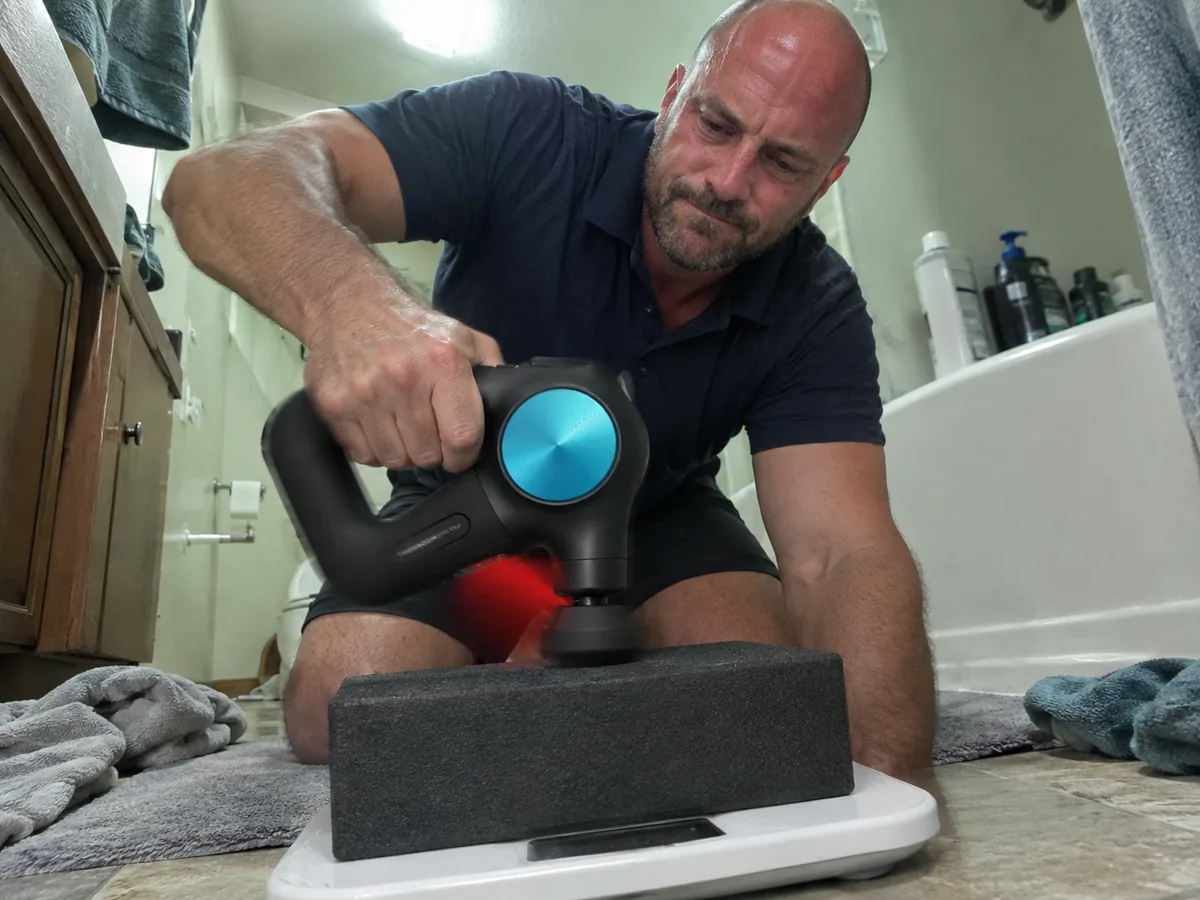
Stall force is the pressure at which a gun gives up and stops moving. Brands quote big numbers, and they're hard to check at home. So Gary put a firm foam block on a bathroom scale and pushed each gun into it on its top speed, slowly adding weight until the head stopped or his arms did.
The $99 gun stalled at 19 lb. The PRO Plus was still hammering away at 41 lb, which is where Gary said "that's enough science" and sat down. We never hit its limit. On my quads after a long run, this was the difference between "that's pleasant" and "oh, that's the spot."
"Most people don't need 60 pounds of force. But you want a gun that doesn't stall when you lean in a little, because stalling means you stop getting the stroke you paid for." Gary Szymanski, physiotherapist
The flip side: more power isn't always kinder. On speed 5 with the standard ball, my calves felt worse the next morning twice, a 6 instead of the usual 4. Gary's diagnosis was simple and slightly embarrassing: I was using it too long and too hard. That brings us to the part of the gun I didn't expect to love.
The heat head changed how we used it
The heated attachment warms to three levels, topping out at about 131°F. From cold, it reached its first level in 1 minute 40 seconds on our thermometer, and the top level in just under 3 minutes. The heated head still percusses, but its wide, flat face spreads each hit, so it feels like warmth and movement rather than pounding.
On my stiff upper back after a long writing day, this was the thing I reached for. Two minutes of heat on each side, then a minute with the regular ball, and my shoulders came down from my ears in a way the $99 gun never managed. Of the 94 sessions in our log, 51 used the heat head at some point. No other feature came close.
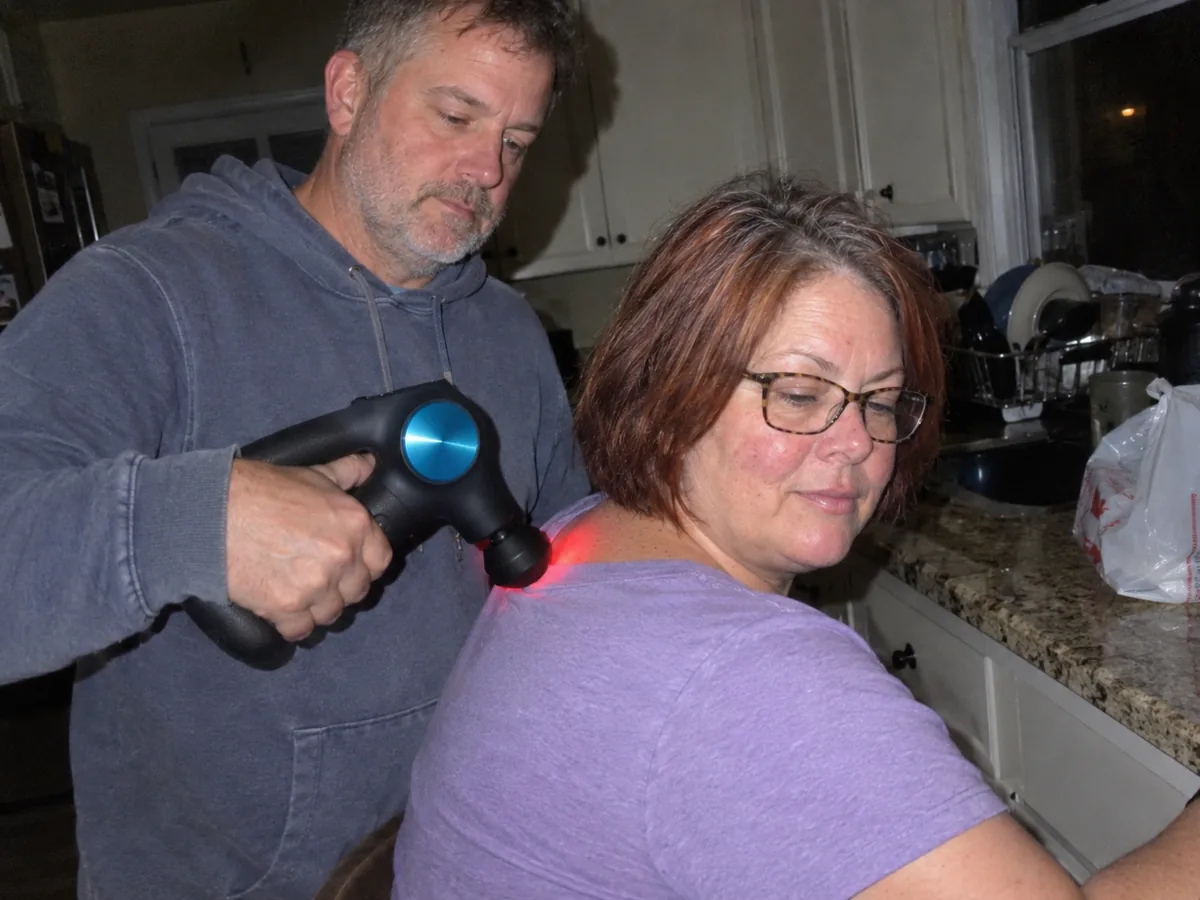
The vibration head, on the other hand, sat in the case most of the time. It's fine for feet and for people who find percussion too much. The near-infrared LEDs are harder to judge. They're on the body of the gun, you hold them against a sore spot for a few minutes, and you feel a mild warmth. Gary's view was cautious: some research supports red and near-infrared light for recovery, but it's early, and he wouldn't pay extra for it alone.
Noise, weight and the stuff you live with
Therabody calls its motor QuietForce, and it's quieter than older Theraguns. On our meter at 3 feet it read 57 dB on speed 1 and 66 dB on speed 5. That's normal conversation up to a loud dishwasher. The $99 gun was louder on high, at 71 dB, with a rattle that got worse after week four. Still, my neighbor asked if I was hanging shelves at 7 a.m. the first Saturday, so I moved my post-run session to after 8.
Weight is the real downside. At 1,650 g, about 3.6 lb, it's heavy for self-massage. On legs it's no problem. On my own upper back and shoulders, my arm got tired after about four minutes, and I found myself handing it to Tom, my husband, which he enjoyed more than I expected. The triangle handle helps a lot. You can hold it from three sides and reach your back without twisting your wrist.
Battery lasted 2 hours 21 minutes of mixed use in our run-down test, close to the 150 minutes Therabody claims. In daily life that meant charging about every two weeks, by USB-C, which is a welcome change from the barrel plugs on older models.
Theragun PRO Plus specs
| Spec | Theragun PRO Plus | Our $99 comparison gun |
|---|---|---|
| Price at the time of writing | $649.99 list, often around $549 on sale | $99 |
| Amplitude | 16 mm | 10 mm |
| Speeds | 5, from 1,750 to 2,400 per minute | 6, speeds not listed |
| Stall in our scale test | No stall at 41 lb | Stalled at 19 lb |
| Noise at 3 ft, low / high | 57 / 66 dB | 60 / 71 dB |
| Weight | 1,650 g (3.6 lb) | 680 g (1.5 lb) |
| Battery claimed / measured | 150 min / 141 min | 6 h claimed / 2 h 5 min |
| Attachments | Standard Ball, Dampener, Thumb, Wedge, Micro-point, heat, vibration | 6 plastic heads |
| Extras | LCD screen, app routines, near-infrared LEDs, heart rate sensor, optional cold head ($99.99) | None |
| Warranty | 1 year limited | 90 days |
Look at the battery row for a second. The cheap gun promised six hours and gave us two. That gap between the box and real life is a pattern we see a lot, and it's one of the quieter reasons the expensive gun scored well.
Gary's rules for using any massage gun
This was the most useful part of the whole test, and it applies whatever gun you buy. Gary gave me these on day one, and I broke two of them in week one.
- One to two minutes per muscle. Keep the head moving. Parking it on one spot for five minutes is how you end up more sore, not less.
- Start on speed 1 or 2. Most of the benefit comes from getting blood moving and calming the muscle, not from force.
- Stay off bone, joints and the front of the neck. Shins, spine, kneecaps and collarbones are off limits. The side of the neck only with the dampener, briefly, on low.
- Not on fresh injuries. Swelling, bruising or a sharp pain in the first 48 hours means ice and rest, not percussion.
- Check with your doctor first if you take blood thinners, are pregnant, or have a history of blood clots or nerve problems.
The screen on the PRO Plus helps here. It runs timed routines that tell you which muscle, which head and which speed, then moves on. After two weeks I stopped overdoing it, and my next-morning soreness scores settled at about 2 to 3 points lower than on days without the gun. The $99 gun got me roughly half of that drop.
Who should buy it, and who should keep their money
If your sore neck and shoulders come from a desk rather than a run, a gun treats the symptom, not the habit. Gary wrote about that side in our piece on what a posture corrector can and can't do, and it pairs well with this one.
Alternatives we'd consider first
Theragun Prime (6th gen): same brand, same triangle handle, no heat or screen, a sturdy rubber shell, and usually around $300. For most runners and gym-goers this is the sweet spot.
Theragun Mini: small enough for a gym bag, less amplitude, surprisingly good on calves and forearms. A good second gun or a travel pick.
Hyperice Hypervolt 2 Pro: quieter and lighter, with a softer, faster feel. Less deep than the PRO Plus but kinder to your arm on long sessions.
If you're thinking of recovery more broadly, sleep is where it actually happens. In our Oura Ring 4 review you can see how a heavy training week shows up in overnight numbers, a good reality check next to any recovery gadget. For our current picks across every category, see the reviews.
Questions people ask about the Theragun PRO Plus
Is the Theragun PRO Plus worth it over the regular PRO or Prime?
Only if you'll use the heat head. That was the feature that made a daily difference for us. If you just want strong percussion, the Prime covers most needs for about half the price.
Can a massage gun make soreness worse?
Yes, if you use it too hard or too long. Twice in our first week, 5 minutes on speed 5 left my calves more sore the next day. Keep it to 1 to 2 minutes per muscle on a low speed and keep the head moving.
Is it safe to use on the neck?
Stay away from the front of the neck completely. On the sides and back of the neck, use only the dampener head, the lowest speed and a few seconds per spot. If you have any neck condition, ask your doctor or physio first.
Does the cold attachment come in the box?
No. The Cold Plus attachment is sold separately for $99.99 at the time of writing. The heat and vibration heads are included.