
Can you wear a posture corrector all day? We tested 4 for 52 days
Four desk workers, four posture correctors, 52 days and a tape measure against the clinic wall. Only one lasted through almost every 8-hour day and still showed a change after week 4.
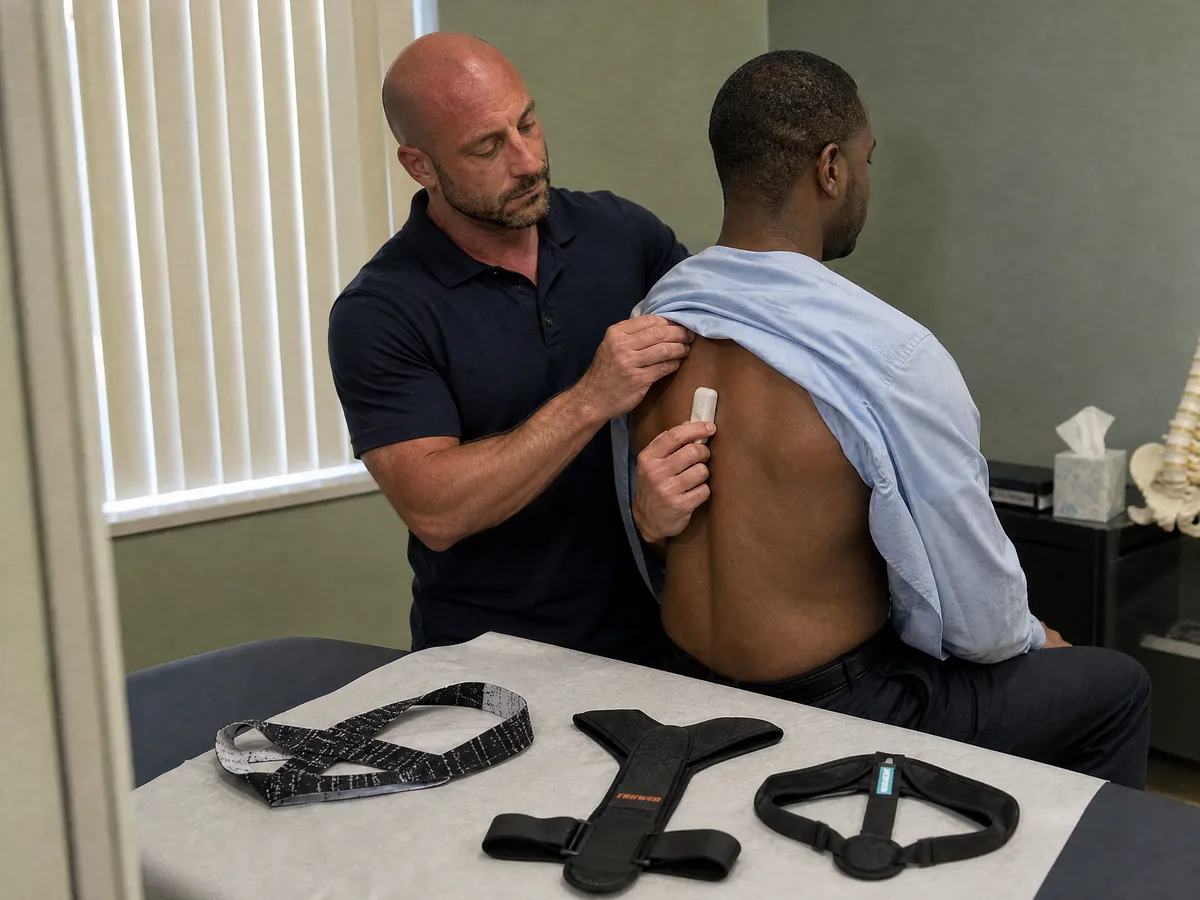
 By Gary Szymanski, physiotherapist
Tested in Pittsburgh, Pennsylvania · October 12, 2026 · 13 min read
At 4:40 p.m. on the last Thursday in August, Tony Caruso called me from the trucking dispatch office where he works in McKees Rocks. No hello. Just: "Gary, my back is a swamp." He'd been wearing his posture corrector since 7 a.m., the office AC was losing to an 88°F afternoon, and the neoprene had stopped feeling like support somewhere around lunch.
That call sums up this test better than any spreadsheet. Plenty of posture correctors feel great for twenty minutes in front of a mirror. Your workday isn't twenty minutes. It's eight hours at a desk, with emails, a sandwich, a 3 p.m. slump and a drive home. In July I wrote about what a corrector can and can't do in general. This time I asked something much narrower.
Which one can you wear through a full 8-hour desk day without pain, and still notice a difference in week 4? Four models, four desk workers from around Pittsburgh, me on my paperwork Fridays, and 52 days from August 18 to October 8. One model did both jobs. Here it is up front, then the long story.
Upright Go S
About $60 at Amazon and Upright when we wrote this, adhesive refills extra
- No straps, so nothing digs into your armpits at hour six
- Ear-to-wall distance down 0.8 in. by week 4, and it held
- Silent tracking mode for calls and meetings
- Invisible under a dress shirt
- Tricky to stick on your own back in week one
- Needed a charge every evening on long days
- Adhesive pads are a running cost
- One humid afternoon loosened the pad
Our verdict: if your head drifts toward the screen by mid-afternoon, the Upright Go S is the corrector you can wear all day, and the only one that changed how our tester stood without it. The BackEmbrace Original is the strap I'd pick if you hate gadgets. The Truweo and the Marakym work for short sessions, not for an 8-hour day.
- Five desks and one clinic wall
- The results on one page
- Upright Go S: the winner that never pulls
- BackEmbrace Original: the strap that almost made it
- Truweo: good for a morning, not a day
- Marakym: too warm for a Pittsburgh August
- My Fridays at the desk
- Which one is right for you
- Prices, stores and holiday deals
- Questions people ask
Five desks and one clinic wall
A posture corrector has to survive a real job, so I recruited people who actually sit for a living. Each one got a main model for the first four weeks:
- Andre Whitlock, 36, staff accountant at a firm downtown. Two monitors, a laptop on the couch at night, and the September 15 tax extension deadline right in the middle of the test. He had the Upright Go S.
- Denise Kostelnik, 51, the receptionist at our clinic in Bloomfield. Headset, check-ins, insurance calls, eight hours in the same chair. She had the BackEmbrace Original.
- Megan Rourke, 27, a PhD student at Pitt writing her dissertation at a kitchen table in Oakland. Five foot three, narrow shoulders. She had the Truweo.
- Tony Caruso, 58, dispatcher for a regional trucking company. Three screens, a radio and an office fan that loses every August. He had the Marakym.
- Me, 42. Most of my week I'm on my feet with patients, but Fridays are notes, insurance appeals and telehealth from 8 to 4:30. I wore each model on at least one of those Fridays.
Phase one ran 28 days, August 18 to September 14. Everyone wore their own model on every workday, 19 of them, since Labor Day gave backs the day off too. Phase two ran the last 24 days. Each tester wore each of the other three models on three workdays and spent the other nine workdays with nothing on at all. Those bare days were the point: I wanted to see what was left once the corrector went into a drawer.
A "full day" counted only if the corrector stayed on from the start of work to quitting time, with lunch as the only break, and nobody took it off for pain, pressure, heat or itch. Everyone wrote down the time of the first twinge. And at 5 p.m. they rated their neck and upper back from 0 to 10.
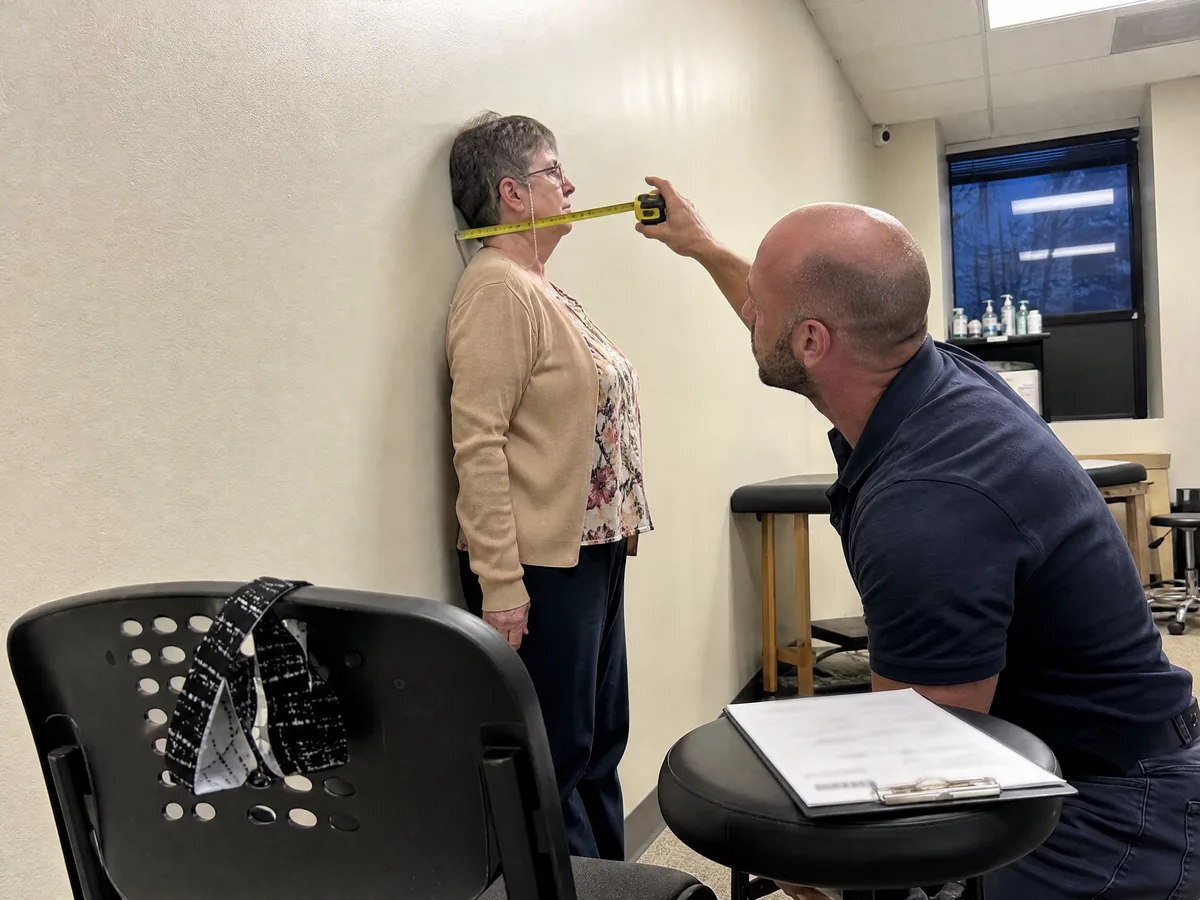
For the week 4 question I used a measurement I do in the clinic every week: tragus-to-wall distance. You stand with heels, backside and shoulder blades against the wall and look straight ahead. I measure from the little flap of cartilage in front of your ear to the wall. The further your head sits in front of your body, the bigger the number. I took it three times per person and averaged it, always without the corrector, on day 1, day 28 and day 52. My repeat readings on the same person wander by about 0.2 inches, so anything smaller is noise.
Everyone also did the same five-minute routine at lunch: chin tucks, the doorway stretch and band pull-aparts from my guide to what a posture corrector can and can't do. Same exercises for all, so the corrector was the only thing that changed between them. The rest of our ground rules are on the how we test page. By the end of week one, the field had already split.
The results on one page
Full days and first twinge combine every tester who wore the model across both phases. The ear-to-wall distance and the 5 p.m. score come from the main tester of each model.
| Model | Price at writing | Full 8-hour days | First twinge after | Ear-to-wall, day 1 → 28 → 52 | 5 p.m. score, week 1 → 4 | Our score |
|---|---|---|---|---|---|---|
| Upright Go S | About $60 | 28 of 30 | No pressure points, 2 days of pink skin | 6.1 → 5.3 → 5.4 in. | 5.4 → 2.6 | 8.6 |
| BackEmbrace Original | About $35 to $70 | 21 of 30 | 6 h 05 min | 5.8 → 5.4 → 5.6 in. | 4.8 → 3.1 | 7.8 |
| Truweo | About $13 to $30 | 4 of 30 | 2 h 20 min | 5.0 → 4.8 → 4.9 in. | 3.9 → 3.4 | 6.0 |
| Marakym | About $20 to $25 | 2 of 29 | 1 h 45 min | 6.4 → 6.3 → 6.4 in. | 5.1 → 4.9 | 5.1 |
The weak spot of any small test is that each model had a different main body in phase one. That's why the swap in phase two matters so much for comfort: every model sat on every back, mine included. And the ranking didn't move once.
So the sensor won both halves of the question. Here's what that looked like on a real accountant in deadline season.
Upright Go S: the winner that never pulls
The Upright Go S isn't a strap at all. It's a small white sensor, smaller than a matchbox, that you stick to the skin between your shoulder blades with a reusable adhesive pad. You sit tall, tap calibrate in the app, and from then on it knows your upright position. In training mode it buzzes when you slouch past that point. In tracking mode it stays silent and just logs. The box comes with five adhesive pads, alcohol wipes and a little tool for peeling the sensor off.
Andre's first attempt happened in the men's room of his office at 8:05 a.m. on day one. He stuck it on blind, about an inch too high and slightly crooked, and it buzzed every time he reached for his mouse. That night his wife placed it for him, and from then on it was a two-second job in the morning.
Day one also taught me something about enthusiasm. Andre left it in training mode for the full eight hours and the app counted 164 buzzes. From day three I gave him a schedule: training mode for the first hour of the morning and the first hour after lunch, silent tracking the rest of the day. His four-year-old daughter named the sensor "Buzz" and asked every evening how many times Buzz had told on Daddy. By day 26 the answer was 41, and she seemed a little disappointed.
"In deadline week I'd catch myself sitting up and then wait for the buzz. It never came. That's when I figured something had changed." Andre, test log, September 11
The numbers agreed with him. The share of upright time in the app went from 61 percent in week one to 84 percent in week four. On the wall, without the sensor, his ear-to-wall distance dropped from 6.1 to 5.3 inches. That's the only change in the whole test well beyond my 0.2-inch noise. And on day 52, after nine bare workdays in phase two, it was still 5.4. His 5 p.m. score fell from 5.4 to 2.6, and that last week of phase one included two 10-hour days before the extension deadline.
Why does a gadget that holds nothing beat the straps? Because it makes you do the work. Every buzz is a tiny rep for the muscles between your shoulder blades and the deep muscles at the front of your neck. A strap does that same job for you, which feels nice and teaches your body very little.
The downsides were small and very real. Andre charged it every evening, and after a long day it was usually into its last third. Each pad lasted him about nine workdays, and refills run roughly a dollar apiece. The two days it failed: Tony's pad peeled loose after a sweaty lunchtime walk across the truck yard in phase two, and Megan pulled it off one deadline afternoon because the buzzing frazzled her. Not pain, but it came off, so it doesn't count. She also had pink skin under the pad on her first two days, gone by the next morning both times. The strap that came closest to the sensor was the one at our own front desk.
BackEmbrace Original: the strap that almost made it
The BackEmbrace Original is made of flat, stretchy woven elastic instead of neoprene, with no padding, no buckles and no velcro. Split straps loop around each shoulder, cross in an X between your shoulder blades and end in a band you tension yourself around your ribs. It can go over or under clothing. The first three mornings Denise needed me to help her get it even. By day five she did it alone in the staff bathroom in under a minute.
Comfort is where it shines. The fabric breathes much better than the two cheaper straps, and under a cardigan nobody noticed it. Well, almost nobody. One of my patients, an 81-year-old retired mail carrier rehabbing a new knee, looked over the counter and asked Denise if she'd "finally joined the team."
Denise wore it the full day on 16 of her 19 workdays in phase one. The three times she gave up, it was after six hours or so, with an ache at the front of the shoulder where the loop sits. Across everyone, 21 of 30 full days and an average of 6 hours 5 minutes to the first twinge. For a strap, that's excellent.
The week 4 picture was more modest. Her ear-to-wall distance went from 5.8 to 5.4 inches, a real change. Her 5 p.m. score dropped from 4.8 to 3.1. But by day 52, after nine workdays without it, she'd drifted back to 5.6. That's the pattern I see with straps in the clinic all the time: you feel better while it's on, and less of it stays with you once it's off.
Two practical notes. The size chart is narrower than on the cheap adjustable straps, so measure your chest before you order. And Denise washed hers twice on the gentle cycle and air-dried it with no harm done. The next strap was a lot cheaper and a lot shorter-lived.
Truweo: good for a morning, not a day
The Truweo is the classic online bestseller: two padded loops you put on like a backpack, joined at the back, with hook-and-loop closure to tighten. It's light, thin and the cheapest of the four. On Megan's narrow shoulders it fit right out of the bag.
Her first hour every morning was genuinely good. Your shoulders go back, you feel how you were sitting before, and you sit up. After an average of 2 hours 20 minutes, though, the loops pressed into the front of her armpits, and by lunch the Truweo usually hung on the back of her chair. Her roommate's cat slept on it more hours in week three than Megan wore it. Across all five of us, only 4 of 30 days went the distance.
By week two Megan had worked out the smartest way to use it: 30 minutes at the start of each writing session, as a cue that work had begun. Her ear-to-wall distance went from 5.0 to 4.8 to 4.9 inches. That's inside my noise, and in fairness she started with the least forward head of the group. For $13 to $30 it's a decent short reminder. The last model didn't even manage that in the heat.
Marakym: too warm for a Pittsburgh August
The Marakym is a neoprene clavicle brace, the stuff wetsuits are made of, adjustable for chests from 28 to 48 inches. It's soft, washable and fits a wide range of bodies. Tony started out wearing it under a T-shirt.
Then came August. His dispatch office hit 85 to 88°F on most afternoons that month, and neoprene holds heat beautifully, which is exactly what you don't want at hour three of a shift. The average first twinge across testers came after 1 hour 45 minutes, nearly always a damp back and rubbing at the armpit edge. On September 11, jersey day at his office, he wore it over his T-shirt and under his Steelers jersey. One of his drivers asked if he was suiting up on Sunday.
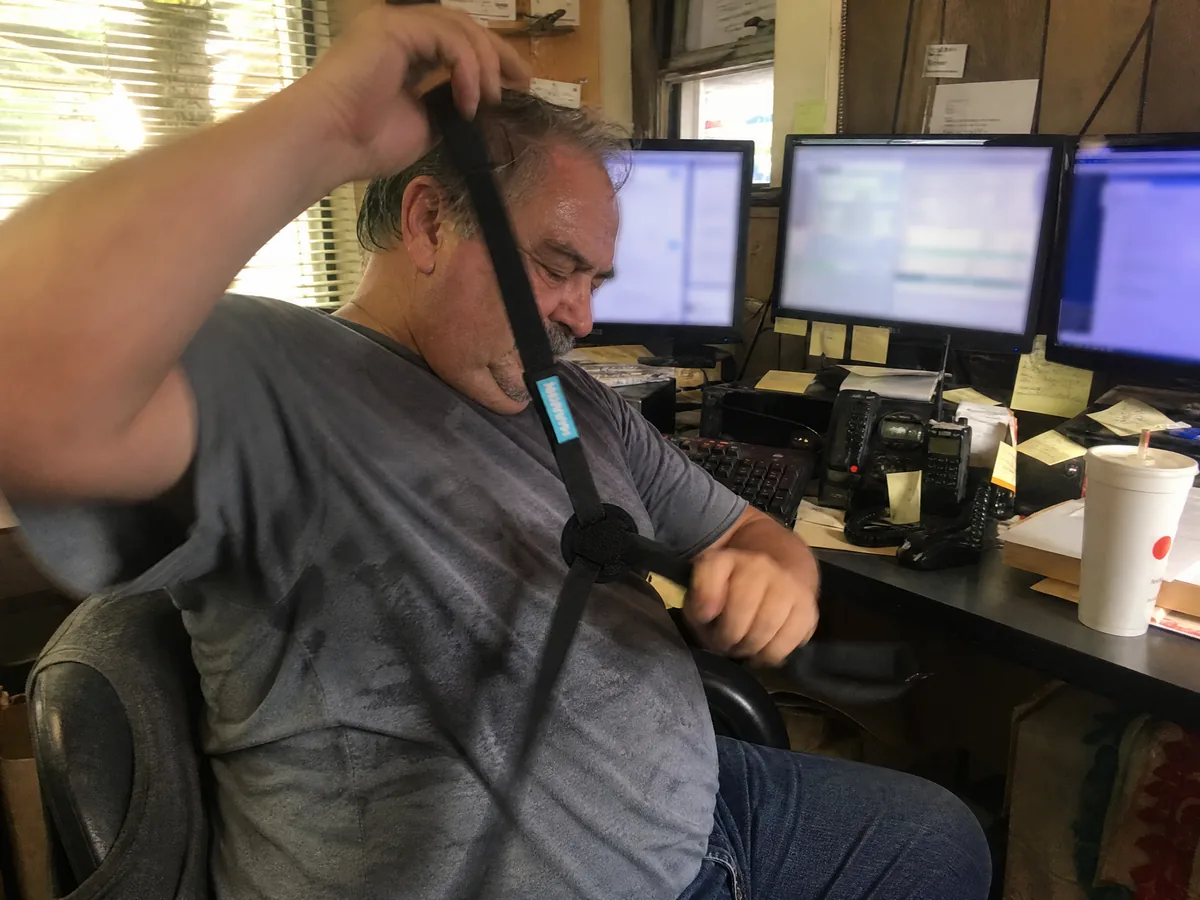
Only 2 of 29 days lasted to quitting time, both on cool late-September days with someone else wearing it. Tony's measurements barely moved: 6.4, 6.3, 6.4 inches, and a 5 p.m. score of 5.1 at the start and 4.9 in week four. What finally helped him was something else entirely. On September 22 I stopped by his office and raised his middle monitor 4 inches on two reams of printer paper. By day 52 his evening score was down to 4, with no corrector at all.
The Marakym isn't a bad product. On a cool day Denise liked how it sat on her shoulders. It's just the wrong tool for an 8-hour shift in a warm room. I tested all of this on my own back too, which brings me to my Fridays.
My Fridays at the desk
Seven Fridays, seven corrector days, 8 a.m. to 4:30 p.m. in the back office of the clinic. Upright and BackEmbrace twice each, Truweo twice, Marakym once, because once was plenty. The Marakym came off at 10:15 a.m. on August 28. The Truweo made it to 11:30 on September 4, and in the middle of that morning a telehealth patient squinted at her screen and asked, "Doc, is that one of those Amazon straps? Does it work?" I told her to ask me in October. Here's your answer, Mrs. Novak.
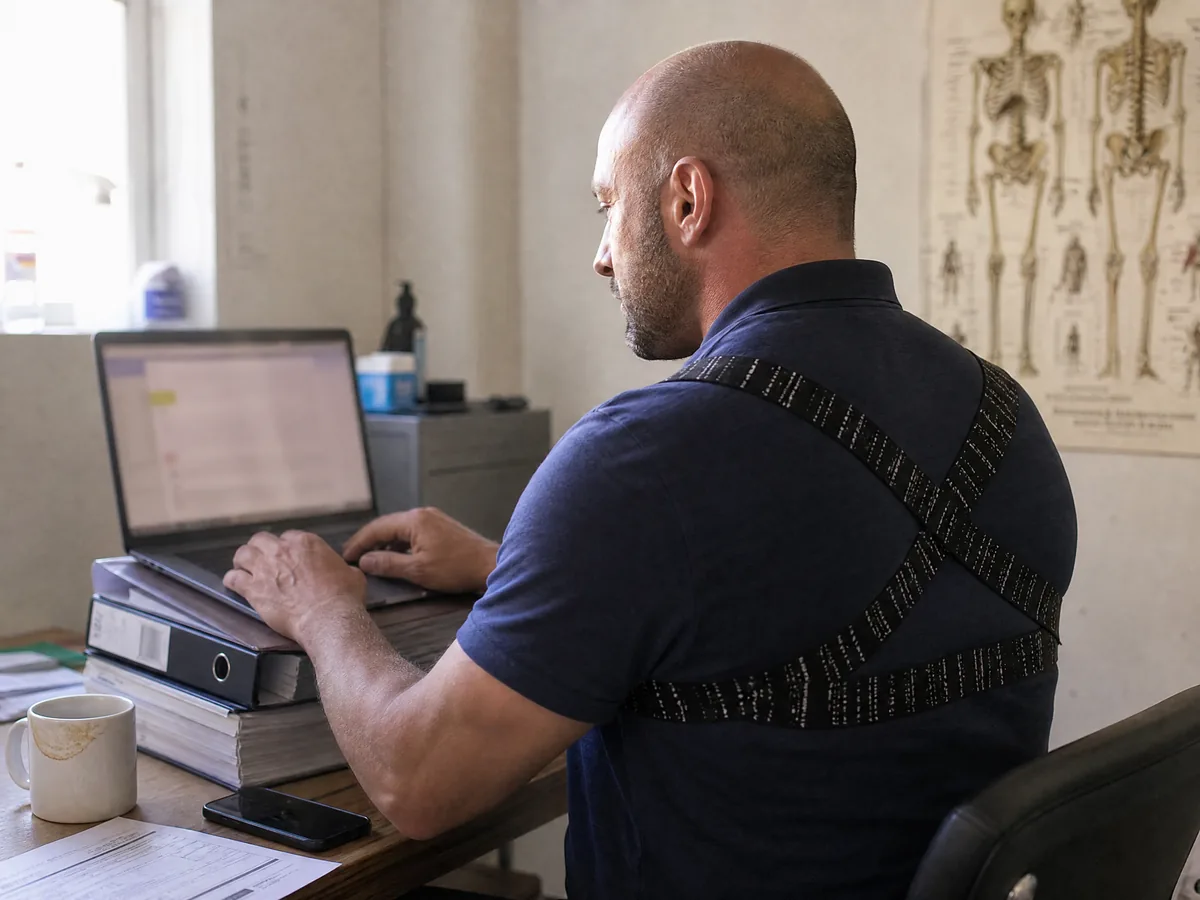
The BackEmbrace went the distance both times. Around 2 p.m. I felt the front of my shoulders, not painful, just a sense of being held in place for too long. The Upright was annoying for the first hour of my first Friday and then disappeared. On September 18 it buzzed exactly once during a 40-minute insurance appeal, at the moment I was leaning into the screen to type something unkind. Fair point, sensor.
The difference I felt mirrors what the wall measured. A strap gives you posture. A sensor makes you produce it yourself, again and again, until you start doing it without being told. Which one suits you depends on what you want from the thing.
Which one is right for you
And skip all four for now if you have pain that wakes you at night, numbness down an arm, or pain that doesn't ease when you move. That's a job for a doctor or a physical therapist first. If you're simply curious whether any of these are worth your money, the prices are the last piece.
Prices, stores and holiday deals
Posture correctors sell well as stocking stuffers and drop in price often, but I don't have reliable records of past lows for all four, so I'll only give you what we saw and the price I'd wait for:
- Upright Go S: about $60 at Amazon and on Upright's own site at the time of writing. Good under $50. Budget around $1 per refill pad, and about $20 if you want the necklace holder, sold separately.
- BackEmbrace Original: $69.99 at Relax The Back, often less on Amazon depending on size and color. Good under $40.
- Truweo: mostly $13 to $30 on Amazon, and it's on sale a lot. Good under $18.
- Marakym: about $20 to $25 on Amazon. Good under $18.
For gifts, think about returns: once a strap has been worn, many sellers treat it as a personal item. For the Upright, add a pack of spare pads, because the five in the box last about two months of workdays at Andre's pace.
Where are they now? Andre still wears the Upright two mornings a week in training mode, mostly because his daughter checks. Denise keeps the BackEmbrace in her desk drawer for Mondays. Megan uses the Truweo for the first half hour of writing, and Tony's Marakym sits on top of the two reams of paper under his monitor. Next on my desk is a stack of neck and shoulder massagers for the stiffness that's left after a long drive, and you can follow it on our tests in progress page. More of my health reviews, like my Apple Watch Series 12 review, live in the health section.
Questions people ask
Can you wear a posture corrector all day?
A sensor like the Upright Go S, yes: it stayed on through 28 of 30 full desk days in our test without pressure points. Most straps, no. The Truweo and Marakym caused discomfort after about two hours on average. The BackEmbrace Original came closest, with 21 of 30 full days, but most people should still use a strap for shorter sessions.
How long does it take for a posture corrector to work?
In our test the first real change showed up around week three, when our Upright tester started sitting up before the sensor buzzed. At week four his ear-to-wall distance was 0.8 inches shorter, and it held three and a half weeks later. The straps showed small or no changes at week four.
Is a posture sensor better than a strap?
For lasting change, it was in our test. A strap holds your shoulders back, so your muscles rest. A sensor only reminds you, so you straighten up yourself every time, and that repetition is what builds the habit. A strap can still be a comfortable short-term reminder.
Why does my posture corrector hurt under the arms?
The loops press on the front of the armpit, where nerves and blood vessels for your arm run. It usually means the strap is too tight or worn too long. Loosen it until two fingers slide under the loop, shorten your sessions, and take it off at once if your fingers tingle.