
Roborock Saros 20 review: 40 days with a $1,600 robot that climbs door sills
An old house full of door sills, a dog that sheds all year and 40 days of logging. Our repair tech tested if Roborock's flagship earns its $1,600 price.
 By Dale Kowalczyk, former appliance repair technician
Tested in Toledo, Ohio · September 19, 2026 · 12 min read
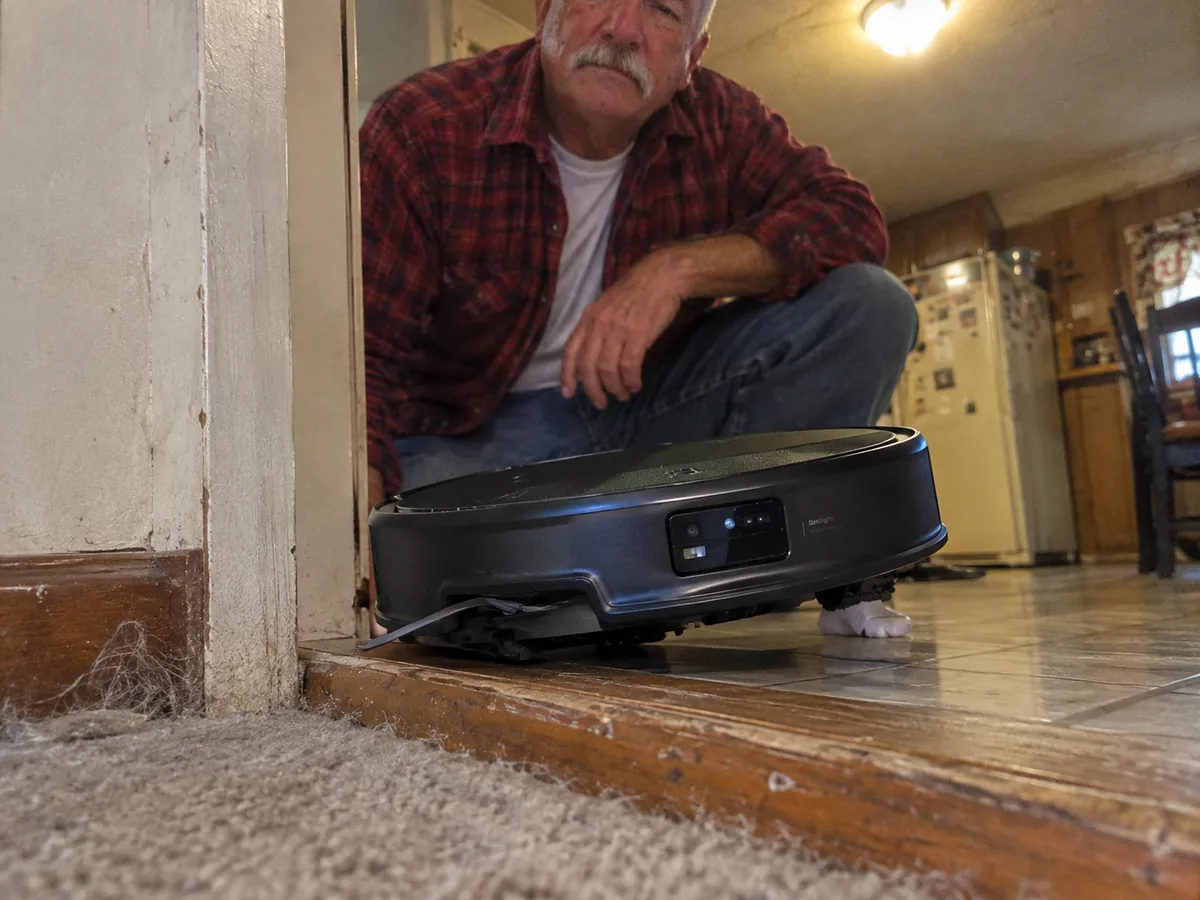
- Climbed every door sill in our 1970s house, even a 2.2-inch step
- No hair wrapped on the brush after 40 days with a shedding dog
- Only 3.1 inches tall, so it cleans under the couch and the beds
- Hot water mop wash and hot air drying: the dock never smelled
- Expensive, and last year's flagship now costs far less
- Small bin on the robot, it goes back to empty more often
- The dock is big and needs a real corner
- Ate a phone cable on day 2 before it learned
Verdict: if your home has thresholds, rugs, pets and low furniture, the Saros 20 handles all of it with almost no help from you. If your floors are flat and simple, a cheaper Roborock gets you 90% of the result for hundreds less.
Every robot vacuum I've tested has died at the same place in my house: the kitchen doorway. There's an oak threshold there, a little under an inch high, and on the other side the tile sits lower than the hall. Robots climb up, tip, spin, and sit there beeping until someone rescues them. Carol calls that doorway "the robot graveyard."
The Roborock Saros 20 is the first one that walked over it on the first try and kept going like nothing happened. It's Roborock's flagship for 2026, it costs $1,599.99, and I lived with it for 40 days in a house that's basically an obstacle course: a 1970s ranch, 1,640 square feet, five different thresholds, three rugs and a golden retriever mix named Rusty who sheds all year.
What makes the Saros 20 different
Robot vacuums have gotten very good at the basics, so the differences now are in the details. On the Saros 20, three of them stood out in daily use.
- It climbs. The chassis can lift itself on its wheels to get over thresholds. Roborock quotes up to about 3.5 inches for a stacked double threshold. In real life, the single steps in my house were the test that mattered.
- It's flat. There's no laser turret on top. The navigation sensor sits flush in the body, so the robot is only about 3.1 inches tall and fits under furniture that other robots bump into.
- It's strong. Roborock rates it at 36,000 Pa of suction, roughly the highest number on the market right now. Numbers like that don't always mean much, but on carpet it showed.
Specs at a glance
| Spec | Roborock Saros 20 |
|---|---|
| Price (US) | $1,599.99 at the time of writing |
| Launched | April 2026 |
| Suction | 36,000 Pa (claimed) |
| Height | About 3.1 inches |
| Thresholds | Up to about 3.5 in for double-layer steps (claimed) |
| Mopping | Two spinning pads, 200 RPM, extend to the edges, lift on carpet |
| Dock | Auto empty, 212°F mop wash, 131°F hot air drying, detergent dispenser |
| Dust bag | Up to about 65 days between changes (claimed) |
| Battery | 6,400 mAh |
| Smart home | App, voice assistants, Matter |
The threshold test: my house versus the robot
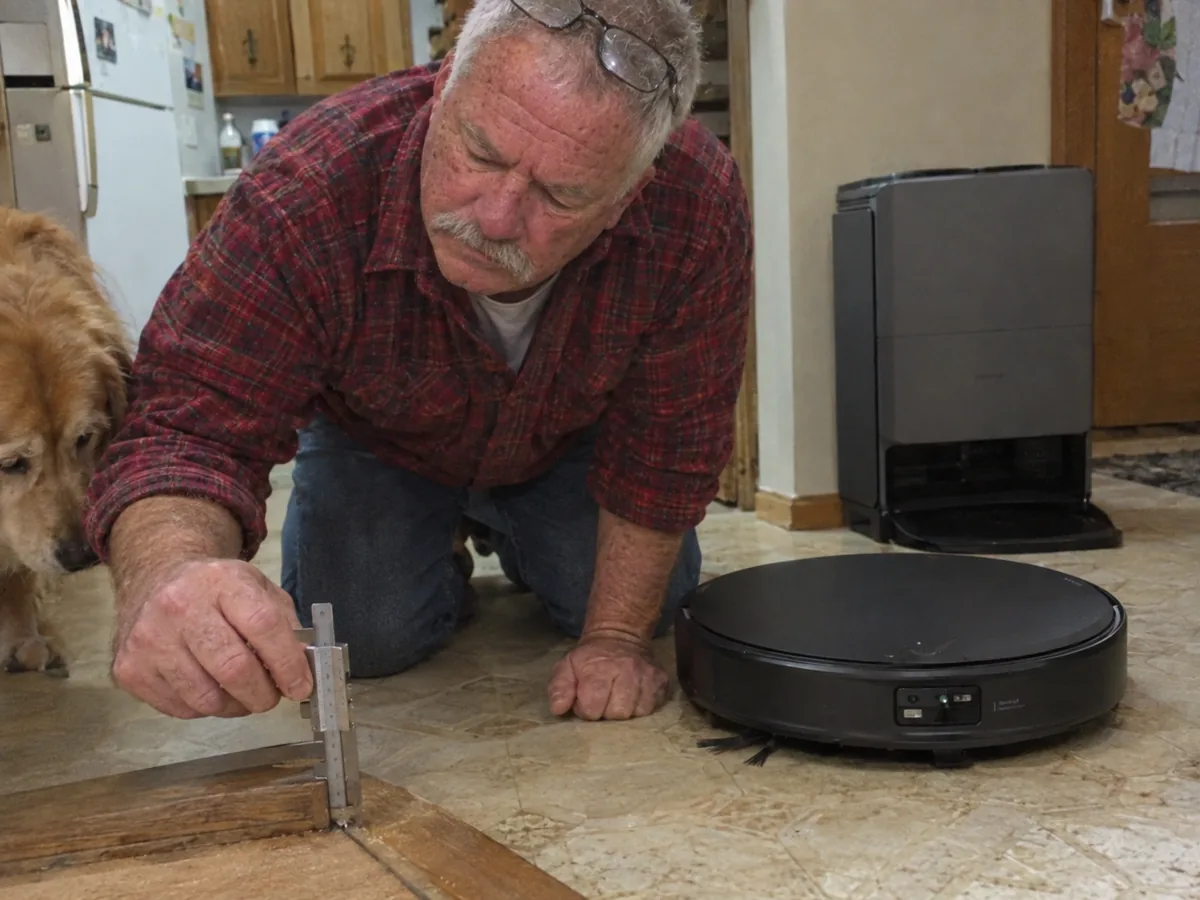
I measured every threshold in the house with a caliper before we started. Then I watched the first five full runs and counted how many times each one needed a second try, or a rescue.
| Threshold | Height | Result over 5 runs |
|---|---|---|
| Bedroom doors | 0.4 in | Crossed every time, no hesitation |
| Bathroom marble sill | 0.7 in | Crossed every time |
| Kitchen oak threshold ("the graveyard") | 0.9 in with a drop | Crossed every time |
| Sliding door track to the sunroom | 1.4 in, two rails | First try 4 times, second try once |
| Step into the laundry room | 2.2 in | Second or third try, every time |
That laundry room step is where I expected it to give up. Instead it backed up, lifted itself and climbed in on the second or third try, with a noise like a small tractor. It's not graceful. It's more force than finesse. But it got there all 5 times, and it never got stuck. In 40 days I had to rescue it exactly once, and that was Rusty's fault. More on that below.
"I spent years telling customers that robot vacuums can't do old houses. I'm going to have to stop saying that." Dale, day 12
Vacuuming: carpet, hard floors and dog hair
I ran our standard sand test: 50 grams of play sand worked into the den carpet, then one full run in max suction on that room. The Saros 20 pulled out 44.2 grams, which is excellent for a robot. For comparison, the stick vacuum we tested at the same house, the Dyson V16 Piston Animal, got 47.3 grams in three passes. A robot that gets within 10% of a top stick vacuum on carpet is doing something right.
Hard floors were easy. Crumbs, kibble Rusty spills from his bowl and the grit that comes in from the back door were gone every day. The side brush sometimes flicked a piece of kibble a few inches instead of catching it, and the robot usually came back for it on the next pass.
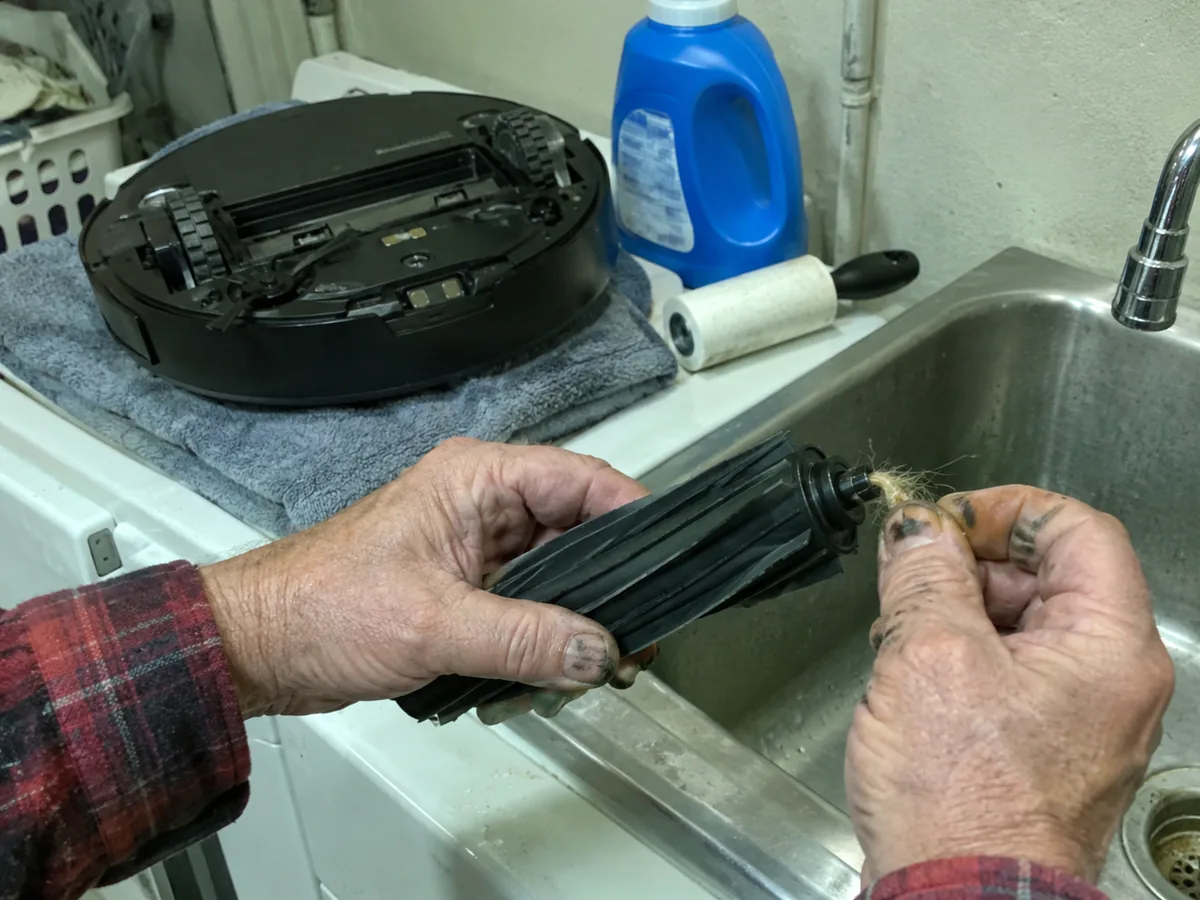
Dog hair is where I paid the closest attention. With my old robot, I cut hair off the main brush every Sunday. After 40 days with the Saros 20, the brush had nothing wrapped around it. A few hairs had gathered at the ends, where they pull out with two fingers. The side brush did collect a little, which is normal for a side brush and took 30 seconds to clean once a week.
The one weak spot is the robot's own bin. It's small, and on heavy shedding days the robot went back to the dock to empty in the middle of a run. It didn't miss anything, it just took longer. A full-house run averaged 96 minutes and used 58% of the battery with vacuum and mop together.
Mopping: much better than I expected from a robot
I'm a skeptic about robot mopping. Most robots drag a damp cloth around and call it clean. The Saros 20 uses two spinning pads that press down on the floor, and one of them swings out to reach the edge along cabinets and baseboards.
The test that convinced me: a dried coffee spill from the morning, left until 4 p.m. on the kitchen tile. One run left a faint ring. The second run, which I set in the app for "deep" on that room only, took it off completely. Dried ketchup under Maddie's chair after a Sunday lunch came off in one pass. Muddy paw prints by the back door were gone every time.
On rugs, the robot lifts the pads and doesn't wet the carpet. For the big den carpet, it goes further and leaves the pads at the dock, vacuums the carpet, then comes back to pick them up for the tile. It's a little theatrical to watch, and it works. In 40 days I didn't find one damp spot on a rug.
Obstacles: the cable, the sock and Rusty's rope
Every robot vacuum review mentions obstacle avoidance, so here's the real-life version. I set up our usual course three times: a sock, a phone cable, a shoe, a rope toy, a fake pile of dog mess (yes, rubber) and a pen.
The Saros 20 avoided 16 of 18 obstacles across the three runs. The two misses: the phone cable on the first run, which it pulled for about a foot before stopping, and the pen, which it pushed under the couch. It never went near the fake dog mess, which is the one that really matters in a house with a dog.
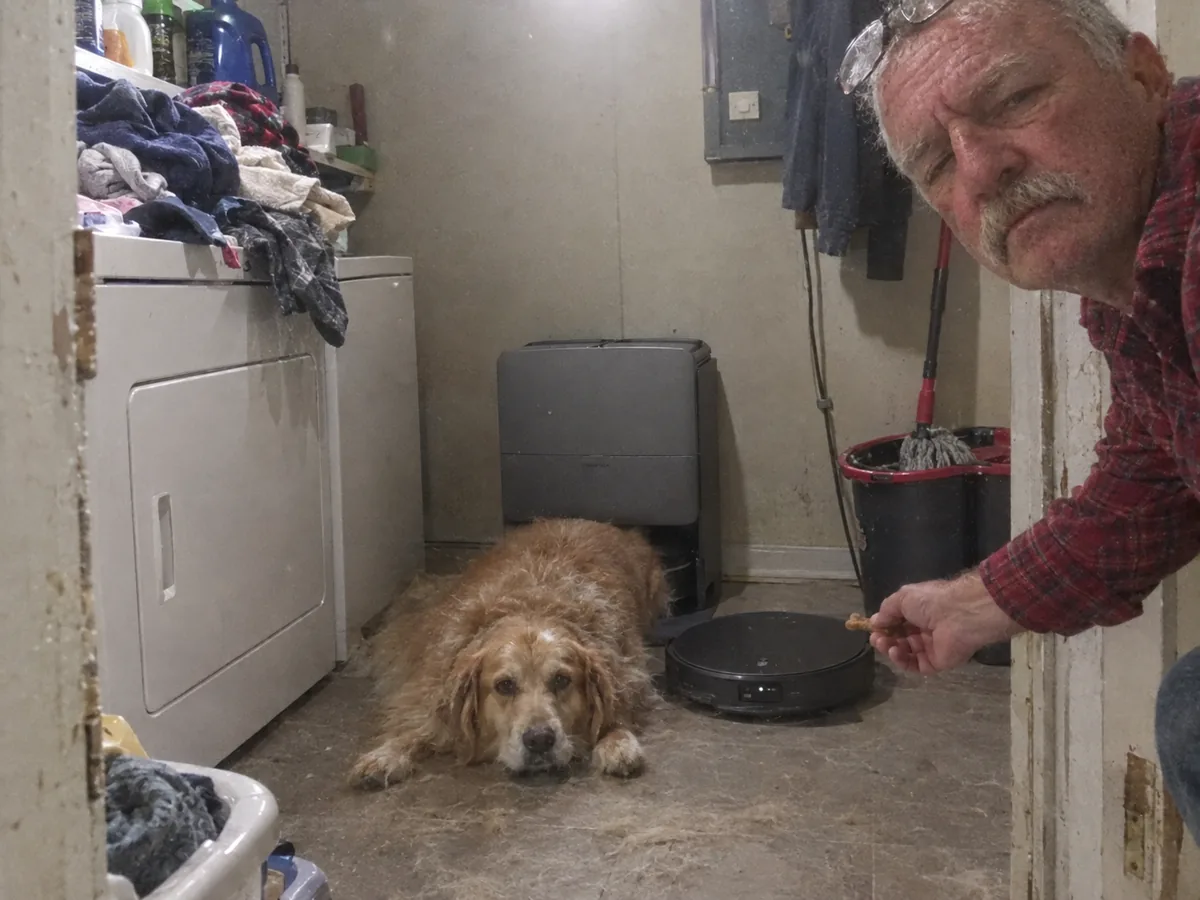
The one rescue of the test was on day 23, and it wasn't the robot's fault. Rusty decided the robot was a new friend and lay down directly in front of the dock. The robot came back, waited, tried to go around, and then sent me a message on my phone saying it couldn't reach its dock. Rusty got a treat to move. The robot got to charge. Everyone was happy.
The dock: big, loud for ten seconds, and clean
The dock is where a lot of the Saros 20's price goes. It empties the robot into a bag, washes the mop pads with water heated close to boiling, dries them with warm air and adds detergent on its own. In 40 days the dock never smelled, which I can't say for two other robots I've tested in the same laundry room.
It's also big. Ours took up a corner of the laundry room about as wide as a small end table and about knee to hip height. Measure your spot before you buy, including the space in front for the robot to drive in.
The auto empty is loud, about 78 dB from three feet, but it lasts roughly ten seconds. Rusty barked at it for the first four days and then decided it was beneath his notice. In normal cleaning, the robot measured 58 dB on the balanced setting, quieter than a conversation. I refilled the clean water tank and emptied the dirty one every three days with daily runs.
What it costs to own
The robot is $1,599.99. After that, you'll buy dust bags, mop pads, filters and brushes over time, plus the detergent if you use it. Based on how fast our bag filled and how the pads looked after 40 days, I'd estimate around $80 to $120 a year in parts for a house like ours with a dog. That's our estimate from use, not a Roborock figure, and it will be lower in a house without pets.
From a repair point of view, the Saros 20 is easy to maintain. The main brush pops out without tools, the side brush has a single screw, and the dock's dirty water tray lifts out for a rinse. The part I'd watch over time is the lifting chassis: it's a clever mechanism with moving parts that take a beating on every threshold. After 40 days and roughly 200 climbs, it was still quiet and smooth.
Who should buy it, and who should skip it
Alternatives worth a look
Roborock Saros 10R. Last year's flagship has the same slim design without a turret and the same kind of hot water dock. It has less suction and doesn't climb as high. Since the Saros 20 arrived, it has regularly sold for well under $1,000. For homes without tall thresholds, it's the smart money pick.
Roborock Qrevo Curv 2 Pro. A cheaper Roborock with a lifting chassis for small thresholds and a strong dock. It's taller, so it won't clean under very low furniture, and its runtime is shorter. For a medium house with normal door sills it's a good fit.
Roborock Saros 20 Sonic. The same robot family with a vibrating mop instead of the spinning pads. We haven't tested it yet. If tile and hard floors are most of your home, it's worth watching.
For every robot and stick vacuum score in one place, check our reviews. Our testing method explains the sand, hair and obstacle tests we run on every cleaning device.
After 40 days
The robot graveyard in my kitchen doorway is closed. The Saros 20 cleaned 38 of 40 days on schedule, crossed every threshold in the house and kept up with a dog who sheds like it's a sport. Carol, who has never liked robot vacuums, now starts it from her phone when she leaves for water aerobics.
It's a lot of money for a vacuum. But if your house is the kind that beats other robots, this is the first one I've tested that beats the house back.
Questions people ask about the Roborock Saros 20
Is the Roborock Saros 20 worth it over the Saros 10R?
If your home has tall thresholds, lots of carpet or a pet that sheds heavily, yes: it climbs higher and has much more suction. For flat homes with mostly hard floors, the Saros 10R does almost as well and costs a lot less since the Saros 20 launched.
How high can the Roborock Saros 20 climb?
Roborock quotes up to about 3.5 inches for double-layer thresholds. In our house it crossed every sill up to 0.9 inches on the first try and a 2.2-inch single step on the second or third try, every time.
Does the Roborock Saros 20 work with pets?
Very well in our test. No hair wrapped on the main brush in 40 days with a shedding dog, and it avoided the fake pet mess in every obstacle run. Empty the side brush of hair about once a week.
Does the Roborock Saros 20 need a water connection?
No. The standard dock has clean and dirty water tanks that you fill and empty by hand, every few days with daily mopping. There is a version of the dock that connects to your water supply and drain for fully automatic refilling.