
KitchenAid Artisan 5-quart review: is the classic tilt-head still worth $380 in 2026?
Five weeks, 27 bakes, one birthday cake and a tray of Ohio buckeyes. The mixer everyone asks for at Christmas, tested in a kitchen with two small kids.
 By Tammy Rademacher, home and kitchen tester and mom of two
Tested in Columbus, Ohio · September 17, 2026 · 12 min read

KitchenAid Artisan 5-Quart Tilt-Head Stand Mixer (KSM150PS)
$379.99 at KitchenAid.com at the time of writing, list price $499.99
- Whipped 2 cups of cream to stiff peaks in 2 min 50 s
- Seven dozen cookies from one bowl, no spills with the shield
- Tilt head makes adding and scraping easy with a kid on your hip
- One hub runs pasta, grinder and ice cream attachments
- Head bounces and the mixer walks on big bread doughs
- Flat beater leaves a butter streak until you adjust it
- About 23 pounds, not something you put away every night
- No scraping beater in the box
Our verdict: for cookies, cakes, frosting, mashed potatoes and the occasional loaf of bread, the Artisan is still the one I'd buy. If you bake dense bread every week or double batches of bagel dough, spend more on a bowl-lift model.
"You don't need a stand mixer. You need a nap." I said that to myself for six years, every time I stood in the appliance aisle at Target and stared at a wall of shiny KitchenAids in 20 colors. I had a $30 hand mixer. It worked. It also sprayed batter on the cabinets and made my wrist ache by the second batch of cookies.
Then my mom's old KitchenAid finally died. It was an almond-colored one from the late '80s that made every birthday cake of my childhood, and it went out with a smell like a hot toaster and a sad little click. She called me, a bit teary, and said, "Just get the red one. Everybody gets the red one."
So I got the red one. This is the KitchenAid Artisan 5-Quart Tilt-Head Stand Mixer, model KSM150PS, in Empire Red. I used it for five weeks, from mid-August to mid-September, and baked 27 times in a kitchen with a four-year-old helper and a two-year-old who thinks flour is a toy. Here's what it does well, where it struggles, and what you should pay for it this holiday season.
Why I finally bought my own
Most of you reading this aren't wondering whether a KitchenAid works. You've seen one at your grandma's house. The real question is whether the classic 5-quart Artisan is still the smart pick in 2026, now that KitchenAid sells an Artisan Mini, an Artisan Plus, bowl-lift models and a dozen bundles that all look the same on a shelf.
The Artisan is the middle of the family. It has a 325-watt motor, 10 speeds on a sliding lever, a 5-quart stainless steel bowl with a handle, and a head that tilts back so you can reach the bowl. In the box you get a coated flat beater, a coated dough hook, a 6-wire whip and a clear pouring shield. The front of the head has the famous attachment hub that runs pasta rollers, meat grinders, an ice cream bowl and more.
No timer, no scale, no screen. After a summer of machines that beep, I found that weirdly relaxing. But simple doesn't mean perfect out of the box, and mine wasn't.
Week one: the dime test
My first batch was plain sugar cookies. They tasted fine, but when I scraped the bowl I found a streak of butter and sugar stuck to the very bottom, right in the center, that the beater never touched. Same thing on the second batch. On a mixer this expensive, that annoyed me.
This is where a very old KitchenAid trick comes in, and it's in the manual too. You drop a dime into the empty bowl, attach the flat beater and run it on stir. If the beater pushes the dime around a little, about a quarter to half an inch each turn, the height is right. If it doesn't touch the dime, the beater sits too high. If it hits it hard, too low.
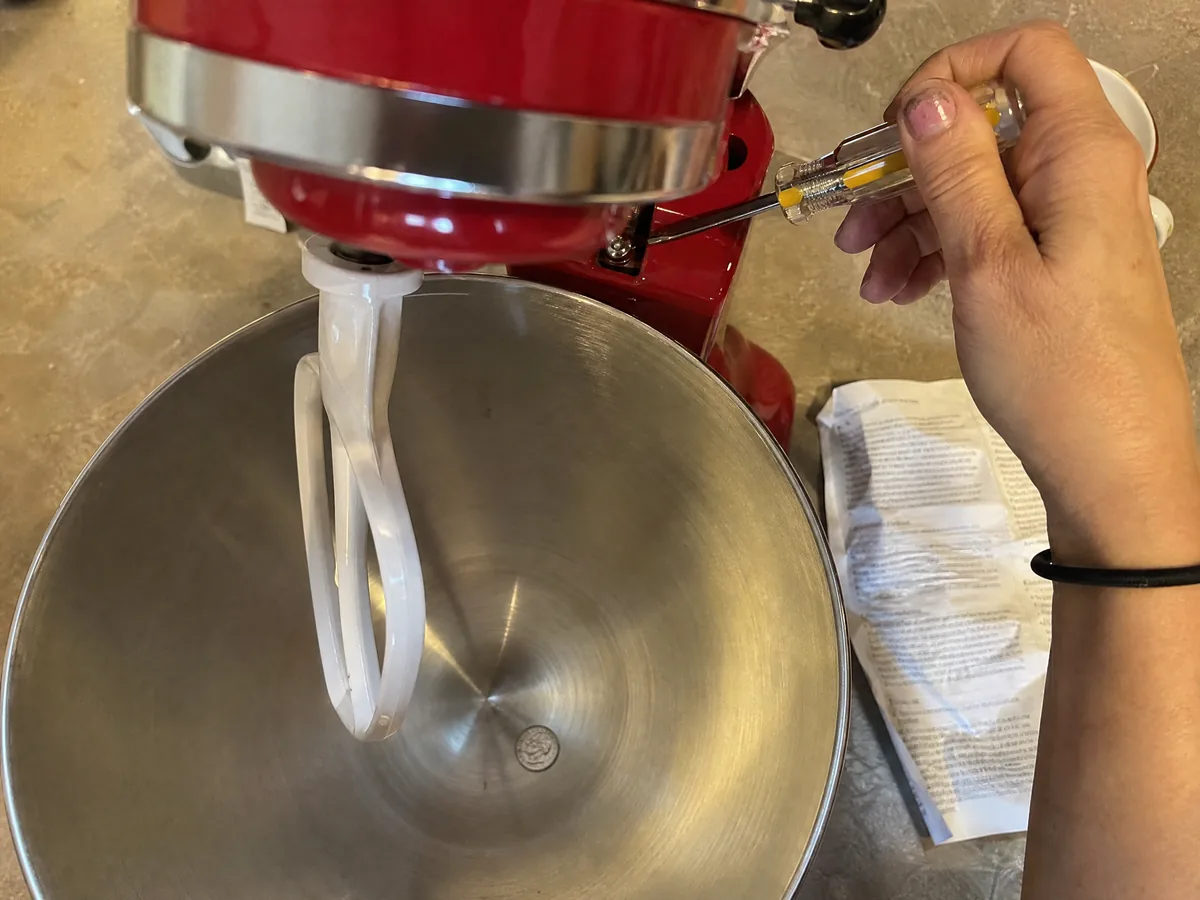
My dime didn't move at all. There's a small screw near the hinge where the head meets the stand. With the head tilted up, a quarter turn with a flat screwdriver lowers the beater. It took me three quarter turns and four tries, about ten minutes in total, and the butter streak was gone for good.
With the height fixed, I started keeping a list on the fridge. Every bake got a time, a speed and a note about how much scraping it needed.
27 bakes, timed
I baked on weeknights after bedtime, on Saturday mornings with "help," and on one very long Sunday before Ellie's fifth birthday. Here are the tasks I repeated at least twice, with average times.
| Task | Attachment and speed | Average time |
|---|---|---|
| 2 cups heavy cream to stiff peaks | Whip, speed 8 | 2 min 50 s |
| 4 egg whites to stiff peaks | Whip, speed 8 | 3 min 20 s |
| Buttercream: 2 sticks butter, 4 cups powdered sugar | Flat beater, speed 2 then 6 | 4 min 10 s |
| Chocolate chip cookie dough, 1.5x recipe (about 7 dozen) | Flat beater, speed 2 to 4 | 5 min 30 s |
| 5 lb mashed potatoes | Flat beater, speed 2 then 4 | 1 min 30 s |
| 3 lb cooked chicken breast, shredded | Flat beater, speed 2 | 25 s |
| Sandwich bread, 2 loaves (6 cups flour) | Dough hook, speed 2 | 7 min knead |
Whipping is where the Artisan shines. The 6-wire whip reaches almost the whole bowl, and 2 cups of cream went from liquid to stiff in under three minutes every time. My hand mixer needed close to six, and my wrist felt all of them.
The shredded chicken was my favorite discovery. You drop warm cooked chicken breasts into the bowl, run the flat beater on low, and 25 seconds later you have taco filling. I've done this with two forks for years like a fool. Josh stood over the bowl and said, "Wait, that's it?"
"Seven years of shredding chicken with forks, and it was a mixer thing the whole time." Josh, my husband, on taco night
Noise, measured with a phone app at three feet: about 63 decibels on speed 2 and 78 on speed 10. That's roughly a normal conversation on low and a loud vacuum on high. The kids didn't care. The dog next door did.
The cookies were the capacity test. KitchenAid says the 5-quart bowl can handle up to 9 dozen cookies in one batch. I made one and a half times my usual recipe, about 7 dozen, and the bowl was full to the brim by the time the chocolate chips went in. It mixed fine on speed 2. I wouldn't push it much further. Cookie dough is one thing, though. Bread is where a tilt-head mixer shows its limits.
Bread day, and the bouncing head
I'm not a big bread baker, but a lot of people buy a stand mixer specifically to stop kneading by hand, so I tested it properly. I made a double batch of sandwich bread with 6 cups of flour, three times, following KitchenAid's rule that yeast dough is kneaded on speed 2 and never higher.
It kneaded the dough well, smooth and stretchy in 7 minutes. But it wasn't pretty to watch. Around minute four, the dough wrapped around the hook and slapped against the side of the bowl, and the whole head started to bob up and down. The mixer "walked" too. On my laminate counter it moved about an inch and a half over the full knead, so I stood next to it with one hand on the base.
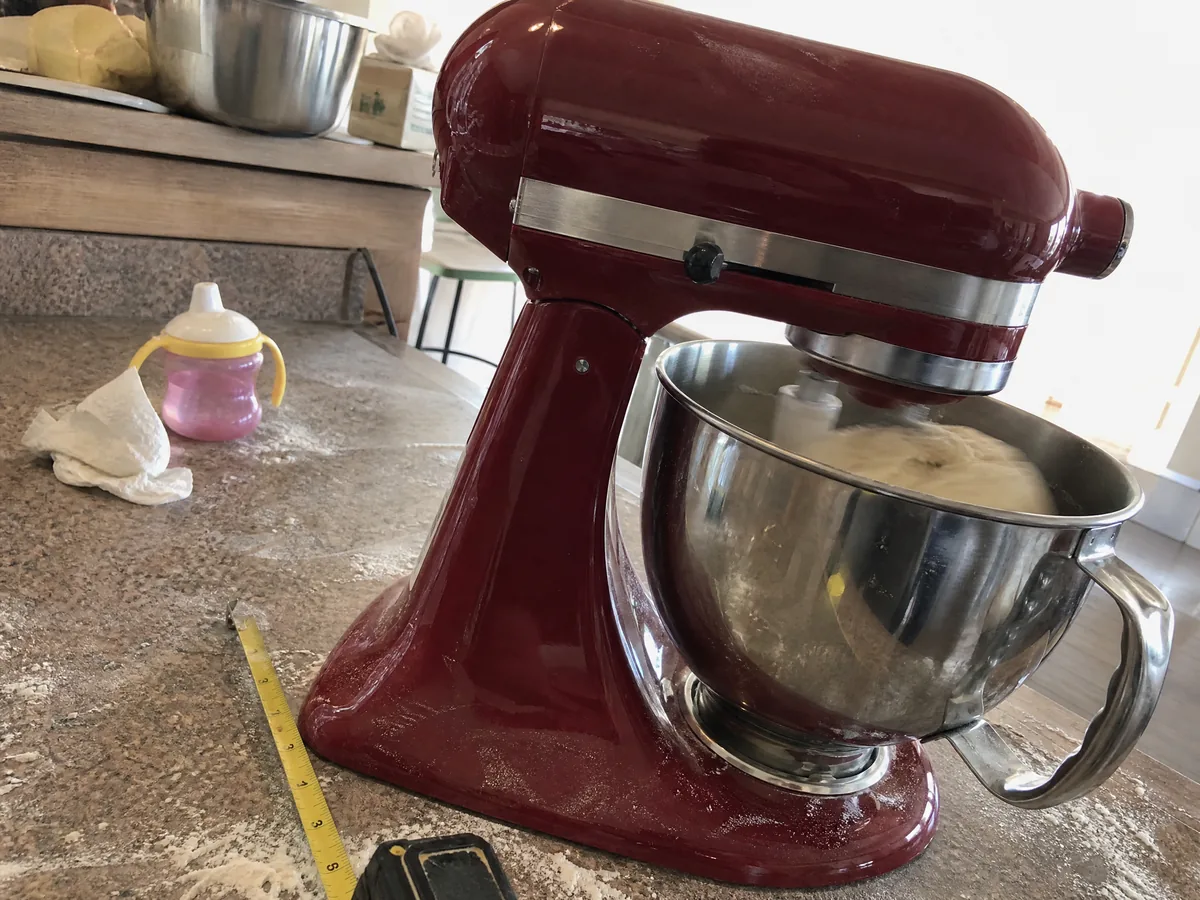
After the third double batch, the top of the motor housing read 112°F on my kitchen thermometer. Warm, not scary. The mixer never slowed or smelled hot, but it was clearly working hard. If I baked bread twice a week, this is where I'd start looking at a bowl-lift model, which holds the bowl on two arms and doesn't bounce.
For a single loaf, pizza dough on Friday or cinnamon rolls at Christmas, it's perfectly fine. The rest of my complaints are smaller, and some of them you only find after a few weeks.
The small stuff nobody mentions
The weight. The Artisan weighs about 23 pounds. That's good for stability and bad for storage. I tried putting it in a lower cabinet after each use for one week and gave up. It lives on the counter now, in the corner where my bread box used to sit.
Under the cabinets. Head down, it slides under my upper cabinets. Head up, it doesn't, so I pull it forward every time I change the beater. Two seconds, a hundred times a month.
Scraping. Even after the dime fix, sticky batters climbed the sides of the bowl, and I stopped to scrape about once per recipe. KitchenAid sells a flex edge beater with a rubber edge that fixes this, but it's not in the box. For thick cookie dough I didn't mind. For cream cheese frosting I really wanted it.
Cleaning. The bowl, the coated flat beater and the dough hook went in the dishwasher all five weeks with no issues. The whip is hand wash. The pouring shield collects powdered sugar in every groove, so rinse it right away.
The powdered sugar cloud. Speed 4 plus powdered sugar equals a white kitchen and a two-year-old covered like a donut. Start on stir, use the shield and move up slowly. I learned this once, and so did the floor.

My favorite bake of the whole test was a very Ohio one: buckeyes, the peanut butter balls half-dipped in chocolate that show up at every tailgate here. The filling is thick, sticky and brutal on a hand mixer. The Artisan mixed four pounds of it in one go while my sister Jen rolled the balls and complained about the Browns. Specs next, then the part you probably came for: price.
Specs at a glance
| Spec | KitchenAid Artisan KSM150PS |
|---|---|
| Motor | 325 watts |
| Speeds | 10, plus stir |
| Bowl | 5 qt stainless steel with handle, dishwasher safe |
| In the box | Coated flat beater, coated dough hook, 6-wire whip, pouring shield |
| Mixing action | Planetary, 59 touchpoints around the bowl (KitchenAid's figure) |
| Height, head down | About 14 inches |
| Weight | About 23 lbs |
| Attachment hub | Yes, fits KitchenAid power hub attachments |
| Warranty | 1-year limited |
| Price at the time of writing | $379.99 at KitchenAid.com, list $499.99 |
One year of warranty feels short next to a mixer that many families keep for decades. The good news is that the Artisan design has barely changed in years, so parts, beaters and bowls are easy to find. That also means the price follows a very predictable holiday pattern.
Black Friday, Christmas and the right price
The Artisan is one of the most searched gifts of the season, and stores know it. List price is now $499.99 on KitchenAid.com and Amazon. Almost nobody pays that. Here's what we tracked:
- Early November 2025: Amazon had the Artisan with pouring shield in Feather Pink at $399.99, down from $499.99.
- Black Friday week 2025: KitchenAid.com advertised up to $180 off stand mixers, and QVC sold an Artisan bundle for $379.98.
- September 2026: KitchenAid.com has the Artisan at $379.99 in several colors during its fall sale, and Amazon shows the Empire Red at the same price.
So should you wait for Black Friday? Honestly, the price you can get right now is already about as good as what we saw last November. My rule: $379.99 or less is a good price for the standard Artisan, and anything under $350 is great. If you see $499.99, walk away, it will come back down.
As a gift it's a safe bet for anyone who bakes more than a few times a year, for newlyweds and for the person who still borrows their mom's mixer. It's a bad gift for someone with a tiny kitchen and no counter space, because it will live in the garage. KitchenAid.com also offers engraving on some mixers for $4.99, which is a sweet touch for a wedding or a first home.
Good things to add: a flex edge beater, an extra bowl if you skipped the bundle, and a silicone spatula that fits the bowl's curve. Save the pasta roller for next year, once the mixer is in weekly use.
On returns: a 23-pound box is a pain to send back, so check the store's holiday window before you buy. Big stores stretch their return periods over the holidays, often into January, but each one sets its own dates, so read the receipt. Unbox it, run the dime test and bake one thing before that date. Now, is it the right mixer for you at all?
Who should buy it, and who shouldn't
If the "also cooks" part caught your eye, I spent 38 days with the Thermomix TM7, which mixes, kneads, weighs and cooks. It's a different tool at four times the price, and for baking alone I prefer the KitchenAid. And if you're decluttering before you buy, our 30-day counter test of kitchen gadgets is a good reality check on what actually gets used.
Alternatives worth a look
- KitchenAid Artisan Mini 3.5-Quart ($349.99 at KitchenAid.com at the time of writing, list $449.99): lighter and smaller, great for one or two people or small kitchens. For a family that doubles recipes, the bowl is too small.
- KitchenAid Artisan Plus 5-Quart ($499.99 at the time of writing, list $599.99): the newer step up in the same tilt-head shape. Worth a look if the person you're buying for is a serious baker, but for most families the plain Artisan does the same job.
- A KitchenAid bowl-lift model: if bread is your main reason to buy, a bowl-lift holds the bowl on two arms, doesn't bounce and handles heavier doughs. Expect to pay more and to give up the easy tilt-head access.
Every mixer we test goes through the same whipping, cookie and bread tasks, as explained on our how we test page. You'll find our other kitchen picks in the reviews.
Five weeks in, my mom has already borrowed it once. She brought it back with a note taped to the bowl: "Good choice. Still miss mine."
Questions people ask
Is the KitchenAid Artisan worth it over the Classic?
For most families, yes. The Artisan has a bigger 5-quart bowl with a handle, a stronger 325-watt motor and a pouring shield. The Classic is cheaper and does fine for small batches, but the extra bowl space matters as soon as you double a cookie recipe.
Can the KitchenAid Artisan knead bread dough?
Yes. In our test it kneaded a 2-loaf batch with 6 cups of flour in 7 minutes on speed 2. The head bounced and the mixer moved about an inch and a half, so stay close. If you bake heavy bread every week, a bowl-lift model is a better fit.
Why is there unmixed butter at the bottom of my KitchenAid bowl?
The flat beater is probably sitting too high. Do the dime test: drop a dime in the bowl and run the mixer on stir. The beater should push it about a quarter to half an inch per turn. If it doesn't, turn the adjustment screw near the hinge a quarter turn at a time.
What's a good Black Friday price for the KitchenAid Artisan?
List price is $499.99. Last November we saw it around $380 to $400 at big retailers. At the time of writing it's $379.99 at KitchenAid.com, so anything at or under that is a good deal, and under $350 is a great one.
Does the KitchenAid Artisan fit under kitchen cabinets?
With the head down it's about 14 inches tall, so it fits under most upper cabinets. You can't tilt the head up underneath them, though. You'll need to slide it forward whenever you add ingredients or change attachments.