
Do LED face masks work? 6 weeks of photos with CurrentBody, Omnilux, Shark and DRx
Four masks, four faces, one tripod in a spare bedroom. After six weeks of daily sessions, an esthetician judged the photos blind. One mask came out ahead, and it wasn't the cheapest.
 By Darlene Hufnagel, health and beauty editor
Tested in Milwaukee, Wisconsin · October 5, 2026 · 12 min read
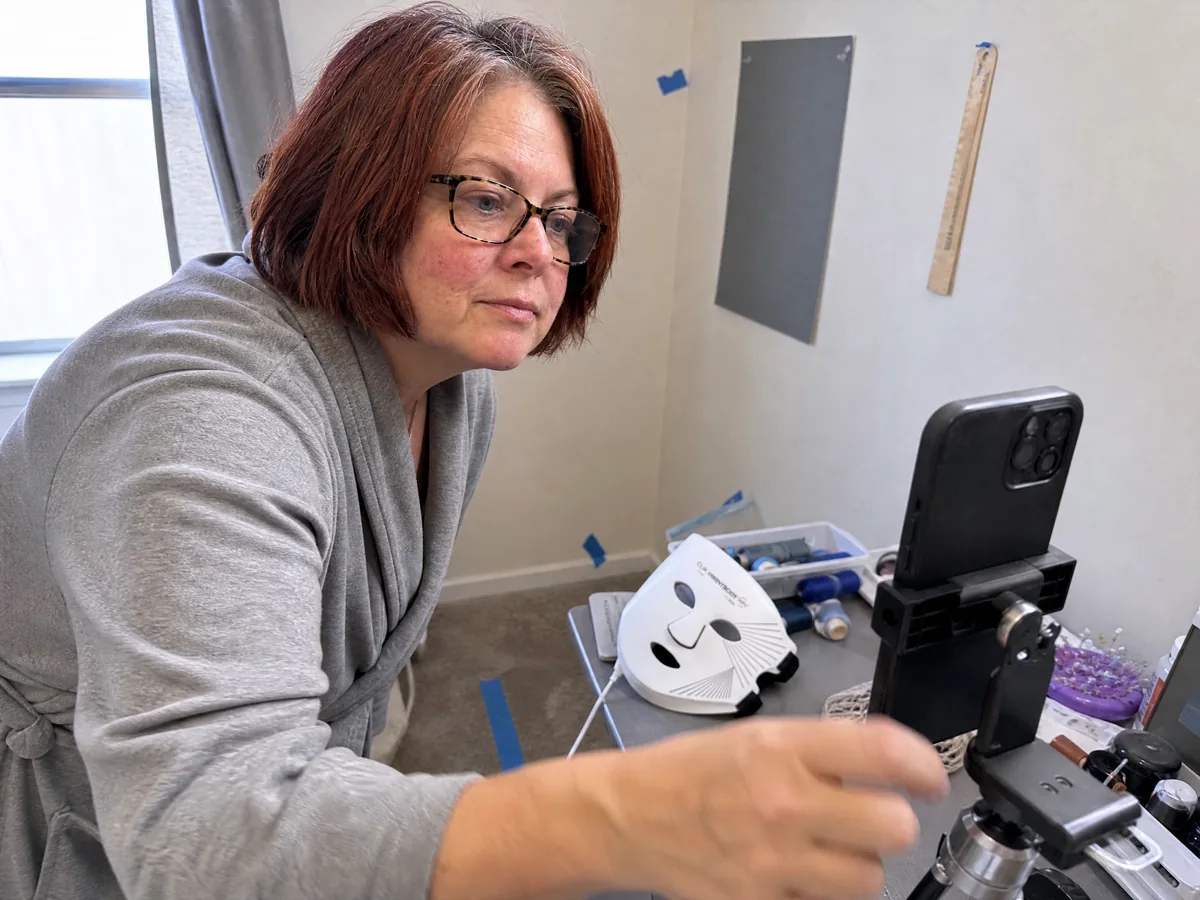
The spare bedroom in our duplex has a north window, a sewing table nobody sews at and, since August 12, a phone on a $19 tripod pointed at a strip of blue painter's tape on the floor. Every morning at 7:30, before coffee and before any skincare, I stood on that tape with a bare face and let the phone take three pictures of me.
I'm 53. I have crow's feet I earned, two forehead lines I blame on my mother's side of the family, and rosacea that turns my cheeks the color of a ripe tomato after red wine, a hot shower or an argument about the thermostat. LED face masks promise to help with most of that. They also cost $300 to $470, and every before and after I've seen online was shot in nicer light than the before.
So we ran the test the ads never show. Four masks, four faces, 49 days, the same light every morning, and a professional who judged the photos without knowing which mask was which. One question decided the winner: which mask shows visible skin changes in photos after six weeks of daily use?
CurrentBody LED Light Therapy Mask Series 2
$469 at CurrentBody and Amazon when we wrote this, often a little less with a code
- Top blind photo score: 7 out of 12
- The red patch on my left cheek went from about 1.5 in. to 1 in.
- Nose flap and chin strap reach the jaw, where other masks stop
- Flexible silicone sat flat on my narrow face
- $469 list, the most expensive of the four
- 10 minutes every day adds up to 7 hours in six weeks
- The multiway strap fights with a ponytail
- Battery lasted about 12 sessions per charge
Our verdict: if you want softer lines and calmer redness that actually show up in a photo, the CurrentBody Series 2 delivered the most in six weeks. The Omnilux Contour Face came very close for $74 less. The DRx SpectraLite was the clear pick for breakouts, and the Shark CryoGlow felt the nicest to wear but changed the least on camera.
- How we ran a fair photo test at home
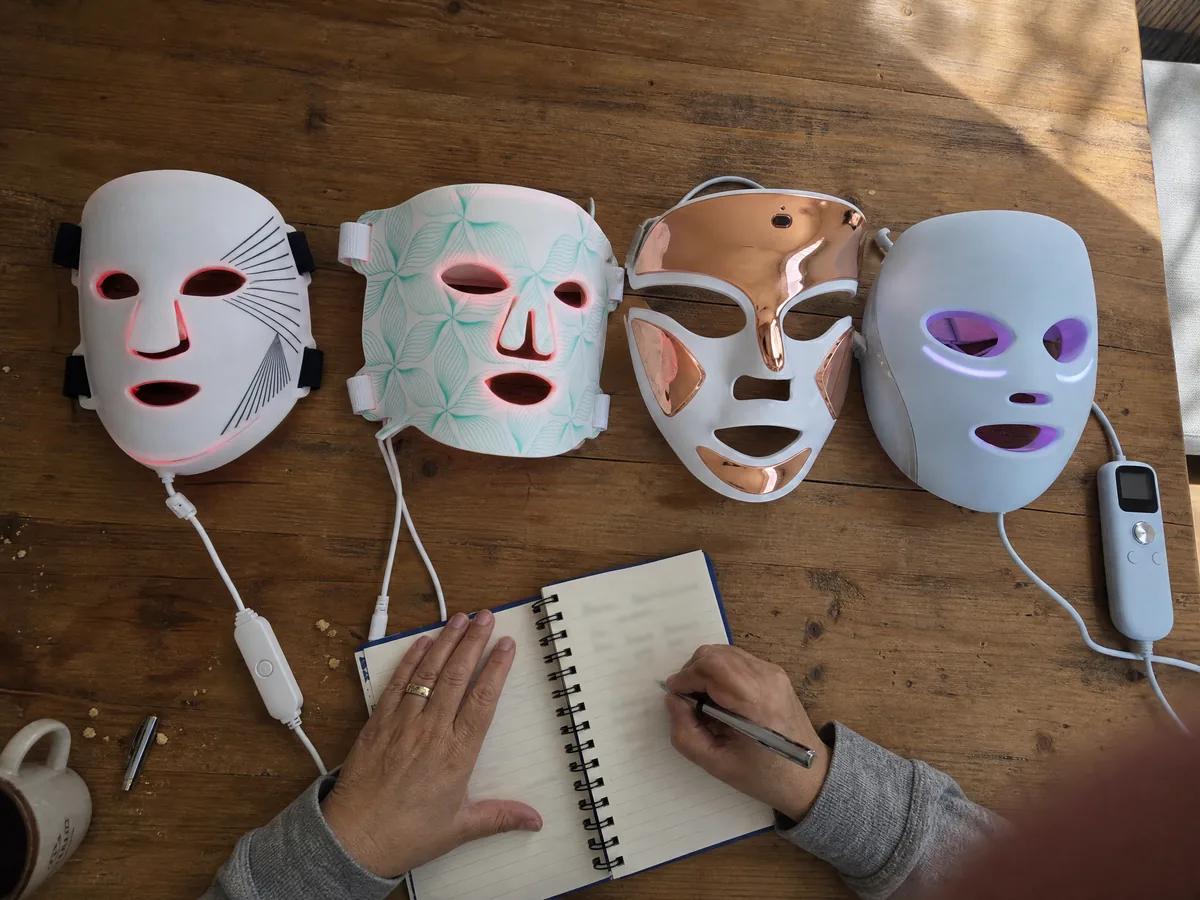
- The four masks, side by side
- What the blind photo check found
- CurrentBody Series 2 on my rosacea
- Omnilux Contour Face: so close
- DRx SpectraLite: three minutes, fewer breakouts
- Shark CryoGlow: lovely, but quiet on camera
- Swap weekend: heat, weight and annoyances
- Which mask is right for you
- Prices, stores and Black Friday
- Questions people ask
How we ran a fair photo test at home
The honest problem with LED masks: the changes they promise are small and slow, and a face looks different every morning anyway. Bad sleep, salty dinner, a cold front off Lake Michigan. So for the first week, August 12 to 18, we took photos and did nothing else.
That baseline week turned out to be the most useful part of the test. My rosacea patch on the left cheek measured anywhere from 1.4 to 1.7 inches across in those seven days, all on its own. Without knowing that, I could have credited a mask for a good Tuesday.
Then came 42 days of daily sessions, August 19 to September 29, with strict photo rules:
- Same tape mark, phone on the tripod 24 inches from the face
- Curtain closed and a ring light at the same setting, because sunrise in Milwaukee moves almost an hour between mid-August and late September
- A gray card and a small paper ruler taped to the wall, so color and size could be compared
- Three angles every morning, hair clipped back, no makeup
- Nothing else new in the routine. My prescription rosacea gel stayed, as it has for two years
At the end, I sent the photos to Marisol Vega, a licensed esthetician with a small studio on Kinnickinnic Avenue in Bay View. For each face she got a baseline photo and a day-42 photo from every angle, shuffled and labeled only with letters. Her job: pick the "after," then score the change in lines, redness, texture and tone from 0 (nothing visible) to 3 (clear change).
Four faces is not a clinical trial, and I won't pretend it is. That's why every face was compared only with itself. The long version of how we keep tests honest is on our how we test page. Here's who wore what.
| Tester | Age | Main concern | Mask | Sessions done |
|---|---|---|---|---|
| Me, Darlene | 53 | Rosacea, crow's feet, forehead lines | CurrentBody Series 2 | 41 of 42 |
| Linda, my sister | 57 | Lines around the mouth, sun spots | Omnilux Contour Face | 39 of 42 |
| Keisha, downstairs neighbor | 31 | Breakouts along the jaw | DRx SpectraLite FaceWare Pro | 37 of 42 |
| Tom, my husband | 56 | Puffy under-eyes, tired-looking skin | Shark CryoGlow | 42 of 42 |
Yes, the biggest skeptic in the house was the only one with perfect attendance. We'll get to why. First, what each of us was strapping on.
The four masks, side by side
All four are FDA-cleared for home use and all four use red light. The differences: how many LEDs, which extra wavelengths, how long a session takes, and whether the mask bends to your face or sits on it like a hockey goalie's.
| CurrentBody Series 2 | Omnilux Contour Face | DRx SpectraLite FaceWare Pro | Shark CryoGlow | |
|---|---|---|---|---|
| List price | $469 | $395 | $455 | $349.99 |
| LEDs | 236 | 132 | 162 (100 red, 62 blue) | 160 three-in-one LEDs |
| Light | Red 633 nm, near-infrared 830 nm and 1072 nm | Red 633 nm, near-infrared 830 nm | Red 630 nm, blue 415 nm | Red, blue, infrared |
| Session | 10 min | 10 min | 3 min | 4 to 8 min, eye cooling 5 to 15 |
| Shape | Flexible silicone | Flexible silicone | Rigid | Rigid, with chill pads |
| Our total time in 42 days | 7 hours | 7 hours | About 2 hours | About 4 hours |
A quick bit of science. Red light around 630 nm works in the upper layers of the skin, where redness and fine texture live. Near-infrared at 830 nm reaches deeper, toward the cells that make collagen. Blue light at 415 nm targets the bacteria behind acne. Marisol put it plainly: "Red and infrared are for aging and calming, blue is for breakouts. Most people buy the wrong one for their face."
The last row of that table is the one nobody prints on the box. Seven hours is a lot of evenings. The photos would tell us if they paid off.
What the blind photo check found
Marisol spent a Wednesday afternoon with our shuffled photos and a cup of coffee she let go cold. Then she called me before I'd asked for her scores.
"Sets A and C, I'd bet money on. Set B is the clearest before and after I've seen from a home device, but it's acne, not wrinkles. Set D, I'm guessing, and I don't like guessing." Marisol Vega, licensed esthetician
Set A was me. Set C was Linda. Set B was Keisha. Set D was Tom. Her scores, out of 3 per category:
| Mask (tester) | "After" picked right | Lines | Redness | Texture | Tone | Total out of 12 |
|---|---|---|---|---|---|---|
| CurrentBody Series 2 (Darlene) | 3 of 3 | 2 | 2 | 2 | 1 | 7 |
| Omnilux Contour Face (Linda) | 3 of 3 | 2 | 1 | 2 | 1 | 6 |
| DRx SpectraLite (Keisha) | 3 of 3 | 0 | 1 | 2 | 1 | 4, plus blemishes down from 9 to 3 |
| Shark CryoGlow (Tom) | 2 of 3 | 1 | 0 | 1 | 1 | 3 |
The two flexible masks with red and near-infrared light, used 10 minutes a day, changed the things most of us buy an LED mask for: lines, redness, texture. And the DRx produced the most dramatic single change of the test, on a completely different problem.
So the winner is the CurrentBody, by one point and one cheek. Here's what that point looked like on my face.
CurrentBody Series 2 on my rosacea
The first three sessions made me nervous. About ten minutes after taking the mask off, my cheeks flushed a faint pink, like after a warm bath. My infrared kitchen thermometer read 97°F inside the mask at the end of a session, the warmest of the four. By day four the flush had stopped, and it never came back.
The change was too slow to see in the mirror. I saw it on day 31, when I put a week-one photo next to that morning's on the laptop. The red patch that swung between 1.4 and 1.7 inches in the baseline week measured right around 1 inch on day 42, and stayed under 1.2 inches on four of the last seven mornings.
The crow's feet changed less, but they changed. The deepest line by my left eye looked more like a crease than a groove in the side photo. My two forehead lines? Exactly the same. I'd love to tell you otherwise.
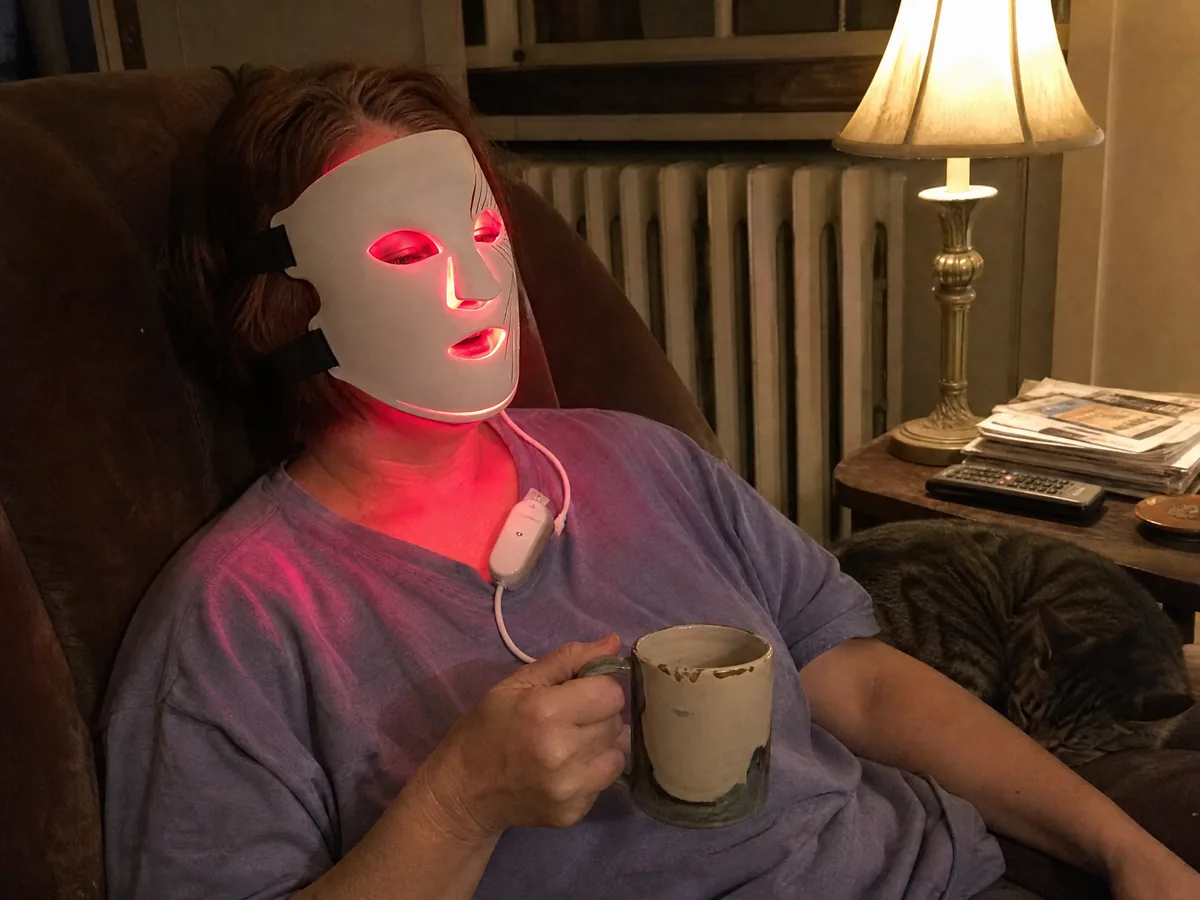
The fit made it easy to stick with. The silicone bends, so there were no gaps at my temples. The nose flap covers the sides of the nose, where my rosacea is worst, and the chin strap carries light down to the jaw. The controller clips to your collar, so I could walk to the kitchen mid-session like a very calm astronaut.
The small stuff: it's bright inside, so I used the eye inserts from the box every time. I charged the controller four times in six weeks. And our cat, Pepper, hissed at my glowing face on night one. By week two she slept on the armrest through the whole session, which is how I know I'm forgiven. My sister's mask, though, did almost the same job for less.
Omnilux Contour Face: so close
Linda is 57, a retired school secretary in West Allis who has spent forty summers in her tomato garden without a hat. She wanted softer lines from her nose to the corners of her mouth, and lighter sun spots on her cheekbones.
She got one of the two. Her smile lines scored a 2, same as my crow's feet, and her cheeks looked smoother in the side photos. The sun spots didn't move. Marisol wasn't surprised: "Pigment that old takes a different tool, or a lot more time."
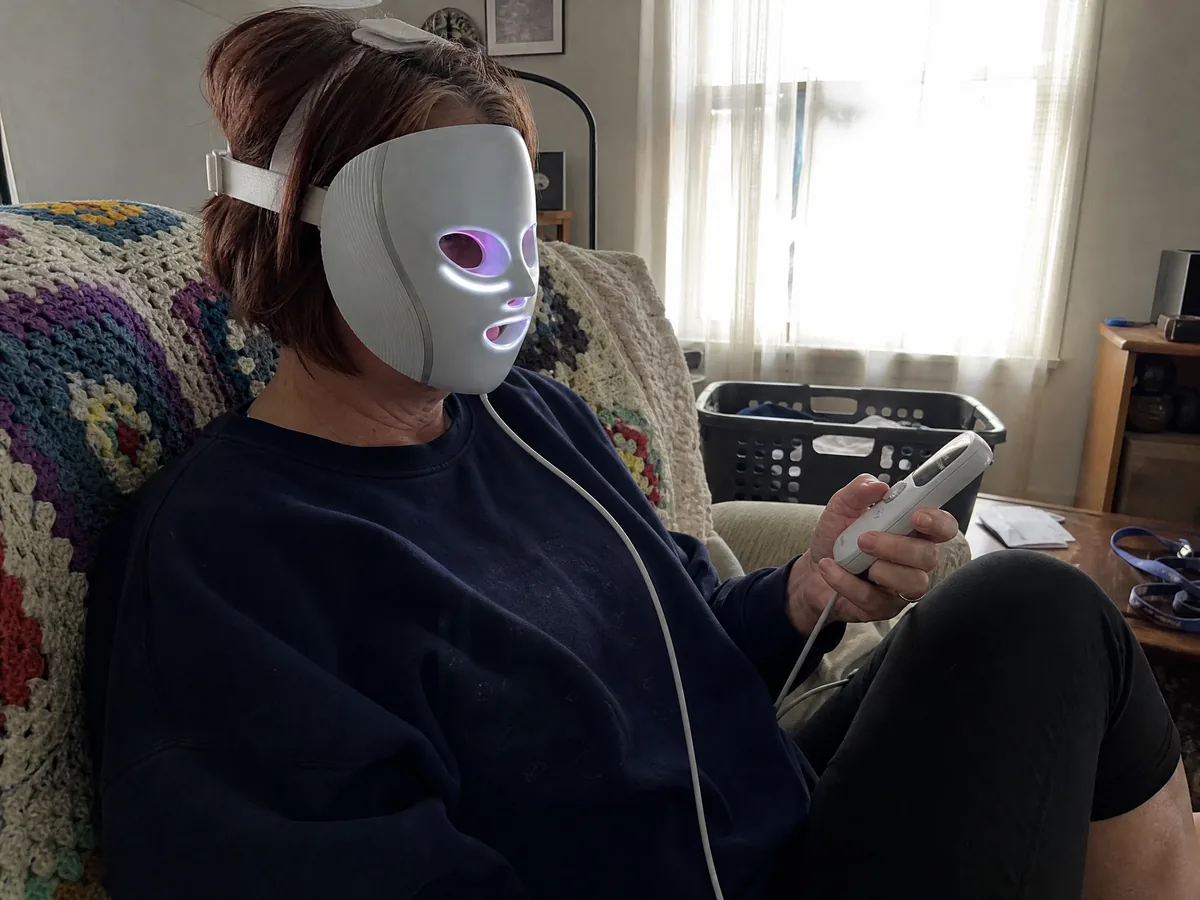
The Omnilux is by far the lightest of the four, flexible silicone with a hook-and-loop strap and a cord to a small controller. It slid down every time Linda looked at her crossword, so by week two she did her sessions lying on the couch. It also covers less of the lower face than the CurrentBody, which may be why her jaw changed less than her cheeks.
She missed three sessions, all on Labor Day weekend at our cousin's cabin in Door County. Her verdict, on the phone while clearly doing something else: "It's the only ten minutes a day nobody asks me for anything." At $395, one point behind the winner for $74 less. The next mask was after something else entirely.
DRx SpectraLite: three minutes, fewer breakouts
Keisha, who lives in the lower half of our duplex, is an ER nurse on night shifts. Months of N95 masks left her with breakouts along the jaw that she calls "my souvenirs." With no wrinkles to speak of, she was the obvious match for the red and blue DRx SpectraLite FaceWare Pro.
Its big selling point is time. A session is three minutes, then it shuts itself off. Keisha used the combined red and blue mode while her coffee brewed after a shift. Her five missed sessions all happened the same way: she fell asleep first.
Her results were the clearest of the test. In the baseline week, her right-side photo showed an average of 9 active blemishes along the jaw. On day 42 there were 3, even after four night shifts in a row the week before. Lines scored a zero, but at 31 there was nothing to soften.
The DRx is rigid plastic with a head strap. On Keisha's fuller cheeks it fit well. On my narrow face it left a gap at the temples. And three minutes is a fraction of the red light dose the 10-minute masks deliver, which shows in its score for lines. The last mask had the happiest tester and the quietest photos.
Shark CryoGlow: lovely, but quiet on camera
Tom agreed to this test the way he agrees to most of my tests: with a sigh and a condition. He'd do his sessions during the late innings of the Brewers games. Then he discovered the under-eye chill pads, and he didn't miss a single day.
The CryoGlow is a rigid light-blue shell with four programs, a remote with a small color screen, and two cooling pads that clip in under the eyes. At the coldest of three chill levels, our thermometer read 52°F on the pads. Tom used the 6-minute Better Aging mode, then 10 minutes of cooling.
"The pictures can say what they want. My eyes feel like I slept till nine." Tom, week five
It does work in the moment. On day ten I photographed him before and fifteen minutes after a session, and the puffiness under his eyes was visibly flatter. But our test photos were taken at 7:30 the next morning, and by then it was back. Marisol saw a slightly more even tone and a softer line between his eyebrows. That's it.
It's also heavy: 1.5 pounds with the remote, and I felt it on the bridge of my nose after six minutes. Tom, who wore a catcher's mask in high school, says it's nothing. Shark does get beauty tools very right sometimes, as my Shark FlexStyle review shows. Here, the mask that felt best changed the least. Which brings me to the weekend we all traded.
Swap weekend: heat, weight and annoyances
On September 26 and 27, the four of us met at our kitchen table and each tried the other three masks once, on top of our own daily session. One extra session doesn't change six weeks of photos, but it tells you a lot about comfort.
Inside temperature after a full session: CurrentBody 97°F, Omnilux 95°F, Shark 93°F, DRx 92°F. If heat triggers your rosacea, that order matters. The little annoyances, per mask:
- CurrentBody: the multiway strap and Linda's ponytail never made peace. Charge it every 12 sessions or so.
- Omnilux: slides when you look down, and the controller cord swings if you walk around.
- DRx SpectraLite: rigid edges, so narrow faces get gaps. Some light leaks around the nose.
- Shark CryoGlow: the heaviest by far, and the chill pads need clipping in every time. Best remote of the four.
The vote for most comfortable went Shark, Shark, Shark, CurrentBody. The CurrentBody vote was mine, and I'm the one with rosacea. Comfort and results don't always point the same way, so let's match masks to faces.
Which mask is right for you
Once you know which mask fits your face, the only question left is what to pay for it.
Prices, stores and Black Friday
LED masks are a favorite holiday gift and go on sale often, but I don't have a clean record of last year's lows for all four, so I won't invent numbers. Here's what they cost at the time of writing, where we found them, and the price I'd wait for.
- CurrentBody Series 2: $469 at CurrentBody and Amazon. Good under $380, great under $330.
- Omnilux Contour Face: $395 at Omnilux and Dermstore. Good under $320.
- DRx SpectraLite FaceWare Pro: $455 at Sephora, Ulta and Dr. Dennis Gross. Good under $370, so watch the big beauty sale events.
- Shark CryoGlow: $349.99 list, $299.99 at Shark when we wrote this, also at Amazon. Good under $260.
For gifts, think about returns. Many stores treat face devices as personal care items and won't take them back once opened. Shark offers a 60-day money-back guarantee on its own site, which makes the CryoGlow the safest blind gift. For the others, keep the box sealed until you're sure. A tip from our house: tuck a note in the box that says "10 minutes, every day, six weeks, then compare photos." That might be the most useful part of the present.
The tripod is still in the spare bedroom. I've kept going with the CurrentBody five evenings a week, Linda ordered her own Omnilux, Keisha refuses to give the DRx back, and Tom has asked twice whether the Shark "has to go anywhere." Our next beauty results are already underway on the tests in progress page, and the rest of our beauty reviews live in the beauty section.
Questions people ask
Do LED face masks actually work?
In our six-week test, yes, but modestly. A blind esthetician spotted the "after" photo for every mask at least two times out of three. The biggest changes were calmer redness, softer fine lines, smoother texture and, with blue light, fewer breakouts. Nobody looked dramatically younger.
How long does it take to see results from an LED mask?
With daily sessions, we saw the first changes in photos around week four and the clearest ones at week six. Comparing photos taken in the same light is the only reliable way to notice, because the changes are too gradual for the mirror.
Is an LED mask safe if you have rosacea?
Red light is often used for rosacea redness, and my cheek redness improved in our test. The masks get warm, up to 97°F inside in our measurements, and I had a faint flush after my first three sessions. Ask your dermatologist first, especially if you take doxycycline or other light-sensitizing medication.
CurrentBody or Omnilux: which one is better?
Very close. In our photo test the CurrentBody Series 2 scored 7 out of 12 and the Omnilux Contour Face 6. The CurrentBody covers more of the nose and jaw and fits narrow faces better. The Omnilux is lighter and $74 cheaper at list price.