
Breville Barista Express Impress review: 212 shots, one repairman and the latte math
Carol's daily drive-thru latte was costing us close to $1,500 a year. So we pulled 212 shots in 34 days on the Impress, weighed every dose we could and did the math.
 By Dale Kowalczyk, former appliance repair technician
Tested in Toledo, Ohio · September 8, 2026 · 12 min read
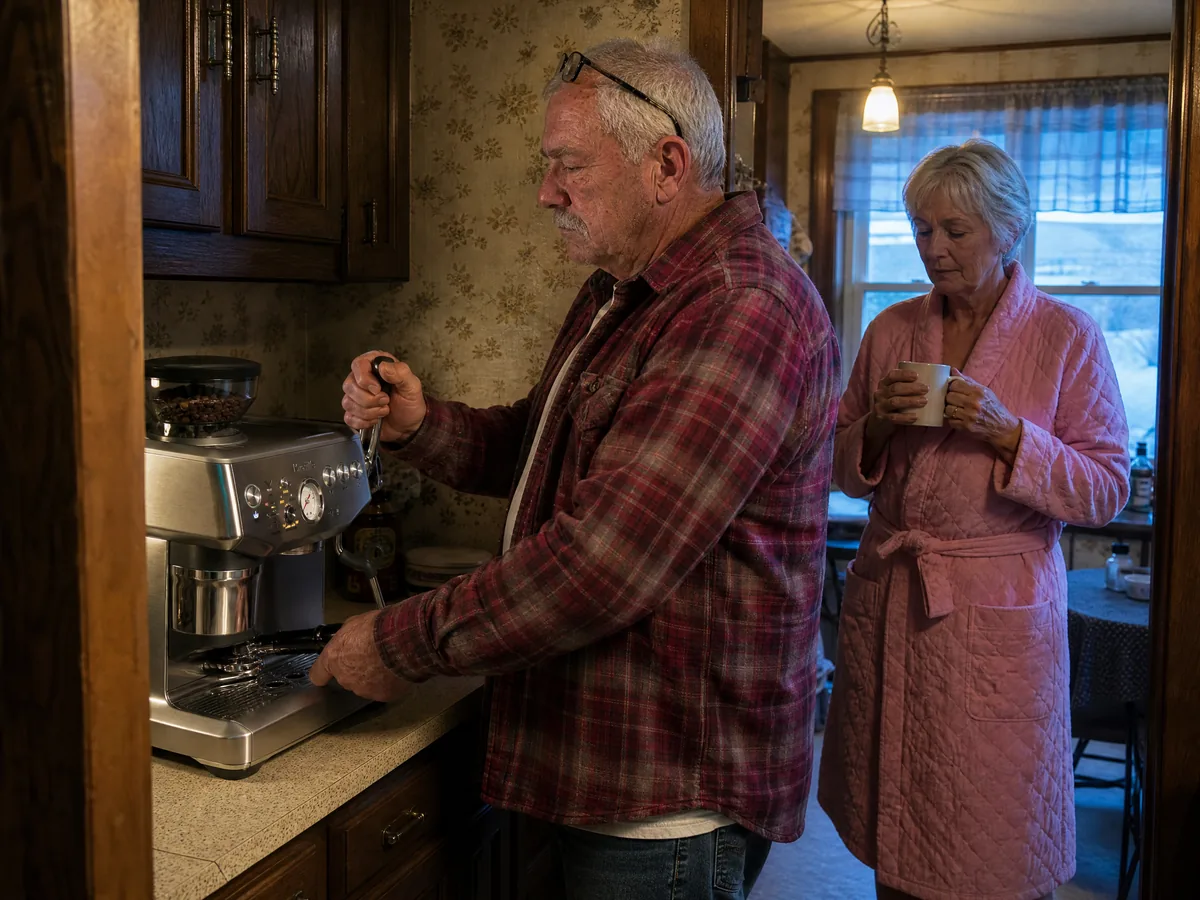
Breville Barista Express Impress (BES876, Brushed Stainless Steel)
$799.95 at Breville.com at the time of writing
- Doses landed within 0.5 g of 18 g on 17 of 20 weighed shots
- Tamping lever means no grounds on the counter
- Ready to pull a shot about 2 minutes after switching on
- User-serviceable burr and a 2-year warranty
- Steam wand is slow: 58 s for 6 oz of milk
- It took a full pound of beans to dial in
- Grinder is loud, and the dog noticed
- The plain Barista Express is often much cheaper
Our verdict: if you want café-style lattes every morning and you don't want to become a coffee hobbyist to get them, the Impress is the easiest all-in-one we've used. If you like tinkering, or you catch the regular Barista Express on sale, you can get most of the coffee for a lot less.
- The drive-thru math that started this
- What "Impress" actually adds
- Week one: a pound of beans to get it right
- I weighed the doses
- Milk, lattes and a very small customer
- What a repairman looks at
- Specs at a glance
- Black Friday, Christmas and a fair price
- Who should buy it, and who shouldn't
- Alternatives worth a look
- Questions people ask
The drive-thru math that started this
$5.95. That's what my wife Carol pays for a medium oat milk latte at the drive-thru on the way to her Tuesday and Thursday volunteer shifts, and on most other days too. I found the number the way you find most things when you're retired: I read the bank statement out loud at the kitchen table. Twenty-one lattes in June. That's $124.95 for one month of coffee, and close to $1,500 a year if June was a normal month. Carol says June was a normal month.
So when the Breville Barista Express Impress came up on our test list, I didn't need a reason to care. I needed to know two things. Will it make a latte Carol actually prefers over the drive-thru? And, because I fixed appliances for 19 years, what's going to break on it, and when?
I used it for 34 days in our kitchen in Toledo. Between Carol, me and a few visitors we pulled 212 shots. I weighed doses, timed shots, measured milk temperatures and kept a log in the same spiral notebook I used for service calls. Here's how it went, starting with what makes this machine different from the Barista Express people have been buying for over a decade.
What "Impress" actually adds
The Impress is an all-in-one espresso machine with a built-in conical burr grinder, like the classic Barista Express. It heats with a ThermoCoil and a PID controller that holds the water at about 200°F, and it pre-infuses at low pressure before a 9-bar extraction. So far, same family.
The difference is on the left side: the Impress puck system. On a normal espresso machine you grind into the portafilter, then level and tamp the coffee by hand with a tamper. That's where beginners make a mess and where most bad shots start. On the Impress you grind, then pull a lever. The lever tamps with a constant force (Breville says 22 lbs) and finishes with a small 7-degree twist that polishes the top of the puck.
Then a little row of lights tells you whether your dose was right, too low or too high, and the machine adjusts the next grind by itself. Breville calls it intelligent dosing. I called it a gimmick on day one. On day 34 I called it the reason Carol uses the machine without me standing over her.
Getting to day 34 took some coffee, though. More coffee than I expected.
Week one: a pound of beans to get it right
Espresso is fussy: the same beans taste sour at one grind and bitter at the next. The Impress has 25 grind settings, and my target was the classic starting point: 18 grams in, about 36 grams out, in 25 to 32 seconds.
Out of the box, the default grind gave me 19-second shots that tasted like lemon juice. I went finer one step at a time, weighed each shot on a $15 kitchen scale and wrote it down. Here's the short version of my notebook, all with the same medium roast from a Toledo roaster.
| Grind setting | Dose in | Espresso out | Shot time | Taste |
|---|---|---|---|---|
| 15 (default area) | 18.1 g | 38 g | 19 s | Sour, thin |
| 12 | 18.3 g | 37 g | 23 s | Better, still sharp |
| 9 | 18.2 g | 36 g | 28 s | Sweet, caramel, our pick |
| 6 | 18.4 g | 35 g | 39 s | Bitter, ashy finish |
It took 21 shots and a little over a pound of beans to land on setting 9. That's normal for any espresso machine, and I'd rather tell you now than let you think the first cup will be great. Buy a cheap bag for week one. Then buy the good stuff.
Once the grind was right, the question was whether the Impress kept it right on its own. That's what the dose lights promise, so I checked them with the scale.
I weighed the doses
For 20 shots in a row in week two, I weighed the ground coffee in the portafilter before tamping. Breville aims for 18 grams in the double basket. My results: an average of 18.2 grams, a low of 17.6 and a high of 18.7. 17 of the 20 doses were within half a gram of 18. For a machine that guesses by itself, that's good. Most people with a manual grinder and a spoon do worse on a Monday morning.
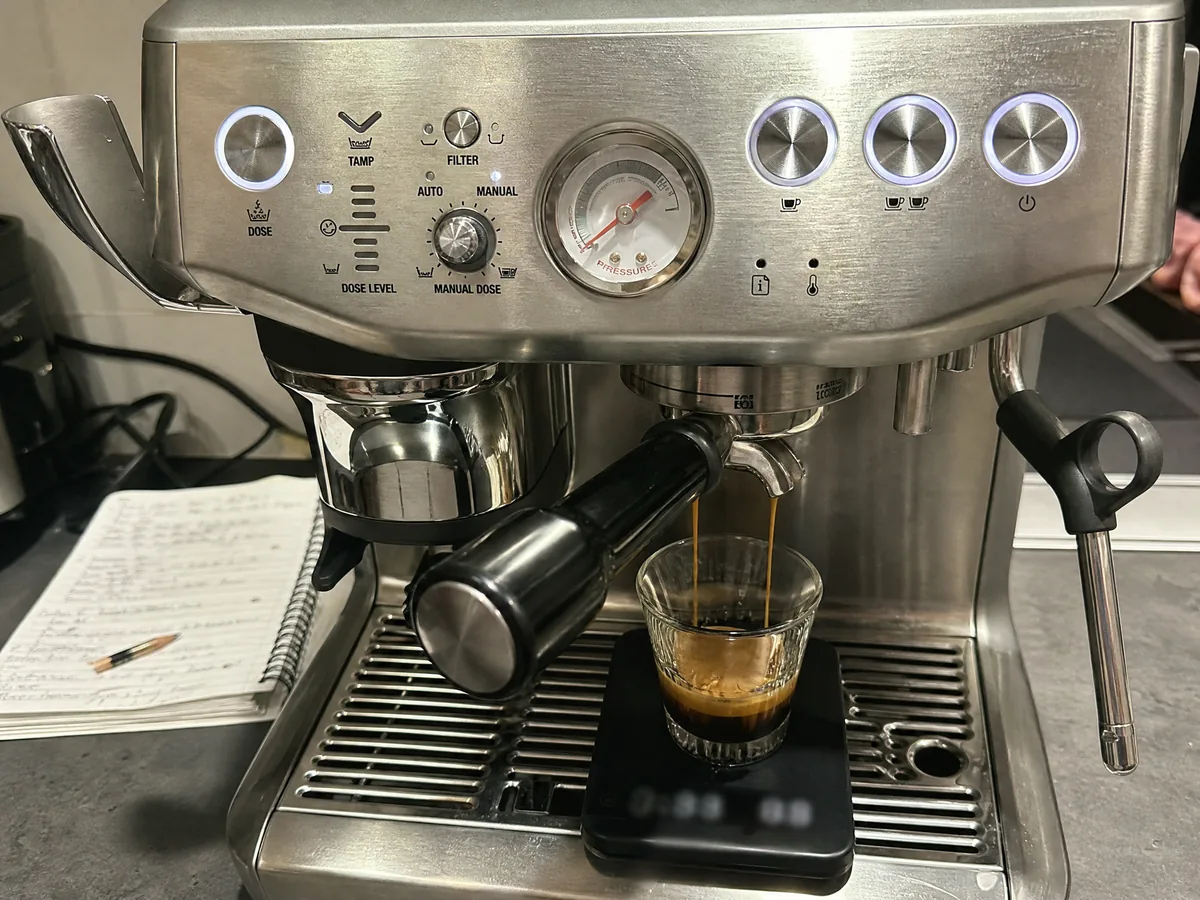
Two of the three misses came right after a fresh bag, when the beans were a different size. The dose lights flagged both, and the next shot was back on target. That's the auto-correct doing its job.
The tamp lever is the part I'd have bet against. Levers wear and springs get tired, I've replaced plenty of both. But after 212 pulls the lever still felt the same as day one, and the puck surface came out flat and polished every time. I measured the puck height with calipers on ten shots: all within 0.3 mm of each other. By hand, mine varied by more than a millimeter.
Carol's verdict came faster than mine.
"I don't have to tamp anything, I don't have to wipe anything, and it tastes like the good place, not the drive-thru." Carol, day 11
Espresso is only half of a latte, though. The other half is milk, and that's where the Impress is merely okay.
Milk, lattes and a very small customer
The steam wand is manual, with a single hole at the tip. You put a stainless pitcher under it, open the steam knob and move the pitcher to make foam. There's no automatic milk mode here. That's the job of the pricier Barista Touch Impress.
I timed it with a clip-on thermometer: 58 seconds to take 6 ounces of cold whole milk to 145°F, a little over a minute for oat milk. That's slow next to café machines and next to Breville's own higher models. It's fine for one or two drinks. For four people on Christmas morning, you'll be standing there a while.
The foam was good once I learned the angle, silky enough for a wobbly heart on the third day and a decent one by the second week. I'm 64 and I have never poured latte art in my life, so I'm counting it as proof the wand is easy.
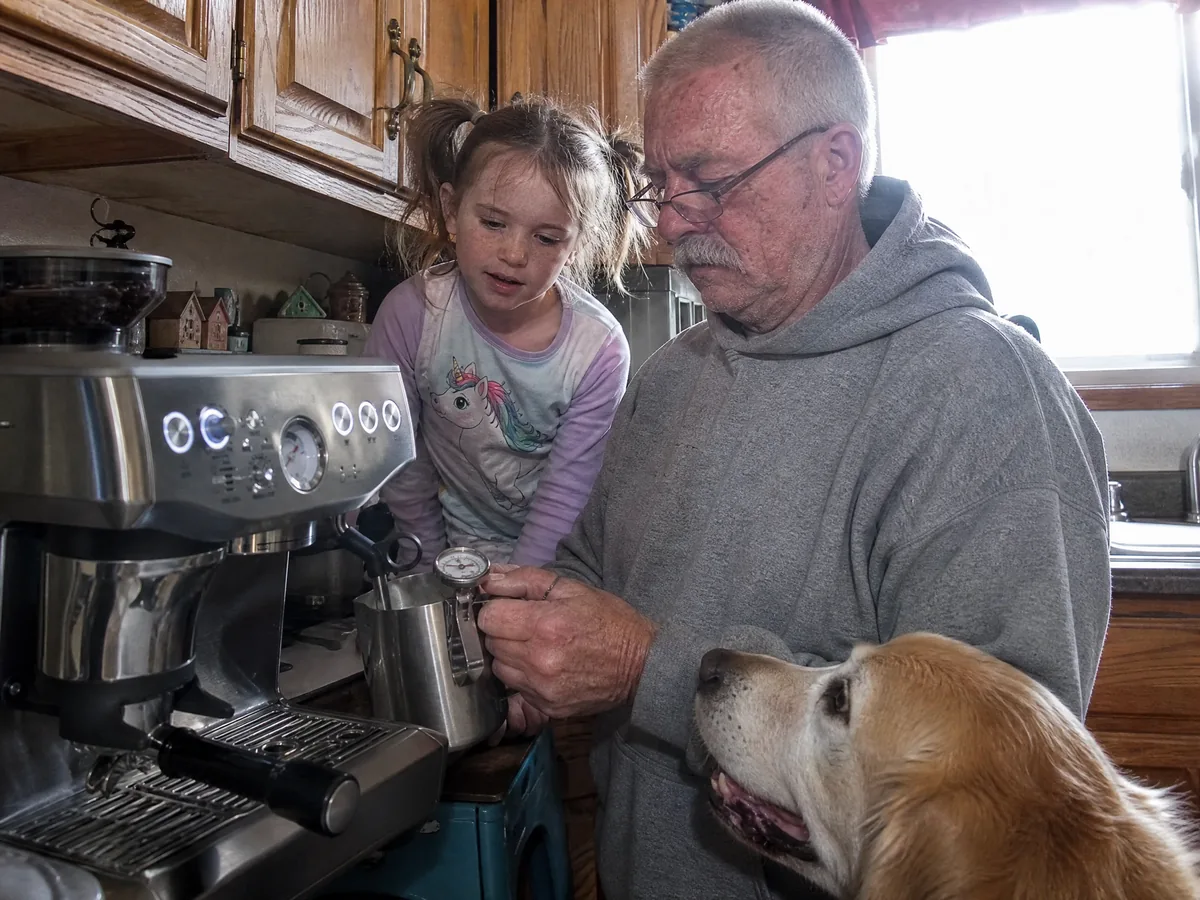
My granddaughter Maddie, who is eight, discovered the machine on her first Saturday visit. She now orders a "babyccino," which is steamed milk with foam and a shake of cocoa, no coffee. She tips well: one hug per cup. Rusty, our golden retriever mix, is less of a fan. The grinder measured 79 decibels at three feet, about as loud as a blender, and every morning at 6:40 he leaves the kitchen for the length of the grind and comes back when it's quiet.
So the machine made coffee we liked and survived a month of real use. The part I care about most comes next: what will fail, and how easy it is to keep it from failing.
What a repairman looks at
I didn't open the case. It's under warranty, and a review that voids its own warranty helps nobody. But I did everything an owner is allowed to do, and I looked hard at the parts I used to replace on espresso machines.
- Scale. The number one killer of home espresso machines is mineral buildup in the heating system. Toledo's water is moderately hard. The Impress has a water filter holder in the 2-liter tank and a descale program. Change the filter on schedule and descale when the machine asks. Skip it and you'll be calling someone like the old me.
- Burrs. The upper burr lifts out without tools for cleaning, and it's a cheap replacement part. After 212 shots and about 8.5 pounds of beans, the burrs showed coffee oil but no visible wear.
- Cleaning cycle. The "clean me" light came on around shot 200, right on time. You run a cleaning tablet with the included cleaning disc. It took 6 minutes. Do it. Old coffee oil makes bitter shots long before it breaks anything.
- Gaskets and the wand. The group gasket and steam wand seals are the wear parts on every machine like this. They're sold as spares. Wipe and purge the wand after every drink so milk never dries inside it.
- Warranty. Breville covers the Impress for two years in the US. That's better than most kitchen machines and it's the window when most early failures show up.
My honest guess: with filtered water, regular cleaning and descaling, this is a machine you replace gaskets on around year three or four, not one you throw out. These machines die of neglect far more often than of design.
And now the math that started all this. I used $15 for a 12-ounce bag of local beans and $4 for a half gallon of oat milk.
| Cost per latte | At home | Drive-thru |
|---|---|---|
| Coffee (18 g) | about $0.80 | included |
| Oat milk (6 oz) | about $0.38 | included |
| Total | about $1.18 | $5.95 |
| Saved per drink | about $4.77 | |
At 21 lattes a month, that's about $100 saved every month. The machine pays for itself in about eight months, a little longer if you count the pound of beans I wasted dialing in. After that, Carol's volunteer mornings get a lot cheaper. Here are the numbers on the machine itself.
Specs at a glance
| Spec | Breville Barista Express Impress |
|---|---|
| Model | BES876 |
| Grinder | Integrated conical burr, 25 settings |
| Tamping | Assisted lever, 22 lbs with 7° twist (Breville's figures) |
| Heating | ThermoCoil with PID, about 200°F |
| Extraction | Low-pressure pre-infusion, then 9 bar |
| Portafilter | 54 mm stainless steel, single and dual wall baskets |
| Bean hopper / water tank | 250 g / 2 L |
| Power | 1,750 W |
| Weight | 22.6 lbs |
| In the box | 480 ml milk jug, Razor trimming tool, cleaning disc and tablets, water filter |
| Warranty | 2-year limited (US) |
| Price at the time of writing | $799.95 at Breville.com |
Measure before buying: with the hopper on, it stands about 16 inches tall. Ours clears the upper cabinets by a little over an inch, and I slide it forward to refill beans.
Black Friday, Christmas and a fair price
I'll be straight with you: we didn't track the Impress closely last Black Friday, so I won't make up a discount. Here's how the Breville lineup was priced when I wrote this, which tells you plenty about how to shop.
- The Impress sits at $799.95 at Breville.com, with no sale.
- The plain Barista Express is listed at $699.95, and Breville.com has shown it at $499.95 on sale (out of stock when I checked).
- The Bambino Plus, which has no grinder, is $399.95 on sale, down from $499.95.
So Breville clearly discounts its espresso machines, and the holiday season is when coffee machines get the most attention. My advice: if you see the Impress under $700 from Breville or a big authorized retailer, that's a good buy. Under $650, don't think twice. At full price it's still fair if you'll use it daily, because the drive-thru math does not wait for Black Friday.
As a gift, it's great for the person who already buys café lattes most days, and a risky one for someone who drinks one cup of drip coffee a day and likes it that way. If you give it, add a few things that make week one easier:
- A cheap digital kitchen scale that reads to 0.1 g
- A second milk pitcher, so two people can make drinks without washing in between
- A bag of fresh beans from a local roaster, with a roast date on it
- A pack of the replacement water filters
On returns and warranty: buy from an authorized seller, or the two-year warranty can get complicated. Keep the box for the holiday return window, which at Amazon usually runs to the end of January for November and December purchases. And register the machine the day you open it. I've seen too many warranty claims fall apart over a missing receipt.
Who should buy it, and who shouldn't
If you're counting counter space, this machine is big, and it earned its spot in our kitchen. Not everything does, as our month-long gadget experiment showed. And if the person you're shopping for would rather have dessert than a latte, my Ninja Swirl by CREAMi review covers a very different kind of treat machine.
Alternatives worth a look
- Breville Barista Express ($699.95 list, seen at $499.95 on Breville.com): same grinder idea and similar espresso, but you tamp by hand. If you don't mind a little mess and some practice, it's the value pick.
- Breville Barista Pro ($849.95): faster heat-up, a screen and a quicker steam wand. Worth it if you make several milk drinks every morning.
- Breville Barista Touch Impress ($1,499.95): the same puck system plus a touchscreen and automatic milk frothing. That's a lot of money for convenience, but it fixes the slow wand.
Our espresso tests all follow the same routine, from dose weights to cleaning time, as described on our how we test page. You'll find more home and kitchen picks in the reviews.
After 34 days, Carol's bank statement for August had four drive-thru lattes on it instead of twenty-one. She says those four were "for old times' sake." I'm counting that as a win.
Questions people ask
What's the difference between the Barista Express and the Barista Express Impress?
Both have a built-in grinder and make similar espresso. The Impress adds an assisted tamping lever and a dosing system that measures each dose and corrects the next one. In our test that meant 17 of 20 doses within half a gram of target and no grounds on the counter.
Is the Breville Barista Express Impress good for beginners?
Yes, it's one of the easiest real espresso machines to learn. Expect to spend a pound of beans and a week dialing in the grind. After that, the lever and dose lights take most of the guesswork out of each shot.
What grind setting should I use on the Barista Express Impress?
It depends on the beans. With a medium roast we ended on setting 9 of 25, for 18 g in, 36 g out in 28 seconds. Start around the middle, then go finer if shots run fast and sour, coarser if they run slow and bitter.
How often do you need to clean and descale it?
Run a cleaning tablet cycle when the "clean me" light comes on, which for us was around 200 shots. Descale when the machine asks, more often with hard water, and change the water filter on schedule. Purge and wipe the steam wand after every milk drink.
Is it worth it compared with buying coffee?
For daily latte drinkers, yes. Our cost was about $1.18 per oat milk latte at home against $5.95 at the drive-thru. At 21 drinks a month, the machine paid for itself in about eight months.